
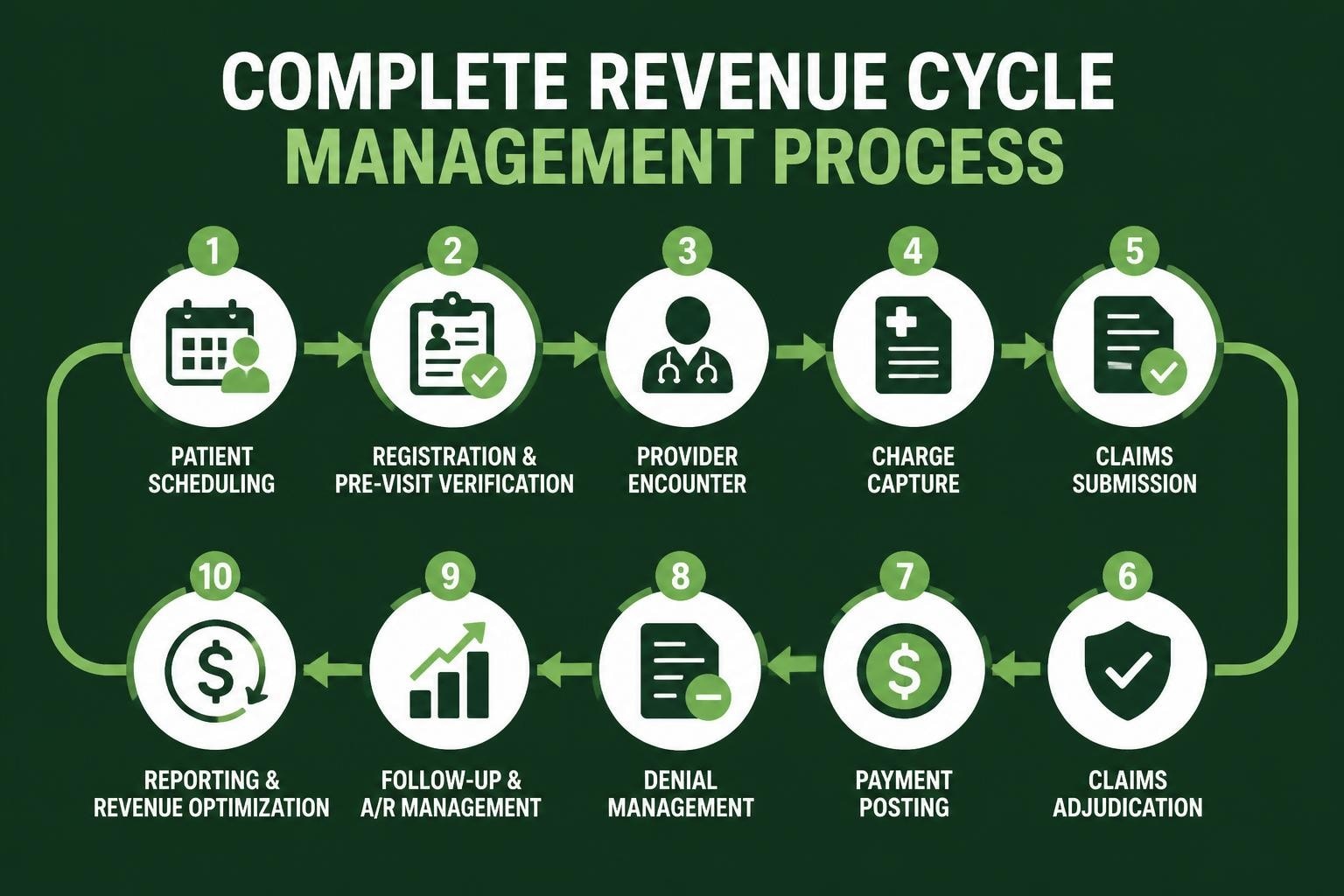
The financial health of healthcare organizations depends heavily on efficient billing practices and timely reimbursements. For medical practices, hospitals, and clinics across the United States, understanding and optimizing the revenue cycle management process has become essential for maintaining operational stability and providing quality patient care. This comprehensive workflow encompasses everything from the moment a patient schedules an appointment through the final payment collection, requiring coordination between administrative staff, clinical teams, and billing specialists. Mastering this process directly impacts cash flow, reduces claim denials, and ensures compliance with complex regulatory requirements.
Understanding the Revenue Cycle Management Process Framework
The revenue cycle management process represents the complete financial journey of a patient encounter within a healthcare setting. This systematic approach integrates both administrative and clinical functions to capture, manage, and collect patient service revenue. According to the comprehensive definition provided by TechTarget, this process begins before the patient arrives and continues until all payments have been collected and reconciled.
Healthcare organizations face unique challenges compared to other industries. Insurance verification, coding accuracy, regulatory compliance, and payer-specific requirements create layers of complexity that demand specialized expertise. The revenue cycle management process addresses these challenges through structured workflows and checkpoints designed to minimize errors and maximize reimbursements.
Key Components That Drive Financial Success
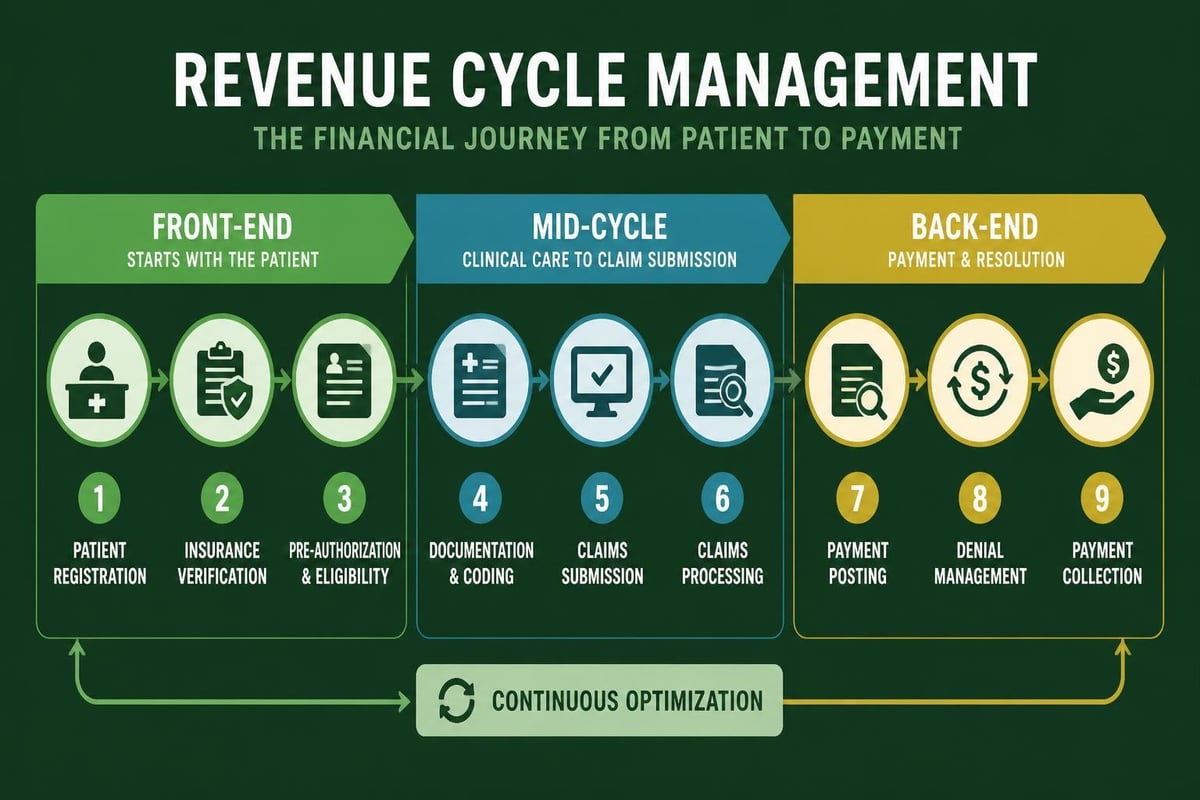
Understanding the fundamental elements helps healthcare providers identify areas for improvement and implement targeted solutions. The process divides into distinct phases, each requiring specific attention and expertise:
- Front-end operations including patient scheduling, registration, and insurance verification
- Mid-cycle activities encompassing charge capture, coding, and claims submission
- Back-end processes covering payment posting, denial management, and accounts receivable follow-up
- Reporting and analytics that measure performance and identify optimization opportunities
These components work together as an integrated system. Weaknesses in one area inevitably affect downstream processes, creating bottlenecks and revenue leakage. For instance, inaccurate information collected during registration leads to claim denials weeks later, requiring additional resources to correct and resubmit.
Front-End Revenue Cycle Operations
The foundation of successful revenue collection begins long before clinical services are rendered. Front-end processes establish the accuracy and completeness of patient information that supports all subsequent billing activities. According to research on front-end revenue cycle steps, these initial stages significantly influence overall collection rates.
Patient Scheduling and Pre-Registration
Appointment scheduling serves as the entry point for the entire revenue cycle management process. During this interaction, staff members collect essential demographic and insurance information that forms the basis for future billing activities. Pre-registration allows practices to verify coverage eligibility before the patient arrives, reducing day-of-service delays and improving the patient experience.
Effective health insurance management requires real-time verification tools that confirm coverage status, identify copayment requirements, and flag potential authorization needs. Many practices now implement automated systems that validate insurance information against payer databases, alerting staff to discrepancies that require resolution before the appointment.
Registration and Insurance Verification
Point-of-service registration represents a critical control point where accuracy directly impacts claim acceptance rates. Registration staff must capture complete and correct information including:
- Full legal name matching insurance records
- Current address and contact information
- Primary and secondary insurance details
- Referral and authorization numbers when required
- Financial responsibility acknowledgment
Insurance eligibility verification confirms active coverage and identifies patient financial obligations. This step prevents situations where services are rendered to patients with inactive coverage or benefits that don’t include the planned procedures. Verification also establishes whether prior authorization is needed, allowing time to secure approvals before the appointment.
| Verification Element | Purpose | Impact on Revenue |
|---|---|---|
| Coverage Status | Confirms active policy | Prevents denied claims |
| Benefit Eligibility | Validates service coverage | Reduces unexpected denials |
| Prior Authorization | Secures payer approval | Ensures reimbursement |
| Patient Responsibility | Identifies copays/deductibles | Improves collections |
Practices that invest in thorough front-end processes experience fewer claim denials and accelerated payment cycles. The time spent verifying information before service delivery saves significant resources that would otherwise be consumed by denial appeals and patient balance collection efforts.
Mid-Cycle Charge Capture and Coding
Once clinical services are delivered, the revenue cycle management process transitions to documentation, coding, and claims generation. These mid-cycle activities transform clinical encounters into billable claims that communicate services to payers in their required format.
Accurate Charge Capture
Charge capture ensures that all billable services, procedures, and supplies are documented and assigned appropriate codes for billing purposes. This process requires close collaboration between clinical and billing teams to ensure nothing is missed or incorrectly reported. Understanding charge entry in medical billing helps practices establish workflows that capture revenue opportunities while maintaining compliance.
Common charge capture challenges include:
- Unbilled procedures due to incomplete documentation
- Delayed charge entry creating cash flow gaps
- Inconsistent coding across similar encounters
- Missing ancillary charges for supplies and medications
Electronic health record (EHR) systems with integrated billing modules help streamline charge capture by automatically suggesting codes based on clinical documentation. However, human review remains essential to ensure accuracy and appropriate code selection.
Medical Coding Excellence
Professional medical coding translates clinical documentation into standardized codes used for billing and reporting. Coders assign diagnosis codes (ICD-10), procedure codes (CPT), and modifiers that describe the medical necessity and specifics of each service. The accuracy of this coding directly determines whether claims are paid, denied, or delayed.
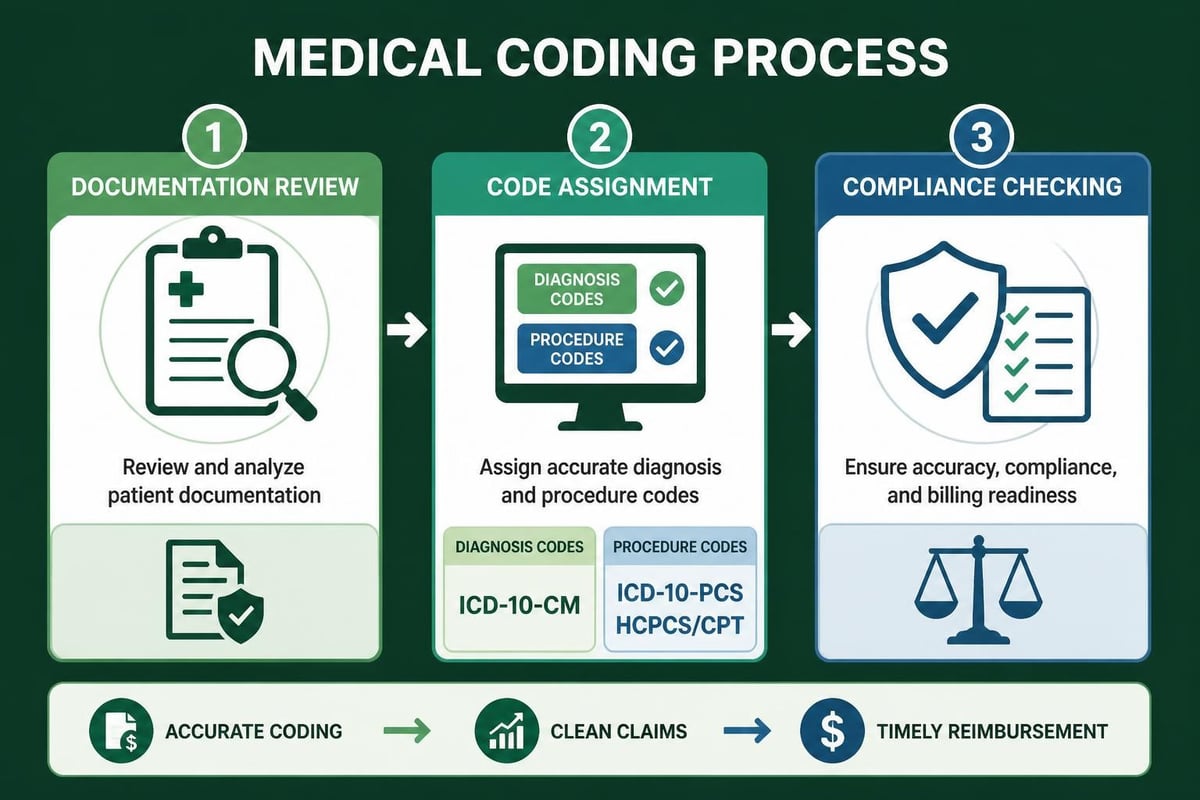
Organizations must maintain current knowledge of coding guidelines, payer-specific requirements, and regulatory changes. The Healthcare Financial Management Association emphasizes that proper integration of clinical and administrative functions optimizes the revenue cycle management process and reduces costly errors.
Coding compliance extends beyond technical accuracy to include medical necessity documentation, modifier usage, and bundling rules. Practices that invest in ongoing coder education and regular audits minimize the risk of claim rejections and potential compliance issues.
Claims Submission and Management
After coding is complete, claims must be formatted according to payer specifications and submitted through appropriate channels. The claims submission phase requires attention to technical requirements, timely filing deadlines, and payer-specific rules that vary across insurance companies.
Clean Claims Creation
A clean claim in medical billing contains no errors or missing information that would prevent immediate processing and payment. Creating clean claims requires comprehensive edits and validation checks before submission. Modern billing systems incorporate scrubbing software that identifies common errors and alerts staff to corrections needed before transmission.
Key elements of clean claims include:
- Accurate patient and provider identification numbers
- Valid diagnosis and procedure code combinations
- Appropriate modifiers supporting medical necessity
- Complete service dates and location information
- Correct rendering provider credentials
Clean claim rates serve as a critical performance indicator for the revenue cycle management process. Organizations achieving high clean claim percentages experience faster payment cycles and reduced administrative burden from denial management activities.
Electronic Submission and Tracking
Electronic claims submission through clearinghouses has become the standard for healthcare billing. These intermediaries validate claims against payer edits before forwarding to insurance companies, providing immediate feedback on formatting errors or missing data. Electronic submission also enables automated tracking of claim status throughout the adjudication process.
Claims management systems monitor submission confirmations, rejection notifications, and payment timelines. Automated workflows alert billing staff when claims require follow-up due to aging without payment or unexpected denial codes. This proactive approach prevents claims from falling through the cracks and ensures timely resolution of payment issues.
Back-End Payment and Denial Management
The back-end portion of the revenue cycle management process focuses on collecting payment and resolving obstacles to reimbursement. According to insights on back-end revenue cycle best practices, these activities require specialized skills and persistent follow-up to maximize collections.
Payment Posting and Reconciliation
When payments arrive from insurance companies, staff must accurately post remittance information to patient accounts. Electronic remittance advice (ERA) automates much of this process by providing structured payment data that interfaces directly with practice management systems. Understanding what ERA in medical billing means helps practices streamline their payment posting workflows.
Payment posting identifies several critical pieces of information:
- Allowed amounts based on contracted rates
- Contractual adjustments reducing charges to negotiated levels
- Patient responsibility amounts including deductibles and copayments
- Denial codes indicating reasons for non-payment
- Correspondence codes requiring additional action
Accurate payment reconciliation ensures that accounts reflect true balances and identifies discrepancies requiring investigation. Regular reconciliation also supports financial reporting and helps practices understand their true collection rates across different payers and service types.
Strategic Denial Management
Denial management in medical billing represents one of the most resource-intensive aspects of the revenue cycle management process. Each denial requires analysis to determine the root cause, appropriate corrective action, and whether appeal is warranted based on potential recovery value.
| Denial Type | Common Causes | Resolution Strategy |
|---|---|---|
| Technical | Missing or incorrect data | Correct and resubmit quickly |
| Authorization | Lack of prior approval | Retrospective authorization request |
| Medical Necessity | Inadequate documentation | Submit additional clinical records |
| Timely Filing | Late submission | File appeal with justification |
Effective denial management extends beyond simply working denials as they arrive. Leading organizations analyze denial patterns to identify systemic issues requiring process improvements. This proactive approach addresses root causes, preventing future denials rather than perpetually working the same problems.
The appeal process requires detailed knowledge of payer policies and persistence through multiple levels of review. Successful appeals often depend on comprehensive documentation, clear communication of medical necessity, and adherence to specific appeal procedures outlined in payer contracts.
Accounts Receivable Management and Collections
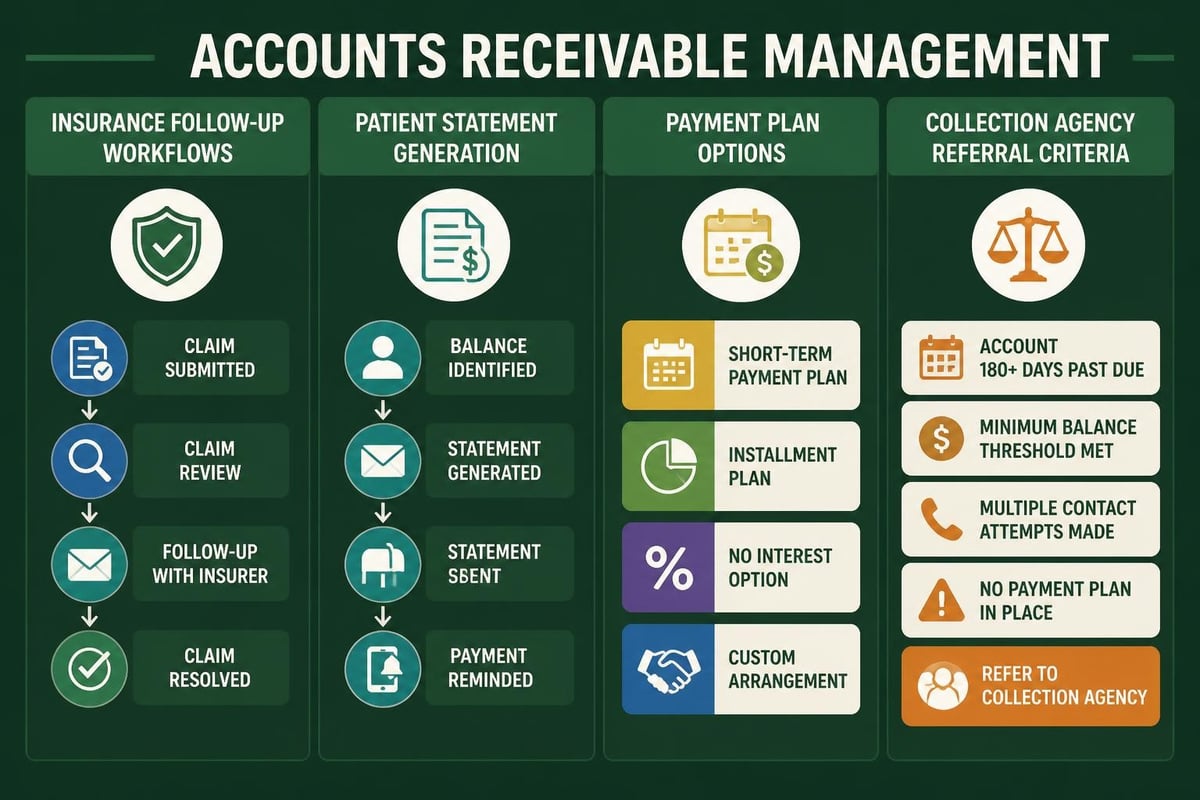
Maintaining healthy accounts receivable represents an ongoing challenge within the revenue cycle management process. Aging claims tie up working capital and increase the likelihood of write-offs as balances become uncollectible over time.
Insurance Follow-Up Workflows
Systematic follow-up on outstanding insurance claims prevents revenue loss from abandoned or forgotten balances. Best practices include:
- Automated work queues prioritizing claims by aging and dollar value
- Documented contact attempts with payer representatives
- Escalation protocols for claims exceeding specific aging thresholds
- Regular review of underpayment and bundling disputes
Insurance follow-up requires knowledge of each payer’s specific processes, contact methods, and typical processing timelines. Experienced billing professionals develop relationships with payer representatives that facilitate faster resolution of complex issues.
Patient Balance Collection
After insurance payments are posted, remaining patient balances require collection through statements, payment plans, and follow-up communications. Patient collections present unique challenges as individuals often lack the resources or understanding to pay medical bills promptly.
Effective patient collection strategies include:
- Clear, itemized statements showing insurance payments and adjustments
- Multiple payment options including online portals and payment plans
- Proactive communication before balances become severely delinquent
- Financial counseling for patients facing significant out-of-pocket costs
- Appropriate use of collection agencies for persistently delinquent accounts
The revenue cycle management process must balance aggressive collection efforts with patient satisfaction and relationship preservation. Many practices find that compassionate, solution-oriented approaches yield better results than purely punitive collection tactics.
Technology and Automation in Revenue Cycle Optimization
Modern healthcare organizations increasingly rely on technology to streamline and optimize their revenue cycle management process. Automation reduces manual tasks, minimizes errors, and allows staff to focus on complex issues requiring human judgment and expertise.
Software Solutions and Integration
Comprehensive medical billing software solutions provide integrated platforms that support end-to-end revenue cycle workflows. These systems combine practice management, electronic health records, and billing functionality to create seamless information flow from scheduling through final payment.
Key technological capabilities include:
- Automated eligibility verification through real-time payer connections
- Rules-based coding assistance and charge capture validation
- Electronic claims submission with built-in scrubbing and edit checks
- Automated payment posting from electronic remittance files
- Business intelligence dashboards providing real-time performance metrics
Integration between clinical and financial systems eliminates duplicate data entry and ensures consistency across platforms. When documentation, coding, and billing systems share a common database, information flows automatically without manual intervention, reducing errors and accelerating processes.
Analytics and Performance Measurement
Data analytics transform the revenue cycle management process from reactive problem-solving to proactive optimization. By measuring key performance indicators and analyzing trends, healthcare organizations identify improvement opportunities and track the impact of process changes.
Essential metrics include:
| Metric | Definition | Target Range |
|---|---|---|
| Days in A/R | Average time from service to payment | 30-40 days |
| Clean Claim Rate | Percentage of claims paid on first submission | >95% |
| Denial Rate | Percentage of claims initially denied | <5% |
| Collection Rate | Total collections as percentage of expected revenue | >95% |
Advanced analytics identify patterns invisible in individual transactions. For example, denial analysis might reveal that specific procedure codes consistently trigger denials with certain payers, pointing to needed authorization workflows or documentation improvements.
Compliance and Regulatory Considerations
The revenue cycle management process operates within a complex regulatory environment that demands strict adherence to privacy, security, and billing standards. Non-compliance risks significant financial penalties and reputational damage that can threaten an organization’s viability.
HIPAA Privacy and Security Requirements
The Health Insurance Portability and Accountability Act (HIPAA) establishes national standards for protecting patient health information. Revenue cycle operations must implement appropriate safeguards to ensure that billing data remains confidential and secure throughout processing.
HIPAA compliance requirements include:
- Access controls limiting who can view patient financial information
- Encryption of electronic transmissions and stored data
- Audit trails documenting system access and data modifications
- Business associate agreements with all vendors handling protected information
- Regular staff training on privacy policies and breach prevention
Violations can result from seemingly minor oversights like unencrypted email communications or inadequate workstation security. Organizations must maintain comprehensive compliance programs that address both technical safeguards and human behavior.
Billing Compliance and Fraud Prevention
Beyond privacy requirements, healthcare billing is subject to strict rules prohibiting fraudulent or abusive practices. The False Claims Act imposes severe penalties for knowingly submitting incorrect claims to government payers, while similar state laws address commercial insurance fraud.
Compliance programs must address common risk areas including:
- Upcoding services to higher reimbursement levels
- Unbundling procedures that should be billed together
- Billing for services not actually rendered
- Inadequate documentation supporting billed services
- Improper use of modifiers to bypass edit restrictions
Regular internal audits help identify coding patterns that might indicate compliance risks. Many organizations engage external auditors to provide objective assessment of billing practices and documentation adequacy. As the Wikipedia overview of revenue cycle management notes, technology plays an increasingly important role in maintaining compliance through automated edit checks and audit trails.
Outsourcing Versus In-House Revenue Cycle Operations
Healthcare providers face an important strategic decision regarding whether to manage revenue cycle functions internally or partner with specialized service providers. This choice significantly impacts operational costs, cash flow, and staff allocation.
Benefits of Professional RCM Services
Specialized revenue cycle management service providers bring dedicated expertise, economies of scale, and proven processes that many individual practices struggle to develop internally. For physician RCM needs, partnering with experienced professionals often delivers superior results compared to managing these complex functions with limited internal resources.
Advantages of professional services include:
- Specialized expertise across coding, billing regulations, and payer requirements
- Advanced technology without capital investment in software and systems
- Scalability to handle volume fluctuations without staffing adjustments
- Performance guarantees based on measurable outcomes and collection rates
- Reduced overhead eliminating hiring, training, and supervision costs
Service providers maintain current knowledge of regulatory changes, payer policy updates, and industry best practices that would require significant investment for individual practices to develop. Their focused expertise often results in higher clean claim rates, faster payment cycles, and reduced denial rates compared to organizations managing these functions as secondary responsibilities.
When In-House Management Makes Sense
Despite the advantages of outsourcing, some organizations benefit from maintaining internal control over revenue cycle functions. Large health systems with sufficient volume to justify dedicated staff and technology investments may achieve better results through in-house operations customized to their specific needs.
In-house management provides:
- Direct control over processes and staff assignments
- Immediate access to billing information and real-time reporting
- Customized workflows aligned with organizational culture
- Integration opportunities with existing systems and processes
- Retention of institutional knowledge within the organization
The decision often depends on practice size, specialty complexity, and available management bandwidth. Many organizations adopt hybrid models, managing certain functions internally while outsourcing specialized activities like denial appeals or patient collections.
Optimizing Payer Contract Management
While often overlooked, contract negotiation and management significantly impact revenue cycle performance. The terms negotiated with insurance payers directly determine reimbursement rates and administrative requirements that affect the revenue cycle management process.
Strategic Contract Analysis
Healthcare providers should regularly analyze payer contracts to understand their financial impact and identify improvement opportunities. This analysis examines reimbursement rates compared to costs, denied claim patterns, and administrative burden associated with each payer’s requirements.
Contract review should evaluate:
- Fee schedules for high-volume services compared to actual costs
- Authorization requirements and their administrative impact
- Claims submission and appeal procedures
- Payment timelines and interest provisions for late payments
- Performance guarantees and penalty provisions
According to insights on payor contract management, annual negotiations provide opportunities to optimize reimbursement rates and streamline administrative tasks. Organizations with strong data documenting their costs and quality outcomes negotiate from positions of strength.
Leveraging Data in Negotiations
Successful contract negotiations depend on comprehensive data demonstrating the value providers deliver and justifying rate increases. Organizations should track and present:
- Quality metrics and patient outcomes
- Service utilization patterns and growth trends
- Cost analysis for major service categories
- Comparison to regional reimbursement benchmarks
- Administrative burden documentation
Understanding the revenue cycle implications of contract terms allows providers to negotiate provisions that reduce administrative costs even when rate increases are limited. Simplified authorization processes, extended filing deadlines, and streamlined appeal procedures all contribute to improved revenue cycle efficiency.
Continuous Improvement and Staff Development
The revenue cycle management process requires ongoing attention to maintain optimal performance as regulations, payer policies, and technology capabilities evolve. Organizations that treat revenue cycle optimization as a continuous journey rather than a one-time project achieve superior long-term results.
Building Revenue Cycle Expertise
Staff competency directly impacts every aspect of revenue cycle performance. Organizations must invest in comprehensive training programs that develop skills in registration accuracy, coding proficiency, claims management, and payer relations.
Effective training programs include:
- Initial onboarding covering fundamental processes and systems
- Ongoing education addressing regulatory and coding updates
- Specialized training for complex procedures and payer requirements
- Cross-training to build organizational resilience and coverage depth
- Performance feedback and coaching to reinforce best practices
Professional certifications in medical coding, billing, and revenue cycle management provide standardized knowledge validation and demonstrate commitment to excellence. Supporting staff pursuit of credentials enhances organizational capability while improving employee engagement and retention.
Implementing Process Improvement Methodologies
Structured improvement approaches like Lean and Six Sigma help healthcare organizations systematically identify and eliminate revenue cycle inefficiencies. These methodologies focus on reducing variation, eliminating waste, and optimizing workflows to improve outcomes.
Process improvement initiatives typically follow these steps:
- Define specific problems or improvement opportunities
- Measure current performance using objective data
- Analyze root causes of performance gaps
- Improve processes through redesigned workflows
- Control gains through monitoring and standardization
Regular performance reviews examining metrics like those tracked by revenue cycle analytics platforms identify trends requiring attention. Organizations should establish formal review cycles where leadership examines key indicators, discusses variances, and allocates resources to address emerging issues.
Specialty-Specific Revenue Cycle Considerations
Different medical specialties face unique revenue cycle challenges based on their service mix, payer requirements, and workflow characteristics. Tailoring the revenue cycle management process to specialty-specific needs improves outcomes compared to generic approaches.
Urgent Care Revenue Cycle Complexity
Urgent care revenue cycle management presents distinct challenges including high patient volumes, significant self-pay balances, and workers’ compensation claims. These facilities must balance rapid patient throughput with accurate information collection and coding.
Urgent care-specific considerations include:
- Point-of-service payment collection to reduce bad debt exposure
- Efficient processes for workers’ compensation documentation
- After-hours staffing models affecting revenue cycle operations
- High volumes requiring automated workflow tools
- Balance between speed and accuracy in registration processes
Understanding these specialty nuances allows providers to implement targeted solutions rather than generic processes poorly suited to their operational reality.
Specialty-Specific Coding and Documentation
Medical specialties vary significantly in coding complexity, documentation requirements, and common denial triggers. Cardiovascular procedures require different expertise than primary care encounters, while surgical specialties face unique challenges around global periods and modifier usage.
Specialized knowledge areas include:
- Procedure-specific bundling rules and modifier requirements
- Specialty-focused documentation supporting medical necessity
- Payer policies varying by specialty and procedure type
- Authorization requirements for specialty services and procedures
- Compliance risks specific to high-reimbursement specialties
Organizations serving multiple specialties must develop expertise across these areas or partner with service providers bringing comprehensive specialty knowledge.
Mastering the revenue cycle management process requires coordinated attention to front-end accuracy, mid-cycle coding excellence, and back-end collection persistence, all supported by appropriate technology and ongoing process improvement. Healthcare providers who optimize these interconnected workflows experience improved cash flow, reduced administrative burden, and enhanced financial stability. Greenhive Billing Solutions delivers comprehensive revenue cycle management services specifically designed for healthcare providers seeking to maximize reimbursements while maintaining compliance and operational efficiency. Our experienced team handles everything from insurance verification through denial appeals, allowing your practice to focus on delivering exceptional patient care.

