
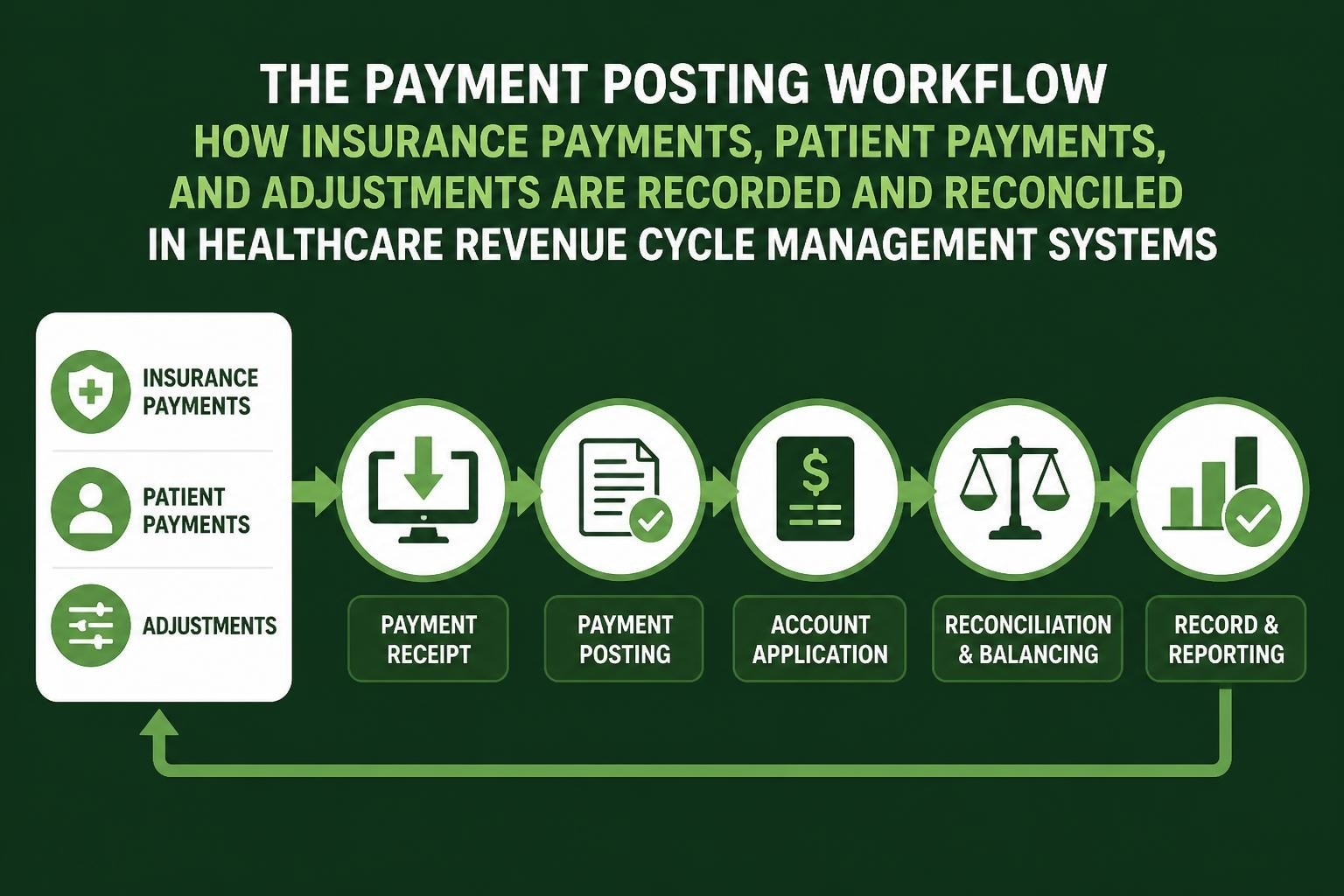
Payment posting represents one of the most critical yet often overlooked components of healthcare revenue cycle management. Every payment received, whether from insurance companies or patients, must be accurately recorded and reconciled against outstanding claims. This process directly impacts cash flow, financial reporting accuracy, and the overall financial health of healthcare practices. For medical providers navigating the complexities of revenue cycle operations, understanding the nuances of this essential function can mean the difference between optimal reimbursement and revenue leakage.
Understanding Payment Posting in Healthcare Revenue Cycle Management
Payment posting is the systematic process of recording and applying payments received from insurance carriers, government payers, and patients to their corresponding patient accounts. This fundamental task ensures that all revenue is properly documented, patient balances are updated accurately, and outstanding accounts receivable are maintained with precision.
The process involves more than simply entering payment amounts into a billing system. Medical billing professionals must verify that payments match expected reimbursement amounts, identify and document adjustments or contractual write-offs, and flag discrepancies for further investigation. Payment posting in medical billing serves as the bridge between claim submission and final account reconciliation.
Core Components of the Payment Posting Process
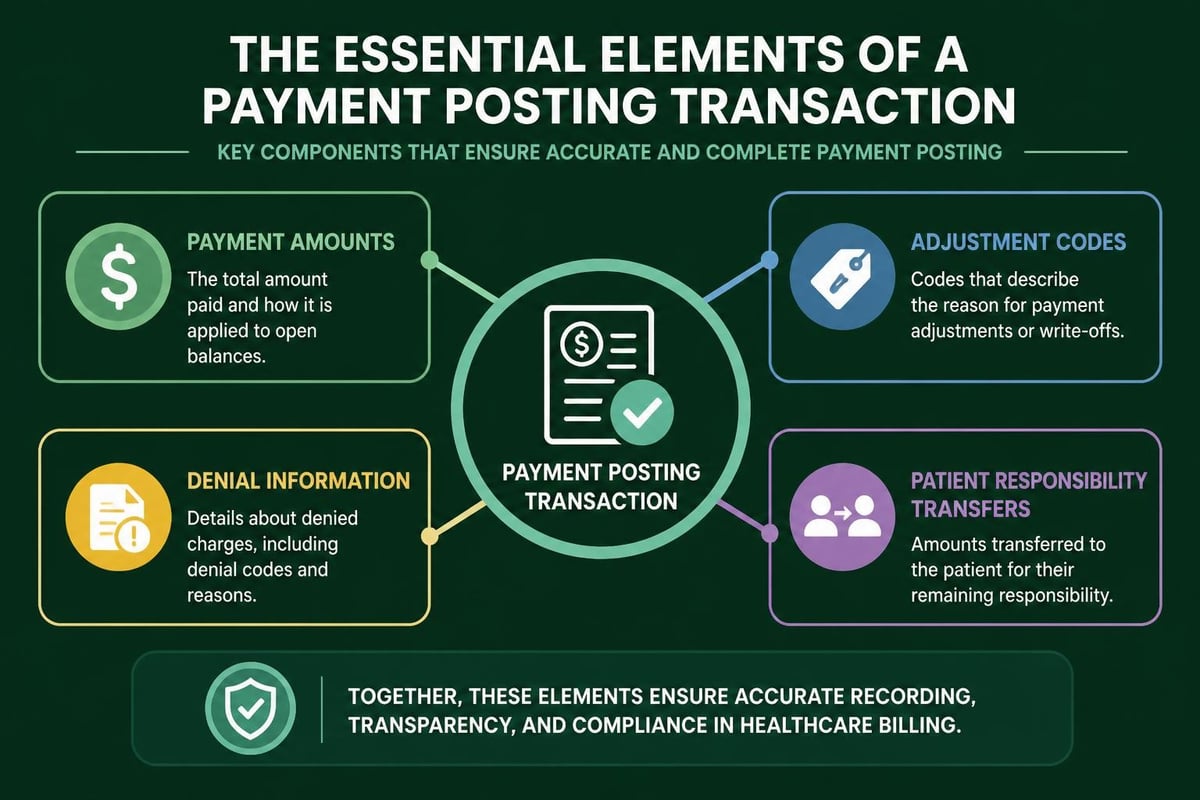
Every payment posting transaction consists of several essential elements that work together to create a complete financial record. These components ensure transparency and enable accurate tracking of revenue throughout the billing cycle.
Primary payment posting elements include:
- Payment amount: The actual dollar amount received from the payer
- Adjustment codes: Contractual or non-contractual write-offs explaining payment differences
- Denial codes: Reasons for payment reductions or rejections
- Patient responsibility: Remaining balance transferred to patient accounts
- Transaction dates: When payments were received and posted
- Check or electronic transfer numbers: Payment reference identifiers
Understanding these components allows billing teams to maintain comprehensive audit trails and quickly identify patterns in payer behavior or reimbursement trends.
The Payment Posting Workflow From Start to Finish
The payment posting workflow follows a structured sequence that ensures accuracy and completeness. Each step builds upon the previous one, creating a systematic approach to revenue recognition.
Step 1: Payment Receipt and Preparation
Healthcare organizations receive payments through multiple channels including checks, electronic funds transfers (EFT), and electronic remittance advice (ERA). The first critical step involves gathering all payment documentation and matching it with the corresponding explanation of benefits (EOB) or ERA.
Electronic payments have streamlined this initial phase considerably. Modern medical billing practices increasingly leverage automated systems that receive and organize ERA data, reducing manual handling and accelerating the posting timeline.
Step 2: Payment Verification and Matching
Before any amounts are posted, billing specialists must verify that payments correspond to the correct claims and patient accounts. This verification process includes confirming claim numbers, patient identifiers, dates of service, and procedure codes.
Discrepancies discovered during verification require immediate attention. Common issues include payments applied to incorrect patient accounts, mismatched claim numbers, or payments for services not yet billed. Resolving these discrepancies before posting prevents downstream complications in account reconciliation.
Step 3: Posting Payments to Patient Accounts
Once verification is complete, payment amounts are entered into the practice management or billing software. This step requires careful attention to detail as posted amounts directly affect patient account balances and accounts receivable totals.
The posting process typically involves:
- Selecting the correct patient account using unique identifiers
- Identifying the specific claim or charge being paid
- Entering the payment amount received from the payer
- Recording adjustment amounts based on contractual agreements
- Applying denial codes for rejected or reduced payments
- Calculating remaining patient responsibility after insurance payment
Step 4: Adjustment and Denial Documentation
Not all submitted charges result in full payment. Contractual adjustments reflect the difference between billed charges and allowed amounts under payer contracts. Understanding the payment posting process helps billing teams properly categorize these adjustments to maintain accurate revenue reporting.
Non-contractual adjustments and denials require different handling. These instances may represent opportunities for appeal or indicate issues with claim submission that need correction for future claims.
| Adjustment Type | Description | Action Required |
|---|---|---|
| Contractual | Pre-negotiated rate differences | Write-off, no further action |
| Non-Contractual | Payer-imposed reductions | Review for appeal potential |
| Denial | Rejected payment for specific reasons | Investigate and correct or appeal |
| Patient Responsibility | Deductibles, copays, coinsurance | Transfer to patient balance |
Step 5: Secondary Billing and Patient Balance Transfer
After primary insurance payments are posted, remaining balances must be evaluated for secondary insurance billing or patient responsibility. This step ensures that all potential revenue sources are pursued appropriately.
For accounts with secondary insurance coverage, claims are prepared and submitted with primary payment information. For accounts without additional insurance, balances are transferred to patient responsibility and appropriate patient statements are generated.
Manual Versus Automated Payment Posting Methods
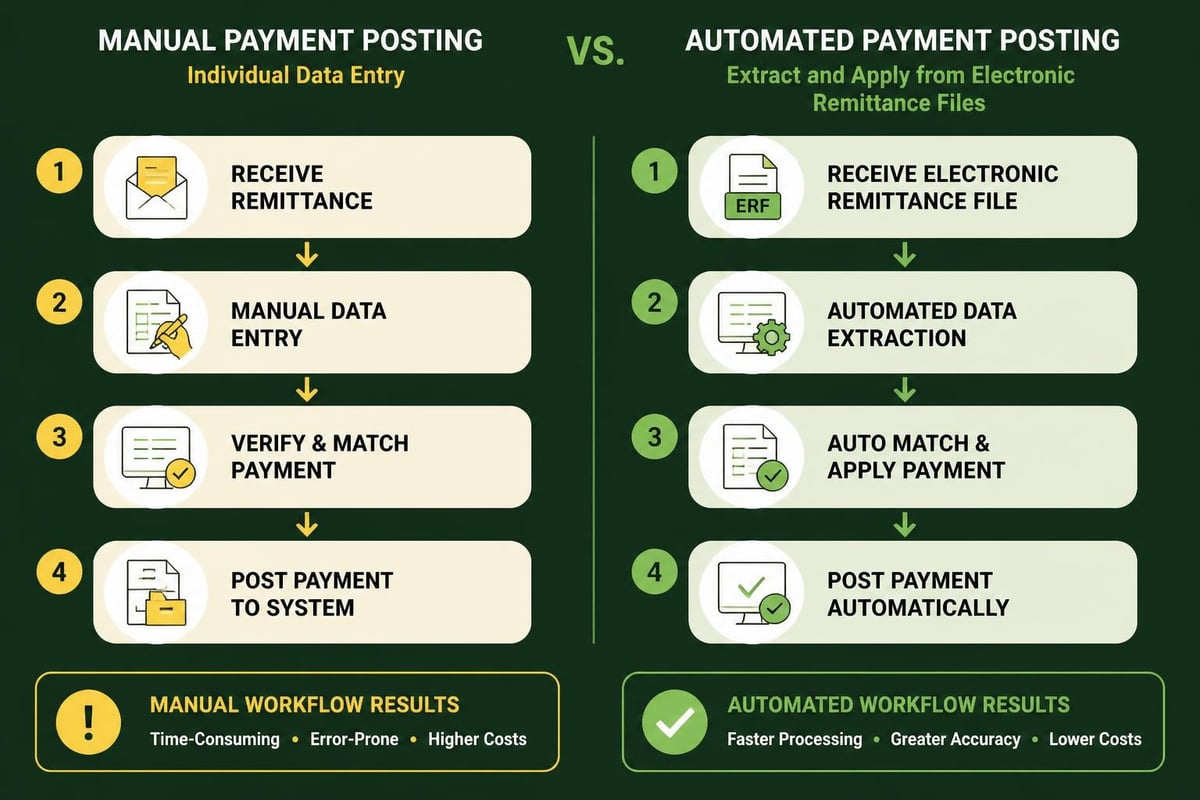
Healthcare organizations can implement payment posting through manual processes, automated systems, or hybrid approaches. Each method presents distinct advantages and challenges that impact efficiency and accuracy.
Manual Payment Posting
Manual payment posting involves billing staff individually entering payment information from paper EOBs into billing systems. While this approach allows for detailed review of each transaction, it is time-intensive and susceptible to human error.
Manual posting remains common in smaller practices with lower claim volumes or organizations without access to electronic remittance systems. However, the resource requirements and error potential make this approach less sustainable as practice volume increases.
Automated Payment Posting
Automated payment posting leverages technology to extract data from electronic remittance advice and populate billing systems with minimal human intervention. Automation in the payment posting process dramatically reduces posting time and improves accuracy by eliminating manual data entry errors.
Modern revenue cycle management systems can automatically match ERA data to corresponding claims, apply payments and adjustments according to predefined rules, and flag exceptions requiring human review. This approach allows billing teams to focus on exception management and revenue optimization rather than routine data entry.
Benefits of automated payment posting:
- Reduced posting time from days to hours or minutes
- Improved accuracy through elimination of transcription errors
- Enhanced productivity allowing staff to manage higher volumes
- Real-time updates to accounts receivable balances
- Better cash flow visibility through faster posting cycles
- Comprehensive audit trails for compliance purposes
Hybrid Approaches
Many healthcare organizations implement hybrid models that combine automation with manual oversight. Automated systems handle straightforward transactions while complex payments, denials, or discrepancies are routed to experienced billing specialists for manual review and posting.
This balanced approach maximizes efficiency while maintaining the accuracy and attention to detail that complex payment scenarios require.
Impact of Payment Posting on Revenue Cycle Performance
Accurate and timely payment posting directly influences multiple revenue cycle metrics that healthcare organizations monitor to assess financial performance. Understanding these connections helps prioritize investment in payment posting capabilities.
Days in Accounts Receivable
Payment posting speed directly affects days in accounts receivable (A/R), a critical metric measuring how long revenue remains outstanding after services are rendered. Efficient revenue cycle management requires prompt payment posting to ensure accurate A/R aging and enable timely follow-up on outstanding balances.
Delayed posting inflates A/R balances and obscures the true status of collections efforts. Practices experiencing posting backlogs may appear to have healthy cash flow when outstanding balances are actually at risk.
Cash Flow and Working Capital
Payment posting timeliness impacts how quickly organizations can access and utilize received funds. Even when payments are physically received, they cannot be recognized as revenue or used for financial planning until properly posted to patient accounts.
Organizations with efficient posting processes maintain better visibility into actual cash positions and can make more informed decisions about operational expenditures, staffing, and strategic investments.
Denial Management and Appeals
Effective denial management begins with accurate payment posting that identifies and categorizes denial reasons. Billing teams cannot initiate appropriate appeals or corrective actions until denials are properly documented in the billing system.
Comprehensive denial tracking enabled by detailed payment posting allows organizations to identify patterns in payer behavior, address systemic claim submission issues, and improve first-pass acceptance rates.
Patient Satisfaction and Communication
Accurate payment posting ensures that patient statements reflect correct balances owed after insurance payments are applied. Errors in posting can result in patients receiving statements for amounts already paid by insurance, creating confusion and dissatisfaction.
Healthcare providers focused on patient experience recognize that billing accuracy affects overall patient satisfaction and willingness to pay outstanding balances promptly.
Common Payment Posting Challenges and Solutions
Healthcare organizations encounter various obstacles in maintaining accurate and efficient payment posting operations. Identifying these challenges and implementing targeted solutions improves overall revenue cycle performance.
High Transaction Volumes
Large practices and multi-location healthcare systems process thousands of payment transactions monthly. Managing this volume while maintaining accuracy requires appropriate staffing levels and technological support.
Solutions include:
- Implementing automated posting systems to handle routine transactions
- Establishing dedicated payment posting teams with specialized training
- Creating tiered workflows that route complex transactions to experienced staff
- Monitoring productivity metrics to ensure adequate resource allocation
Payer-Specific Variations
Different insurance carriers use varying formats for remittance advice, apply different adjustment codes, and follow distinct payment timelines. These variations complicate standardization of payment posting procedures.
Organizations must maintain comprehensive reference materials documenting payer-specific nuances and train staff to recognize and appropriately handle these variations. Automated systems should be configured with payer-specific rules that account for these differences.
Denial Code Complexity
Understanding denial codes and their implications requires specialized knowledge and ongoing education. Incorrectly categorized denials may be inappropriately written off rather than appealed, resulting in revenue loss.
Regular training sessions, accessible denial code references, and quality assurance reviews help ensure denials are properly identified and routed for appropriate action.
Coordination of Benefits Issues
Patients with multiple insurance policies require careful coordination of benefits to ensure claims are submitted to payers in the correct sequence and that payment posting reflects accurate primary and secondary payments.
Establishing clear workflows for coordination of benefits and implementing systematic verification of insurance coverage order prevents payment posting errors and billing delays.
| Challenge | Impact | Solution Strategy |
|---|---|---|
| High transaction volume | Posting backlogs, delayed A/R updates | Automation and workflow optimization |
| Payer variations | Inconsistent posting, increased errors | Standardized protocols with payer-specific rules |
| Denial complexity | Revenue leakage through improper write-offs | Enhanced training and denial management systems |
| Staff turnover | Knowledge loss, quality inconsistency | Comprehensive documentation and cross-training |
| System limitations | Manual workarounds, reduced efficiency | Technology upgrades and integration improvements |
Best Practices for Payment Posting Excellence
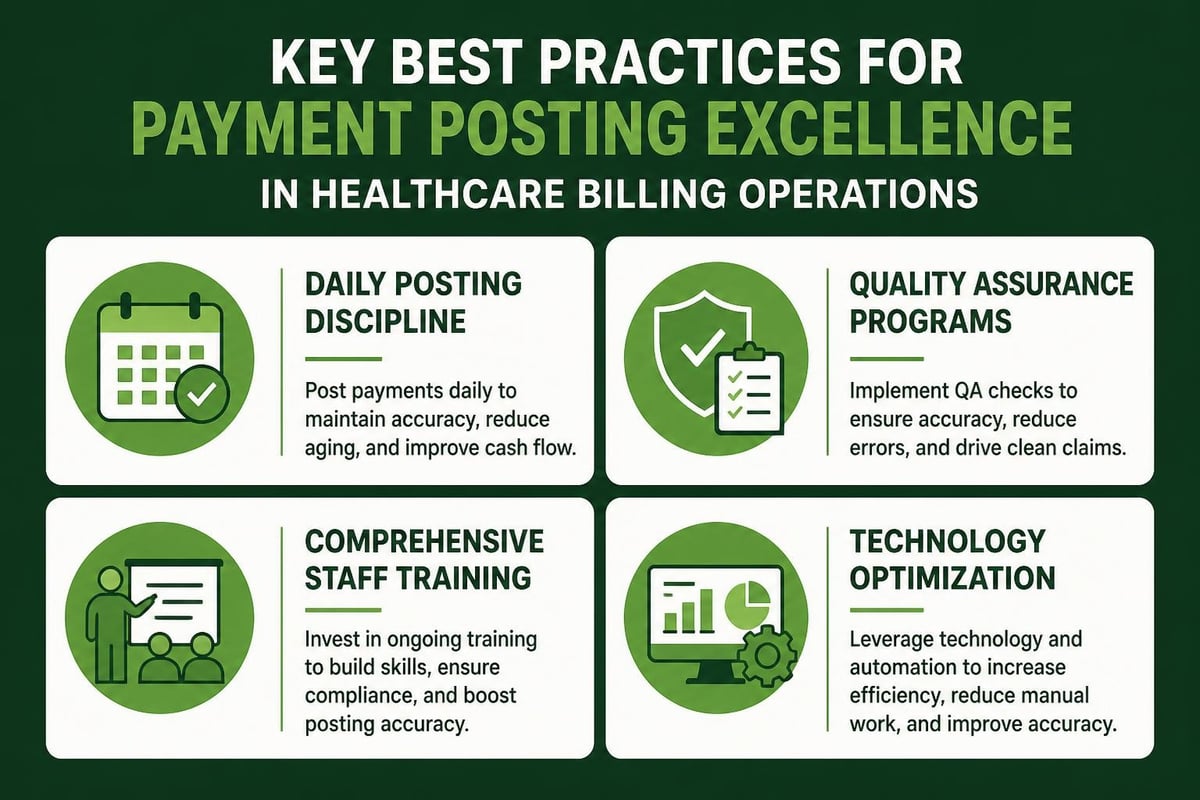
Healthcare organizations committed to revenue cycle optimization implement specific practices that enhance payment posting accuracy, efficiency, and compliance.
Daily Posting Discipline
Establishing a daily payment posting routine prevents backlogs and ensures accounts receivable balances remain current. Best practices in payment posting emphasize same-day or next-day posting as the standard for optimal cash flow management.
Daily posting also enables prompt identification of payment discrepancies while details remain fresh and supporting documentation is readily available.
Systematic Quality Assurance
Regular quality audits of posted payments identify patterns of errors, training needs, and opportunities for process improvement. Quality assurance programs should review a statistical sample of transactions for accuracy in payment amounts, adjustment coding, and denial documentation.
Audit findings should be shared with posting staff as educational opportunities rather than punitive measures, fostering a culture of continuous improvement.
Comprehensive Staff Training
Payment posting requires detailed knowledge of insurance contracts, adjustment coding, denial management, and practice management system functionality. Organizations should invest in initial training programs for new staff and ongoing education to keep teams current with payer policy changes and system updates.
Cross-training team members on different payer types and transaction complexities builds organizational resilience and reduces vulnerability to individual staff absences.
Technology Optimization
Leveraging appropriate medical billing software configured to organizational needs maximizes payment posting efficiency. Regular system optimization ensures that automation rules remain current with payer requirements and that integration with banking systems operates smoothly.
Organizations should periodically evaluate whether current technology meets operational needs or whether upgrades would deliver meaningful efficiency improvements.
Clear Documentation Standards
Establishing and enforcing documentation standards ensures that payment posting creates comprehensive audit trails supporting financial reporting and compliance requirements. Documentation should clearly indicate who posted payments, when they were posted, and any unusual circumstances requiring special handling.
Standardized notes and comment fields within billing systems facilitate consistent documentation across the payment posting team.
Integration With Broader Revenue Cycle Functions
Payment posting does not exist in isolation but connects intimately with other revenue cycle functions. Understanding these connections helps organizations optimize overall financial performance.
Relationship With Claims Processing
Effective claims processing sets the foundation for smooth payment posting by ensuring accurate charge capture, proper coding, and complete documentation. Clean claims submitted to payers result in straightforward payment posting with fewer denials and adjustments requiring investigation.
Conversely, payment posting data provides valuable feedback to claims processing teams about payer requirements, common denial reasons, and opportunities to improve claim accuracy before submission.
Connection to Eligibility Verification
Insurance eligibility verification conducted prior to service delivery influences payment posting outcomes by ensuring claims are submitted to active policies with current coverage information. Accurate eligibility verification reduces payment posting complications from coverage terminations and coordination of benefits issues.
Impact on Patient Financial Counseling
Payment posting determines patient responsibility amounts that drive collections efforts and patient financial counseling activities. Accurate and timely posting ensures that patient outreach focuses on legitimate balances and that payment plans reflect current account status.
Organizations with integrated revenue cycle functions share payment posting data with patient financial services teams in real-time, enabling proactive patient communication about balances owed.
Support for Financial Reporting
Posted payments form the basis for revenue recognition in financial reporting and business analytics. Comprehensive reporting and analytics depend on accurate payment posting that properly categorizes revenue sources, payer mix, and adjustment types.
Finance teams rely on payment posting accuracy to forecast cash flow, prepare financial statements, and assess practice profitability across service lines and locations.
Regulatory Compliance Considerations
Payment posting operations must adhere to various regulatory requirements that protect patient information and ensure financial integrity.
HIPAA Privacy and Security
Payment posting involves accessing protected health information (PHI) including patient identities, insurance details, and service information. Organizations must implement appropriate safeguards ensuring that payment posting staff access only the minimum necessary information and that electronic systems protect data from unauthorized access.
Regular HIPAA training for payment posting teams and periodic security risk assessments help maintain compliance with privacy regulations.
Anti-Kickback and Stark Law Compliance
While payment posting itself does not typically trigger anti-kickback or Stark Law concerns, organizations must ensure that adjustment and write-off policies do not create improper financial relationships with referring physicians or other healthcare providers.
Adjustment policies should be applied consistently across all payers and patient categories without consideration of referral relationships.
Retention Requirements
Payment posting documentation including EOBs, ERAs, and system audit logs must be retained according to federal and state requirements, typically ranging from five to ten years. Organizations should establish clear retention policies and ensure that electronic and paper records remain accessible throughout required retention periods.
Metrics for Measuring Payment Posting Performance
Establishing and monitoring key performance indicators helps organizations assess payment posting effectiveness and identify improvement opportunities.
Posting Lag Time
Posting lag measures the time elapsed between payment receipt and posting to patient accounts. Industry best practices target posting within 24 to 48 hours of receipt for optimal accounts receivable accuracy.
Organizations should track posting lag separately for electronic and paper payments as expectations differ based on payment method.
Posting Accuracy Rate
Accuracy rates measure the percentage of posted payments that contain no errors requiring correction. Regular quality audits sampling posted transactions provide data for this metric.
Target accuracy rates typically exceed 98% for experienced payment posting teams working with well-configured automated systems.
Transactions Per Hour
Productivity metrics tracking transactions posted per hour help organizations assess staffing adequacy and identify training needs. These metrics should account for transaction complexity as automated posting of straightforward payments requires less time than manual posting of complex denials.
Key payment posting metrics dashboard:
| Metric | Target | Measurement Frequency |
|---|---|---|
| Posting lag time | 24-48 hours | Daily |
| Posting accuracy rate | 98%+ | Monthly (via audit) |
| Transactions per hour | Varies by method | Weekly |
| Error correction rate | <2% | Monthly |
| Denial identification rate | 100% | Monthly (via audit) |
Error Correction Rate
This metric tracks the percentage of posted payments requiring subsequent correction or adjustment. High error correction rates indicate training needs, system configuration issues, or process gaps requiring attention.
Root cause analysis of errors helps organizations implement targeted improvements rather than simply tracking overall error rates.
Mastering payment posting fundamentals and implementing best practices significantly impacts healthcare revenue cycle performance through improved cash flow, reduced accounts receivable aging, and enhanced financial reporting accuracy. For healthcare organizations seeking to optimize these critical functions without diverting internal resources from patient care, partnering with experienced revenue cycle management specialists offers a proven solution. Greenhive Billing Solutions delivers comprehensive payment posting services using industry-leading systems and experienced professionals who ensure accurate, timely posting while maintaining HIPAA compliance and transparent communication throughout the revenue cycle process.

