
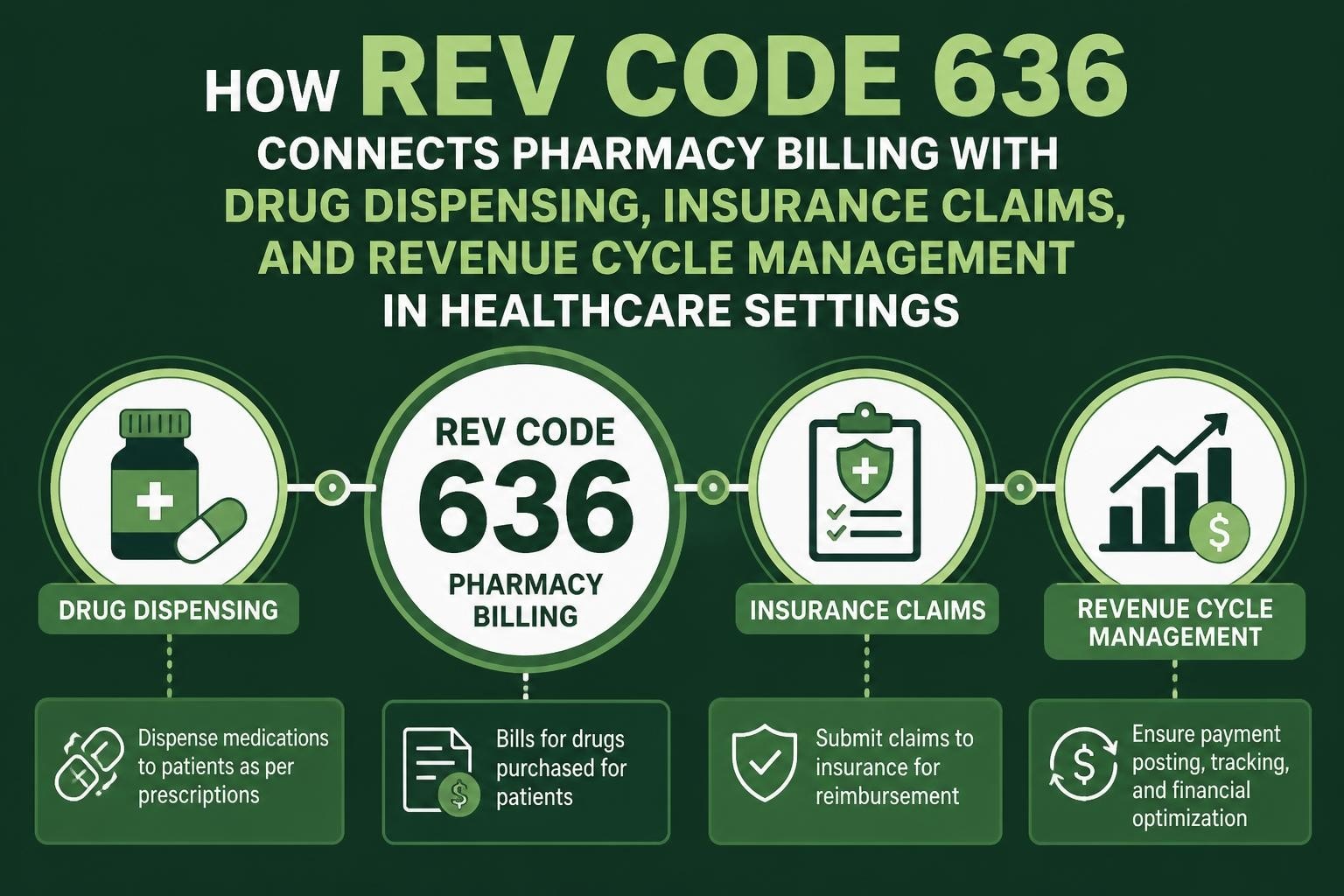
Healthcare billing requires precision and attention to detail, especially when dealing with specialized revenue codes that impact reimbursement. Understanding rev code 636 is essential for facilities that dispense medications and provide pharmacy services, as incorrect application can lead to claim denials and revenue loss. This revenue code represents a specific category within the UB-04 claim form structure that healthcare providers must navigate carefully to ensure proper payment for pharmaceutical services and supplies.
Understanding Revenue Code 636 in Healthcare Billing
Rev code 636 specifically designates drugs requiring detailed documentation and falls under the broader pharmacy revenue code category. This code is used when billing for certain pharmaceutical products and services that require additional justification or meet specific criteria established by payers. Unlike standard pharmacy codes, rev code 636 often applies to medications that fall outside typical formulary coverage or require special handling.
Healthcare facilities must recognize when to apply this code versus other pharmacy-related revenue codes. The distinction matters significantly for claims processing and reimbursement accuracy. Revenue coding in healthcare billing requires staff to understand the nuances between various drug-related codes to prevent costly errors.
When Healthcare Providers Use Rev Code 636
Facilities typically apply rev code 636 in several specific scenarios:
- Medications administered during outpatient procedures that require pass-through status
- Specialty pharmaceuticals not covered under standard pharmacy codes
- Drugs requiring prior authorization or special documentation
- Investigational medications used in clinical settings
- Biologics and biosimilars with specific payer requirements
The application of this code often connects to the type of facility, the setting where medication administration occurs, and the specific payer guidelines. Hospitals, ambulatory surgical centers, and specialized treatment facilities all encounter situations requiring rev code 636.
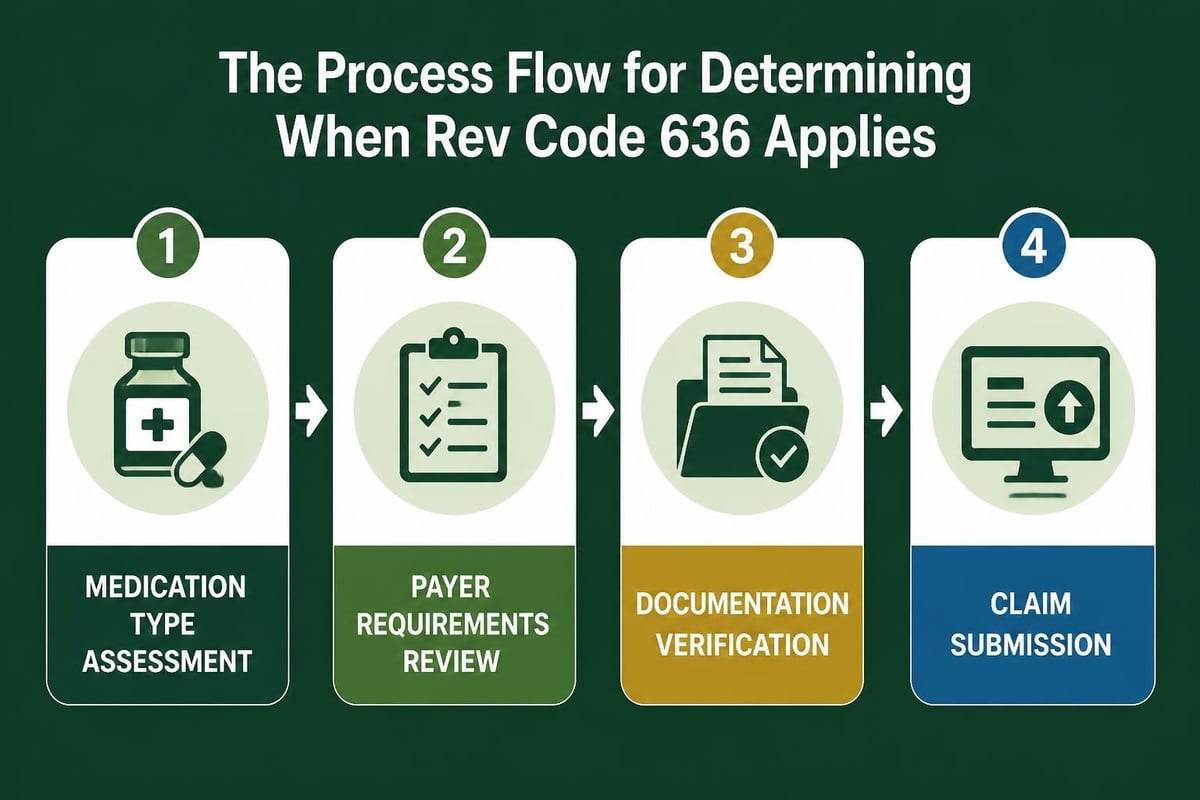
Documentation Requirements for Rev Code 636
Proper documentation forms the foundation of successful billing with rev code 636. Payers scrutinize these claims more carefully than standard pharmacy charges, making comprehensive records essential for reimbursement. Healthcare providers must maintain detailed documentation that supports the medical necessity and appropriateness of the medications billed under this code.
Essential Documentation Elements
Every claim using rev code 636 should include specific supporting information:
- Physician orders demonstrating the prescribed medication and dosage
- Administration records showing date, time, and method of delivery
- Medical necessity justification explaining why this particular medication was required
- National Drug Codes (NDC) for precise pharmaceutical identification
- Quantity and units administered during the service period
Missing any of these elements can trigger claim denials or requests for additional information, delaying payment and increasing administrative burden. The denial management process becomes critical when rev code 636 claims face rejection.
| Documentation Type | Purpose | Common Pitfall |
|---|---|---|
| Physician Order | Establishes medical necessity | Incomplete dosage information |
| Administration Record | Proves service delivery | Missing timestamps |
| NDC Number | Identifies specific drug | Using outdated codes |
| Quantity Documentation | Supports billed amount | Unit of measure errors |
Billing Best Practices for Rev Code 636
Healthcare organizations must implement systematic approaches to ensure accurate rev code 636 billing. This requires coordination between clinical staff, pharmacy departments, and billing professionals. Each group plays a vital role in capturing the information needed for clean claims submission.
Billing staff should verify that the medication qualifies for rev code 636 before claim submission. This verification step prevents rejections and reduces the need for claim corrections. Cross-referencing payer policies and maintaining updated fee schedules helps ensure proper code application.
Coordination Between Departments
Successful rev code 636 billing demands seamless communication across departments. Pharmacy staff must document medication dispensing accurately, clinical teams need to record administration details, and billing professionals must translate this information into compliant claims. Breaking down these silos improves claim accuracy and speeds reimbursement.
Many healthcare organizations benefit from establishing standard workflows specifically for medications that fall under rev code 636. These workflows create checkpoints for documentation review before claim submission, reducing error rates significantly. Professional medical billing services often implement these systematic approaches to maximize reimbursement.
Common Challenges with Rev Code 636 Claims
Healthcare providers frequently encounter obstacles when billing with rev code 636. Recognizing these challenges helps organizations develop strategies to overcome them and maintain healthy revenue cycles. Understanding where problems typically arise allows for proactive solutions rather than reactive corrections.
Payer-Specific Requirements
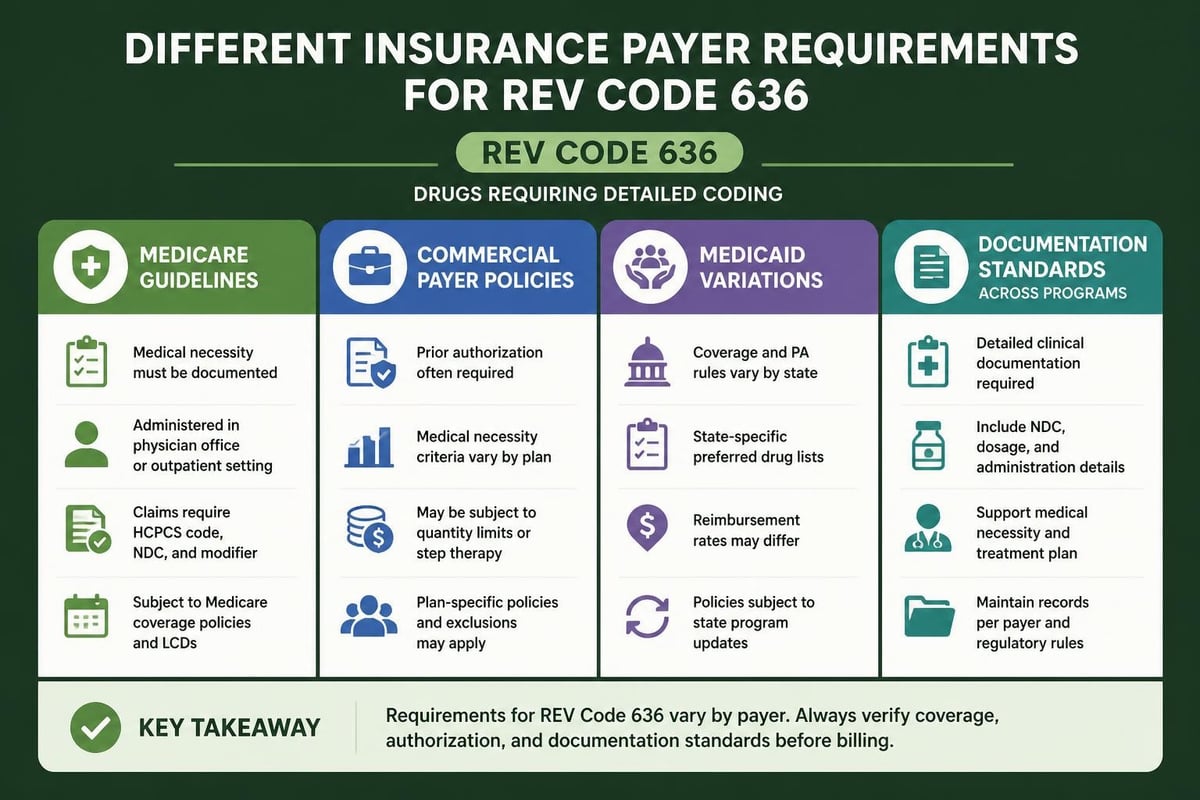
Different insurance companies maintain varying policies regarding rev code 636 application. What one payer accepts may trigger a denial from another. This inconsistency creates complexity for billing departments that must track multiple sets of rules simultaneously.
Medicare has specific guidelines about when rev code 636 is appropriate versus other pharmacy codes. Understanding these distinctions is crucial for providers serving Medicare beneficiaries. The Code of Federal Regulations outlines procedures for how Part D plan sponsors must handle certain determinations that can impact claims involving this revenue code.
Commercial payers often establish their own criteria, which may differ substantially from Medicare requirements. Billing staff must maintain current knowledge of each payer’s policies to avoid submission errors.
- Medicare Advantage plans may have unique formulary restrictions
- State Medicaid programs apply varying coverage rules
- Private insurers often require prior authorization for specific drugs
- Workers’ compensation carriers have distinct pharmaceutical policies
Rev Code 636 and Pass-Through Drug Billing
The relationship between rev code 636 and pass-through drugs represents an important consideration for hospital outpatient departments. Pass-through drugs receive temporary additional payment under Medicare’s Outpatient Prospective Payment System (OPPS) because they’re new and not yet included in standard payment bundles.
Healthcare facilities must distinguish between drugs that qualify for pass-through status and those that don’t when applying rev code 636. Discussion among coding professionals highlights the importance of understanding this relationship to ensure proper reimbursement.
Identifying Pass-Through Medications
Not all medications maintain pass-through status indefinitely. The Centers for Medicare & Medicaid Services (CMS) regularly updates the list of qualifying drugs, and providers must stay current with these changes. Using rev code 636 for medications that no longer qualify as pass-through can result in claim denials or incorrect payment amounts.
Facilities should implement regular reviews of their pharmaceutical inventory to identify which products currently hold pass-through status. This ongoing monitoring prevents billing errors and ensures compliance with evolving CMS policies.
Integration with Revenue Cycle Management Systems
Modern revenue cycle management depends on technology systems that accurately capture and process billing information. Rev code 636 requires proper configuration within these systems to ensure claims generate correctly. Healthcare organizations must verify that their billing software correctly handles this revenue code across different scenarios.
System configuration should account for:
- Automatic NDC requirement validation
- Quantity and unit of measure checks
- Payer-specific edits and rules
- Documentation attachment capabilities
- Denial tracking for rev code 636 claims
Technology alone cannot solve billing challenges, but properly configured systems significantly reduce manual errors. The RCM process benefits from automation that flags potential issues before claim submission, allowing staff to address problems proactively.
| System Function | Rev Code 636 Application | Impact on Revenue |
|---|---|---|
| Charge Capture | Auto-populates required fields | Reduces missing information |
| Edit Checks | Validates NDC presence | Prevents claim rejections |
| Payer Rules | Applies specific requirements | Improves first-pass acceptance |
| Reporting | Tracks denial patterns | Identifies improvement areas |
Training Staff on Rev Code 636 Compliance
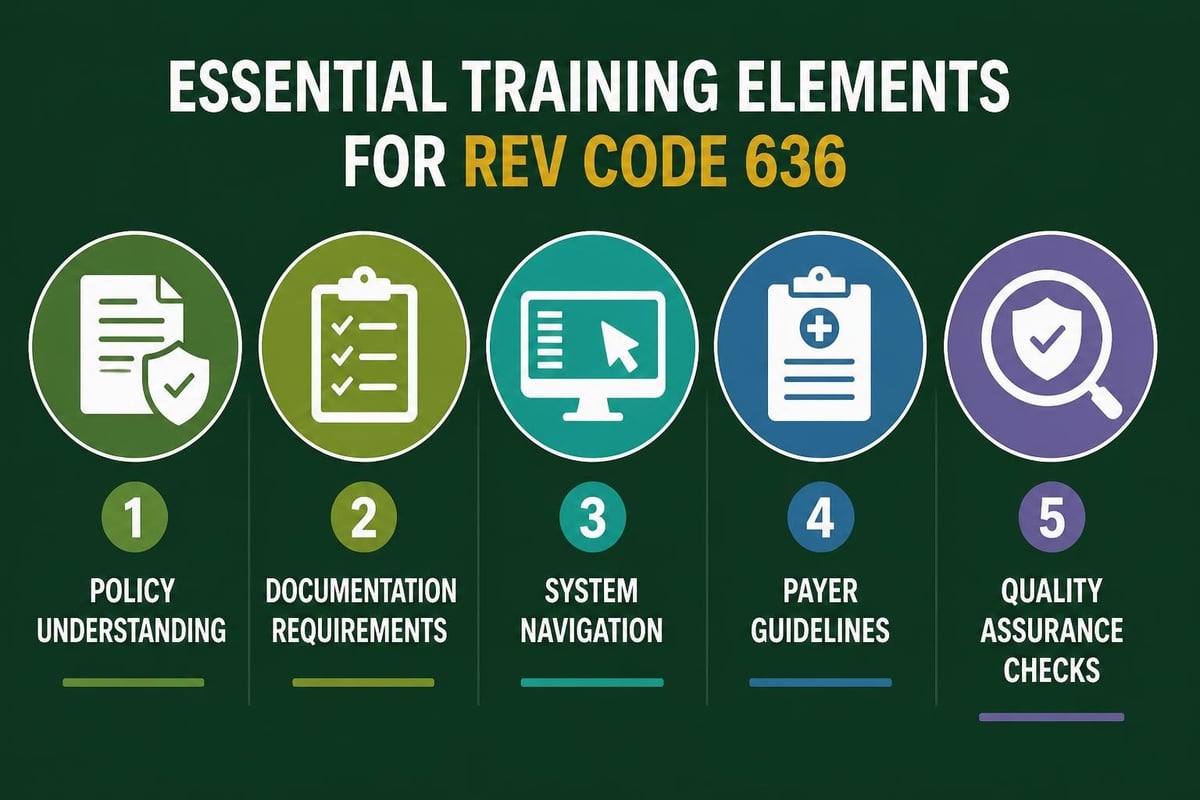
Healthcare organizations must invest in comprehensive staff training to maintain billing accuracy with rev code 636. This training should extend beyond billing department personnel to include clinical staff who document medication administration and pharmacy teams who dispense pharmaceuticals.
Effective training programs cover both the technical aspects of code application and the documentation requirements that support claims. Staff members need to understand not just what to do, but why specific information matters for successful reimbursement.
Developing a Training Curriculum
A structured approach to rev code 636 education ensures consistent knowledge across teams:
- Foundational knowledge covering basic revenue code purposes and structure
- Specific rev code 636 criteria explaining when this code applies
- Documentation standards detailing required supporting information
- Payer policy variations highlighting differences between insurance companies
- System workflows demonstrating how to process these charges correctly
- Error recognition teaching staff to identify and correct common mistakes
Regular refresher training helps maintain compliance as policies evolve. Quarterly updates keep staff informed about changes in payer requirements or regulatory guidelines affecting rev code 636 application.
Monitoring and Auditing Rev Code 636 Usage
Ongoing monitoring of rev code 636 claims provides valuable insights into billing accuracy and potential areas for improvement. Healthcare organizations should establish regular audit procedures to review how this code is being applied and whether claims are processing successfully.
Internal audits serve multiple purposes: identifying training gaps, uncovering system configuration issues, and detecting patterns that might indicate compliance risks. These reviews should occur frequently enough to catch problems before they become significant revenue issues.
Key Performance Indicators to Track
Measuring specific metrics helps organizations assess their rev code 636 billing performance:
- First-pass claim acceptance rate for claims containing this code
- Average days to payment compared to other pharmacy codes
- Denial rate and most common rejection reasons
- Documentation compliance percentage for required elements
- Payer-specific performance to identify problem relationships
Analytics in healthcare revenue cycle management enables data-driven decision-making about where to focus improvement efforts. Tracking these metrics over time reveals trends and helps validate whether implemented changes are producing desired results.
Rev Code 636 Reimbursement Optimization
Maximizing reimbursement for services billed under rev code 636 requires strategic attention to both billing accuracy and payer negotiations. Healthcare providers should analyze their contracts to ensure appropriate payment rates for these specialized pharmaceutical services.
Rate negotiation becomes particularly important for rev code 636 because these medications often represent significant costs to facilities. Understanding the full financial picture-including acquisition costs, handling requirements, and administration expenses-helps providers negotiate fair reimbursement rates with commercial payers.
Contract Review Considerations
When reviewing payer contracts, organizations should examine:
- How rev code 636 services are categorized and priced
- Whether current rates reflect actual medication costs
- If separate reimbursement exists beyond the base facility fee
- What documentation payers require for payment
- Whether prior authorization affects payment timelines
Many healthcare facilities discover that their contracts lack specific language addressing rev code 636, leaving payment amounts ambiguous. Proactively addressing these gaps during contract negotiations prevents future disputes and ensures predictable revenue.
Staying Current with Rev Code 636 Requirements
Healthcare billing regulations evolve continuously, and providers must maintain current knowledge of changes affecting rev code 636. Regulatory updates, new payer policies, and shifts in pharmaceutical coverage all impact how this code should be applied.
Organizations can implement several strategies to stay informed:
Subscribe to industry publications that cover coding and billing updates. Professional associations regularly publish guidance on revenue code changes and application clarifications.
Participate in professional networks where billing professionals share insights and discuss challenges. Learning from peers helps identify solutions to common problems.
Attend continuing education programs focused on hospital billing and pharmacy services. These educational opportunities provide in-depth coverage of complex topics like rev code 636.
Monitor payer communications for policy updates affecting pharmaceutical billing. Insurance companies typically announce changes with varying lead times, making it essential to track these notifications systematically.
Understanding what revenue codes are in medical billing provides the foundation for properly applying specialized codes like 636. This broader knowledge helps billing professionals recognize when situations fall outside standard categories and require careful attention.
Impact of Rev Code 636 on Cash Flow
The financial implications of rev code 636 billing extend beyond individual claim amounts. How effectively an organization manages these claims influences overall cash flow patterns and revenue predictability. Claims that require additional documentation or face higher denial rates create payment delays that ripple through the entire revenue cycle.
Healthcare providers should analyze their accounts receivable aging specifically for rev code 636 claims. If these claims consistently age longer than other pharmacy charges, investigation into root causes becomes necessary. Common issues include incomplete documentation, payer policy misunderstandings, or system configuration problems.
Addressing rev code 636 challenges improves broader revenue cycle performance. Effective revenue cycle billing depends on minimizing claim delays and maximizing first-pass acceptance rates across all service categories, including specialized pharmaceutical billing.
| Financial Metric | Target Performance | Common Challenge |
|---|---|---|
| Days in A/R | Under 35 days | Documentation delays |
| Clean Claim Rate | Above 95% | Missing NDC codes |
| Denial Rate | Below 5% | Medical necessity issues |
| Appeal Success | Above 60% | Insufficient justification |
Mastering rev code 636 requires comprehensive understanding of documentation requirements, payer policies, and systematic billing processes that minimize errors while maximizing reimbursement. Healthcare organizations that invest in proper training, technology configuration, and ongoing monitoring position themselves for financial success in this complex area of pharmaceutical billing. Greenhive Billing Solutions offers specialized expertise in revenue cycle management, helping healthcare providers navigate the complexities of specialized billing codes while ensuring compliance and optimizing reimbursement across all service lines.

