BLOG ARTICLES

The RCM Guide for Healthcare
Providers in the USA

December 19, 2025

Medical billing has never been more complex. In 2026, healthcare practices face mounting administrative tasks, shifting payer rules, and a growing risk of costly errors. Studies show that billing inefficiencies cost practices billions each year.

This article explores the top 10 medical billing software designed to simplify operations, maximize revenue, and minimize mistakes. Discover the features, pricing, pros and cons, and best use cases for each solution.

Ready to reduce your administrative burden and improve your bottom line? Explore your options and find the best fit among the top 10 medical billing software available today.

What is Medical Billing Software & Why It Matters in 2026

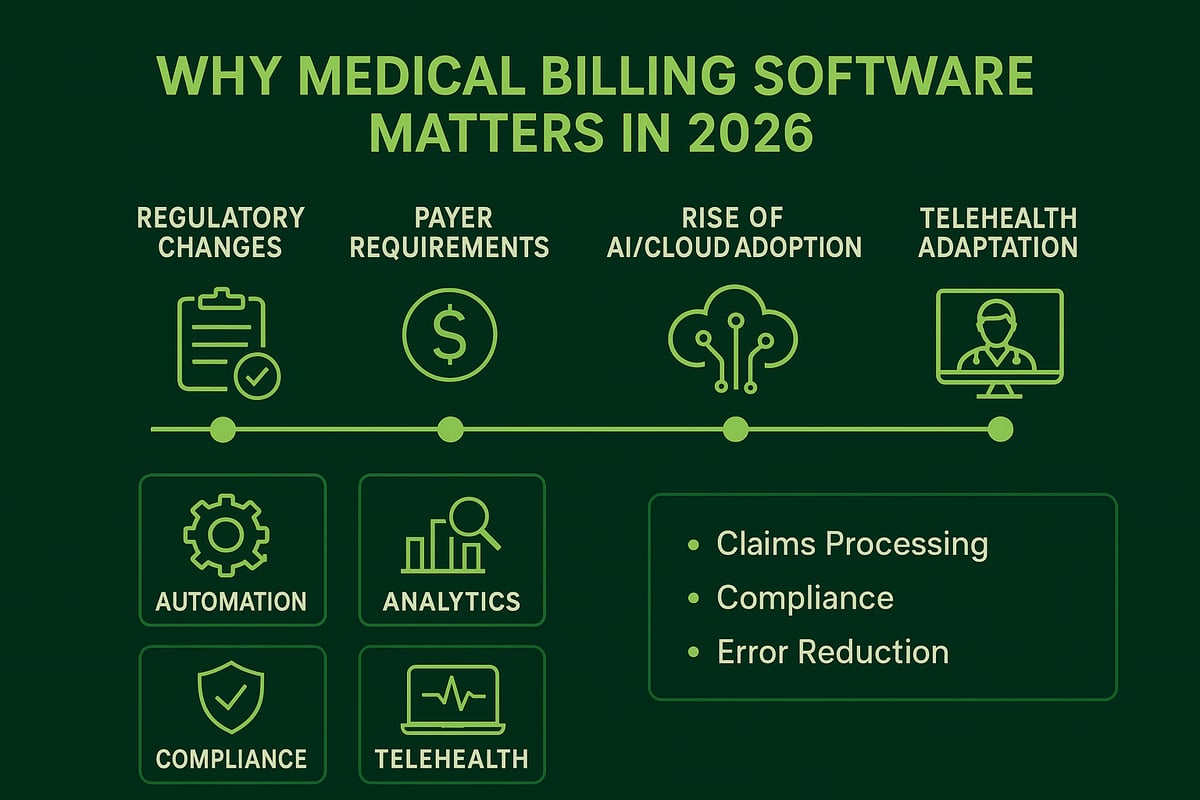
The healthcare billing landscape is evolving rapidly. New regulations, complex payer requirements, and the ongoing digital transformation are reshaping how practices manage revenue. In 2026, accuracy and speed in claims submission are more crucial than ever. As cloud-based and AI-powered tools gain traction, practices are turning to the top 10 medical billing software solutions to keep pace with industry demands and minimize costly errors.
What is Medical Billing Software & Why It Matters in 2026

The Evolving Landscape of Healthcare Billing

Healthcare billing in 2026 faces unprecedented complexity. Regulatory bodies frequently update compliance standards, while payers demand precise, timely documentation. The top 10 medical billing software options help practices navigate this shifting terrain by automating workflows and supporting fast, accurate submissions.

Digital transformation is another driving force. Practices are rapidly adopting cloud-based and AI-driven solutions to streamline billing, reduce manual effort, and ensure security. This shift allows both small clinics and large organizations to stay competitive, respond to regulatory changes, and maintain efficient billing operations.

Core Functions of Medical Billing Software

At the heart of every top 10 medical billing software platform are several essential functions. These systems automate the entire claims process, from insurance verification and eligibility checks to payment posting and denial management. Integration with EHR and EMR systems ensures seamless data flow, reducing duplication and errors.

Modern solutions also provide real-time analytics and compliance tracking, empowering practices to make informed decisions. Many platforms offer specialty-specific coding support and automated claim scrubbing to further reduce denials. For a deeper dive into how denial management impacts cash flow, see Denial Management in Medical Billing.

Key Benefits for Modern Practices

Choosing the right top 10 medical billing software brings measurable advantages. Automation reduces manual errors and administrative workload, freeing staff to focus on patient care. Faster reimbursement cycles improve cash flow and financial stability for practices of all sizes.

Advanced platforms enhance compliance with HIPAA and payer policies, reducing audit risks. Scalability is built-in, enabling growing or multi-location practices to expand with confidence. These benefits collectively help practices thrive in a dynamic healthcare environment.

Challenges Solved by Top Solutions

The top 10 medical billing software options tackle persistent industry challenges. Automated claim scrubbing minimizes denials and delays, ensuring cleaner submissions and faster payments. Specialty-specific coding features support unique billing needs across various fields.

Transparent patient billing and clear communication are prioritized, improving patient satisfaction and reducing confusion. Adaptability to telehealth and hybrid care models means practices can offer flexible services without billing obstacles. By addressing these pain points, leading solutions drive operational efficiency and better outcomes for both providers and patients.

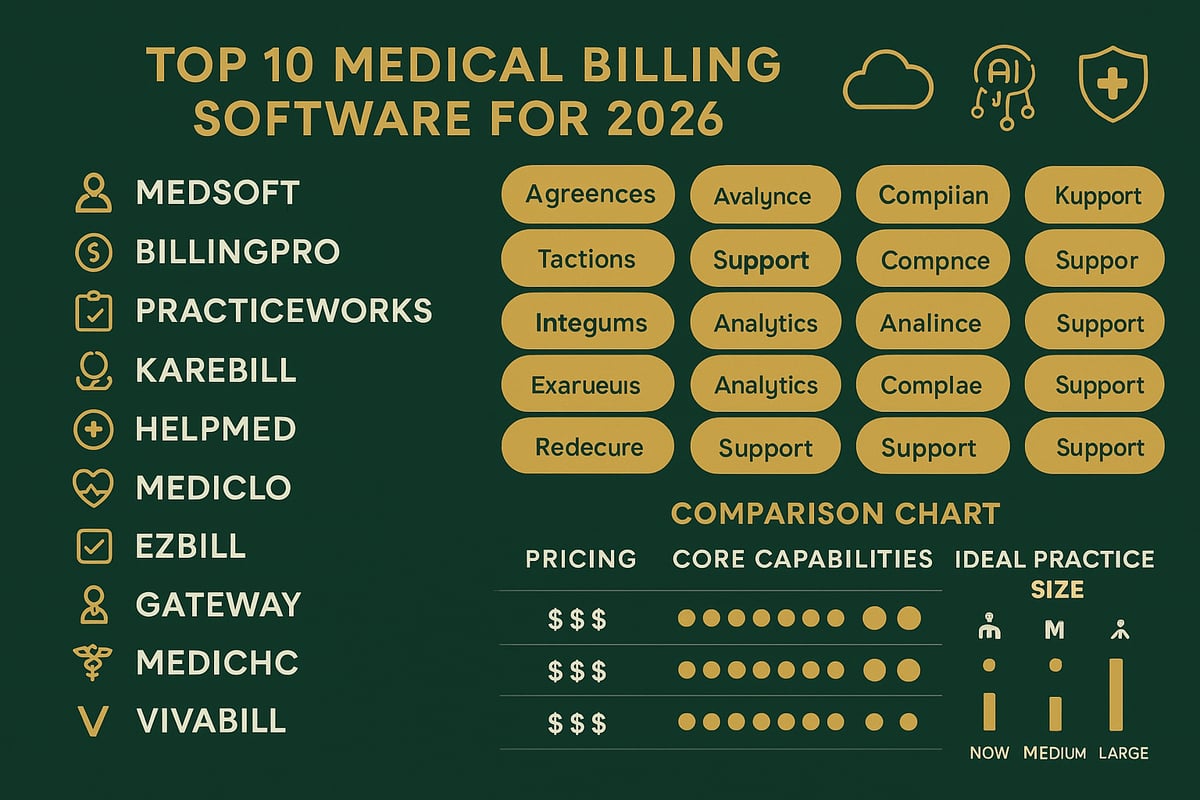
Top 10 Medical Billing Software to Streamline Practice 2026

Choosing the right tool from the top 10 medical billing software options can transform a healthcare practice’s revenue cycle, efficiency, and patient satisfaction. With a rapidly evolving regulatory landscape and increasing patient volumes, practices need robust, scalable solutions. Below, we explore each leading platform, highlighting features, pricing, and ideal fit to help you navigate the crowded market and select the best software for your needs.
Top 10 Medical Billing Software to Streamline Practice 2026

Greenhive Billing Solutions

Greenhive Billing Solutions stands out among the top 10 medical billing software platforms for its transparent, results-based pricing and comprehensive revenue cycle management. This software is designed for solo providers, small practices, and multi-specialty clinics, delivering HIPAA-compliant processes and encrypted data security.

Key features include seamless EHR and PMS integration, specialty-specific billing, real-time analytics, and access to dedicated account managers. Practices benefit from a clean claims guarantee, nationwide payer expertise, and scalable solutions. Regular audits ensure compliance and data integrity.

  • Pros: Maximum transparency, clean claims guarantee, 24/7 U.S.-based support.
  • Cons: Outsourced service model may not suit those preferring in-house software.

Ideal for practices seeking end-to-end revenue cycle management with full support and no hidden fees, Greenhive offers a robust choice within the top 10 medical billing software landscape.

DrChrono

DrChrono is a cloud-based, integrated EHR and billing platform, making it a mainstay in any list of top 10 medical billing software for small to medium-sized practices. It offers real-time insurance eligibility checks, denial analysis, and customizable billing profiles.

With subscription pricing starting at $199 per month, DrChrono provides mobile access, robust reporting, and seamless scheduling integration. Its user-friendly interface and strong automation make it popular among providers.

  • Pros: Easily scalable, intuitive design, mobile-friendly.
  • Cons: Some advanced analytics require add-ons.

Best suited for practices looking for an all-in-one workflow management solution, DrChrono is especially valuable for teams that need mobile access and streamlined operations.

Kareo Billing

Kareo Billing is engineered for independent practices and billing companies, earning its spot in the top 10 medical billing software due to its cloud-driven tools and affordability. Real-time claim tracking, billing analytics, and automated workflows are core strengths.

Pricing starts at $125 per month per provider, making Kareo accessible for smaller practices. The dashboard is intuitive, and the solution simplifies collections and reduces manual tasks.

  • Pros: Affordable, excellent support, customizable workflows.
  • Cons: Advanced integration options are limited for larger enterprises.

Kareo Billing is ideal for independent providers who want a straightforward, effective medical billing solution without unnecessary complexity.

NextGen Healthcare

NextGen Healthcare’s cloud-based platform is a powerful contender among the top 10 medical billing software, offering user-friendly workflows and integrated clinical and financial tools. The software supports accurate claim submissions, patient payment options, and rapid claims processing.

Custom pricing ensures practices only pay for the features they need. Implementation support and training are included, helping practices reduce denials and maintain compliance.

  • Pros: Reduces denials, regulatory compliance, scalable.
  • Cons: May have a steeper learning curve for new users.

NextGen Healthcare is best for growing practices that need a scalable, compliant billing system with integrated EHR capabilities.

Practice EHR

Practice EHR is purpose-built for small and medium practices, securing its place among the top 10 medical billing software for 2026. It combines cloud-based EHR, billing, and practice management into a single platform.

Features include automated claims processing, real-time eligibility checks, and transparent billing. Pricing starts at $149 per month per provider, with certified billers and specialty-specific support.

  • Pros: Transparent processes, clean claims, flexible service options.
  • Cons: Limited customization for very large practices.

Practice EHR is a top pick for practices seeking simplicity, transparency, and expertise in specialty billing.

AdvancedMD

AdvancedMD is a comprehensive cloud-based EHR and billing solution that consistently ranks in the top 10 medical billing software for practices of all sizes. It offers integrated credit card processing, online charge slips, and robust financial analytics.

Pricing is custom, typically starting at $429 per month per provider. AdvancedMD’s workflow automation and scalable modules ensure it meets the needs of multi-provider practices.

  • Pros: Highly customizable, strong support, advanced analytics.
  • Cons: Higher price point, complex initial setup.

AdvancedMD is perfect for practices needing advanced analytics, customizable workflows, and scalability to grow with their needs.

eClinicalWorks

eClinicalWorks is a leading cloud-based EHR with powerful revenue cycle management tools, making it a staple in the top 10 medical billing software lists. It features automated workflows, claim edit rules, ERA management, and AI-driven insights.

Custom pricing provides flexibility for large practices and multi-specialty clinics. Natural language billing queries and specialty-specific automation set eClinicalWorks apart.

  • Pros: Robust automation, scalable, deep customization.
  • Cons: Complex interface for beginners.

eClinicalWorks is best for large practices or clinics requiring advanced customization and automation in their billing processes.

CureMD

CureMD delivers cloud-based billing and practice management for a wide range of specialties, earning its spot in the top 10 medical billing software. Features include real-time claim scrubbing, specialty-specific billing, and comprehensive RCM services.

Pricing starts at $195 per month per provider, with strong support for specialties like cardiology, radiology, and neurology. The software minimizes denials and improves billing accuracy.

  • Pros: Versatile, accurate, tailored specialty modules.
  • Cons: Some advanced features require additional fees.

CureMD is ideal for specialty practices seeking a billing solution tailored to their unique needs.

Practice Fusion

Practice Fusion is a cloud-based EHR and billing system designed for small or independent practices, cementing its place in the top 10 medical billing software for affordability and ease of use. Patient communication tools, insurance AR follow-up, and automated claim scrubbing are included.

The EHR is free, with variable billing costs through integrated partners. Practice Fusion offers easy onboarding, payor compliance tools, and transparent workflows.

  • Pros: Low cost, user-friendly, fast implementation.
  • Cons: Limited advanced features, relies on third-party billing partners.

Best for small practices and startups needing a cost-effective, simple billing solution.

Epic Systems

Epic Systems is an enterprise-grade EHR with integrated billing and revenue cycle management, making it a heavyweight in the top 10 medical billing software for large organizations. Features include electronic insurance verification, customizable workflows, and advanced analytics.

Pricing is custom and geared toward hospitals and large health systems. Epic is lauded for seamless interoperability, eligibility confirmation, and robust self-pay options.

  • Pros: Highly customizable, trusted by large health systems, robust analytics.
  • Cons: Expensive, complex deployment.

Epic Systems is best suited for hospitals and large organizations with complex billing requirements and a need for advanced interoperability.


Comparison Table: Top 10 Medical Billing Software at a Glance

Software Best For Starting Price Key Features Pros Cons
Greenhive Billing End-to-end RCM, support Custom Clean claims, analytics, support Transparency, guarantee Outsourced model
DrChrono Mobile, all-in-one $199/mo Real-time eligibility, reporting Scalable, user-friendly Add-ons needed
Kareo Billing Small practices $125/mo Claim tracking, analytics Affordable, support Limited integration
NextGen Healthcare Growing practices Custom Payment options, compliance Reduces denials Learning curve
Practice EHR Simplicity, specialties $149/mo Transparency, specialty support Clean claims, flexibility Customization limits
AdvancedMD Large, multi-provider $429+/mo Financial analytics, automation Customizable, analytics Price, setup
eClinicalWorks Large/multi-specialty Custom AI insights, ERA management Automation, customization Complex interface
CureMD Specialty practices $195/mo Claim scrubbing, specialty modules Versatile, accurate Extra fees
Practice Fusion Small/startups Free EHR Communication, claim scrubbing Low cost, user-friendly Limited features
Epic Systems Enterprise/hospitals Custom Insurance verification, analytics Customizable, robust Expensive, complex

For further insight into market trends influencing the top 10 medical billing software, see the latest Medical Billing Software Market Growth & Trends report.

How to Choose the Right Medical Billing Software for Your Practice

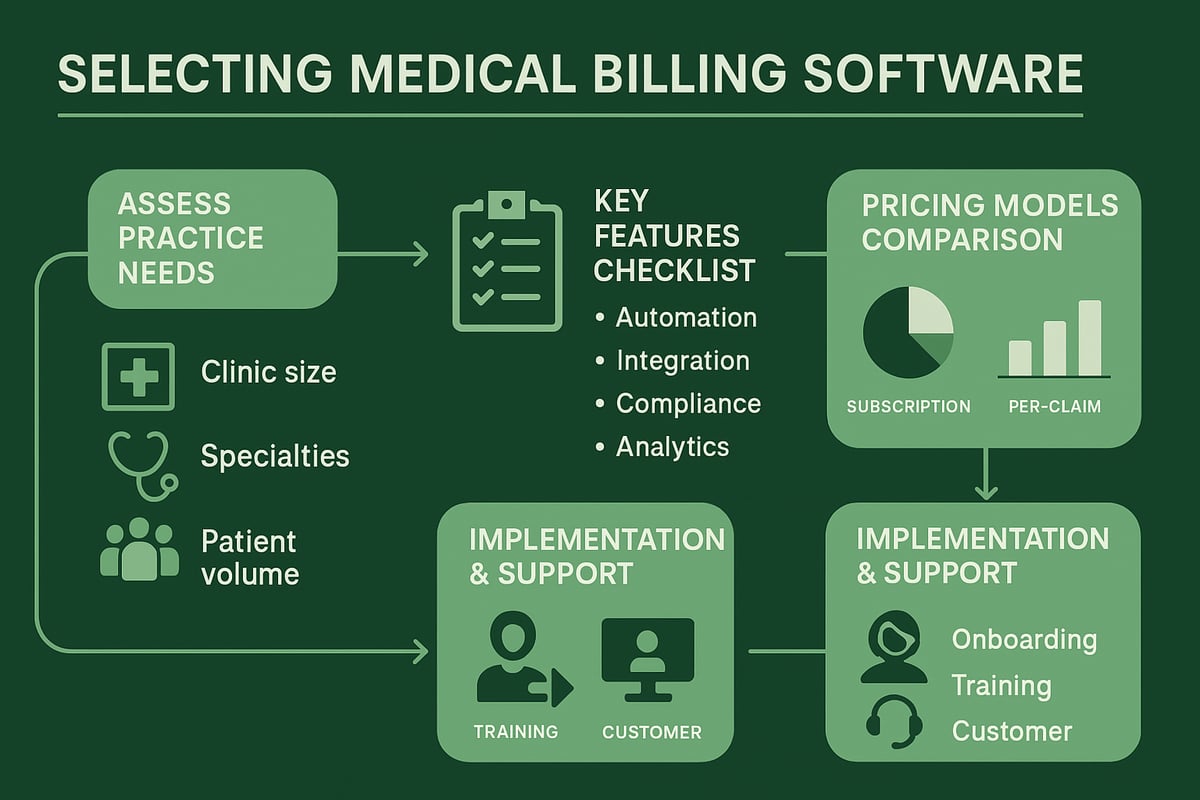
Selecting the right solution from the top 10 medical billing software options can transform your practice’s efficiency and financial health. With so many platforms available in 2026, it is crucial to make an informed decision tailored to your specific needs. Below, we break down a practical approach to evaluating and choosing the best fit for your organization.
How to Choose the Right Medical Billing Software for Your Practice

Assessing Your Practice’s Needs

Begin by analyzing your practice’s size, specialty focus, and patient volume. These factors directly influence the complexity of your billing requirements and the features you will need from the top 10 medical billing software solutions.

Identify current challenges, such as frequent claim denials, slow reimbursements, or difficulty managing multi-location workflows. For small clinics or solo providers, consider reviewing Medical Billing Services for Small Practices to see how software and service combinations can address unique needs.

Ask yourself:

  • Does your specialty require advanced coding support?
  • Are you planning for growth or multi-site expansion?
  • What is your current administrative workload?

Defining these parameters will help you focus on solutions best suited for your operational realities.

Key Features to Consider

Not all systems on the top 10 medical billing software list offer the same capabilities. Prioritize platforms that include:

  • Automated claims submission and scrubbing
  • Seamless integration with EHR/EMR systems
  • Built-in compliance updates and alerts
  • Real-time analytics and reporting dashboards

Specialty-specific coding, denial management, and robust customer support are also essential. To dive deeper into analytics, explore Reporting and Analytics in Billing for insights on how advanced reporting can drive better financial decisions.

Assess whether the interface is user-friendly and if the software supports telehealth, hybrid care, and transparent patient billing. These features ensure your practice stays compliant and competitive.

Pricing Models & ROI Considerations

Understanding the pricing structure of top 10 medical billing software options is vital for budgeting and long-term planning. Models typically include:

  • Subscription-based (monthly/annual per provider)
  • Per-claim or transaction fees
  • Results-based or percentage of collections

Calculate the total cost of ownership, including setup, integration, training, and ongoing support. Evaluate the return on investment by considering how the software will reduce administrative time, minimize errors, and accelerate cash flow.

Review available add-ons or hidden fees that may affect your budget. A clear understanding of costs versus benefits will help you select a solution that maximizes value for your practice.

Implementation, Training & Support

Successful adoption of top 10 medical billing software depends on effective onboarding and continuous support. Assess the vendor’s implementation process, including data migration, timeline, and dedicated assistance.

Check if the provider offers comprehensive training resources for your staff and if ongoing support is accessible via multiple channels. Responsive customer service can make a significant difference when resolving billing or technical issues.

Prepare your team for the learning curve and ensure regular training sessions to keep up with software updates and regulatory changes. A strong support system will help your practice maintain efficiency and compliance as you scale.

Future Trends in Medical Billing Software (2026 & Beyond)

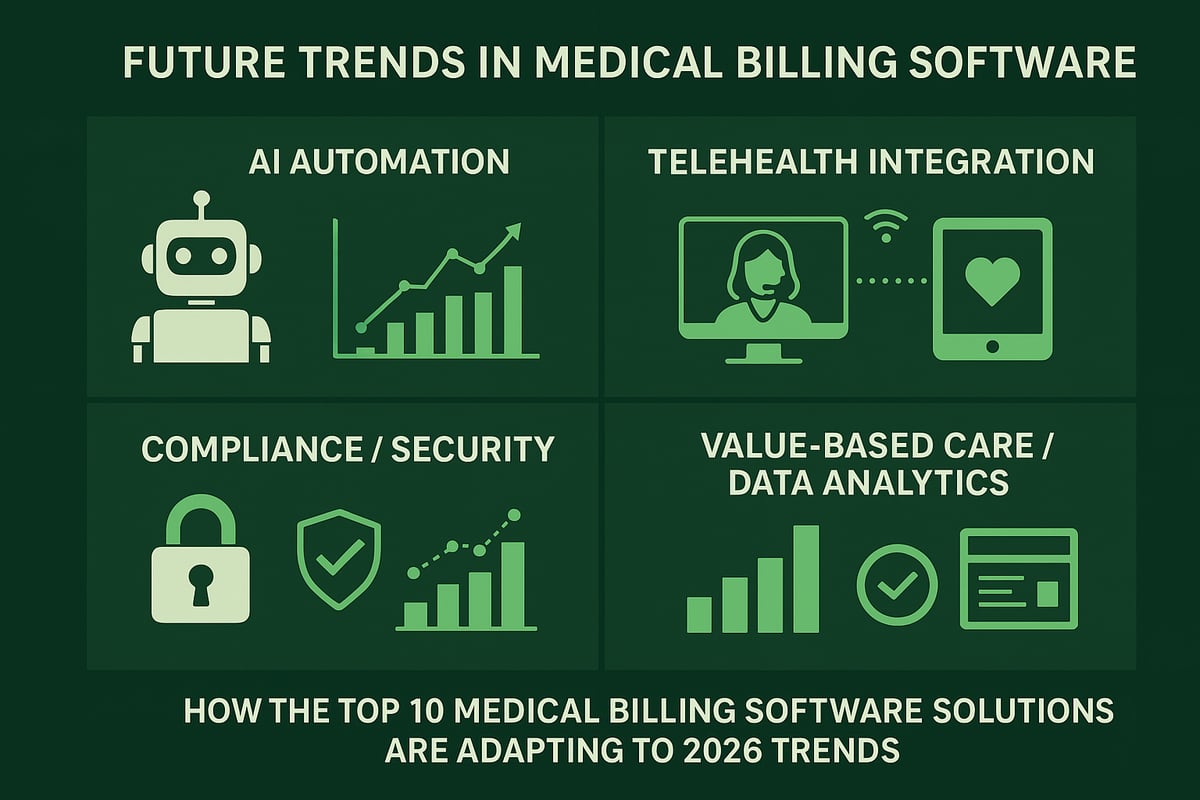
The landscape of medical billing is evolving rapidly, and the top 10 medical billing software providers are already shaping the future. As we look ahead to 2026 and beyond, practices must prepare for transformative changes in automation, integration, compliance, and analytics. Understanding these trends will help organizations select solutions that remain competitive, efficient, and secure.
Future Trends in Medical Billing Software (2026 & Beyond)

AI & Automation in Revenue Cycle Management

AI-powered tools are redefining how the top 10 medical billing software platforms handle revenue cycle management. Predictive analytics now forecast claim approvals and denials with remarkable accuracy, reducing costly rework and delays. Automation extends to coding, where advanced algorithms identify potential errors before submission.

For example, leading solutions use machine learning to flag anomalies and optimize claim edits in real time. Automated denial management speeds up appeals and ensures faster reimbursements. This trend is expected to accelerate, with AI and Automation in Medical Billing playing a vital role in reducing administrative burdens and improving financial outcomes.

Integration with Telehealth & Patient Engagement

As telehealth becomes a standard care model, the top 10 medical billing software offerings are prioritizing unified billing for both virtual and in-person visits. Seamless integration with telehealth platforms ensures accurate charge capture and eligibility verification, regardless of care setting.

Enhanced patient payment portals are another key development. Patients can easily review statements, manage balances, and communicate with billing teams online. Improved transparency leads to higher satisfaction and faster collections. These advancements support the growing demand for flexible, patient-centric billing experiences.

Compliance, Security & Regulatory Updates

Compliance requirements are evolving, and the top 10 medical billing software vendors are enhancing their platforms to meet new standards. Practices must adapt to changing HIPAA, CMS, and payer regulations, which increasingly mandate advanced encryption and real-time compliance monitoring.

Modern solutions provide detailed audit trails and automated alerts for potential breaches. Security features, such as multi-factor authentication and role-based access, protect sensitive patient data. Staying ahead of regulatory changes is essential for practices to avoid penalties and maintain trust.

The Rise of Value-Based Care & Data Analytics

Value-based care is transforming reimbursement, and the top 10 medical billing software systems are responding with robust analytics. These platforms support quality metrics tracking, enabling practices to demonstrate performance and maximize value-based payments.

Sophisticated dashboards deliver actionable insights into operational and financial trends. By leveraging data, practices make informed decisions that drive growth and compliance. For a deeper look at upcoming innovations, see Emerging Medical Billing Trends in 2026, which highlights how analytics and automation are shaping the industry.

If you’re feeling overwhelmed by the fast-changing demands of medical billing in 2026, you’re not alone. Choosing the right software can make all the difference in streamlining your workflows and boosting your bottom line—whether you manage a solo practice or a multi-specialty clinic. At Greenhive Billing Solutions, I understand how essential it is to get tailored support, transparent communication, and proven results. If you’re ready to explore the best-fit option for your unique needs or have questions about optimizing your revenue cycle, I invite you to Book Your Free Consultation. Let’s work together to strengthen your practice’s financial future.
December 18, 2025

The healthcare billing landscape is evolving rapidly, placing new demands on providers and highlighting the essential role of top medical billing companies in ensuring profitability and quality patient care. With the U.S. medical billing outsourcing market projected to reach $17.53 billion by 2033, the push for outsourced solutions has never been stronger.

Providers face mounting challenges in compliance, reimbursement delays, and denied claims. The right partner can transform these obstacles into opportunities for efficiency and growth. This article spotlights seven top medical billing companies set to shape the industry in 2026, offering healthcare leaders actionable insights for selecting the best fit.

We will explore selection criteria such as advanced technology, pricing transparency, specialty expertise, and scalability. By the end, you will know what distinguishes the leaders—and how to choose the right partner for your organization.

The Evolving Landscape of Medical Billing in 2026

The medical billing sector is undergoing rapid transformation as regulatory complexity increases and new technology solutions emerge. For healthcare leaders, understanding these changes is essential for selecting the top medical billing companies that will drive success in 2026. Let’s examine the key drivers, trends, and industry benchmarks shaping the future of medical billing.

Drivers of Outsourcing Medical Billing

Healthcare organizations are increasingly turning to the top medical billing companies to handle their revenue cycle management. This shift is driven by rising administrative demands, frequent regulatory updates, and the need to reduce costly claim denials. Providers face mounting pressure to optimize revenue, improve cash flow, and stay compliant with ever-changing rules.

New technologies, such as AI and automation, make it easier for the top medical billing companies to manage complex billing tasks more efficiently than in-house teams. Outsourcing also leads to significant cost savings, freeing up resources for patient care and practice growth.

Key Trends Shaping the Industry

Several trends are redefining what it means to be among the top medical billing companies. AI-driven coding and claims processing are now standard, enabling faster turnaround and fewer errors. Integration with EHR and practice management systems streamlines workflows, while real-time analytics empower practices to monitor financial performance closely.

There is also a notable shift toward value-based care models, bundled payments, and specialty-specific billing solutions. The top medical billing companies continuously adapt to these trends, ensuring clients benefit from the latest innovations and remain competitive.

What to Look for in a Top Medical Billing Company

Selecting from the top medical billing companies requires careful evaluation of several factors. HIPAA compliance and robust data security measures are non-negotiable. Transparent pricing and results-oriented models help practices control costs and measure outcomes.

Look for companies with certified staff, specialty expertise, and end-to-end revenue cycle management capabilities. A proven track record, supported by client testimonials, signals reliability. Choosing the right partner ensures your practice can scale, adapt, and thrive in an evolving healthcare environment.

Market Data and Industry Insights

The market for top medical billing companies continues to expand. According to Medical Billing Outsourcing Market To Reach $44.30 Billion By 2033, the industry is poised for significant growth, with hospitals accounting for nearly half of all outsourcing. Outsourced billing can reduce costs dramatically compared to in-house teams.

High denial rates and low clean claim percentages can erode revenue, making expert billing services essential. Leading providers demonstrate measurable improvements in cash flow and claim acceptance, underscoring the value of partnering with the top medical billing companies.

7 Top Medical Billing Companies to Watch in 2026

The landscape of top medical billing companies is rapidly evolving, driven by innovation and the demand for efficiency. In 2026, these seven standout providers are set to redefine industry standards, each offering unique solutions to help healthcare organizations thrive.

1. Greenhive Billing Solutions

Greenhive Billing Solutions leads the list of top medical billing companies with its transparent, results-based pricing model and no long-term contracts. The company delivers comprehensive revenue cycle management, including eligibility verification, coding, billing, denial management, payment posting, and advanced analytics.

7 Top Medical Billing Companies to Watch in 2026 - Greenhive Billing Solutions

  • Specialty expertise covers behavioral health, urology, labs, urgent care, and more.
  • HIPAA-compliant systems and certified professionals ensure security and reliability.
  • Real-time dashboards and monthly performance reviews enhance transparency.
  • 24/7 U.S.-based support with dedicated account managers.
  • Providers report up to 30% cost savings compared to in-house billing.

For practices seeking end-to-end RCM and specialty billing, Greenhive is a strong choice. Their medical billing services overview highlights how their tailored approach addresses the challenges that top medical billing companies must solve.

Pros: Significant cost savings, tailored solutions, high claim acceptance rates
Cons: May not offer proprietary EHR, best for small to mid-sized practices
Ideal for: Practices seeking transparency, efficiency, and specialty billing

2. DrChrono

DrChrono stands out among the top medical billing companies for its cloud-based platform and seamless EHR integration. Its mobile-friendly features make it ideal for providers on the go, while telemedicine and hospital billing capabilities address the needs of modern healthcare.

7 Top Medical Billing Companies to Watch in 2026 - DrChrono

  • Automated insurance verification, claim processing, and patient billing streamline workflows.
  • Advanced analytics and reporting tools support revenue optimization.
  • Scalable for solo practitioners through large health systems.
  • Subscription-based pricing with custom quotes.

DrChrono’s robust analytics and integration help practices navigate billing complexities efficiently.

Pros: Seamless EHR integration, mobile access, robust analytics
Cons: Some advanced features may cost extra, learning curve for larger systems
Ideal for: Telehealth providers, hospitals, and practices needing flexible, integrated billing

3. Tebra

Tebra is quickly gaining recognition among top medical billing companies for its intuitive, user-friendly platform. Designed for solo practices, medical groups, and urgent care centers, it automates billing workflows and delivers real-time analytics.

7 Top Medical Billing Companies to Watch in 2026 - Tebra

  • Offers coding, insurance verification, payment processing, and reporting.
  • Global reach, serving providers in the USA and UK.
  • Transparent pricing, typically per-provider or per-claim.

Tebra’s automation reduces administrative burden and improves billing accuracy.

Pros: Intuitive interface, automation, strong support
Cons: Some advanced features require higher-tier plans
Ideal for: Practices prioritizing ease of use and automation

4. Athenahealth

Athenahealth remains one of the top medical billing companies due to its cloud-based RCM solution and integrated patient engagement tools. The platform excels in real-time claim scrubbing and insurance verification, helping practices achieve higher reimbursement rates.

7 Top Medical Billing Companies to Watch in 2026 - Athenahealth

  • Includes patient billing tools and self-service portals.
  • End-to-end billing, denial management, and strong analytics.
  • Pricing is a percentage of collections, with custom quotes.

Athenahealth’s data-driven approach reduces billing delays and enhances patient satisfaction.

Pros: End-to-end billing, strong patient engagement, proven results
Cons: Percentage-based fees may be higher for high-volume practices
Ideal for: Health centers, medical groups, and hospitals needing cloud-based, data-driven billing

5. Cerner

Cerner’s robust platform and seamless EHR integration place it firmly among top medical billing companies. Its customizable workflows and advanced reporting tools provide deep insights into financial health and billing performance.

7 Top Medical Billing Companies to Watch in 2026 - Cerner

  • Handles entire billing cycle, including claims, payments, and denial management.
  • User-friendly dashboard supports quick navigation and efficient workflow.
  • Custom pricing based on practice size and needs.

Cerner’s scalability makes it a preferred choice for growing organizations.

Pros: Powerful reporting, scalable for all practice sizes, strong support
Cons: May require IT resources for integration, pricing not always transparent
Ideal for: Large practices, hospitals, and organizations seeking comprehensive, integrated billing

6. AdvancedMD

AdvancedMD is a top pick among top medical billing companies, renowned for its personalized billing and coding solutions. The platform features modular pricing and integrates seamlessly with practice management and EHR systems.

  • Offers claim management, payment posting, and revenue cycle analysis.
  • Customizable pricing bundles allow practices to pay only for needed services.
  • Scalable and adaptable for growing practices.

AdvancedMD’s flexibility and integration capabilities help providers optimize revenue and operations.

Pros: Highly customizable, robust integration, scalable for growth
Cons: Some features require additional fees, initial setup complexity
Ideal for: Practices needing tailored solutions and integration flexibility

7. CareCloud

CareCloud serves healthcare organizations ranging from large hospital systems to solo physicians, offering a broad set of tools that include billing analytics, telehealth, patient billing, revenue cycle management, and practice management.

Cloud-based platform with real-time analytics and reporting.
Supports practices across multiple sizes and specialties.
Pricing details are not publicly disclosed and require a demo.

CareCloud is positioned as a comprehensive, all-in-one healthcare technology vendor rather than a billing-only solution.

Pros: Wide range of services, cloud-based system, real-time reporting
Cons: Pricing not transparent, platform may feel complex for smaller practices
Ideal for: Practices looking for a multi-module healthcare management platform rather than standalone billing services

How to Choose the Right Medical Billing Partner for Your Practice

Selecting the right partner among the top medical billing companies is a pivotal decision that can shape your practice’s financial health and operational efficiency. With the landscape evolving rapidly, it is essential to follow a structured approach that matches your unique needs with the strengths of industry leaders.

Assessing Your Practice’s Needs

Begin by evaluating your practice’s size, specialty, and billing volume. Top medical billing companies often tailor solutions for specific segments, so understanding your unique requirements is critical.

Solo practitioners might benefit from streamlined, automated platforms, while multi-specialty groups require robust integration with EHR or practice management systems. Identify workflow pain points, such as high denial rates or time-consuming eligibility checks.

Consider if you need full revenue cycle management or just specific modules. For small practices, specialized providers like medical billing for small practices can deliver targeted value and support. Aligning these factors ensures you select a partner equipped to handle your complexity.

Comparing Pricing Models and Transparency

Top medical billing companies offer a range of pricing structures, including fixed fees, percentage of collections, and per-claim rates. Understanding these options helps you avoid hidden costs and lock in long-term savings.

Pricing Model Description Best For
Fixed Fee Set monthly cost Predictable volumes
% of Collections Fee tied to revenue collected High-volume practices
Per-Claim Cost per processed claim Fluctuating workloads

Transparent contracts and no surprise charges are hallmarks of reputable partners. Greenhive’s results-based pricing sets a strong benchmark for clarity. When comparing, always analyze total cost of ownership and consider how different models align with your financial goals.

Evaluating Technology, Support, and Compliance

The best top medical billing companies harness technology to streamline claims, minimize denials, and ensure compliance. Look for HIPAA-certified systems, robust security protocols, and staff with up-to-date certifications.

Automation, AI-driven denial management, and real-time dashboards are essential for transparency and cash flow. Responsive support and a dedicated account manager can make a significant difference during onboarding and ongoing operations. For more insight on how denial management can improve your revenue, see this overview on denial management in billing.

Prioritize platforms that offer analytics and customizable workflows to fit your practice’s evolving needs.

Checking Reputation, Experience, and Scalability

Before committing, review client testimonials, industry awards, and case studies. Top medical billing companies demonstrate a proven track record, adaptability to regulatory changes, and the ability to scale as your practice grows.

Check for specialty-specific expertise, high clean claim rates, and evidence of long-term client success. A reputable partner will support your current operations and future expansion, ensuring your billing processes remain efficient and compliant as the industry evolves.

Future Outlook: Innovations and Challenges in Medical Billing

As the healthcare industry rapidly transforms, the future of top medical billing companies is closely tied to innovation and adaptability. Leaders in the field are leveraging new technologies and strategies to improve outcomes for providers and patients alike. Here is what the next few years may hold.

The Rise of AI and Automation

Artificial intelligence is reshaping the landscape for top medical billing companies. Automation tools now handle coding, claim scrubbing, and risk adjustment with unprecedented speed and accuracy. This technology is helping reduce denial rates by up to 70 percent, giving providers a significant edge.

Key benefits include:

  • Faster claims processing
  • Fewer human errors
  • Predictive analytics to flag potential issues

According to recent U.S. Medical Billing Outsourcing Market Trends Analysis Report 2025-2030, the adoption of AI is a driving force behind market growth and improved revenue cycle management. As autonomous solutions advance, top medical billing companies are poised to lead the way in efficiency and compliance.

Enhanced Patient Experience and Engagement

Patient expectations are higher than ever. Top medical billing companies are meeting these demands with user-friendly portals, easy online payments, and transparent billing statements. These features empower patients to manage their accounts and understand charges clearly.

For providers, the benefits are clear:

  • Faster collections through self-service tools
  • Improved patient satisfaction scores
  • Reduced billing-related confusion and disputes

Solutions such as those from Athenahealth and Kareo make it simple for patients to interact with their financial information. By prioritizing engagement, top medical billing companies help practices build trust and loyalty while accelerating payment cycles.

Navigating Regulatory and Payer Complexity

Compliance remains a moving target for providers. Top medical billing companies must stay current with evolving payer rules, coding guidelines, and documentation standards. Keeping systems updated for changes in ICD, CPT, and E&M codes is essential to avoid costly errors.

Challenges include:

  • Adapting to value-based care and bundled payment models
  • Managing frequent regulatory updates
  • Ensuring ongoing staff training and certification

Expert billing partners play a critical role in maintaining compliance and maximizing reimbursements. Their deep knowledge helps practices navigate a complex landscape while focusing on patient care.

The Role of Data Analytics and Real-Time Reporting

Data-driven decision-making is now a competitive advantage for top medical billing companies. Advanced analytics platforms offer real-time dashboards, actionable insights, and predictive tools for denial prevention.

Key features include:

  • Revenue optimization through performance tracking
  • Customizable reports for claims and collections
  • Workflow improvements based on data trends

For an in-depth look at how analytics drive results, see Reporting and analytics in billing. Practices that leverage these tools gain better financial visibility, spot issues early, and continuously improve their revenue cycle management.

As you’ve seen throughout this guide, selecting the right medical billing partner can make a real difference in your practice’s financial health, efficiency, and ability to focus on patient care. With the landscape evolving rapidly and new technologies transforming how billing gets done, now is the perfect time to evaluate your options. If you’re ready to explore how a transparent, results-oriented approach can benefit your practice—whether you’re looking to reduce denials, streamline revenue, or ensure compliance—I encourage you to Book Your Free Consultation and take the next step toward a smarter billing solution.

December 17, 2025

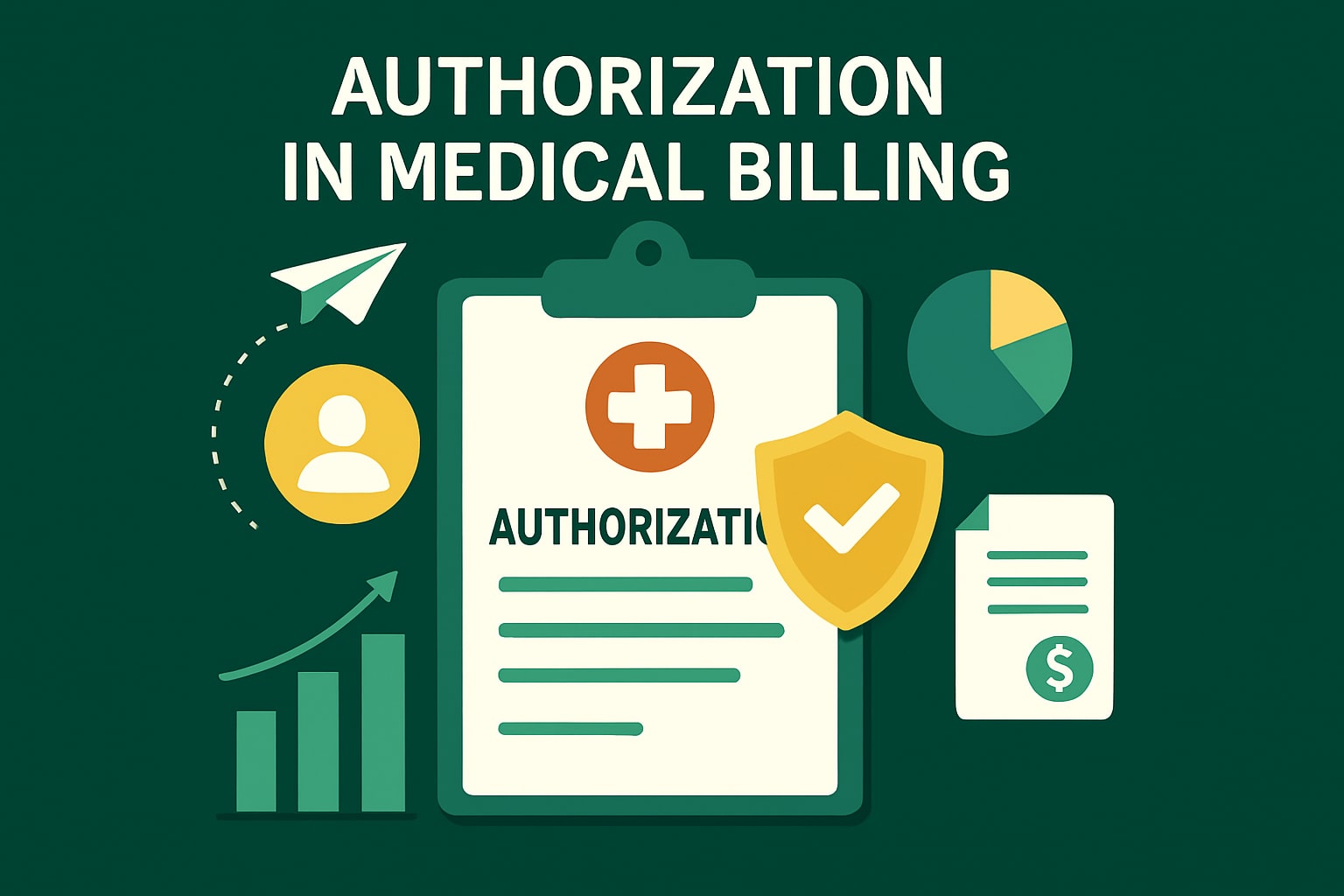
Did you know that authorization delays can cost healthcare organizations millions each year and directly impact patient care? In 2026, authorization in medical billing remains a complex challenge for providers, as payer requirements continue to evolve. Navigating this process is crucial not only for reducing claim denials but also for improving patient satisfaction and financial performance. This guide delivers expert insights, current best practices, and actionable strategies to help providers, billing professionals, and healthcare administrators master the entire authorization workflow. Ready to take control? Dive in for practical solutions and the latest trends shaping medical billing this year.

Understanding Authorization in Medical Billing

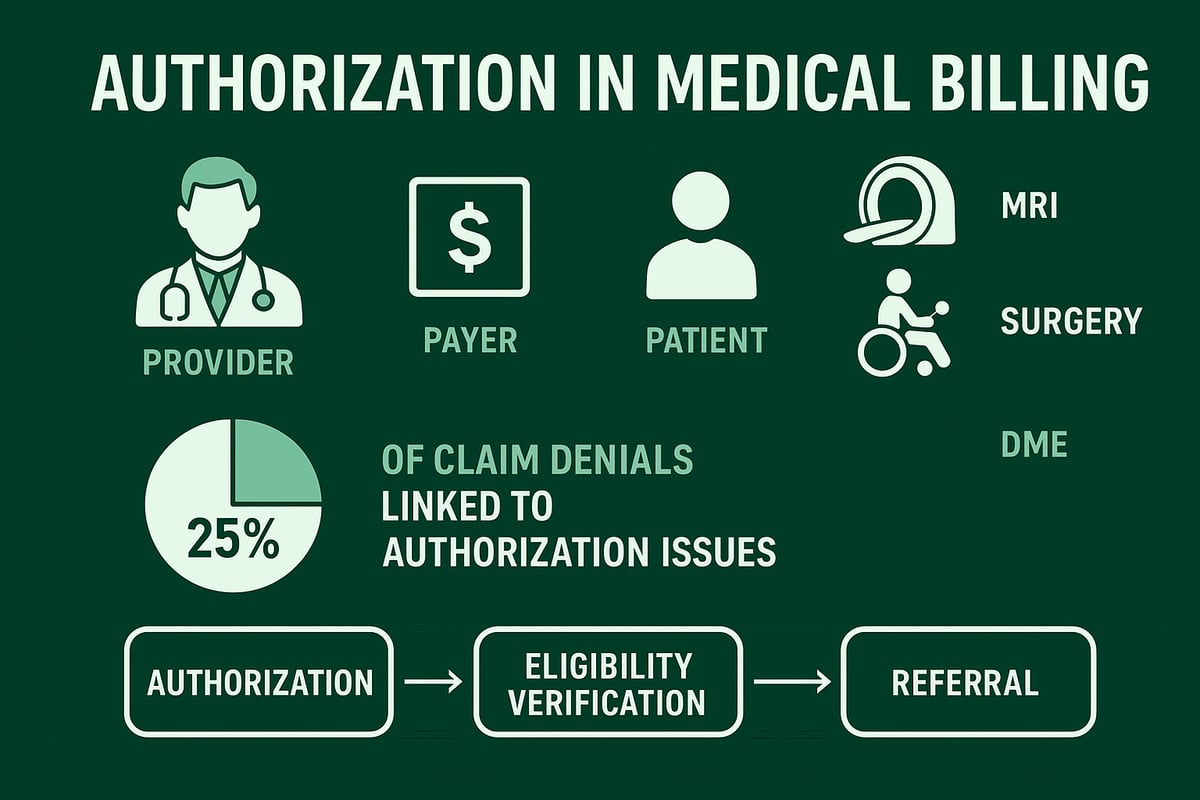
Authorization in medical billing is a formal process where healthcare providers obtain approval from payers before delivering specific medical services. This step is distinct from eligibility verification, which confirms a patient’s coverage, and from referrals, which are recommendations from a primary care provider for specialist care. Payers require authorization to manage utilization and control costs, ensuring only medically necessary procedures are performed. This process directly affects patient access to care and provider reimbursement, especially for high-value services like MRIs or surgeries. In fact, up to 25% of claim denials are linked to authorization issues, making it critical to understand and optimize this workflow. For a deeper dive into how this process works, visit the Prior authorization services overview.

Understanding Authorization in Medical Billing

What is Authorization?

Authorization in medical billing refers to the payer’s approval required before a provider delivers certain healthcare services. Unlike eligibility verification, which checks if a patient has active coverage, or a referral, which is a primary provider’s recommendation, authorization is about getting payer consent for specific procedures. Payers implement this step to ensure utilization management and cost containment. Without proper authorization, patients may face barriers to care, and providers risk not being reimbursed. For example, a patient needing an MRI or elective surgery often requires pre-approval. With up to 25% of claim denials tied to authorization in medical billing, mastering this process is vital.

Key Purposes and Benefits

The primary purpose of authorization in medical billing is to prevent unnecessary or duplicative services. It also helps verify medical necessity, especially for costly treatments. By ensuring that only appropriate care is delivered, payers can manage risk and reduce overall healthcare spending. For providers, this process offers financial protection from uncompensated care by clarifying coverage before services are rendered. Additionally, it enhances patient understanding of what is covered, helping to avoid surprise bills. Ultimately, effective authorization in medical billing promotes accountability and transparency for all parties involved.

Types of Services Commonly Requiring Authorization

Certain healthcare services almost always require authorization in medical billing due to their complexity or cost. These include inpatient admissions, extended hospital stays, and advanced imaging such as MRI, CT, and PET scans. Durable medical equipment (DME) and high-cost specialty drugs also fall into this category. Surgeries, complex outpatient procedures, behavioral health, and home health services often trigger the need for prior approval. Recognizing which services require authorization in medical billing helps providers avoid claim denials and streamline the patient care journey.

Authorization vs. Referral vs. Eligibility Verification

Understanding the differences between authorization in medical billing, referrals, and eligibility verification is essential for clean claims. Eligibility verification confirms a patient’s active coverage and plan details. A referral is a primary care provider’s recommendation for specialist care, often needed in HMO or POS plans. Authorization, on the other hand, is payer approval for a specific service. Confusing these steps can lead to denied claims and delayed care.

Process Purpose Example
Eligibility Verification Confirm coverage Checking insurance status
Referral PCP recommends specialist PCP refers to cardiologist
Authorization Payer approves service Pre-approval for MRI

Integrating all three steps in authorization in medical billing ensures compliance and improves reimbursement outcomes.

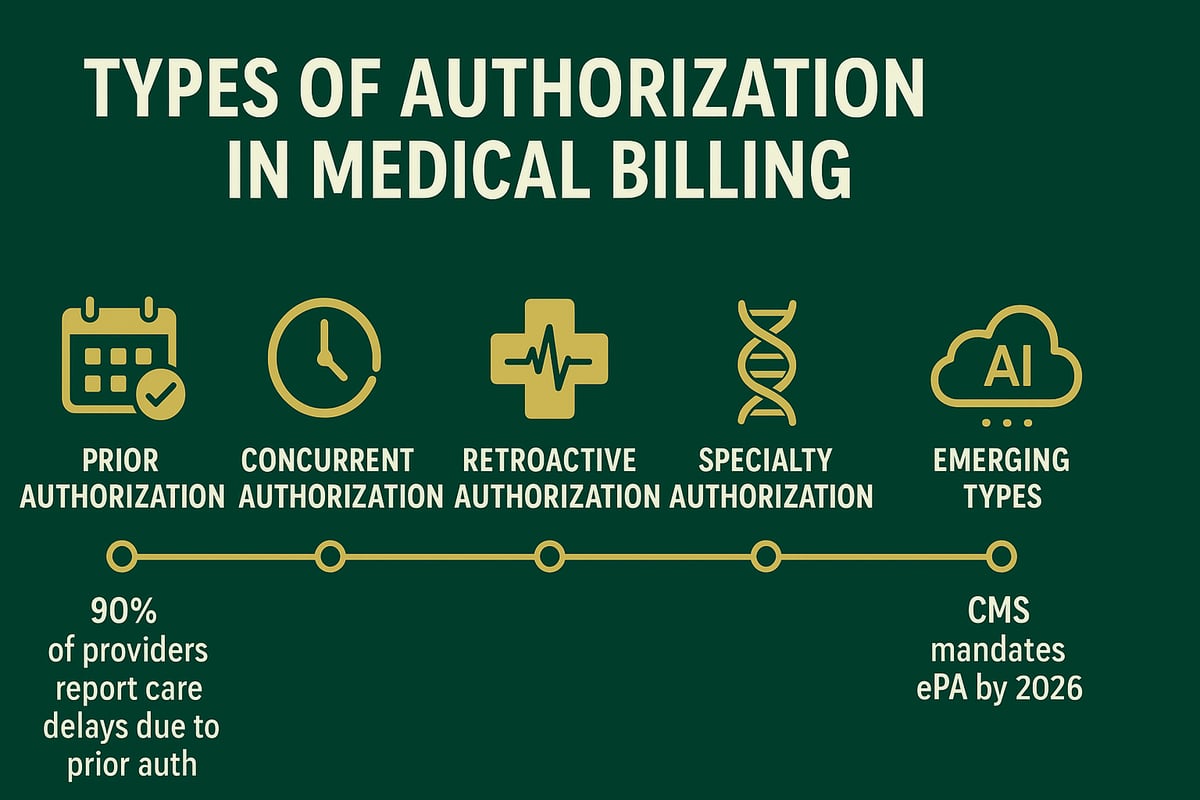
Types of Authorization in Medical Billing

Navigating the landscape of authorization in medical billing is crucial for ensuring timely care, minimizing denials, and maintaining compliance in 2026. Each type of authorization serves a distinct role, reflecting the complexity of payer requirements and the evolving nature of healthcare services.

Types of Authorization in Medical Billing

Prior Authorization (Pre-Authorization)

Prior authorization in medical billing is a process where providers obtain approval from payers before delivering specific services or treatments. This type of authorization is most commonly required for elective surgeries, high-cost medications, and advanced imaging procedures. For example, a provider must secure prior authorization before administering biologic drugs or scheduling non-urgent orthopedic surgery.

The process typically involves submitting detailed clinical documentation and waiting for payer review, which may take 24 to 72 hours. According to the AMA, over 90% of providers experience care delays due to prior authorization requirements. Missing or incorrect information can result in denials, so integrating robust workflows is essential for success in authorization in medical billing.

Concurrent Authorization

Concurrent authorization in medical billing applies when ongoing approval is necessary during a patient’s course of treatment. This is especially relevant for extended inpatient hospitalizations or long-term therapies, such as rehabilitation or chemotherapy. Providers regularly submit updates and clinical information to justify continued services.

If concurrent authorization lapses or is not properly managed, care interruptions and reimbursement issues may arise. For instance, if a hospital stay extends beyond the originally approved days, the provider must seek additional concurrent authorization in medical billing to avoid claim denials and ensure uninterrupted patient care.

Retroactive Authorization

Retroactive authorization in medical billing refers to obtaining payer approval after services have already been rendered. This is typically allowed in emergencies or when coverage transitions prevent timely prior authorization. Providers must submit comprehensive documentation explaining the urgent need for care and the circumstances that prevented advance approval.

A common scenario involves emergency surgery performed without prior authorization due to immediate risk to the patient. Retroactive authorization in medical billing requires strict adherence to payer timelines and policies, as delayed or insufficient documentation can lead to payment denials and financial losses for both providers and patients.

Specialty Authorization

Specialty authorization in medical billing focuses on services that require advanced expertise or unique treatment protocols, such as oncology, cardiology, or fertility care. These authorizations often involve complex clinical reviews and additional layers of documentation, including genetic testing results or prior treatment records.

The interplay between referrals and specialty authorization in medical billing is critical, as many payers require both a referral from a primary care provider and a separate authorization for the specialist’s intervention. For example, obtaining specialty authorization is essential for approval of targeted cancer therapies, ensuring appropriate and covered care.

Referral Authorization

Referral authorization in medical billing is initiated by a primary care provider (PCP) when a patient needs to see a specialist. This process is common in Health Maintenance Organization (HMO) and Point of Service (POS) plans, where network rules are strict. The PCP submits a referral request, and once approved, the patient can access specialist services.

Properly documenting referral authorization in medical billing is crucial; errors or omissions can result in denied claims or increased out-of-pocket costs for patients. For instance, a dermatology consult for a suspicious skin lesion requires both a PCP referral and payer authorization to guarantee coverage and compliance.

Other Emerging Types (2026 Trends)

In 2026, digital and automated solutions are reshaping authorization in medical billing. Real-time electronic prior authorization (ePA) platforms, AI-driven workflows, and payer portals are reducing manual effort and speeding up approvals. Telehealth and virtual care services have prompted new authorization rules, with some payers now offering instant decisions for remote behavioral health visits.

Regulatory changes, such as the CMS Interoperability and Prior Authorization Final Rule, mandate greater transparency and faster turnaround times for authorization in medical billing. The widespread adoption of ePA and automation is expected to streamline processes and improve outcomes for both providers and patients.

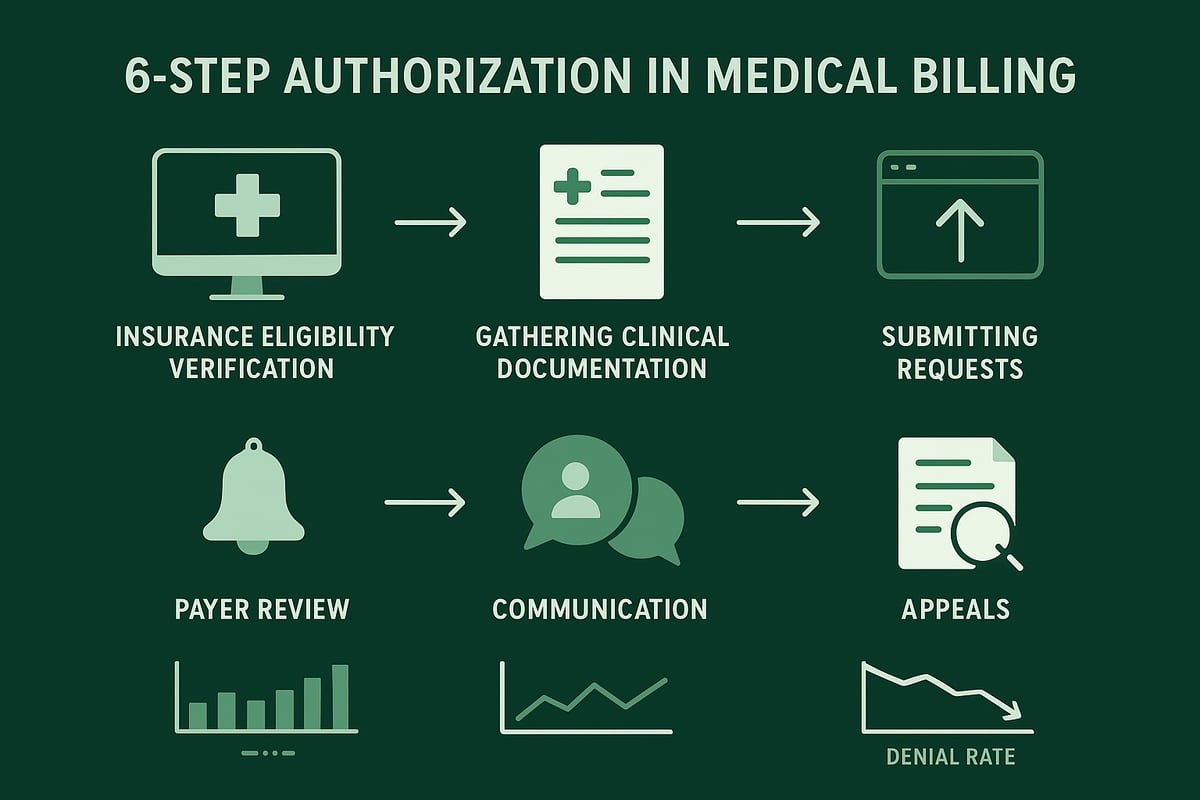
Step-by-Step Authorization Workflow in 2026

Navigating the authorization in medical billing workflow in 2026 requires a precise, step-by-step approach. Each stage is vital to ensure clean claims, reduce denials, and support timely patient care. Below, we break down the modern workflow, highlighting best practices and real-world examples at every phase.

Step-by-Step Authorization Workflow in 2026

Step 1: Insurance Eligibility Verification

The first step in authorization in medical billing is verifying insurance eligibility. This process confirms the patient’s active coverage and identifies which services require prior approval. Accurate eligibility checks prevent costly mistakes and claim denials.

Modern practices rely on integrated EHR tools and payer portals for real-time eligibility confirmation. For example, automated systems can flag services needing authorization during appointment scheduling. For more details on optimizing this step, review Eligibility verification best practices.

A thorough eligibility verification at this stage lays the foundation for smooth authorization in medical billing throughout the rest of the process.

Step 2: Gathering Clinical Documentation

The second step of authorization in medical billing involves collecting all necessary clinical documentation. This includes provider notes, lab results, imaging studies, and any evidence supporting medical necessity.

Each payer has specific requirements, so documentation must match their criteria exactly. Missing or incomplete records often lead to delays or outright denials. For example, durable medical equipment requests may need recent test results and detailed physician notes.

Timely and accurate documentation ensures that authorization in medical billing requests are processed efficiently and meet payer expectations.

Step 3: Submitting Authorization Requests

Submitting the authorization in medical billing request comes next. Practices use various channels such as online portals, fax, phone, or clearinghouses, but digital submissions are increasingly standard in 2026.

Standard forms must be filled out completely, including all relevant patient, provider, and clinical details. Submitting through a payer’s digital portal often speeds up review times. For example, many payers now offer real-time status updates for submitted requests.

Careful attention to submission details reduces errors and supports a successful authorization in medical billing outcome.

Step 4: Payer Review and Response

After submission, payers conduct a review as part of the authorization in medical billing workflow. Depending on service complexity, review timelines may range from 24 to 72 hours.

Payers respond with an approval, denial, or request for more information. Tracking the status of each request is essential, especially for concurrent authorizations, such as ongoing hospital stays.

Prompt follow-up on payer communications helps avoid unnecessary care delays and keeps the authorization in medical billing process on track.

Step 5: Communicating Outcomes to Patients and Providers

The next essential step in authorization in medical billing is to communicate outcomes promptly. Clinical teams and patients must be notified as soon as a decision is made.

If an authorization is denied or partially approved, providers should discuss alternative options or the next steps. All communications should be documented for compliance. For example, notifying a patient about a denied specialty drug allows for timely appeals or care adjustments.

Clear and timely communication supports transparency and patient satisfaction during the authorization in medical billing journey.

Step 6: Appeals and Reconsiderations

If a request is denied, the final step in authorization in medical billing is the appeals process. Providers must gather additional documentation, address payer feedback, and submit appeals within specified timelines.

Understanding escalation paths and preparing comprehensive appeal packets are crucial for overturning denials. For example, appealing a denied pre-authorization for surgery may require medical literature and updated clinical notes.

A structured approach to appeals not only recovers lost revenue but also strengthens future authorization in medical billing efforts.

Common Authorization Challenges and How to Overcome Them

Healthcare organizations continue to face significant hurdles with authorization in medical billing, affecting both operational efficiency and patient care. Understanding the most common challenges and how to address them is critical for providers aiming to reduce denials, accelerate reimbursements, and enhance patient satisfaction.

Frequent Reasons for Authorization Denials

Authorization in medical billing is particularly prone to denials due to a range of preventable errors. The most frequent reasons include:

  • Submission of incomplete or incorrect patient or procedural information.
  • Absence of required clinical documentation to establish medical necessity.
  • Failure to follow payer-specific criteria or using outdated forms.
  • Use of out-of-network providers for services that require pre-authorization.
  • Expired or missing authorizations at the time of claim submission.

Each of these issues can result in payment delays or outright claim denials. Proactive review of authorization in medical billing requirements and regular audits of submission processes are essential to minimize these avoidable errors.

Administrative and Workflow Bottlenecks

Many practices struggle with internal workflow challenges that hinder effective authorization in medical billing. Common bottlenecks include:

  • Insufficient staff training on payer requirements and evolving policies.
  • High turnover among billing or authorization teams, leading to knowledge gaps.
  • Heavy reliance on manual tracking systems such as spreadsheets or paper logs.
  • Slow communication between clinical staff and billing teams, causing missed deadlines.

To address these challenges, organizations should invest in staff education and adopt automated tracking tools that streamline the authorization in medical billing process. This not only reduces errors but also ensures timely follow-up on outstanding requests.

Payer-Specific Complexities

No two payers are alike when it comes to authorization in medical billing. Providers must navigate:

  • Different documentation requirements and medical necessity criteria for each insurance plan.
  • Frequent changes in payer policies, requiring constant vigilance and updates.
  • Multiple online portals and submission systems, each with unique processes and timelines.

For example, the steps to obtain an authorization for a Medicare Advantage patient may differ significantly from those for a commercial insurance plan. Misunderstanding these nuances can lead to avoidable denials and increased administrative burden. Maintaining a payer matrix and regular policy reviews can help standardize processes and reduce confusion.

Patient Impact and Satisfaction Risks

When authorization in medical billing is delayed or denied, the effects ripple out to patients. Common risks include:

  • Delays in scheduling or receiving medically necessary treatments.
  • Unexpected out-of-pocket expenses if services are denied after delivery.
  • Negative experiences that can impact satisfaction scores and patient retention.

A delay in cancer therapy, for instance, due to an authorization denial can have serious health and emotional consequences for patients. Clear communication with patients about authorization status and coverage expectations is crucial for fostering trust and satisfaction.

Best Practices for Reducing Denials and Delays

Implementing structured workflows and proactive communication can dramatically improve outcomes in authorization in medical billing. Key best practices include:

  • Using standardized checklists to ensure all required data is collected before submission.
  • Conducting regular training sessions for staff on payer updates and documentation standards.
  • Leveraging technology for automated reminders, status tracking, and integrated EHR workflows.
  • Establishing open lines of communication with payers and patients to resolve issues quickly.

Industry data shows that denial rates can drop by 30% when robust pre-authorization processes are in place. For more targeted strategies, explore these denial management strategies to further minimize authorization-related claim denials and optimize your revenue cycle.

Regulatory Updates and Payer Policy Changes for 2026

Navigating regulatory changes is critical for anyone managing authorization in medical billing. The landscape in 2026 is rapidly evolving, with new federal mandates, payer-driven reforms, and industry-wide technological upgrades shaping how practices secure approvals and minimize claim denials.

CMS and Federal Regulations

For 2026, CMS has finalized rules requiring greater transparency and faster turnaround times for authorization in medical billing. These regulations mandate electronic prior authorization (ePA) for Medicare, Medicaid, and many commercial plans. Practices must ensure all requests and responses are transmitted electronically, reducing paper-based delays.

The new CMS rules establish maximum response windows, often 72 hours for urgent requests, which directly impacts operational workflows. Practices should familiarize themselves with these requirements and monitor updates closely. For a deeper look at how these federal changes will improve prior authorization processes, see CMS Finalizes Rule to Expand Access to Health Information.

Failure to comply with these standards can result in delayed payments and increased denials. Ensuring that your workflow aligns with federal requirements is essential for success with authorization in medical billing.

Major Payer Policy Shifts

Private payers are also shifting their approach to authorization in medical billing. Many insurers are streamlining or even eliminating prior authorization requirements for select services, particularly preventive care and routine screenings. This trend is designed to reduce administrative burden for providers and improve patient access.

Payers are investing in automated approval systems and exploring new policies for telehealth and remote care, reflecting lessons learned during the pandemic. For example, some insurers have begun waiving authorization for virtual visits and behavioral health services, a significant change from previous years.

Staying informed about these evolving payer-specific requirements is crucial for anyone managing authorization in medical billing. Regularly check payer bulletins and participate in industry forums to stay ahead of policy changes.

Industry Standards and Best Practices

Industry groups such as the AMA and MGMA are leading efforts to standardize authorization in medical billing. Widespread adoption of electronic data interchange (EDI) and artificial intelligence is making real-time approvals more common. These standards help reduce manual errors, speed up approvals, and improve the overall efficiency of revenue cycle management.

AI-powered systems can flag incomplete requests, ensure documentation meets payer criteria, and track status updates automatically. Following best practices, like using certified EHR integrations and standardized checklists, helps practices adapt to new industry norms for authorization in medical billing.

Ongoing collaboration between providers, payers, and technology vendors is accelerating these improvements, making compliance less burdensome and more transparent.

Preparing Your Practice for 2026 Changes

To stay compliant with the latest requirements for authorization in medical billing, practices should conduct regular audits of their workflows. Upgrading to EHR and billing systems that support ePA is now essential. Staff training on new payer portals and federal rules should be a priority.

Create a compliance checklist that includes documentation standards, eligibility verification, and timely submission protocols. Engage in ongoing education through webinars and professional associations to keep your team informed about regulatory updates.

By proactively preparing, you can ensure your practice meets 2026’s regulatory demands and maintains a high standard for authorization in medical billing.

Technology and Automation in Authorization Management

Staying ahead in authorization in medical billing depends on embracing technology and automation. As digital solutions mature, providers can streamline workflows, reduce errors, and respond faster to payer requirements. Technology not only accelerates routine tasks but also supports compliance, data security, and continual performance improvement.

Digital Authorization Platforms and Tools

Modern digital platforms are transforming authorization in medical billing. Electronic prior authorization (ePA) solutions integrate seamlessly with EHR and practice management systems, allowing staff to submit requests and receive real-time updates without leaving their workflow. These platforms reduce manual data entry, minimize errors, and speed up approvals.

Providers benefit from automated reminders, standardized forms, and built-in payer rules. Many payers now offer online portals for faster submissions. Industry momentum is building, as health insurers work to ease prior authorization requirements through streamlined digital processes and greater transparency. Adopting these tools is essential for efficient authorization in medical billing as payer requirements evolve.

AI and Machine Learning Applications

Artificial intelligence is optimizing authorization in medical billing by automating complex, repetitive tasks. AI-driven platforms use predictive analytics to flag which services require authorization, extract relevant clinical data, and auto-complete forms with high accuracy. Machine learning models learn from historical data to identify patterns, helping staff prioritize high-risk or time-sensitive cases.

These tools significantly reduce processing time. In fact, AI-powered solutions can cut authorization turnaround by 40 percent, freeing up staff for more value-added work. As AI continues to develop, it will become a cornerstone of efficient authorization in medical billing, helping organizations stay ahead of payer changes.

Data Security and HIPAA Compliance

As practices digitize authorization in medical billing, safeguarding patient data is non-negotiable. Platforms must ensure secure data transmission, robust encryption, and strict access controls. HIPAA and state privacy rules dictate how information is stored, shared, and audited across systems.

Best practices include using cloud-based solutions with end-to-end encryption, regular user access reviews, and comprehensive audit trails. By prioritizing security, providers protect both their patients and their reputation. Secure technology is foundational for successful authorization in medical billing, especially as automation increases data exchange.

Measuring ROI and Performance

To maximize the value of technology in authorization in medical billing, organizations must track key performance indicators. Metrics such as approval rates, turnaround times, and denial rates provide actionable insights. Monthly dashboards and benchmarking help practices identify bottlenecks and areas for improvement.

Leveraging analytics, revenue cycle teams can refine workflows, reduce claim denials, and boost financial outcomes. For more on how technology and denial management drive results, see improving cash flow with denial management. Continuous measurement ensures technology investments translate to tangible gains in authorization in medical billing.

Training, Outsourcing, and Expert Support for Authorization Success

Building a strong foundation for authorization in medical billing depends on having the right expertise, tools, and support systems in place. As payer rules and technologies evolve, investing in staff development and strategic partnerships can transform your revenue cycle performance.

Building an Expert Authorization Team

A dedicated and knowledgeable team is essential for successful authorization in medical billing. Key roles include authorization specialists, billers, and clinical reviewers, each bringing unique expertise to the process. Certification and ongoing education keep staff current with the latest payer requirements and regulatory changes.

Cross-training enables coverage during absences, ensuring no interruption in workflow. Practices that invest in certified staff often see a measurable reduction in claim denials and faster turnaround times. Consider regular in-service sessions and workshops to keep your team sharp and compliant.

Role Key Responsibilities
Authorization Specialist Request submission, payer follow-up
Biller Claims integration, documentation
Clinical Reviewer Medical necessity evaluation

When to Outsource Authorization Management

For many organizations, the demands of authorization in medical billing can exceed in-house capacity. Outsourcing becomes a strategic option when high volumes, complex specialty services, or rapid payer changes create administrative burdens.

Outsourcing offers scalability, access to specialized expertise, and advanced technology platforms that streamline workflows. It helps reduce errors, minimize delays, and improve denial management. Evaluate potential vendors by their compliance standards, transparent reporting, and proven results with practices similar to yours.

Practices with frequent staff turnover, specialty authorizations, or rapid growth often achieve greater efficiency and cost savings through an experienced outsourcing partner.

Partnering with Greenhive Billing Solutions for Authorization Excellence

Partnering with Greenhive Billing Solutions elevates your approach to authorization in medical billing through end-to-end management and technology-driven workflows. Greenhive’s experts understand payer-specific requirements for specialty authorizations and proactively prevent denials.

Comprehensive Guide to Authorization in Medical Billing 2026 - Partnering with Greenhive Billing Solutions for Authorization Excellence

Their integrated, HIPAA-compliant systems deliver fast, accurate submissions and real-time tracking for every request. Transparent communication with your clinical and billing teams ensures nothing falls through the cracks. With Greenhive, practices nationwide report reduced denial rates, improved cash flow, and higher patient satisfaction scores.

Choosing the right partner can be a catalyst for sustained success and compliance in today’s complex landscape.

Continuous Improvement and Staying Informed

Success in authorization in medical billing requires ongoing vigilance. Regularly update your team on payer policies, regulatory changes, and best practices. Conduct process audits and leverage resources from professional associations like CMS and AMA to stay ahead of the curve.

As you’ve seen throughout this guide, mastering authorization in medical billing can make a significant difference in reducing denials and ensuring faster reimbursements for your practice. If you’re ready to streamline your workflows, stay compliant with evolving regulations, and boost your financial performance, you don’t have to do it alone. Let’s work together to build a customized solution that meets your unique needs and supports your team every step of the way.
Book Your Free Consultation and discover how Greenhive Billing Solutions can help you take the guesswork out of authorization management.

Revenue Codes in Medical Billing

October 6, 2025

Revenue codes are numeric codes that identify services and accommodations provided to patients. They originated with Medicare and now apply across hospitals and healthcare facilities. Each code indicates the type of service and the location where it occurred. 

Revenue codes include three or four digits. These digits hold information about medical care, equipment use, and the treatment context. Revenue codes must align with procedure codes, such as CPT or HCPCS, for insurance claims to be approved. Without correct revenue codes, claims risk denial and payment delays. 

Revenue codes work with other universal codes. ICD-10 codes describe diagnoses. CPT and HCPCS codes describe procedures and supplies. Revenue codes describe where and under what circumstances a service occurred. This combination ensures claims are accurate and acceptable to insurers. 

The Role of Revenue Codes in Automated Medical Billing

Revenue codes group charges on the UB-04 claim form. They specify where a service occurred and whether equipment is used in the facility or taken home. Revenue codes differentiate costs for the same procedure performed in different locations. 

Example: A blood transfusion performed in an emergency room uses revenue code 0450. The same transfusion in a treatment room uses code 0761. Procedure codes remain the same, but revenue codes change according to location. 

Example: CPT 12001, simple repair of superficial wounds, performed in an operating room uses revenue code 0360. In the emergency room, it uses 0450. In a treatment room, it uses 0761. These distinctions affect reimbursement. 

Common Revenue Codes for Accurate Medical Billing

Intensive Care Unit

  • 200 General
  • 201 Surgical
  • 202 Medical
  • 203 Pediatric
  • 204 Psychiatric
  • 206 Intermediate ICU
  • 207 Burn Care
  • 208 Trauma
  • 209 Other

Pharmacy

  • 250 General
  • 251 Generic Drugs
  • 252 Non-generic Drugs
  • 253 Take Home Drugs
  • 254 Drugs incidental to Diagnostics
  • 255 Drugs incidental to Radiology
  • 256 Experimental Drugs
  • 257 Non-prescription
  • 258 IV Solutions
  • 259 Other Pharmacy

Physical Therapy

  • 420 General
  • 421 Visit Charge
  • 422 Hourly Charge
  • 423 Group Rate
  • 424 Evaluation or Reevaluation
  • 429 Other Physical Therapy 

Emergency Room

  • 450 General
  • 451 EMTALA Emergency Screening
  • 452 ER Beyond EMTALA Screening
  • 456 Urgent Care
  • 459 Other Emergency Room

Clinic

  • 510 General
  • 511 Chronic Pain Center
  • 512 Dental Clinic
  • 513 Psychiatric
  • 514 OB-GYN
  • 515 Pediatric
  • 516 Urgent Care Clinic
  • 517 Family Practice Clinic519 Other Clinic

Revenue codes ensure claims reflect actual services. They provide clarity on location, type, and context of treatment. Insurance companies rely on these codes to calculate reimbursement. Errors in revenue codes frequently lead to denied claims and delayed payments. 

Revenue codes are maintained by the National Uniform Billing Committee, founded in 1975. The committee oversees forms and coding standards for medical claims in the United States. Accurate coding supports compliance and financial accuracy.

The Impact of Revenue Codes on the Revenue Cycle

Revenue codes influence claim approval speed and reimbursement accuracy. Accurate coding reduces administrative burden, prevents denials, and improves revenue flow. They are critical for coding teams to understand and apply consistently. Documentation, training, and cross-checking codes with procedures ensure claims are precise. 

Using correct revenue codes aligns the coding process with payer requirements. This alignment strengthens the revenue cycle, minimizes errors, and allows healthcare providers to focus on patient care. Every coding team benefits from structured training and detailed documentation on revenue code usage. 

Revenue codes are a fundamental component of medical billing. They specify services, locations, and contexts. They work with procedure and diagnosis codes to produce complete, accurate claims. Understanding and applying revenue codes is essential for timely reimbursement, compliance, and operational efficiency in healthcare billing.

Types of Modifiers in Medical Billing 

October 2, 2025

When I first started working in revenue cycle management, one of the biggest challenges I noticed was how often claims were delayed or denied because of modifiers. These two-digit codes may seem small, but they carry a lot of weight in how a claim is processed. Over the past five years, I’ve worked closely with practices to improve reimbursements, and one consistent lesson has been this: if modifiers are not used correctly, you will see avoidable denials. 

In this blog, I want to share a practical breakdown of the types of modifiers in medical billing, along with examples from real-world scenarios that providers and billing teams deal with every day.

What Exactly Are Modifiers?

Think of a CPT or HCPCS code as the headline of a story. It tells payers what procedure or service was performed. But sometimes the headline isn’t enough. That’s where modifiers step in, they add the important details that explain how, where, or under what circumstances the service was provided. 

For example, if a physician performs two procedures during one visit, you can’t just submit the codes as-is. Without the right modifier, payers might bundle them together and pay less than what’s owed. The right modifier makes sure the claim tells the full story.

The Main Types of Modifiers You’ll See in Billing

Over the years, I’ve noticed that most coding errors come from not knowing which type of modifier applies. Let’s walk through the main categories:

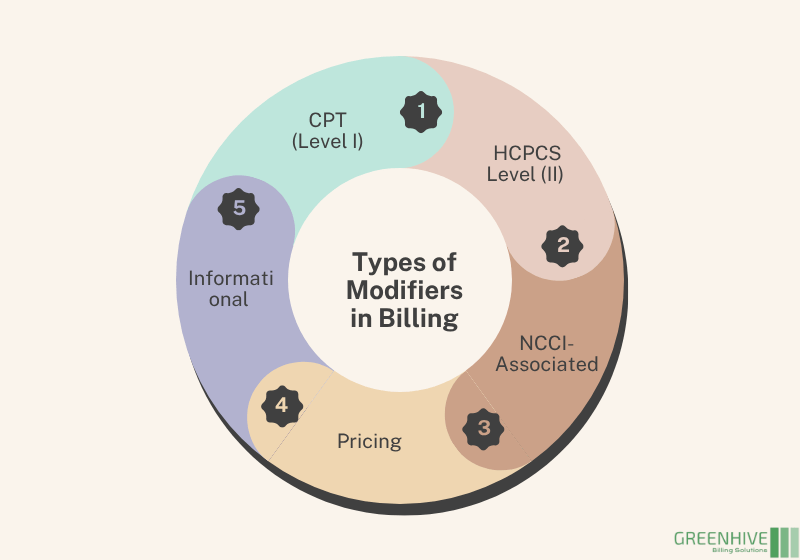
1. CPT Modifiers (Level I)

These are numeric modifiers created by the AMA. They’re the ones you’ll probably use most often in practice. 

  • Modifier 25 – A common one in clinics. It shows that an E/M service was provided separately from a procedure on the same day.
  • Modifier 51 – Used when multiple procedures are done in the same session. 

When I worked with a family practice, we saw denials drop significantly after tightening up the use of Modifier 25. 

2. HCPCS Level II Modifiers

These are alphanumeric and often relate to equipment, supplies, or anatomical sites.

  • LT (Left Side) and RT (Right Side) – mark which side of the body was treated.
  • E1–E4 – specify eyelids (upper left, lower left, etc.). 

I’ve seen these especially important in ophthalmology and orthopedics, where side specificity makes all the difference. 

3. NCCI-Associated Modifiers

The National Correct Coding Initiative prevents “unbundling” of services. But sometimes procedures that usually bundle together truly are distinct. That’s when modifiers step in. 

  • Modifier 59 – Distinct Procedural Service.
  • Newer subsets like XE, XS, XP, XU are used for even more clarity. 

I always remind billing teams: Modifier 59 is one of the most audited, so it should only be used when documentation fully supports it.

4. Pricing Modifiers

These directly affect how much reimbursement you get. 

  • Modifier 26 – Professional component (e.g., interpreting a test).
  • Modifier TC – Technical component (e.g., equipment and staff). 

One imaging center I worked with had major payment delays because they weren’t distinguishing between 26 and TC correctly. Fixing that improved cash flow almost immediately.

5. Informational Modifiers

These don’t usually change payment but give payers important context. 

  • Modifier 24 – Unrelated E/M during a postoperative period.
  • Modifier 33 – Preventive services. 

Even if they don’t impact pricing, they help avoid extra documentation requests and reduce payer back-and-forth. 

Types of Modifiers in Billing

The Modifiers I See Most Often

In day-to-day billing, a handful of modifiers appear repeatedly. Here are the ones I usually train teams to pay the most attention to: 

  • 22 – Increased Procedural Service
  • 25 – Separate E/M Service
  • 26 / TC – Splitting professional and technical work
  • 50 – Bilateral Procedure
  • 51 – Multiple Procedures
  • 59 – Distinct Procedural Service

Get this right, and you’ll avoid a large percentage of common denials. 


Why Modifiers Matter So Much

For me, the importance of modifiers boils down to three things: 

  • Cleaner claims, fewer denials. Every correctly applied modifier is one less resubmission.
  • Proper reimbursement. Providers deserve to be paid for the full scope of services delivered.
  • Audit protection. Misused modifiers, especially 25 and 59, can trigger compliance red flags.

I’ve seen practices improve their bottom line significantly just by focusing on proper modifier use. It may feel like a small detail, but it’s one that directly impacts revenue. 

My Best Practices for Working with Modifiers

Here’s what I always recommend to the teams I work with: 

  1. Use official references – CPT Appendix A and HCPCS Level II are your guide.
  2. Stay current – Medicare and commercial payers update modifier rules frequently.
  3. Back everything with documentation – Never use a modifier without clinical support.
  4. Provide refresher training – Even experienced coders can fall into bad habits.
  5. Know payer-specific rules – Not all insurers treat modifiers the same. 

My Takeaway from Experience

After working in healthcare billing for years, I can say that understanding modifiers is one of the simplest ways to strengthen a revenue cycle. They may be just two characters long, but they make the difference between an underpaid claim and a fully reimbursed one. 

If you’re a provider or billing professional, I encourage you to take a closer look at how your team is using modifiers. In my experience, even a small adjustment here can make a noticeable improvement in cash flow and compliance. 

What Is a CPT Code for Insurance in Healthcare Claims

September 24, 2025

In my experience working with medical practices, one of the most common sources of delays and denials is misunderstanding CPT codes. CPT stands for Current Procedural Terminology. These five-digit codes describe the services and procedures you provide. Insurers use them to process claims and determine payment. Using the wrong code can delay payment and increase denials, affecting your practice revenue. 

I have seen firsthand how a clear understanding of CPT codes improves reimbursements and reduces back-and-forth with insurance companies. These codes create a uniform language between providers and insurers. They ensure accuracy for claims, compliance, and tracking of services. Every service you provide should have the correct CPT code. This code must align with ICD-10 codes to justify medical necessity. 

Types of CPT Codes

Not all CPT codes are the same. Understanding categories makes medical billing simpler and prevents claim errors. 

  • Category I: Standard procedures such as office visits, surgeries, radiology, and laboratory tests. Most coding occurs here.
  • Category II: Optional tracking codes for performance and quality measures. They do not replace Category I codes.
  • Category III: Temporary codes for new procedures or technologies. They collect data for assessment and evaluation.
  • PLA Codes: Proprietary laboratory tests approved by the FDA. These include advanced diagnostic tests and clinical diagnostic tests.

Each category updates regularly. Category I codes update annually. Category II updates three times per year. Category III updates twice per year. Using outdated codes leads to denied or delayed claims.

How CPT Codes Affect Your Practice Revenue

From my work with practices, I know that CPT codes directly affect revenue. Medicare sets baseline reimbursement. Commercial insurers often pay above that rate. Medicaid usually pays below. Understanding these differences allows you to forecast revenue and manage cash flow. 

For example:

  • Office visit, established patient (99213): $75 Medicare, $95 commercial, $65 Medicaid.
  • Surgical procedure code: $400 Medicare, $500 commercial, $350 Medicaid.

Incorrect coding reduces payment and triggers denials. Tracking codes and modifiers impacts revenue accuracy.

Key Obstacles in CPT Coding

I often see practices struggle with: 

  • Billing procedures together that cannot be combined
  • Missing or incorrect modifiers
  • Outdated codes after annual updates
  • Incorrect pairing with ICD-10 codes 

Addressing these issues improves claim acceptance and accelerates payment.

Practical Steps for Your Practice

Based on my experience helping practices: 

  • Keep your CPT codebooks updated every year
  • Assign trained staff to verify codes before submission
  • Track high-volume codes and reimbursement rates
  • Audit denied claims to identify patterns and prevent future errors 

Understanding CPT codes protects your practice revenue. It reduces administrative delays and allows your team to focus on patient care. Clear coding practices lead to smoother operations, fewer disputes with insurers, and faster reimbursement. 

CPT codes are more than numbers. They are a tool to manage revenue, maintain compliance, and ensure accurate claims processing. Treat them as a core part of your practice operations. From my perspective, mastering CPT codes is one of the most effective ways to keep a practice financially healthy while letting providers focus on what matters most, patient care.

Let’s identify where you’re losing revenue and show you how Greenhive can help.

Scroll to Top