
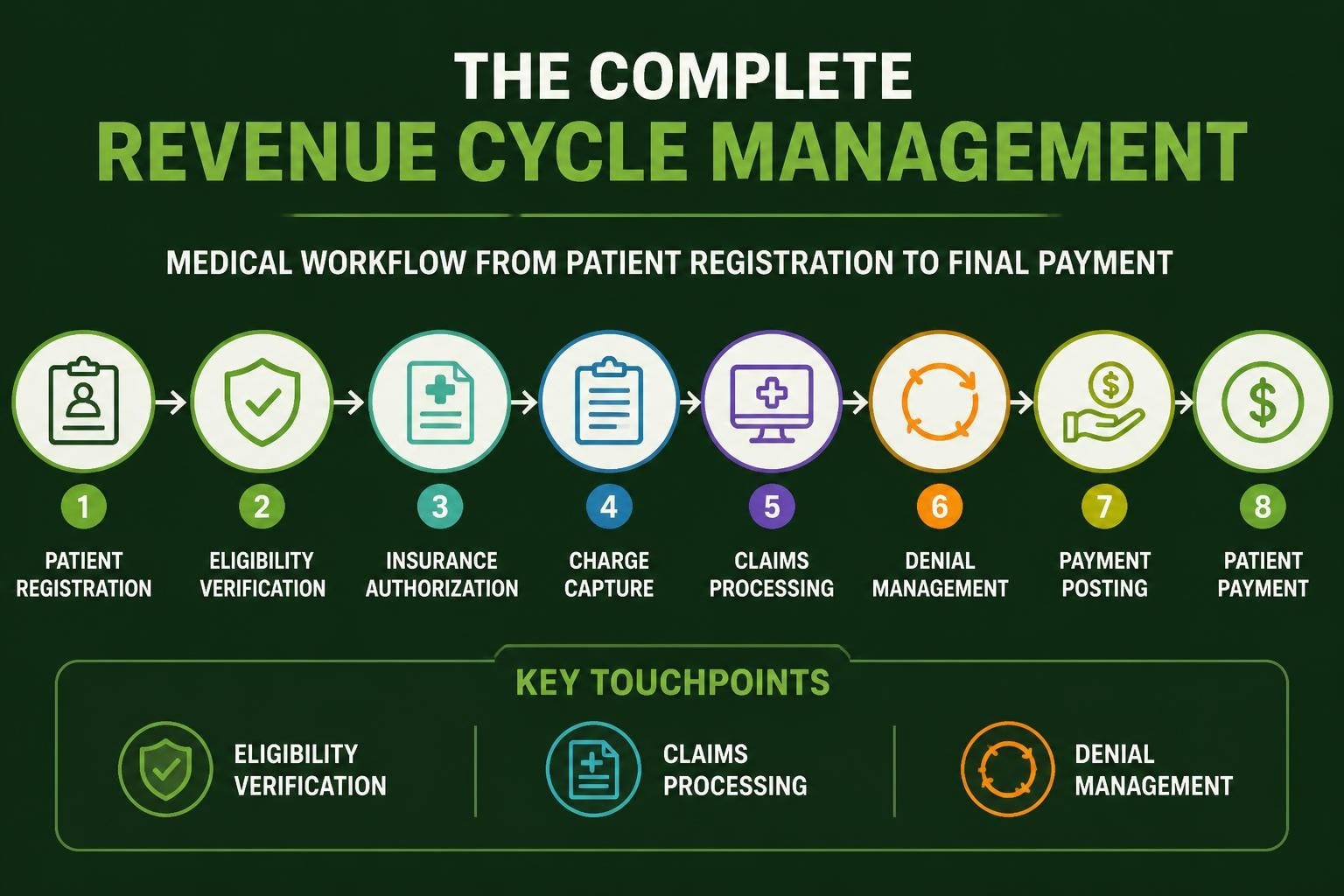
Healthcare providers face mounting pressure to maintain financial stability while delivering exceptional patient care. Revenue cycle management medical services have emerged as the critical infrastructure connecting clinical operations with financial performance. Understanding and optimizing this complex process determines whether practices thrive or struggle in today’s challenging healthcare landscape. From patient registration to final payment posting, every step requires precision, expertise, and strategic oversight.
Understanding Revenue Cycle Management Medical Fundamentals
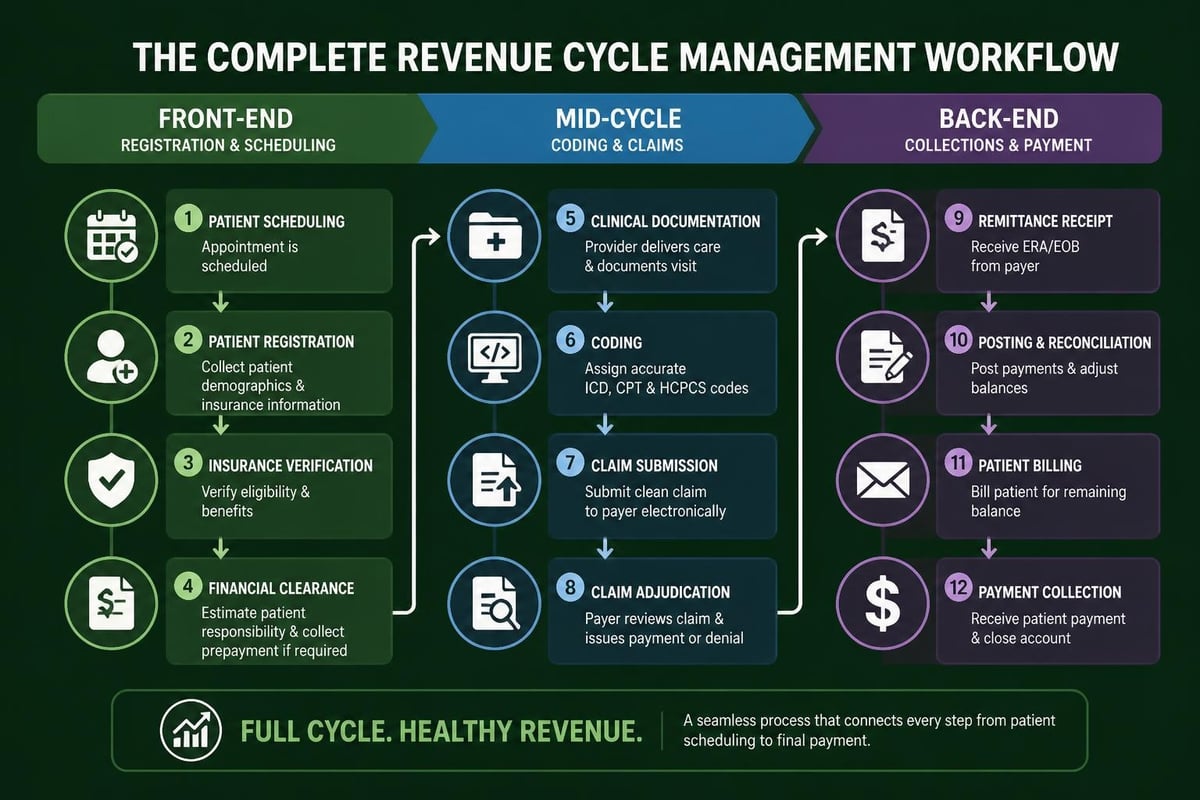
Revenue cycle management encompasses all administrative and clinical functions that contribute to capturing, managing, and collecting patient service revenue. This comprehensive process begins when patients schedule appointments and continues through the final payment reconciliation.
The scope of revenue cycle management medical operations extends far beyond simple billing. It integrates patient access functions, clinical documentation, charge capture, coding accuracy, claims submission, payment posting, and denial management into a cohesive system designed to maximize legitimate reimbursement while minimizing administrative burden.
Core Components of Medical Revenue Cycle Management
Successful revenue cycle management medical programs address several interconnected elements that work together to ensure financial health:
- Patient access and registration establishing accurate demographic and insurance information from the start
- Insurance verification confirming coverage, benefits, and authorization requirements before services
- Charge capture documenting all billable services accurately and completely
- Medical coding translating clinical documentation into standardized codes for billing
- Claims submission transmitting clean claims to payers through appropriate channels
- Payment posting recording and reconciling payments from all sources
- Denial management identifying, appealing, and preventing claim rejections
- Patient collections managing patient responsibility balances professionally and effectively
Each component requires specialized knowledge and dedicated attention. When one area underperforms, the entire revenue cycle suffers cascading effects that impact cash flow and profitability.
Financial Impact of Optimized Revenue Cycle Management Medical Services
Healthcare organizations that implement robust revenue cycle management medical strategies experience measurable improvements across multiple performance indicators. According to research published in PubMed exploring the art and science of RCM, effective revenue cycle oversight directly correlates with improved financial outcomes and operational efficiency.
Key Performance Metrics
Tracking the right metrics provides visibility into revenue cycle health and identifies opportunities for improvement. The following table outlines critical benchmarks:
| Metric | Industry Benchmark | Impact Area |
|---|---|---|
| Days in A/R | 30-40 days | Cash flow timing |
| First-pass claim rate | 95%+ | Clean claim submission |
| Denial rate | Below 5% | Revenue leakage |
| Collection rate | 95%+ | Revenue realization |
| Cost to collect | 2-4% of collections | Operational efficiency |
Organizations that fall outside these benchmarks often leave significant revenue on the table. Even small percentage improvements translate to substantial financial gains when applied across entire patient volumes.
Common Challenges in Revenue Cycle Management Medical Operations
Healthcare providers encounter numerous obstacles that disrupt smooth revenue cycle performance. Identifying these challenges represents the first step toward developing effective solutions.
Coding and documentation gaps create the foundation for many revenue cycle problems. When clinical documentation fails to support coded services or coders lack sufficient information to assign appropriate codes, claims face denials or downcoding that reduces reimbursement.
Insurance verification failures generate downstream complications throughout the revenue cycle. Services rendered without proper authorization or to patients with inactive coverage result in denied claims and difficult patient conversations about unexpected financial responsibility.
Payer-Related Complications
Working with multiple payers introduces complexity that strains internal resources:
- Varying submission requirements across different insurance companies and plan types
- Frequent policy changes that require constant monitoring and system updates
- Inconsistent denial reasons that complicate appeal processes and root cause analysis
- Complex fee schedules with different reimbursement rates for identical services
- Prior authorization requirements that delay services and create administrative burden
Denial management services specifically address these payer challenges by implementing systematic approaches to prevention, identification, and resolution of claim rejections.
Strategic Approaches to Revenue Cycle Management Medical Excellence
The American Medical Association emphasizes effective RCM strategies that focus on understanding payment mechanics, streamlining workflows, and monitoring performance indicators. Healthcare providers can adopt several proven strategies to enhance their revenue cycle operations.
Technology Integration
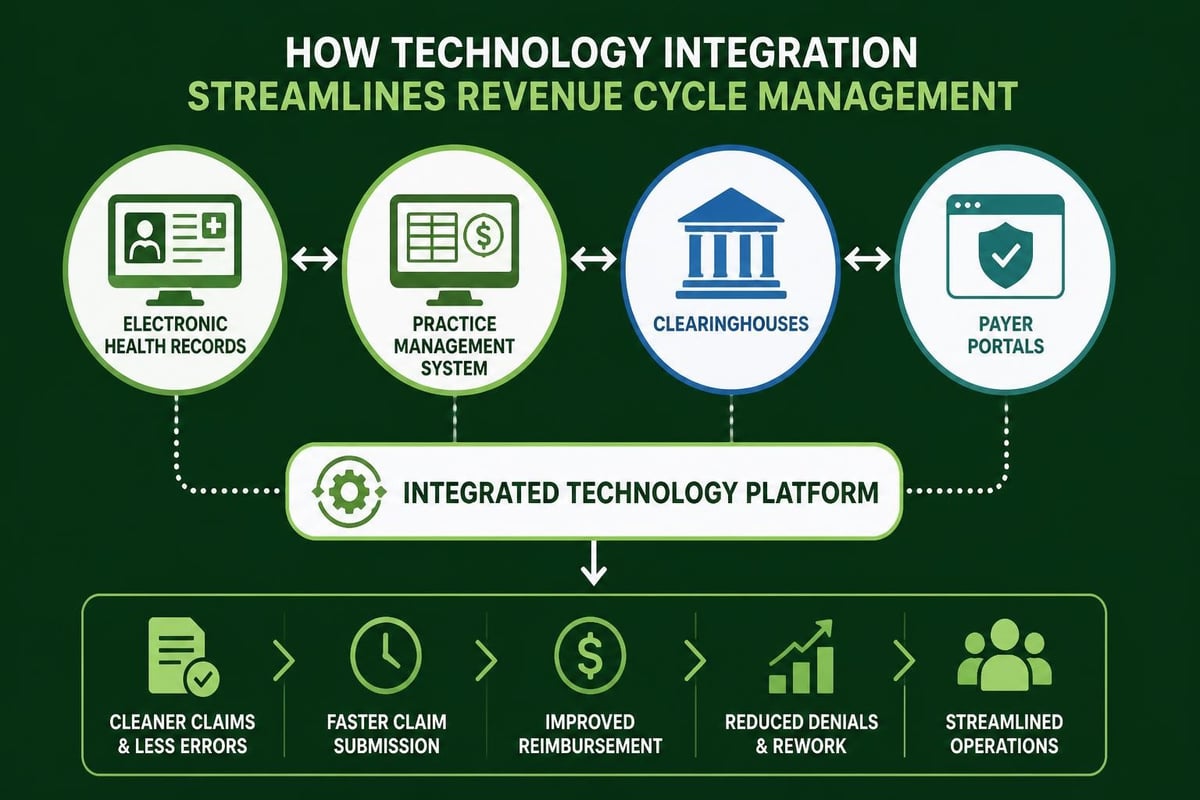
Modern revenue cycle management medical operations leverage technology platforms that automate routine tasks and provide real-time visibility into performance metrics. Electronic claims submission reduces processing time and accelerates payment cycles compared to paper submissions.
Practice management systems integrated with electronic health records eliminate duplicate data entry and ensure consistency between clinical documentation and billing information. This integration reduces errors while improving efficiency.
Automated eligibility verification tools check insurance coverage in real-time, preventing services to patients with inactive or terminated coverage. These systems also identify patient financial responsibility upfront, enabling transparent conversations about costs before services.
Staff Training and Development
Even the most sophisticated technology cannot compensate for undertrained staff. Investing in comprehensive training programs ensures team members understand both technical requirements and strategic importance of their roles.
Regular education on coding updates, payer policy changes, and regulatory compliance maintains staff competency as the healthcare landscape evolves. Cross-training team members across multiple revenue cycle functions builds organizational resilience and improves collaboration.
Front-End Revenue Cycle Management Medical Best Practices
Revenue cycle performance depends heavily on accuracy and completeness of information gathered during patient access functions. Front-end processes establish the foundation for all subsequent revenue cycle activities.
Registration Excellence
Collecting accurate demographic and insurance information represents the critical first step in revenue cycle management medical operations. Staff must verify patient identity, confirm current contact information, and obtain complete insurance details including policy numbers, group numbers, and subscriber information.
The following checklist ensures comprehensive patient registration:
- Verify patient identity using government-issued identification
- Confirm current address, phone number, and email contact information
- Photocopy both sides of insurance cards for all active coverage
- Collect guarantor information for minor patients or dependents
- Document emergency contact details and communication preferences
- Obtain necessary consents for treatment, billing, and information release
- Verify employer information when relevant for insurance coordination
Eligibility verification services streamline this critical front-end function by automating insurance checks and identifying coverage issues before services are rendered.
Financial Counseling
Transparent conversations about patient financial responsibility improve collection rates and reduce bad debt. Front-end staff should discuss estimated out-of-pocket costs, payment options, and financial assistance programs during the registration process.
Mid-Cycle Revenue Cycle Management Medical Operations
After patient encounters conclude, the revenue cycle enters its most technical phase where clinical services transform into billable claims. This mid-cycle stage demands precision and expertise to ensure accurate reimbursement.
Charge Capture Accuracy
Every billable service, supply, and procedure must be documented and captured for billing. Charge capture failures directly reduce revenue when legitimate services go unbilled.
Implementing charge capture audits identifies patterns of missed charges. Common areas where charges frequently fall through the cracks include:
- Supplies used during procedures but not documented
- Time-based services where duration is not properly recorded
- Ancillary services performed by support staff
- Follow-up services included in global periods but separately billable
- Facility fees for procedures performed in office settings
Medical Coding Excellence
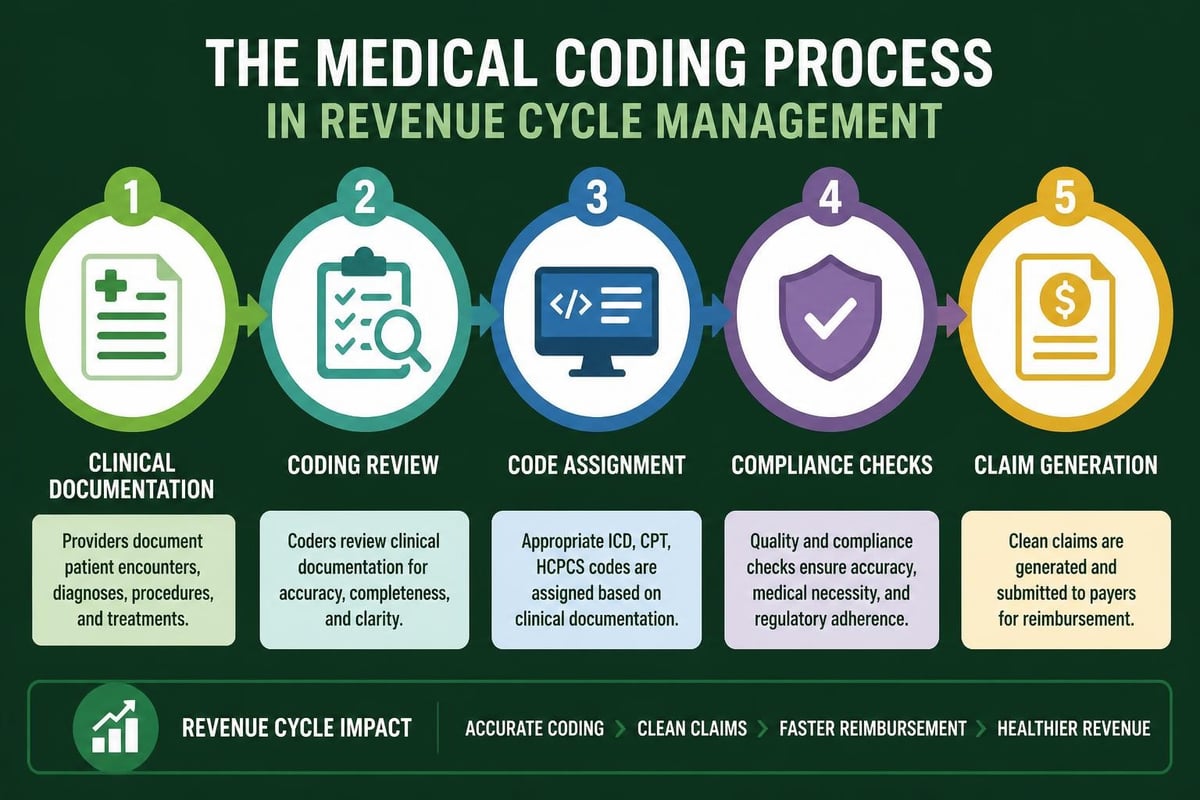
Professional medical coding represents the technical core of revenue cycle management medical operations. Coders translate clinical documentation into standardized CPT, HCPG, and ICD-10 codes that payers use to adjudicate claims.
| Coding Category | Description | Common Issues |
|---|---|---|
| Evaluation & Management | Office visits, consultations, hospital encounters | Level of service documentation |
| Procedures | Surgical and diagnostic procedures | Bundling and unbundling rules |
| Diagnostic Codes | ICD-10 diagnosis codes | Specificity and medical necessity |
| Modifiers | Additional claim information | Appropriate modifier selection |
Understanding different types of medical coding helps healthcare providers appreciate the complexity involved in translating clinical encounters into compliant, reimbursable claims.
Claims Management and Submission
Once coding is complete, claims must be submitted to appropriate payers through proper channels. Medical claim submission services handle the technical requirements of transmitting claims electronically while ensuring compliance with payer-specific formatting requirements.
Clean Claims Initiative
Clean claims pass all payer edits and contain no errors requiring manual review or clarification. Maximizing first-pass clean claim rates accelerates payment and reduces administrative costs.
Implementing systematic claim scrubbing before submission catches common errors:
- Demographic verification ensuring patient and insurance information matches payer records
- Code validation confirming all codes are current, valid, and properly matched
- Medical necessity checks verifying diagnosis codes support services rendered
- Authorization confirmation documenting required pre-approvals before submission
- Duplicate prevention identifying potential duplicate claims before transmission
Clean claim rates above 95% indicate mature revenue cycle management medical processes with effective quality controls.
Back-End Revenue Cycle Management Medical Functions
After claims submission, the revenue cycle enters its collection phase where practices monitor claim status, post payments, and manage denials. Back-end efficiency determines how quickly legitimate revenue converts to collected cash.
Payment Posting and Reconciliation
Accurate payment posting provides the financial data necessary for analysis and decision-making. Each payment requires careful posting to the correct patient account, matched to specific dates of service, and categorized by payment source.
Payment posting services ensure timely and accurate recording of all revenue, including insurance payments, patient payments, and contractual adjustments.
Denial Management Strategy
Despite best efforts at front-end verification and clean claims submission, denials occur. Effective denial management requires systematic approaches to both resolution and prevention.
The denial management lifecycle includes four distinct phases:
- Identification tracking all denied claims through automated systems or manual review
- Analysis categorizing denials by reason, payer, and service type to identify patterns
- Resolution appealing or correcting denied claims according to payer requirements
- Prevention implementing process changes to eliminate root causes of recurring denials
Healthcare providers should track denial rates by category to focus improvement efforts on highest-impact areas. Common denial categories include registration errors, authorization failures, coding errors, timely filing issues, and medical necessity concerns.
Compliance Considerations in Revenue Cycle Management Medical Services
Healthcare billing operates within a complex regulatory environment where compliance failures carry serious financial and legal consequences. Revenue cycle management medical programs must incorporate robust compliance safeguards throughout all processes.
HIPAA Privacy and Security
Protected health information flows through every stage of the revenue cycle. Staff training, system security, and process controls ensure patient information remains confidential and secure.
Business associate agreements with third-party revenue cycle management medical partners establish clear responsibilities for data protection and breach notification.
Coding Compliance and Fraud Prevention
Accurate coding serves both reimbursement accuracy and legal compliance. The Healthcare Financial Management Association provides comprehensive RCM guidance emphasizing the importance of compliant coding practices.
Practices must avoid common compliance pitfalls:
- Upcoding services to higher levels than documentation supports
- Unbundling procedures that should be reported with comprehensive codes
- Billing for services not rendered or medically unnecessary
- Duplicate billing for the same service or encounter
- Misrepresenting providers or locations of service
Regular coding audits identify potential compliance risks before they escalate into serious problems. External auditors provide objective assessments of coding accuracy and compliance with current guidelines.
Outsourcing Revenue Cycle Management Medical Operations
Many healthcare providers choose to partner with specialized revenue cycle management medical companies rather than maintaining entirely internal billing operations. This strategic decision offers several compelling advantages.
Benefits of Professional RCM Partners
Specialized revenue cycle management companies bring dedicated expertise, proven processes, and sophisticated technology platforms that would be cost-prohibitive for individual practices to develop internally.
Professional RCM partners maintain current knowledge across multiple specialties, payer requirements, and regulatory changes. This breadth of experience enables rapid adaptation to healthcare industry changes that might overwhelm internal teams.
Scalability represents another significant advantage of outsourcing revenue cycle management medical functions. As practices grow, specialized partners scale services without requiring practices to recruit, hire, and train additional internal staff.
| In-House RCM | Outsourced RCM |
|---|---|
| Fixed overhead costs regardless of volume | Variable costs aligned with collections |
| Staff recruitment and retention challenges | Immediate access to experienced team |
| Technology investment and maintenance | Included platform access and updates |
| Limited specialty expertise | Multi-specialty knowledge base |
| Difficult to scale quickly | Flexible capacity |
Selecting the Right RCM Partner
Healthcare providers evaluating revenue cycle management medical partners should consider several critical factors during the selection process.
Transparency in reporting and communication enables productive partnerships where both parties work toward shared financial goals. Partners should provide regular, detailed reporting on key performance metrics with clear explanations of trends and variances.
Industry-specific experience matters significantly in revenue cycle management medical services. Partners with deep expertise in specific specialties understand unique coding requirements, common denial reasons, and payer tendencies that affect reimbursement.
The Role of Analytics in Revenue Cycle Management Medical Performance
Data-driven decision making separates high-performing revenue cycle operations from those that struggle with persistent challenges. Comprehensive analytics transform raw billing data into actionable insights that guide strategic improvements.
Key Performance Indicators
Monitoring the right metrics provides early warning of emerging problems and validates the effectiveness of improvement initiatives. The American Hospital Association tracks RCM trends across the industry, providing benchmarks for comparative analysis.
Leading indicators predict future performance and enable proactive intervention before problems fully materialize. These include pre-registration completion rates, point-of-service collection percentages, and clean claim submission rates.
Lagging indicators measure historical outcomes and validate whether current processes achieve desired results. Days in accounts receivable, net collection rates, and bad debt write-offs fall into this category.
Reporting and Dashboards
Effective revenue cycle management medical reporting presents complex data in accessible formats that facilitate quick understanding and decision-making. Dashboard visualizations highlight key metrics, trends, and exceptions requiring attention.
Customized reports for different stakeholders ensure each team member receives relevant information for their specific responsibilities. Front-end staff need registration quality metrics, coders require coding accuracy feedback, and practice administrators focus on overall financial performance.
Future Trends in Revenue Cycle Management Medical Services
The healthcare industry continues evolving rapidly, with several trends reshaping revenue cycle management medical operations. Forward-thinking providers prepare for these changes by building adaptable processes and technology infrastructure.
Artificial Intelligence and Automation
Machine learning algorithms increasingly handle routine revenue cycle tasks including eligibility verification, coding suggestions, and denial prediction. These technologies augment human expertise rather than replacing skilled professionals.
Automated prior authorization systems reduce administrative burden by submitting authorization requests directly to payer portals and tracking approval status without manual intervention. This automation accelerates patient access while ensuring compliance with payer requirements.
Value-Based Payment Models
The gradual shift from fee-for-service to value-based reimbursement requires revenue cycle management medical systems that track quality metrics, patient outcomes, and episode-based costs alongside traditional claims data.
Providers participating in accountable care organizations, bundled payments, or capitation arrangements need sophisticated analytics that measure performance against quality benchmarks and financial targets.
Patient Financial Engagement
Rising patient cost-sharing transfers more financial responsibility to individuals, making patient collections an increasingly important component of revenue cycle management medical operations. Tools that provide cost estimates, payment plans, and convenient payment options improve patient satisfaction while optimizing collections.
Price transparency requirements compel providers to publish service costs and help patients understand their expected financial responsibility before receiving care. Integrating this information into revenue cycle workflows ensures accurate estimates and reduces surprise billing disputes.
Mastering revenue cycle management medical operations determines financial sustainability for healthcare providers navigating today’s complex reimbursement landscape. From accurate front-end registration through efficient back-end collections, every process requires specialized expertise and strategic oversight. Greenhive Billing Solutions delivers comprehensive revenue cycle management services designed to optimize your practice’s financial performance through expert medical billing, claims processing, denial management, and insurance verification. Our team of experienced professionals adapts to your existing systems while implementing proven strategies that maximize reimbursements, reduce administrative burden, and ensure HIPAA compliance across all operations.

