
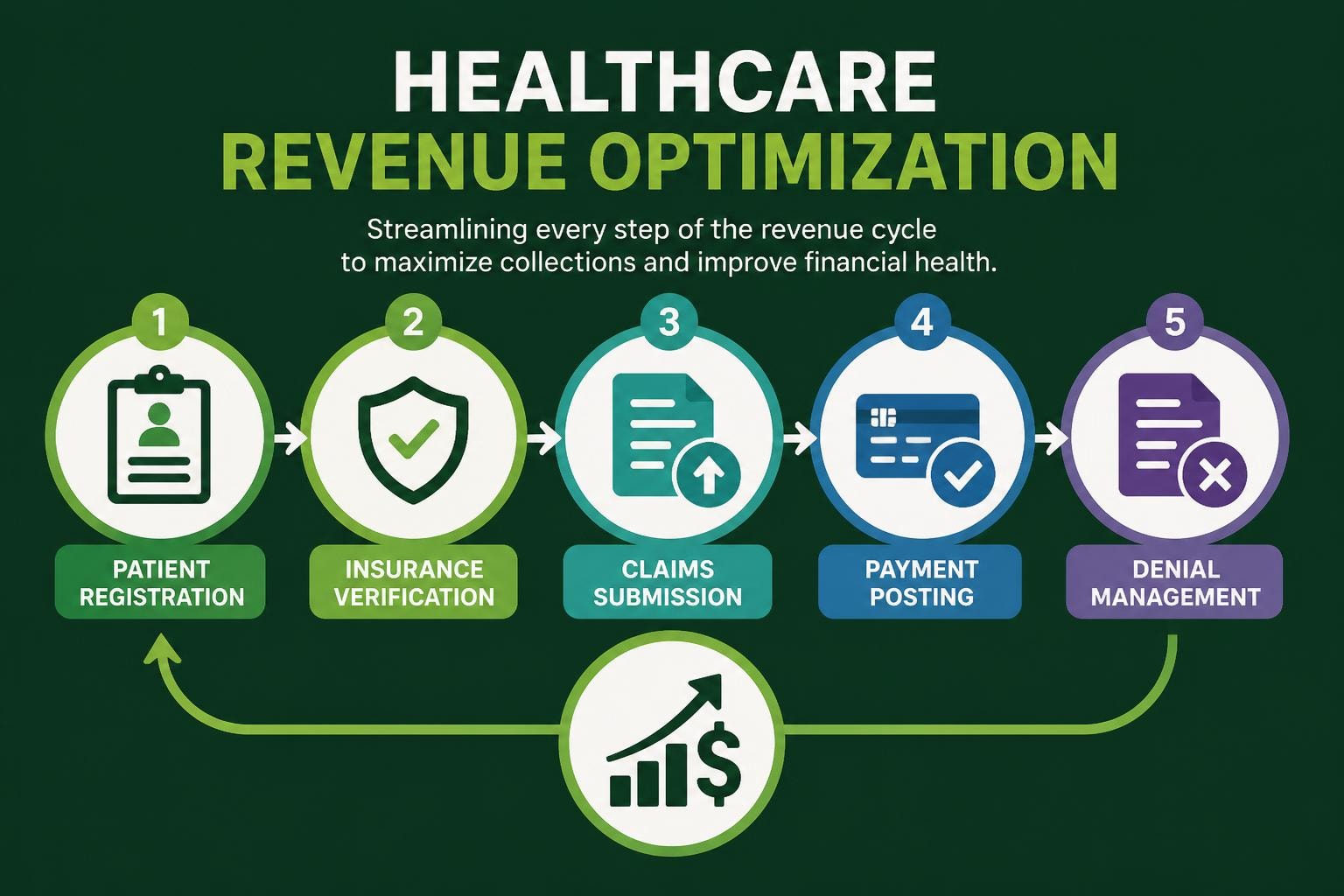
Healthcare revenue represents the financial lifeblood of medical practices, hospitals, and healthcare organizations across the United States. As reimbursement models evolve and operational costs continue to rise, healthcare providers face mounting pressure to optimize every aspect of their revenue cycle. Understanding the intricacies of revenue generation, from patient registration through final payment collection, has become essential for maintaining financial viability while delivering quality care. This comprehensive examination explores the critical components that drive healthcare revenue and provides actionable strategies for maximizing returns.
Understanding the Healthcare Revenue Landscape
The healthcare revenue ecosystem operates within a complex framework of payer relationships, regulatory requirements, and operational workflows. Medical practices must navigate multiple revenue streams, including commercial insurance, government payers like Medicare and Medicaid, and patient responsibility portions.
Financial performance in healthcare settings depends heavily on the efficiency of administrative processes. When claims are submitted accurately and denials are addressed promptly, healthcare revenue cycle analytics demonstrates measurable improvements in cash flow and collection rates.
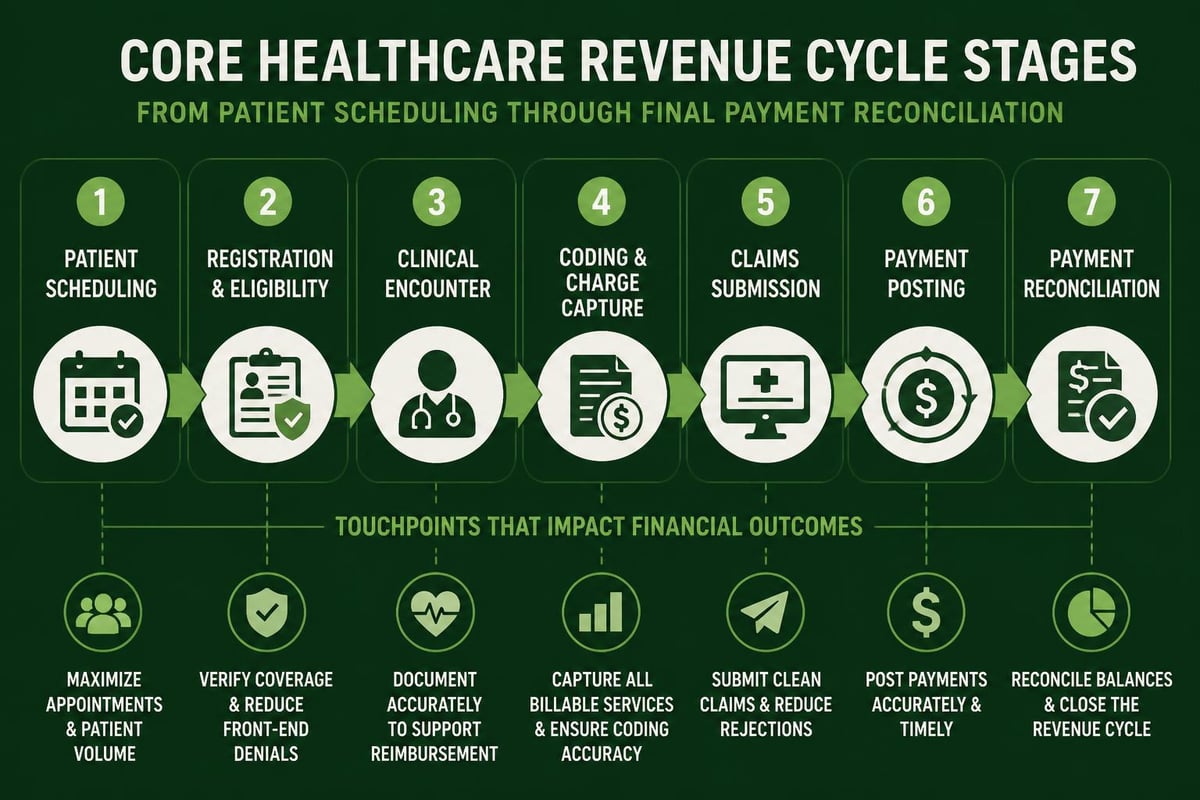
The Healthcare Financial Management Association provides comprehensive insights into how revenue cycle management serves as the backbone of healthcare financial operations. Organizations that implement systematic approaches to managing their revenue cycles consistently outperform those relying on reactive strategies.
Key Revenue Cycle Stages
Front-End Operations:
- Patient registration and demographic verification
- Insurance eligibility confirmation
- Benefit verification and authorization
- Financial counseling and estimate provision
- Point-of-service collection
Mid-Cycle Functions:
- Charge capture and documentation
- Medical coding and compliance review
- Claims scrubbing and validation
- Electronic claims submission
- Payer follow-up and status monitoring
Back-End Processes:
- Payment posting and reconciliation
- Denial management and appeals
- Patient billing and statement generation
- Collections and bad debt management
- Reporting and analytics
Each stage contributes directly to overall healthcare revenue performance. Disruptions or inefficiencies at any point create downstream impacts that reduce collections and extend the payment timeline.
Optimizing Charge Capture and Documentation
Accurate charge capture forms the foundation of healthcare revenue integrity. When services are not properly documented or charges go unbilled, providers experience significant revenue leakage that directly impacts their bottom line.
Charge entry in medical billing requires meticulous attention to detail and comprehensive understanding of service documentation. Many practices discover substantial revenue recovery opportunities simply by implementing systematic charge capture audits.
| Charge Capture Challenge | Revenue Impact | Solution Approach |
|---|---|---|
| Incomplete documentation | 10-15% revenue loss | Provider education and templates |
| Missed ancillary services | 5-8% revenue loss | Automated charge triggers |
| Incorrect coding | 3-7% revenue loss | Certified coder review |
| Delayed charge entry | Extended A/R days | Real-time posting protocols |
Healthcare organizations should establish clear protocols for charge capture that include regular audits, provider feedback loops, and technology-assisted verification. The relationship between accurate documentation and healthcare revenue cannot be overstated.
Strategic Claims Management
Claims represent the primary vehicle through which healthcare providers receive reimbursement for services rendered. The path from service delivery to payment collection depends entirely on submitting clean, accurate claims that meet payer requirements.
Clean claims in medical billing pass through payer adjudication without additional information requests or corrections. Industry benchmarks suggest that clean claim rates above 95% correlate strongly with superior healthcare revenue performance.
Claims Submission Best Practices
Pre-Submission Validation:
- Verify Patient Demographics – Confirm name spelling, date of birth, and insurance member ID match payer records exactly
- Validate Coverage – Check active coverage dates and benefit eligibility before service delivery
- Review Coding Accuracy – Ensure CPT and ICD-10 codes align with documentation and payer policies
- Apply Modifiers Correctly – Use appropriate modifiers to clarify service circumstances and prevent denials
- Scrub for Errors – Run automated edits to catch common submission errors before claims reach payers
Organizations that implement comprehensive claims scrubbing reduce initial denial rates by 40-60%, directly accelerating healthcare revenue realization. Research on best practices in revenue cycle management confirms that front-end claim quality determines back-end collection success.
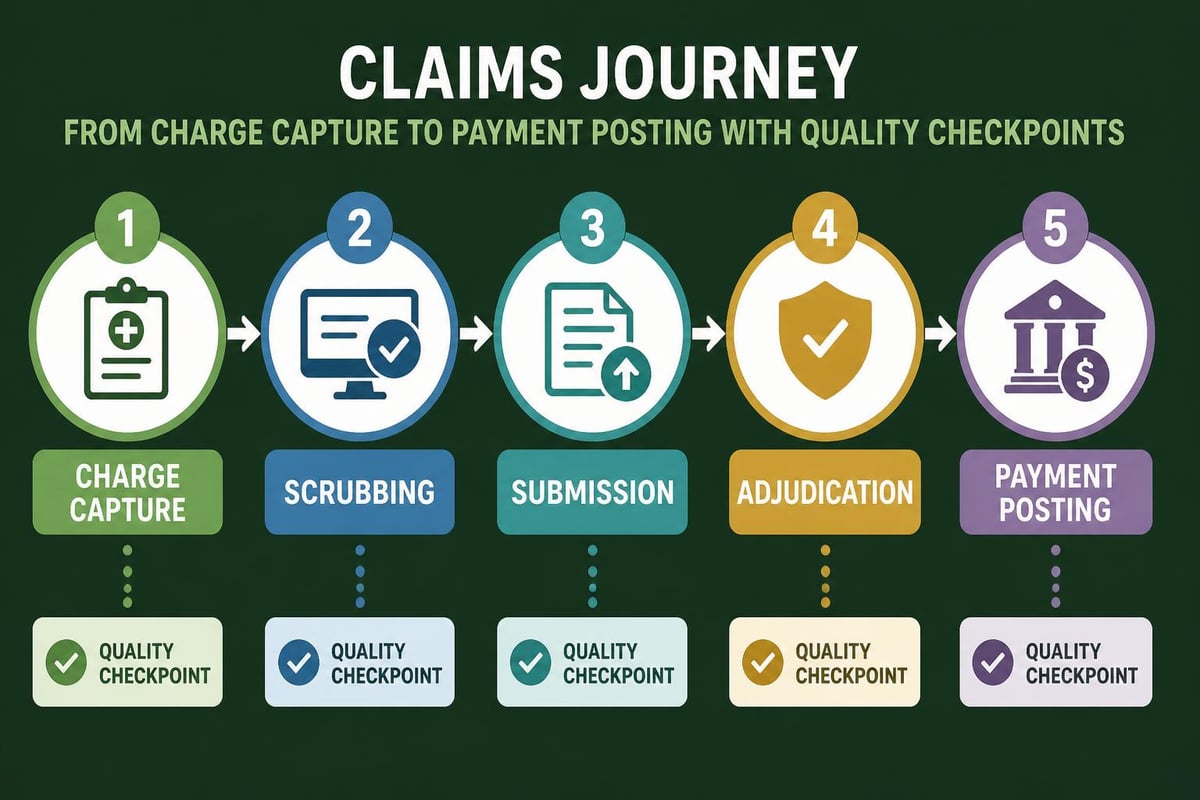
Technology plays an increasingly vital role in claims management efficiency. Automated clearinghouses identify formatting errors, missing information, and potential compliance issues before claims reach payers, reducing rework and expediting reimbursement.
Denial Management as a Revenue Protection Strategy
Denied claims represent one of the most significant threats to healthcare revenue stability. Industry studies indicate that 5-10% of claims initially deny, with 60-70% of those denials proving preventable through proper front-end processes.
Denial management in medical billing transforms reactive claim correction into proactive revenue protection. Practices that track denial patterns and implement corrective workflows recover substantially more revenue than those treating denials as isolated incidents.
Common Denial Categories and Solutions
| Denial Reason | Percentage of Denials | Prevention Strategy |
|---|---|---|
| Missing information | 25-30% | Enhanced intake protocols |
| Authorization issues | 15-20% | Pre-service verification |
| Coding errors | 20-25% | Ongoing coder education |
| Timely filing | 10-15% | Accelerated submission schedules |
| Medical necessity | 8-12% | Documentation improvement |
Effective denial management requires dedicated resources and systematic approaches. Organizations should establish clear workflows for denial categorization, root cause analysis, and appeals management.
The financial impact of denials extends beyond the immediate claim value. Administrative costs associated with reworking denied claims, appealing unfavorable decisions, and managing patient communication add substantial overhead that erodes healthcare revenue margins.
Leveraging Technology for Revenue Enhancement
Modern revenue cycle operations depend heavily on technology platforms that automate routine tasks, identify exceptions, and provide actionable analytics. Healthcare providers who strategically implement these tools experience measurable improvements in collection rates and operational efficiency.
Practice management systems, electronic health records, and specialized revenue cycle management platforms work together to create integrated workflows. When properly configured, these systems reduce manual effort while improving accuracy across all revenue cycle touchpoints.
Revenue Cycle Technology Categories:
- Eligibility Verification Systems – Real-time insurance verification and benefit checking
- Claims Management Platforms – Automated scrubbing, submission, and tracking
- Payment Posting Solutions – Electronic remittance processing and auto-posting
- Denial Management Tools – Pattern recognition and workflow automation
- Analytics and Reporting – Performance dashboards and predictive modeling
Understanding back-end revenue cycle best practices reveals how technology integration accelerates payment collection while reducing administrative burden. Organizations investing in comprehensive technology ecosystems report 20-30% improvements in days in accounts receivable.
The selection of appropriate technology partners requires careful evaluation of integration capabilities, scalability, and ongoing support. Solutions must accommodate existing workflows while providing flexibility for future process improvements.
Payer Contract Management and Reimbursement Optimization
Healthcare revenue depends significantly on negotiated rates with commercial insurance payers. Contract terms, reimbursement methodologies, and performance incentives all influence the revenue potential for services rendered.
Many practices discover substantial revenue opportunities through systematic contract review and renegotiation. Understanding actual reimbursement patterns compared to contracted rates often reveals underpayment issues that impact overall financial performance.
Contract Review Components
Regular contract analysis should evaluate:
- Fee schedule accuracy – Verify reimbursement rates match contracted amounts
- Modifier policies – Understand payer-specific modifier application rules
- Bundling edits – Identify inappropriate claim adjustments
- Timely filing limits – Track submission deadlines by payer
- Appeal rights – Document dispute resolution processes
Providers should maintain detailed records of payer performance, including average reimbursement rates, denial percentages, and payment timelines. This data provides leverage during contract renegotiations and supports revenue optimization efforts.
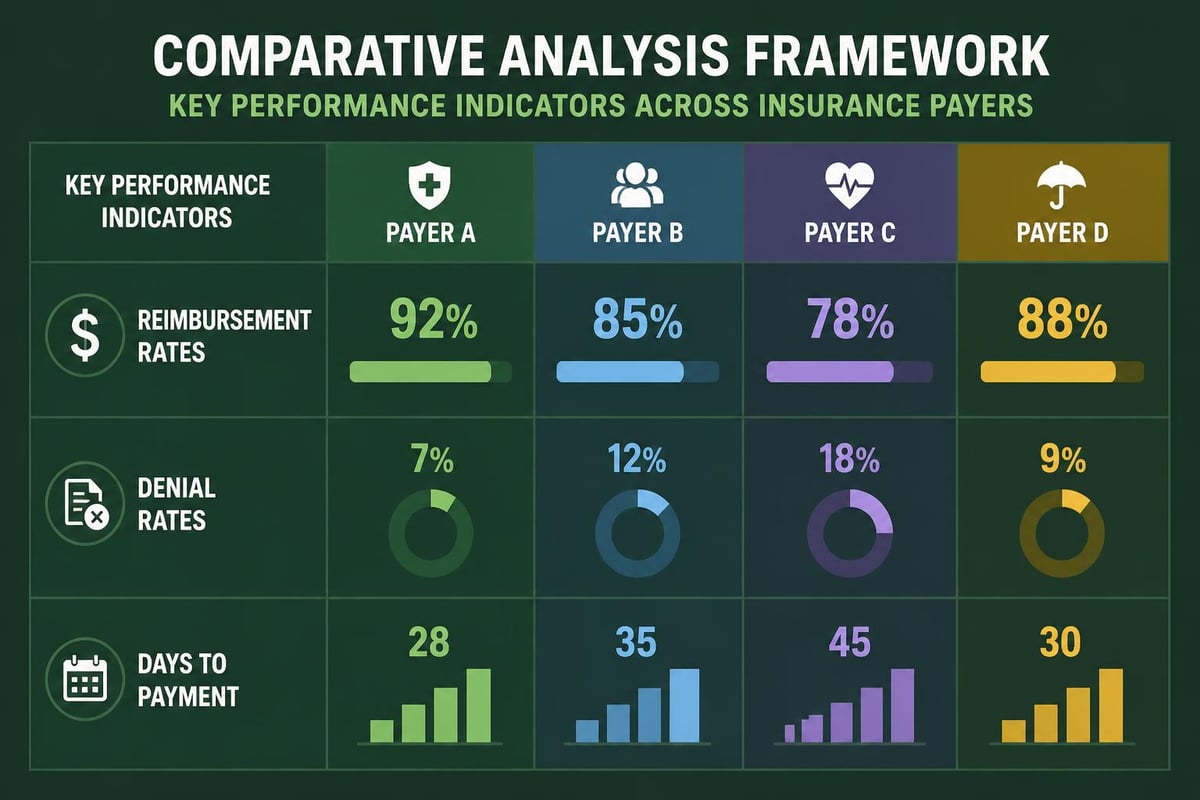
How revenue cycle billing processes integrate with contract management determines whether providers capture full reimbursement potential. Systematic verification of payments against contracted rates identifies underpayments that would otherwise go unnoticed.
Patient Financial Responsibility and Collections
The shift toward high-deductible health plans has dramatically increased patient financial responsibility. Healthcare revenue now depends more heavily on effective patient collection strategies, requiring providers to balance financial necessity with patient satisfaction.
Transparent communication about costs before service delivery significantly improves collection rates. Patients who understand their financial obligations upfront are substantially more likely to pay balances promptly.
Effective Patient Financial Engagement:
- Provide Cost Estimates – Offer good-faith estimates for scheduled services
- Explain Benefits – Clarify insurance coverage and patient responsibility
- Offer Payment Plans – Establish flexible payment arrangements for large balances
- Accept Multiple Payment Methods – Enable online payments, credit cards, and digital wallets
- Communicate Regularly – Send timely statements with clear balance explanations
Organizations implementing comprehensive financial counseling programs report 30-40% improvements in patient collections. These programs educate patients about their benefits while establishing payment expectations before services are rendered.
The timing of patient communication significantly impacts collection success. Discussions about financial responsibility should occur during appointment scheduling, at check-in, and at service completion to maximize awareness and payment likelihood.
Compliance and Regulatory Considerations
Healthcare revenue operations must navigate complex regulatory requirements that govern billing practices, documentation standards, and claims submission. Non-compliance creates significant financial risk through payment denials, audit recoupments, and potential penalties.
Revenue coding practices must align with federal and state regulations, payer-specific policies, and professional coding guidelines. Regular compliance audits identify potential vulnerabilities before they result in financial consequences.
Critical Compliance Areas
| Compliance Category | Key Requirements | Risk Mitigation |
|---|---|---|
| Documentation | Medical necessity support | Provider education programs |
| Coding accuracy | Proper code selection | Regular audits and feedback |
| Billing practices | Anti-kickback compliance | Policy review and training |
| Privacy protection | HIPAA requirements | Security protocols and monitoring |
| Fraud prevention | False Claims Act adherence | Internal controls and oversight |
The regulatory environment continues evolving, requiring healthcare organizations to maintain current knowledge of billing rules and documentation requirements. Recent healthcare financial performance reports highlight how changing utilization patterns and reimbursement models impact revenue cycle operations.
Compliance investments protect healthcare revenue by preventing denials, reducing audit risks, and maintaining payer relationships. Organizations that prioritize compliance consistently demonstrate superior long-term financial performance compared to those treating it as an afterthought.
Performance Metrics and Analytics
Data-driven decision making separates high-performing healthcare revenue operations from those struggling with cash flow and collection challenges. Key performance indicators provide visibility into operational efficiency and identify improvement opportunities.
Essential Revenue Cycle Metrics:
- Days in Accounts Receivable – Average time from service to payment collection
- Clean Claim Rate – Percentage of claims paid without additional work
- Denial Rate – Percentage of submitted claims initially denied
- Net Collection Rate – Collected revenue as percentage of collectible charges
- Cost to Collect – Administrative expense per dollar collected
- Point-of-Service Collection Rate – Percentage of patient responsibility collected at visit
Benchmarking performance against industry standards reveals relative strengths and weaknesses. Healthcare revenue optimization requires continuous monitoring of these metrics with regular analysis of trends and variances.
Advanced analytics capabilities enable predictive modeling that identifies potential denials before submission, forecasts cash flow patterns, and prioritizes accounts for follow-up. Organizations leveraging these insights consistently outperform those relying on retrospective reporting alone.
Outsourcing Considerations for Revenue Cycle Functions
Many healthcare providers enhance their financial performance by partnering with specialized revenue cycle management service providers. These partnerships allow clinical teams to focus on patient care while experienced billing professionals optimize revenue collection.
Exploring top medical billing companies reveals diverse service models ranging from full-cycle outsourcing to targeted support for specific functions like denial management or coding. The right partnership model depends on organizational size, internal capabilities, and strategic objectives.
Benefits of RCM Service Partnerships:
- Access to specialized expertise in billing and coding
- Scalable resources that flex with volume fluctuations
- Advanced technology without capital investment
- Reduced administrative overhead and staffing challenges
- Improved compliance through dedicated focus
- Enhanced analytics and performance reporting
Organizations evaluating outsourcing options should assess provider experience in their specialty, technology capabilities, communication protocols, and pricing transparency. Hospital revenue cycle management requirements differ substantially from ambulatory settings, requiring appropriately specialized service providers.
The transition to outsourced revenue cycle services requires careful planning, clear communication, and realistic timeline expectations. Successful partnerships establish defined performance metrics, regular reporting cadences, and collaborative problem-solving approaches that align provider and client objectives.
Staff Training and Development
Human expertise remains central to healthcare revenue optimization despite advancing technology. Well-trained staff who understand payer requirements, coding guidelines, and billing regulations directly impact collection rates and financial performance.
Ongoing education ensures teams remain current with regulatory changes, payer policy updates, and industry best practices. Organizations investing in professional development for revenue cycle staff consistently demonstrate superior performance metrics.
Training Program Components
Foundational Knowledge:
- Medical terminology and anatomy
- Insurance plan types and coverage rules
- CPT and ICD-10 coding systems
- Payer-specific billing requirements
- Privacy and security regulations
Advanced Skills:
- Complex coding scenarios
- Denial prevention strategies
- Contract interpretation
- Appeals writing and submission
- Performance analysis and reporting
Cross-training revenue cycle staff across multiple functions creates operational flexibility while deepening individual understanding of how various processes interconnect. Staff who comprehend the full revenue cycle workflow make better decisions within their specific roles.
Recognition programs that reward superior performance, accuracy improvements, and innovation encourage continuous excellence. Healthcare revenue outcomes improve when teams feel valued and understand how their contributions impact organizational success.
Maximizing healthcare revenue requires comprehensive attention to every stage of the revenue cycle, from patient registration through final payment collection. By implementing systematic approaches to charge capture, claims management, denial prevention, and patient collections, healthcare providers position themselves for sustained financial success. Greenhive Billing Solutions delivers expert revenue cycle management services that optimize financial performance through specialized expertise in medical billing, claims processing, and denial management, enabling healthcare providers to focus on patient care while achieving maximum reimbursements.

