The healthcare billing landscape is evolving rapidly, placing new demands on providers and highlighting the essential role of top medical billing companies in ensuring profitability and quality patient care. With the U.S. medical billing outsourcing market projected to reach $17.53 billion by 2033, the push for outsourced solutions has never been stronger.
Providers face mounting challenges in compliance, reimbursement delays, and denied claims. The right partner can transform these obstacles into opportunities for efficiency and growth. This article spotlights seven top medical billing companies set to shape the industry in 2026, offering healthcare leaders actionable insights for selecting the best fit.
We will explore selection criteria such as advanced technology, pricing transparency, specialty expertise, and scalability. By the end, you will know what distinguishes the leaders—and how to choose the right partner for your organization.
The Evolving Landscape of Medical Billing in 2026
The medical billing sector is undergoing rapid transformation as regulatory complexity increases and new technology solutions emerge. For healthcare leaders, understanding these changes is essential for selecting the top medical billing companies that will drive success in 2026. Let’s examine the key drivers, trends, and industry benchmarks shaping the future of medical billing.
Drivers of Outsourcing Medical Billing
Healthcare organizations are increasingly turning to the top medical billing companies to handle their revenue cycle management. This shift is driven by rising administrative demands, frequent regulatory updates, and the need to reduce costly claim denials. Providers face mounting pressure to optimize revenue, improve cash flow, and stay compliant with ever-changing rules.
New technologies, such as AI and automation, make it easier for the top medical billing companies to manage complex billing tasks more efficiently than in-house teams. Outsourcing also leads to significant cost savings, freeing up resources for patient care and practice growth.
Key Trends Shaping the Industry
Several trends are redefining what it means to be among the top medical billing companies. AI-driven coding and claims processing are now standard, enabling faster turnaround and fewer errors. Integration with EHR and practice management systems streamlines workflows, while real-time analytics empower practices to monitor financial performance closely.
There is also a notable shift toward value-based care models, bundled payments, and specialty-specific billing solutions. The top medical billing companies continuously adapt to these trends, ensuring clients benefit from the latest innovations and remain competitive.
What to Look for in a Top Medical Billing Company
Selecting from the top medical billing companies requires careful evaluation of several factors. HIPAA compliance and robust data security measures are non-negotiable. Transparent pricing and results-oriented models help practices control costs and measure outcomes.
Look for companies with certified staff, specialty expertise, and end-to-end revenue cycle management capabilities. A proven track record, supported by client testimonials, signals reliability. Choosing the right partner ensures your practice can scale, adapt, and thrive in an evolving healthcare environment.
Market Data and Industry Insights
The market for top medical billing companies continues to expand. According to Medical Billing Outsourcing Market To Reach $44.30 Billion By 2033, the industry is poised for significant growth, with hospitals accounting for nearly half of all outsourcing. Outsourced billing can reduce costs dramatically compared to in-house teams.
High denial rates and low clean claim percentages can erode revenue, making expert billing services essential. Leading providers demonstrate measurable improvements in cash flow and claim acceptance, underscoring the value of partnering with the top medical billing companies.
7 Top Medical Billing Companies to Watch in 2026
The landscape of top medical billing companies is rapidly evolving, driven by innovation and the demand for efficiency. In 2026, these seven standout providers are set to redefine industry standards, each offering unique solutions to help healthcare organizations thrive.
1. Greenhive Billing Solutions
Greenhive Billing Solutions leads the list of top medical billing companies with its transparent, results-based pricing model and no long-term contracts. The company delivers comprehensive revenue cycle management, including eligibility verification, coding, billing, denial management, payment posting, and advanced analytics.

- Specialty expertise covers behavioral health, urology, labs, urgent care, and more.
- HIPAA-compliant systems and certified professionals ensure security and reliability.
- Real-time dashboards and monthly performance reviews enhance transparency.
- 24/7 U.S.-based support with dedicated account managers.
- Providers report up to 30% cost savings compared to in-house billing.
For practices seeking end-to-end RCM and specialty billing, Greenhive is a strong choice. Their medical billing services overview highlights how their tailored approach addresses the challenges that top medical billing companies must solve.
Pros: Significant cost savings, tailored solutions, high claim acceptance rates
Cons: May not offer proprietary EHR, best for small to mid-sized practices
Ideal for: Practices seeking transparency, efficiency, and specialty billing
2. DrChrono
DrChrono stands out among the top medical billing companies for its cloud-based platform and seamless EHR integration. Its mobile-friendly features make it ideal for providers on the go, while telemedicine and hospital billing capabilities address the needs of modern healthcare.

- Automated insurance verification, claim processing, and patient billing streamline workflows.
- Advanced analytics and reporting tools support revenue optimization.
- Scalable for solo practitioners through large health systems.
- Subscription-based pricing with custom quotes.
DrChrono’s robust analytics and integration help practices navigate billing complexities efficiently.
Pros: Seamless EHR integration, mobile access, robust analytics
Cons: Some advanced features may cost extra, learning curve for larger systems
Ideal for: Telehealth providers, hospitals, and practices needing flexible, integrated billing
3. Tebra
Tebra is quickly gaining recognition among top medical billing companies for its intuitive, user-friendly platform. Designed for solo practices, medical groups, and urgent care centers, it automates billing workflows and delivers real-time analytics.
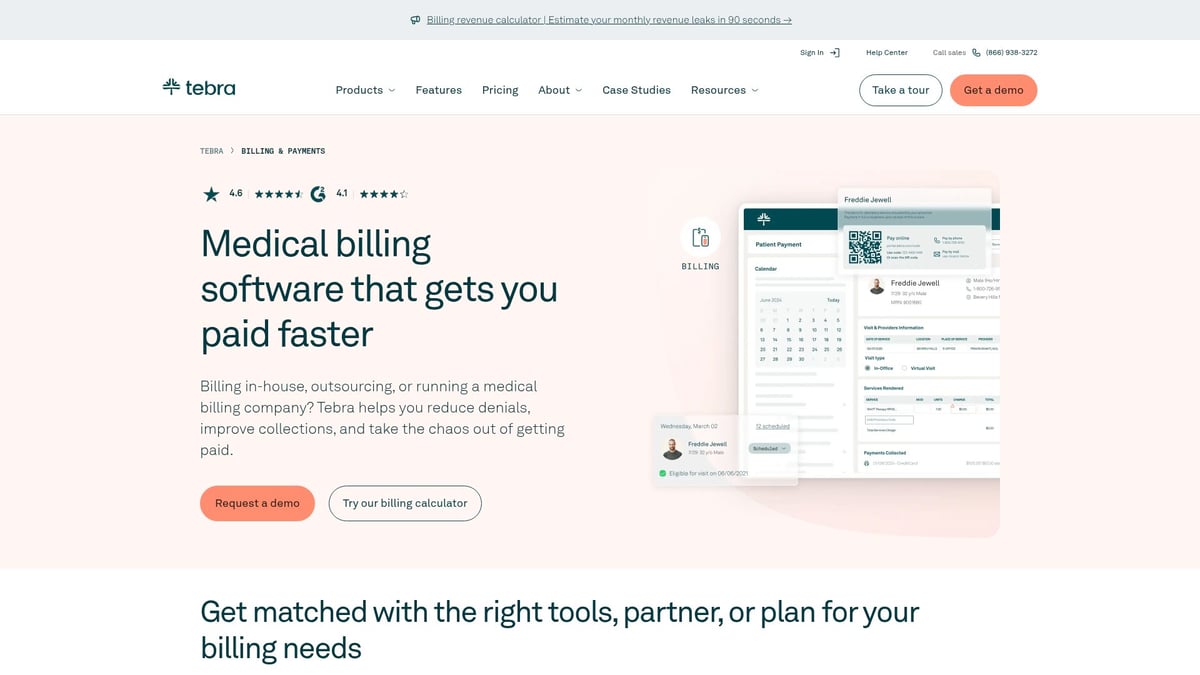
- Offers coding, insurance verification, payment processing, and reporting.
- Global reach, serving providers in the USA and UK.
- Transparent pricing, typically per-provider or per-claim.
Tebra’s automation reduces administrative burden and improves billing accuracy.
Pros: Intuitive interface, automation, strong support
Cons: Some advanced features require higher-tier plans
Ideal for: Practices prioritizing ease of use and automation
4. Athenahealth
Athenahealth remains one of the top medical billing companies due to its cloud-based RCM solution and integrated patient engagement tools. The platform excels in real-time claim scrubbing and insurance verification, helping practices achieve higher reimbursement rates.

- Includes patient billing tools and self-service portals.
- End-to-end billing, denial management, and strong analytics.
- Pricing is a percentage of collections, with custom quotes.
Athenahealth’s data-driven approach reduces billing delays and enhances patient satisfaction.
Pros: End-to-end billing, strong patient engagement, proven results
Cons: Percentage-based fees may be higher for high-volume practices
Ideal for: Health centers, medical groups, and hospitals needing cloud-based, data-driven billing
5. Cerner
Cerner’s robust platform and seamless EHR integration place it firmly among top medical billing companies. Its customizable workflows and advanced reporting tools provide deep insights into financial health and billing performance.

- Handles entire billing cycle, including claims, payments, and denial management.
- User-friendly dashboard supports quick navigation and efficient workflow.
- Custom pricing based on practice size and needs.
Cerner’s scalability makes it a preferred choice for growing organizations.
Pros: Powerful reporting, scalable for all practice sizes, strong support
Cons: May require IT resources for integration, pricing not always transparent
Ideal for: Large practices, hospitals, and organizations seeking comprehensive, integrated billing
6. AdvancedMD
AdvancedMD is a top pick among top medical billing companies, renowned for its personalized billing and coding solutions. The platform features modular pricing and integrates seamlessly with practice management and EHR systems.
- Offers claim management, payment posting, and revenue cycle analysis.
- Customizable pricing bundles allow practices to pay only for needed services.
- Scalable and adaptable for growing practices.
AdvancedMD’s flexibility and integration capabilities help providers optimize revenue and operations.
Pros: Highly customizable, robust integration, scalable for growth
Cons: Some features require additional fees, initial setup complexity
Ideal for: Practices needing tailored solutions and integration flexibility
7. CareCloud
CareCloud serves healthcare organizations ranging from large hospital systems to solo physicians, offering a broad set of tools that include billing analytics, telehealth, patient billing, revenue cycle management, and practice management.
Cloud-based platform with real-time analytics and reporting.
Supports practices across multiple sizes and specialties.
Pricing details are not publicly disclosed and require a demo.
CareCloud is positioned as a comprehensive, all-in-one healthcare technology vendor rather than a billing-only solution.
Pros: Wide range of services, cloud-based system, real-time reporting
Cons: Pricing not transparent, platform may feel complex for smaller practices
Ideal for: Practices looking for a multi-module healthcare management platform rather than standalone billing services
How to Choose the Right Medical Billing Partner for Your Practice
Selecting the right partner among the top medical billing companies is a pivotal decision that can shape your practice’s financial health and operational efficiency. With the landscape evolving rapidly, it is essential to follow a structured approach that matches your unique needs with the strengths of industry leaders.
Assessing Your Practice’s Needs
Begin by evaluating your practice’s size, specialty, and billing volume. Top medical billing companies often tailor solutions for specific segments, so understanding your unique requirements is critical.
Solo practitioners might benefit from streamlined, automated platforms, while multi-specialty groups require robust integration with EHR or practice management systems. Identify workflow pain points, such as high denial rates or time-consuming eligibility checks.
Consider if you need full revenue cycle management or just specific modules. For small practices, specialized providers like medical billing for small practices can deliver targeted value and support. Aligning these factors ensures you select a partner equipped to handle your complexity.
Comparing Pricing Models and Transparency
Top medical billing companies offer a range of pricing structures, including fixed fees, percentage of collections, and per-claim rates. Understanding these options helps you avoid hidden costs and lock in long-term savings.
| Pricing Model | Description | Best For |
|---|---|---|
| Fixed Fee | Set monthly cost | Predictable volumes |
| % of Collections | Fee tied to revenue collected | High-volume practices |
| Per-Claim | Cost per processed claim | Fluctuating workloads |
Transparent contracts and no surprise charges are hallmarks of reputable partners. Greenhive’s results-based pricing sets a strong benchmark for clarity. When comparing, always analyze total cost of ownership and consider how different models align with your financial goals.
Evaluating Technology, Support, and Compliance
The best top medical billing companies harness technology to streamline claims, minimize denials, and ensure compliance. Look for HIPAA-certified systems, robust security protocols, and staff with up-to-date certifications.
Automation, AI-driven denial management, and real-time dashboards are essential for transparency and cash flow. Responsive support and a dedicated account manager can make a significant difference during onboarding and ongoing operations. For more insight on how denial management can improve your revenue, see this overview on denial management in billing.
Prioritize platforms that offer analytics and customizable workflows to fit your practice’s evolving needs.
Checking Reputation, Experience, and Scalability
Before committing, review client testimonials, industry awards, and case studies. Top medical billing companies demonstrate a proven track record, adaptability to regulatory changes, and the ability to scale as your practice grows.
Check for specialty-specific expertise, high clean claim rates, and evidence of long-term client success. A reputable partner will support your current operations and future expansion, ensuring your billing processes remain efficient and compliant as the industry evolves.
Future Outlook: Innovations and Challenges in Medical Billing
As the healthcare industry rapidly transforms, the future of top medical billing companies is closely tied to innovation and adaptability. Leaders in the field are leveraging new technologies and strategies to improve outcomes for providers and patients alike. Here is what the next few years may hold.
The Rise of AI and Automation
Artificial intelligence is reshaping the landscape for top medical billing companies. Automation tools now handle coding, claim scrubbing, and risk adjustment with unprecedented speed and accuracy. This technology is helping reduce denial rates by up to 70 percent, giving providers a significant edge.
Key benefits include:
- Faster claims processing
- Fewer human errors
- Predictive analytics to flag potential issues
According to recent U.S. Medical Billing Outsourcing Market Trends Analysis Report 2025-2030, the adoption of AI is a driving force behind market growth and improved revenue cycle management. As autonomous solutions advance, top medical billing companies are poised to lead the way in efficiency and compliance.
Enhanced Patient Experience and Engagement
Patient expectations are higher than ever. Top medical billing companies are meeting these demands with user-friendly portals, easy online payments, and transparent billing statements. These features empower patients to manage their accounts and understand charges clearly.
For providers, the benefits are clear:
- Faster collections through self-service tools
- Improved patient satisfaction scores
- Reduced billing-related confusion and disputes
Solutions such as those from Athenahealth and Kareo make it simple for patients to interact with their financial information. By prioritizing engagement, top medical billing companies help practices build trust and loyalty while accelerating payment cycles.
Navigating Regulatory and Payer Complexity
Compliance remains a moving target for providers. Top medical billing companies must stay current with evolving payer rules, coding guidelines, and documentation standards. Keeping systems updated for changes in ICD, CPT, and E&M codes is essential to avoid costly errors.
Challenges include:
- Adapting to value-based care and bundled payment models
- Managing frequent regulatory updates
- Ensuring ongoing staff training and certification
Expert billing partners play a critical role in maintaining compliance and maximizing reimbursements. Their deep knowledge helps practices navigate a complex landscape while focusing on patient care.
The Role of Data Analytics and Real-Time Reporting
Data-driven decision-making is now a competitive advantage for top medical billing companies. Advanced analytics platforms offer real-time dashboards, actionable insights, and predictive tools for denial prevention.
Key features include:
- Revenue optimization through performance tracking
- Customizable reports for claims and collections
- Workflow improvements based on data trends
For an in-depth look at how analytics drive results, see Reporting and analytics in billing. Practices that leverage these tools gain better financial visibility, spot issues early, and continuously improve their revenue cycle management.
As you’ve seen throughout this guide, selecting the right medical billing partner can make a real difference in your practice’s financial health, efficiency, and ability to focus on patient care. With the landscape evolving rapidly and new technologies transforming how billing gets done, now is the perfect time to evaluate your options. If you’re ready to explore how a transparent, results-oriented approach can benefit your practice—whether you’re looking to reduce denials, streamline revenue, or ensure compliance—I encourage you to Book Your Free Consultation and take the next step toward a smarter billing solution.

