
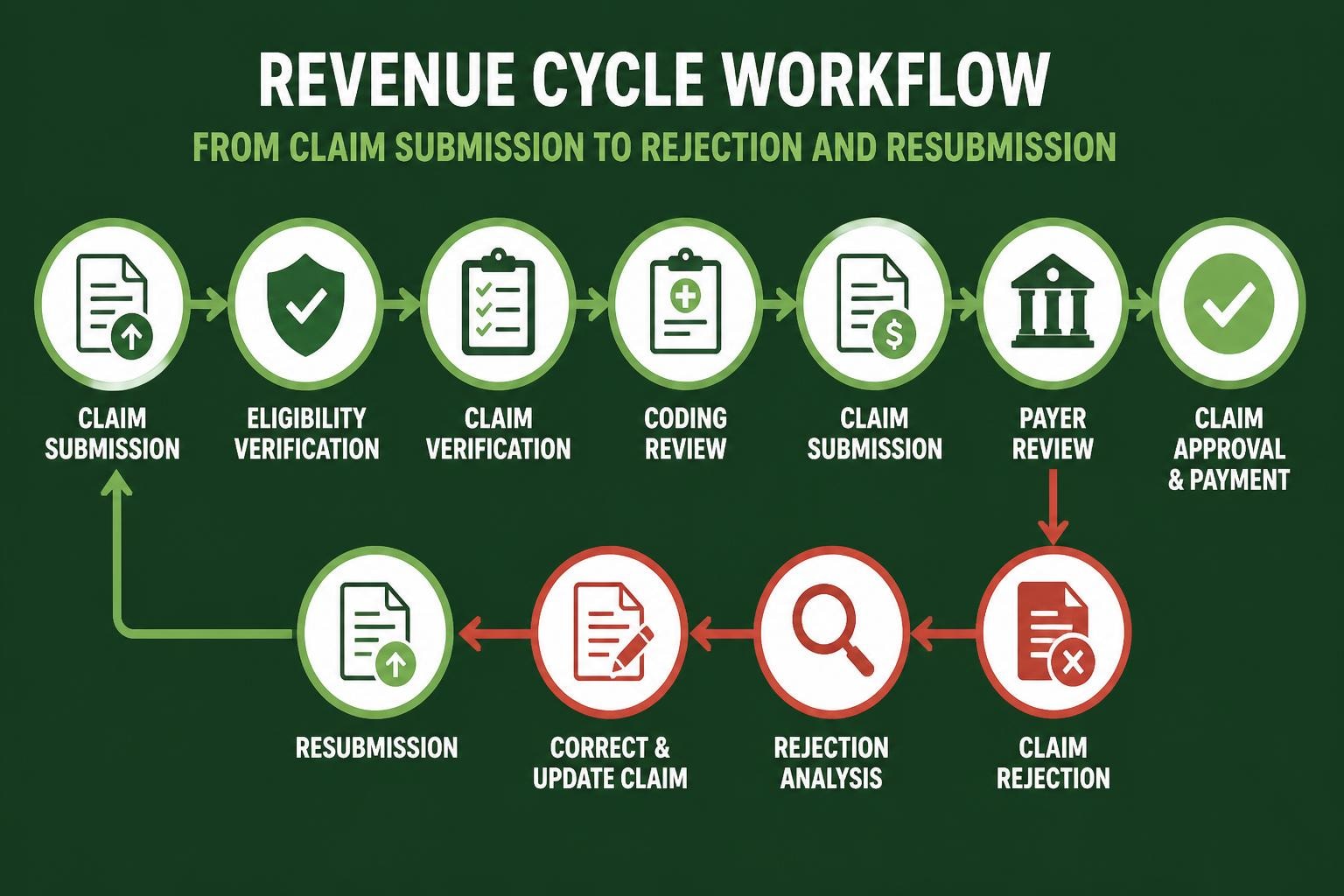
Rejected claims represent one of the most significant financial challenges facing healthcare providers today. When insurance companies return claims without processing them, practices face immediate revenue disruption, increased administrative burden, and delayed reimbursements. Understanding the distinction between rejections and denials, identifying common causes, and implementing preventive strategies can transform your practice's financial performance. This comprehensive guide explores the mechanics of rejected claims, their impact on revenue cycle management, and actionable solutions that healthcare organizations can implement to minimize losses and optimize cash flow.
Understanding Rejected Claims in Healthcare Revenue Cycle Management
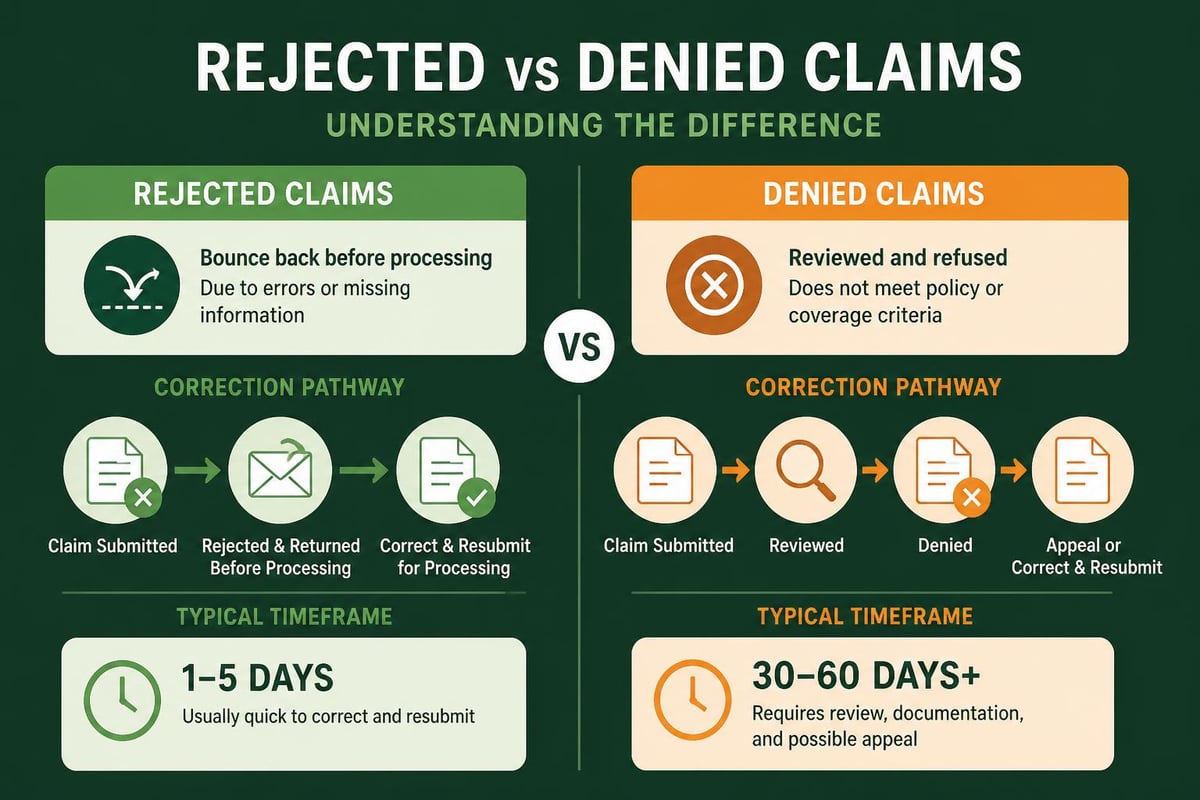
Rejected claims occur when insurance payers return submissions without processing them due to errors or missing information. Unlike denials, which represent processed claims that payers refuse to reimburse, rejections happen at the initial submission stage.
The financial impact extends beyond lost revenue. According to recent industry data, private payers deny 15% of claims initially, creating significant administrative overhead for healthcare practices. Rejected claims require correction and resubmission, consuming valuable staff time and delaying payment cycles.
Key Differences Between Rejections and Denials
Understanding these distinctions helps practices develop targeted intervention strategies:
| Aspect | Rejected Claims | Denied Claims |
|---|---|---|
| Processing Status | Not processed by payer | Processed but not paid |
| Correction Method | Fix errors and resubmit | Appeal with documentation |
| Timeframe Impact | Immediate correction possible | Subject to appeal deadlines |
| Revenue Impact | Delayed payment | Potential permanent loss |
Common Causes of Rejected Claims
Healthcare providers encounter rejected claims for numerous reasons, many of which stem from preventable errors in the submission process. Identifying these root causes enables practices to implement targeted quality control measures.
Patient Information Errors consistently rank among the top rejection reasons. Simple mistakes like transposed digits in policy numbers, misspelled names, or incorrect birthdates trigger automatic rejections. Insurance verification systems match submitted data against their databases with zero tolerance for discrepancies.
Coding Inaccuracies create substantial rejection volumes. Medical billing relies on precise CPT, ICD-10, and HCPCS codes that must align with documented services. Common reasons for claim denials include mismatched diagnosis and procedure codes, outdated code sets, and incorrect modifier usage.
Technical and Administrative Rejection Triggers
- Missing or invalid National Provider Identifier (NPI) numbers for rendering or referring providers
- Incorrect place of service codes that don't match the actual service location
- Duplicate claim submissions flagged by payer systems as potential billing errors
- Formatting errors in electronic claim files that fail clearinghouse edits
- Missing prior authorization numbers for services requiring pre-approval
Eligibility and Coverage Issues generate rejections when patients lack active coverage on service dates. Real-time eligibility verification services help practices confirm coverage before rendering services, preventing costly rejections downstream.
Financial Impact of Rejected Claims on Healthcare Practices
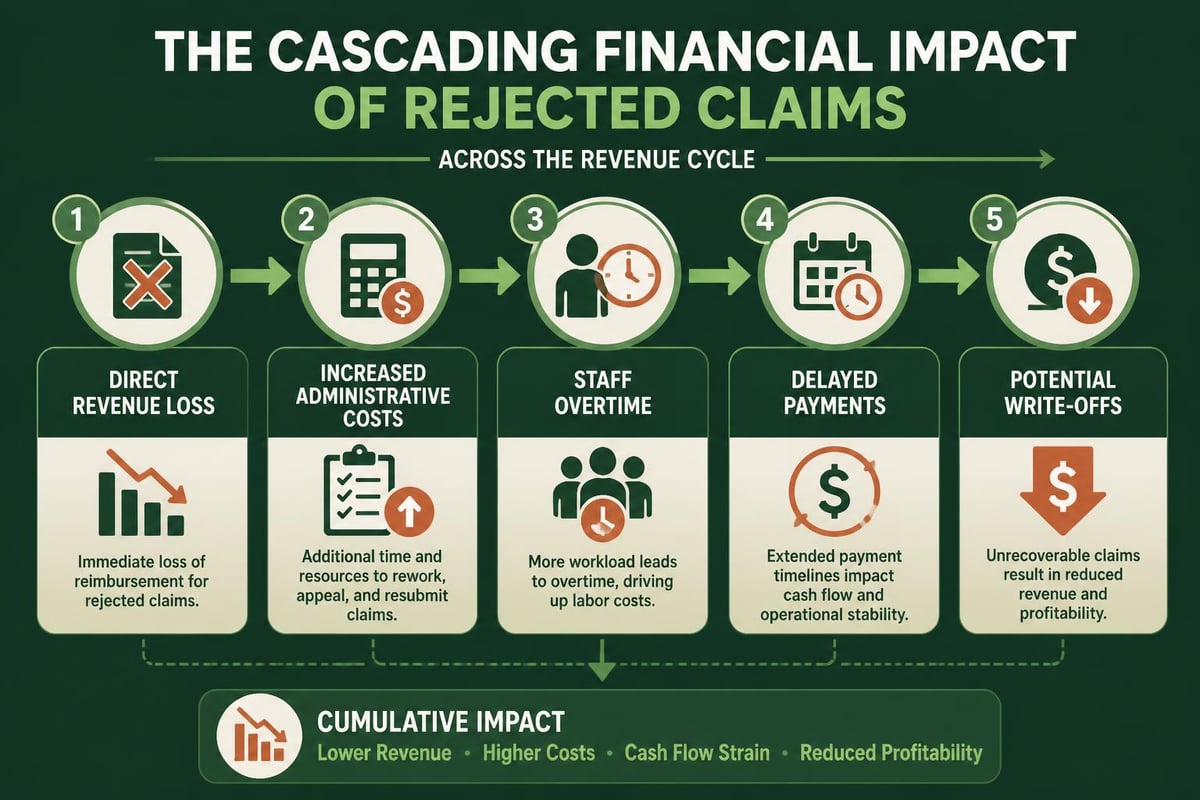
The true cost of rejected claims extends far beyond the face value of unpaid services. Healthcare organizations experience compound financial losses that affect both short-term cash flow and long-term operational efficiency.
Direct Revenue Loss occurs when rejected claims age beyond timely filing limits. Most insurance contracts specify submission deadlines ranging from 90 to 365 days from the service date. Claims rejected multiple times risk exceeding these windows, resulting in permanent write-offs.
Quantifying the Hidden Costs
Consider a mid-sized practice submitting 500 claims monthly with a 10% rejection rate:
| Cost Category | Monthly Impact | Annual Impact |
|---|---|---|
| Rejected Claim Volume | 50 claims | 600 claims |
| Average Claim Value | $250 | $250 |
| Potential Revenue at Risk | $12,500 | $150,000 |
| Staff Rework Hours (2 hrs/claim) | 100 hours | 1,200 hours |
| Labor Cost at $25/hour | $2,500 | $30,000 |
Administrative Burden multiplies when staff members dedicate hours to investigating rejections, correcting errors, and resubmitting claims. These activities divert resources from patient care and revenue-generating functions. Understanding how denial management in medical billing improves cash flow helps practices appreciate the strategic value of prevention.
Patient Satisfaction Decline accompanies rejected claims when patients receive unexpected bills for services they believed insurance would cover. These billing disputes damage provider-patient relationships and increase collection challenges.
Preventive Strategies to Reduce Rejected Claims
Successful rejection prevention requires systematic processes embedded throughout the revenue cycle. Healthcare organizations that implement comprehensive quality control measures significantly reduce rejection rates and accelerate reimbursement.
Front-End Verification Processes establish the foundation for clean claims. Training front-desk staff to collect accurate demographic and insurance information prevents downstream rejections. Digital intake forms with validation rules reduce transcription errors that plague manual data entry.
Step-by-Step Pre-Submission Quality Control
Step 1: Verify patient insurance eligibility in real-time at scheduling and check-in, confirming active coverage and benefit details.
Step 2: Collect complete demographic information including accurate spelling of patient names, current addresses, and valid policy numbers.
Step 3: Obtain necessary prior authorizations before service delivery, documenting approval numbers and covered service details.
Step 4: Review charge entry for coding accuracy, ensuring procedure codes match documented services and diagnosis codes support medical necessity.
Step 5: Run claims through clearinghouse edits before submission, catching formatting errors and common rejection triggers.
Technology Integration streamlines verification and validation processes. Modern practice management systems with built-in claim scrubbing functionality identify errors before submission. Integration with top medical billing software platforms provides real-time payer edits and validation rules.
Staff Training and Education create sustainable quality improvement. Regular updates on coding changes, payer-specific requirements, and common rejection patterns empower team members to prevent errors proactively. Cross-training ensures consistency across all billing staff members.
Managing and Recovering Rejected Claims
When rejected claims occur despite preventive measures, efficient management processes minimize revenue disruption and accelerate resolution. Structured workflows ensure timely correction and resubmission within payer deadlines.
Rejection Monitoring and Tracking begins with establishing clear accountability. Designated team members should review rejection reports daily, categorizing issues by root cause and prioritizing based on claim value and submission deadlines.
Effective Rejection Resolution Workflow
Successful practices implement standardized procedures for addressing rejections:
- Immediate triage upon receipt of rejection notices, sorting by complexity and urgency
- Root cause analysis to identify whether the issue stems from registration, coding, or technical errors
- Rapid correction using verified information sources and payer-specific requirements
- Quality assurance review before resubmission to prevent repeat rejections
- Follow-up tracking to confirm successful processing after resubmission
Payer-Specific Knowledge proves invaluable when resolving rejections. Insurance companies maintain unique formatting requirements, authorization processes, and documentation standards. Building reference guides for major payers reduces research time during corrections.
Performance Metrics and Reporting drive continuous improvement. Tracking rejection rates by payer, service type, provider, and root cause reveals patterns requiring intervention. Industry benchmarks suggest rejection rates below 5% indicate effective processes, while rates exceeding 10% signal systemic issues.
| Performance Metric | Target Range | Action Threshold |
|---|---|---|
| Overall Rejection Rate | < 5% | > 10% |
| Time to Rework Rejection | < 24 hours | > 48 hours |
| Repeat Rejection Rate | < 1% | > 3% |
| Aged Rejections (> 30 days) | 0% | > 5% |
Leveraging professional denial management services provides specialized expertise for complex rejections and systematic process improvement.
Leveraging Technology and Automation
Advanced technology solutions transform rejection management from reactive firefighting to proactive prevention. Healthcare organizations investing in automation and analytics achieve measurably lower rejection rates and faster revenue collection.
Automated Claim Scrubbing identifies errors before submission by comparing claim data against thousands of payer-specific edits. These systems flag missing information, invalid code combinations, and formatting issues that would trigger rejections. Real-time validation during charge entry prevents errors from entering the billing workflow.
Artificial Intelligence Applications analyze historical rejection patterns to predict high-risk claims. Machine learning algorithms identify subtle correlations between claim characteristics and rejection likelihood, enabling targeted quality reviews before submission.
Technology Components for Rejection Prevention
Modern revenue cycle technology stacks include:
- Eligibility verification platforms that automate real-time insurance coverage checks
- Electronic claim submission systems with built-in payer edits and validation rules
- Analytics dashboards visualizing rejection trends and performance metrics
- Workflow automation tools routing rejected claims to appropriate staff based on rejection reason
- Integrated documentation systems linking clinical notes to coding and billing functions
Electronic Remittance Advice (ERA) Processing accelerates rejection identification and response. Understanding what is ERA in medical billing and why it matters helps practices implement automated workflows that parse electronic rejection notices and trigger correction processes immediately.
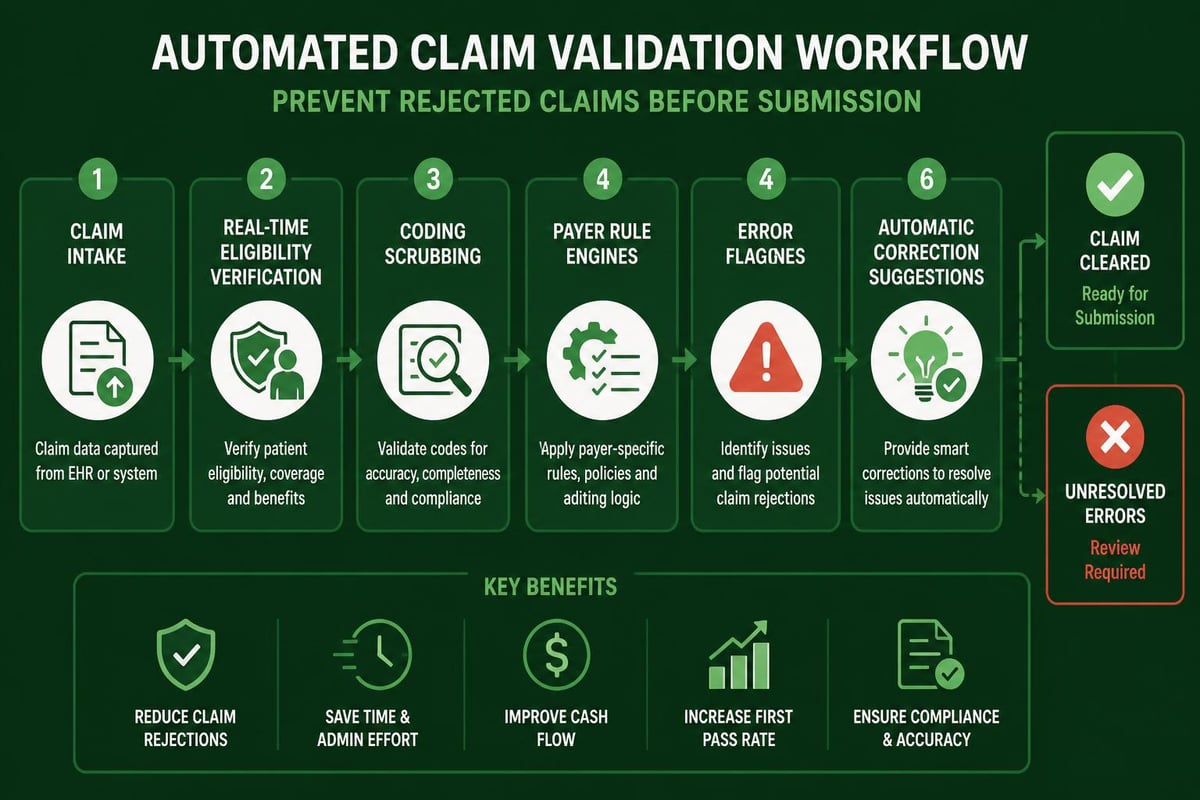
Integration Across Systems eliminates data silos that contribute to rejections. When electronic health records, practice management systems, and billing platforms share information seamlessly, demographic data, clinical documentation, and charge capture align naturally. This integration reduces manual data entry and associated transcription errors.
Industry Trends and Payer Behavior
Understanding broader industry trends helps healthcare providers anticipate challenges and adapt strategies accordingly. Payer behavior, regulatory changes, and market dynamics all influence rejection rates and resolution complexity.
Rising Denial and Rejection Rates across the industry create mounting pressure on provider revenue. Research shows claim denial rates among healthcare payers have increased steadily, with some insurers rejecting or denying more than 20% of submitted claims. These trends reflect increased payer scrutiny, more complex coverage requirements, and aggressive cost containment strategies.
Marketplace Plan Challenges present unique obstacles. Analysis indicates Healthcare.gov plans denied 20% of claims in recent periods, with rejection reasons spanning prior authorization failures, coverage exclusions, and administrative technicalities. Providers treating patients with marketplace coverage must implement specialized verification and documentation protocols.
Payer-Specific Variation in Rejection Patterns
Different insurance companies exhibit distinct rejection behaviors:
| Payer Characteristic | Impact on Rejections | Provider Strategy |
|---|---|---|
| Commercial National Plans | Standardized edits, consistent rules | Master core requirements, automate validation |
| Regional Plans | Unique formatting, local policies | Build payer-specific templates, maintain relationships |
| Government Programs | Strict compliance, detailed documentation | Ensure complete records, follow CMS guidelines |
| Managed Care Organizations | Authorization-heavy, care coordination requirements | Strengthen referral management, track authorizations |
Prior Authorization Complexity continues intensifying as payers expand services requiring pre-approval. Surprisingly, prior authorization services reveal that even pre-approved claims face rejection when authorization numbers aren't properly documented or when services deviate from approved parameters.
Regulatory Environment Changes periodically introduce new requirements affecting claim submission. Staying current with Centers for Medicare & Medicaid Services updates, state-specific mandates, and payer policy changes prevents rejections from regulatory non-compliance.
Building a Comprehensive Rejection Prevention Program
Sustainable rejection rate reduction requires holistic program development rather than isolated tactical fixes. Healthcare organizations achieving consistently low rejection rates embed quality throughout their revenue cycle operations.
Leadership Commitment establishes organizational priority and resource allocation. When executive teams recognize rejection prevention as strategic rather than tactical, they authorize necessary technology investments, staff training, and process redesign initiatives.
Core Components of Effective Programs
Successful rejection prevention programs incorporate these elements:
- Clear policies and procedures documented in accessible formats with regular updates
- Defined roles and responsibilities ensuring accountability at each revenue cycle stage
- Regular training programs covering coding updates, payer policy changes, and system enhancements
- Performance monitoring with transparent metrics shared across the organization
- Continuous improvement processes analyzing trends and implementing corrective actions
Cross-Functional Collaboration breaks down departmental barriers that contribute to rejections. Clinical staff documenting services, coding professionals translating documentation, and billing specialists submitting claims must communicate effectively. Regular team meetings reviewing rejection patterns foster collective problem-solving.
Vendor Partnerships extend internal capabilities. Many healthcare providers benefit from partnering with specialized medical billing services organizations that bring expertise, technology, and dedicated resources. These partnerships prove particularly valuable for smaller practices lacking internal billing infrastructure.
Patient Education Initiatives reduce rejections stemming from coverage misunderstandings. Clear communication about insurance requirements, prior authorization needs, and patient responsibilities prevents situations where services are rendered without proper coverage verification.
Advanced Tactics for Complex Rejection Scenarios
Certain rejection situations require specialized knowledge and strategic approaches beyond standard correction protocols. Healthcare providers facing complex cases benefit from advanced resolution tactics.
Multi-Payer Coordination challenges arise when patients have primary and secondary insurance coverage. Coordination of benefits errors trigger rejections when claims aren't submitted in proper sequence or lack required explanations of benefits from primary payers. Systematic tracking of secondary claim dependencies prevents these timing-related rejections.
Modifier Usage Precision becomes critical for services that might otherwise appear duplicative or bundled. Understanding types of modifiers in medical billing and applying them correctly differentiates legitimate separate services from billing errors in payer adjudication systems.
Specialized Rejection Categories and Solutions
Credentialing-Related Rejections occur when providers aren't recognized in payer systems or lack appropriate privileges for billed services. Proactive medical credentialing services maintain current provider enrollment across all relevant payer networks.
Timely Filing Disputes require careful documentation and appeals when practices believe rejections are unjust. Maintaining proof of original submission dates and correspondence creates leverage in these disputes.
Coordination with Third-Party Services like laboratories and durable medical equipment suppliers prevents rejections from incomplete or conflicting information. Establishing clear communication protocols with ancillary service providers ensures alignment on billing arrangements.
Specialty-Specific Challenges vary across medical disciplines. Surgical specialties face different rejection patterns than primary care practices. Tailoring approaches to specialty-specific requirements, such as specialized services for particular regions or practice types, improves outcomes.
Measuring Success and Continuous Improvement
Effective rejection management programs rely on comprehensive measurement frameworks that track performance, identify improvement opportunities, and demonstrate value. Healthcare organizations must establish both leading and lagging indicators to guide decision-making.
Key Performance Indicators provide objective assessment of rejection prevention effectiveness:
- First-pass acceptance rate measuring percentage of claims processed without rejection on initial submission
- Average days in accounts receivable tracking how quickly claims convert to cash
- Rejection rate by root cause identifying whether issues stem from registration, coding, or technical errors
- Staff productivity metrics evaluating claims processed per full-time equivalent and rework time required
- Clean claim rate calculating percentage of claims requiring no corrections or follow-up
Benchmarking Against Standards contextualizes performance. While individual practice characteristics influence achievable targets, industry standards suggest rejection rates below 5% indicate well-managed processes. Comparing performance to specialty-specific and regional benchmarks reveals relative strengths and improvement priorities.
Creating Actionable Dashboards
Effective reporting transforms data into insights:
| Metric Category | Reporting Frequency | Primary Users | Action Triggers |
|---|---|---|---|
| Daily Rejection Volume | Daily | Billing Staff | Volume spikes > 20% above baseline |
| Root Cause Distribution | Weekly | Billing Managers | New rejection reason appears |
| Payer Performance | Monthly | Revenue Cycle Leadership | Payer rejection rate > 10% |
| Financial Impact | Monthly | Executive Team | Revenue at risk > $25,000 |
Feedback Loops ensure continuous improvement by connecting data analysis to process modification. Regular review meetings where teams examine rejection trends, discuss root causes, and implement preventive measures create organizational learning. Documenting successful interventions builds institutional knowledge that prevents recurring issues.
Celebrating Improvements reinforces positive changes and sustains momentum. Recognizing staff contributions to rejection rate reductions, sharing success stories, and linking performance to organizational goals maintain engagement in quality initiatives.
Rejected claims create significant financial and operational challenges for healthcare providers, but implementing systematic prevention strategies, leveraging technology, and maintaining vigilant quality control dramatically reduce their occurrence and impact. Success requires commitment across the entire revenue cycle, from front-desk verification through final claim submission. Greenhive Billing Solutions specializes in comprehensive revenue cycle management services that address every aspect of rejection prevention and recovery, combining expert staff, proven processes, and advanced technology to maximize reimbursements and streamline operations for healthcare practices nationwide.

