
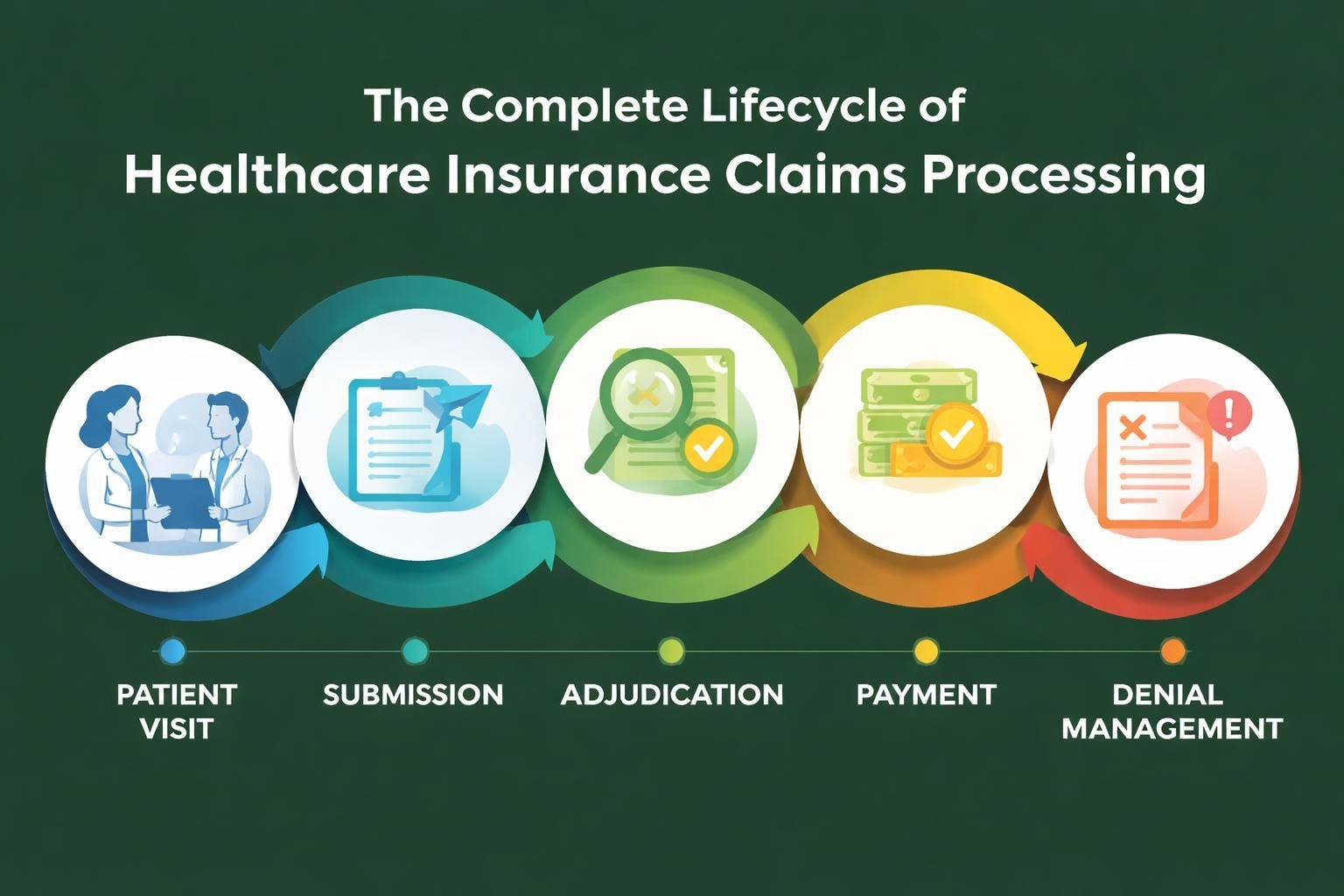
The financial health of healthcare organizations depends heavily on the efficiency and accuracy of their revenue cycle operations. At the core of this critical function lies claims processing in healthcare, a complex workflow that transforms patient encounters into reimbursable revenue. For healthcare providers, understanding every aspect of this process can mean the difference between steady cash flow and mounting accounts receivable. This comprehensive guide examines the fundamental components, common challenges, and best practices that define successful claims management in modern healthcare settings.
Understanding the Claims Processing Lifecycle
Claims processing in healthcare encompasses a series of interconnected steps that begin the moment a patient receives care and conclude when payment is received or a denial is resolved. The American Medical Association provides extensive resources on navigating these complex workflows effectively.
Pre-Service Verification and Authorization
Before claims processing in healthcare can even begin, accurate patient information collection forms the foundation. This initial stage includes:
- Insurance eligibility verification to confirm active coverage
- Prior authorization for services that require payer approval
- Demographic data accuracy to prevent downstream rejections
- Benefit verification to understand patient financial responsibility
Professional eligibility verification services help practices identify coverage issues before services are rendered. This proactive approach significantly reduces claim denials related to patient eligibility.
The authorization process varies by payer and procedure type. Some surgical procedures, advanced imaging, and specialty medications require explicit approval before services can be provided. Failing to obtain proper authorization often results in automatic claim denials, regardless of medical necessity.
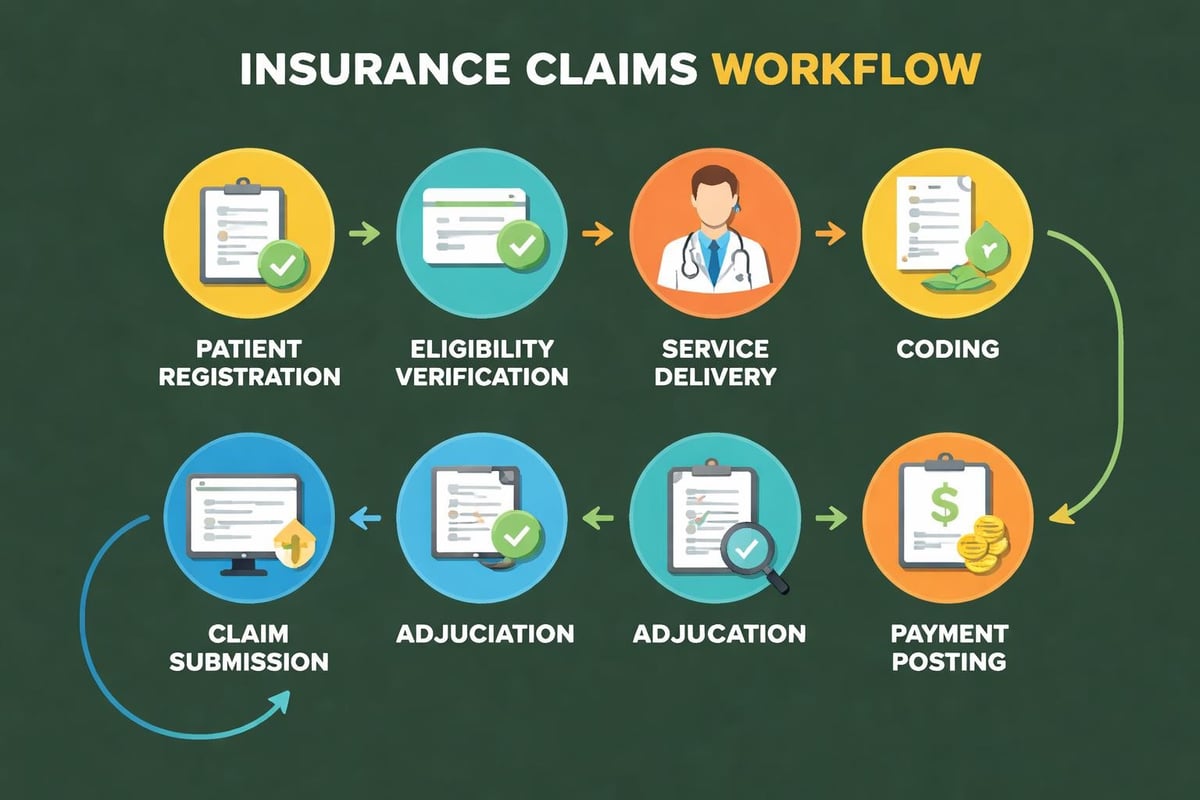
Documentation and Coding Accuracy
Medical coding serves as the universal language that translates clinical services into standardized codes for billing purposes. This critical component of claims processing in healthcare requires precision and comprehensive understanding of multiple coding systems.
The Role of Clinical Documentation
Accurate coding depends entirely on thorough clinical documentation. Physicians and clinical staff must record detailed information about:
- Patient symptoms and chief complaints
- Clinical findings from examinations
- Diagnostic test results and interpretations
- Treatment plans and procedures performed
- Medical decision-making complexity
- Follow-up care instructions
Clinical documentation improvement initiatives help bridge the gap between clinical care and accurate coding. When documentation lacks specificity, coders cannot assign the most accurate codes, potentially leading to underpayment or claim denials.
Coding Systems and Standards
Professional medical coders work with several coding systems simultaneously:
| Coding System | Purpose | Common Applications |
|---|---|---|
| CPT | Procedures and services | Physician services, outpatient procedures |
| ICD-10-CM | Diagnoses and conditions | Medical necessity, disease classification |
| HCPCS Level II | Supplies and equipment | Durable medical equipment, medications |
| Revenue Codes | Facility charging | Hospital departments, cost centers |
Understanding what CPT codes mean for insurance helps healthcare providers ensure proper service documentation and billing. Each code carries specific billing rules, bundling edits, and modifier requirements that affect reimbursement.
The complexity of different types of medical coding requires ongoing education and expertise to maintain compliance and optimize revenue.
Claim Submission Methods and Timing
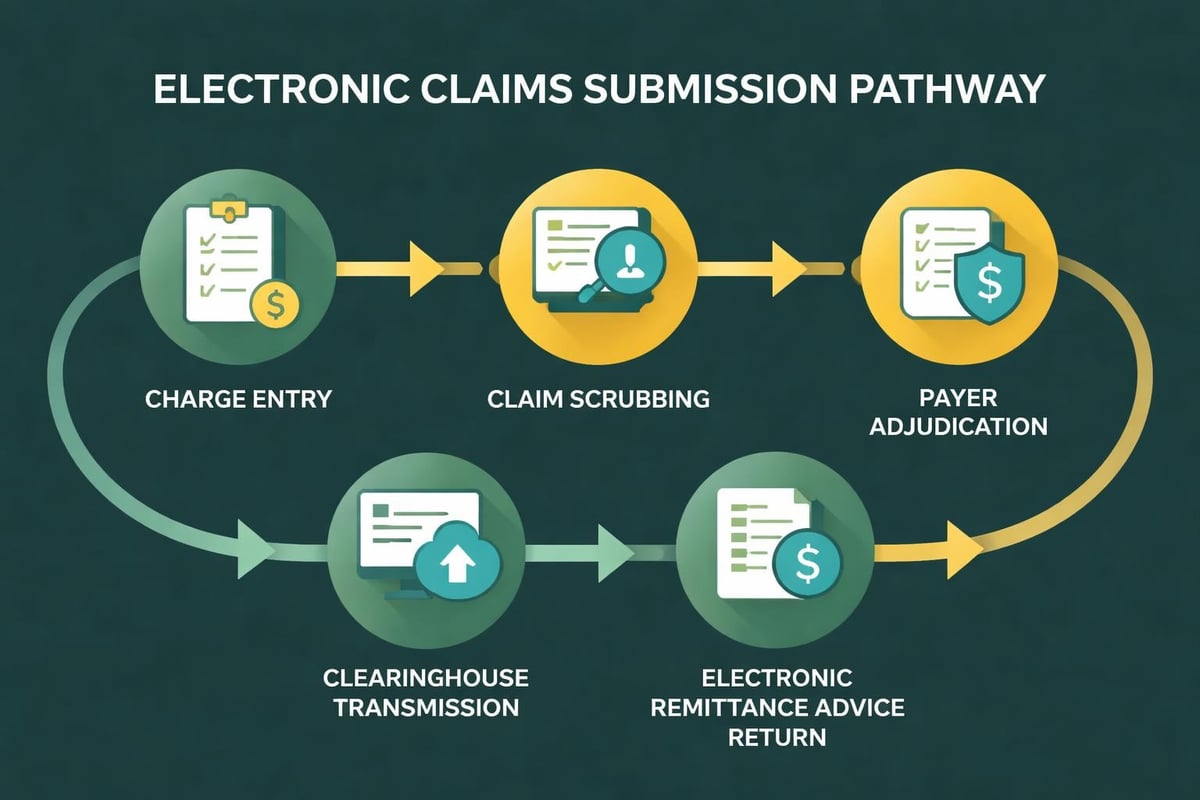
Once coding is complete, claims must be submitted to payers through established channels. Electronic claim submission has become the industry standard, offering speed and efficiency that paper claims cannot match.
Electronic vs. Paper Claims
Electronic data interchange (EDI) facilitates the vast majority of healthcare claims transactions. Benefits include:
- Faster processing times with turnaround in days rather than weeks
- Immediate validation through clearinghouses that check for errors
- Reduced administrative costs associated with paper handling
- Enhanced tracking capabilities for monitoring claim status
- Compliance with HIPAA requirements for electronic transactions
HIPAA regulations mandate specific standards for electronic healthcare transactions, including claims processing in healthcare. These standards ensure consistency and security across all electronic claim transmissions.
Timely Filing Requirements
Every insurance payer establishes specific deadlines for claim submission, known as timely filing limits. These requirements typically range from:
- 30 to 365 days from the date of service for commercial payers
- 90 to 365 days for Medicare and Medicaid programs
- Immediate to 90 days for workers' compensation claims
Missing these deadlines results in automatic denials, with limited appeal options. Professional medical claim submission services implement systematic processes to ensure all claims meet filing deadlines consistently.
Payer Adjudication Process
After submission, insurance payers evaluate claims through adjudication, a systematic review process that determines payment eligibility and amount. Understanding how payers adjudicate claims helps providers anticipate potential issues and structure claims for success.
Automated Claim Edits and Audits
Modern payer systems employ sophisticated algorithms to review claims instantly. These automated edits check for:
- Correct Coding Initiative (CCI) edits that identify unbundling
- Medical necessity validation against coverage policies
- Duplicate claim detection to prevent overpayment
- Coordination of benefits when multiple insurers are involved
Research on data quality assessments in claims databases demonstrates the importance of accurate data for proper adjudication. Clean, complete claims pass through automated edits smoothly, while problematic claims trigger manual review or automatic denials.
Medical Necessity and Coverage Determinations
Payers evaluate whether services meet medical necessity criteria based on established guidelines. This evaluation considers:
- Clinical appropriateness of the service for the diagnosis
- Policy coverage for the specific procedure or service
- Prior authorization compliance when required
- Frequency limitations on certain services
- Place of service requirements for particular procedures
When claims fail medical necessity review, payers issue denials that require clinical documentation to appeal successfully. Understanding revenue codes in medical billing helps ensure proper service categorization that supports medical necessity.
Payment Posting and Reconciliation
Successful claims processing in healthcare culminates in payment receipt and accurate posting to patient accounts. This stage requires attention to detail and thorough understanding of explanation of benefits (EOB) documents.
Understanding Payment Components
Insurance payments rarely match the originally billed amount. Several factors influence final payment:
| Payment Component | Definition | Impact on Revenue |
|---|---|---|
| Allowed Amount | Contracted rate for service | Determines maximum payment |
| Contractual Adjustment | Difference between billed and allowed | Write-off per contract |
| Deductible | Patient's annual out-of-pocket requirement | Transferred to patient balance |
| Coinsurance | Patient's percentage of allowed amount | Collected from patient |
| Copayment | Fixed patient payment per service | Due at time of service |
Understanding what adjustments on medical bills mean ensures accurate financial reporting and proper revenue recognition. The distinction between contractual adjustments and other write-offs affects how practices analyze their financial performance.
Professional payment posting services ensure that every payment component is correctly applied to patient accounts. This accuracy supports appropriate patient billing and financial analysis.
Electronic Remittance Advice (ERA)
Electronic payment posting through ERA files streamlines the reconciliation process significantly. Benefits include:
- Automated posting that reduces manual data entry
- Improved accuracy with fewer transcription errors
- Faster processing of large payment batches
- Enhanced reporting capabilities for financial analysis
Understanding what ERA means in medical billing helps practices leverage this technology for operational efficiency. ERA adoption represents a significant advancement in claims processing in healthcare operations.
Denial Management and Appeals
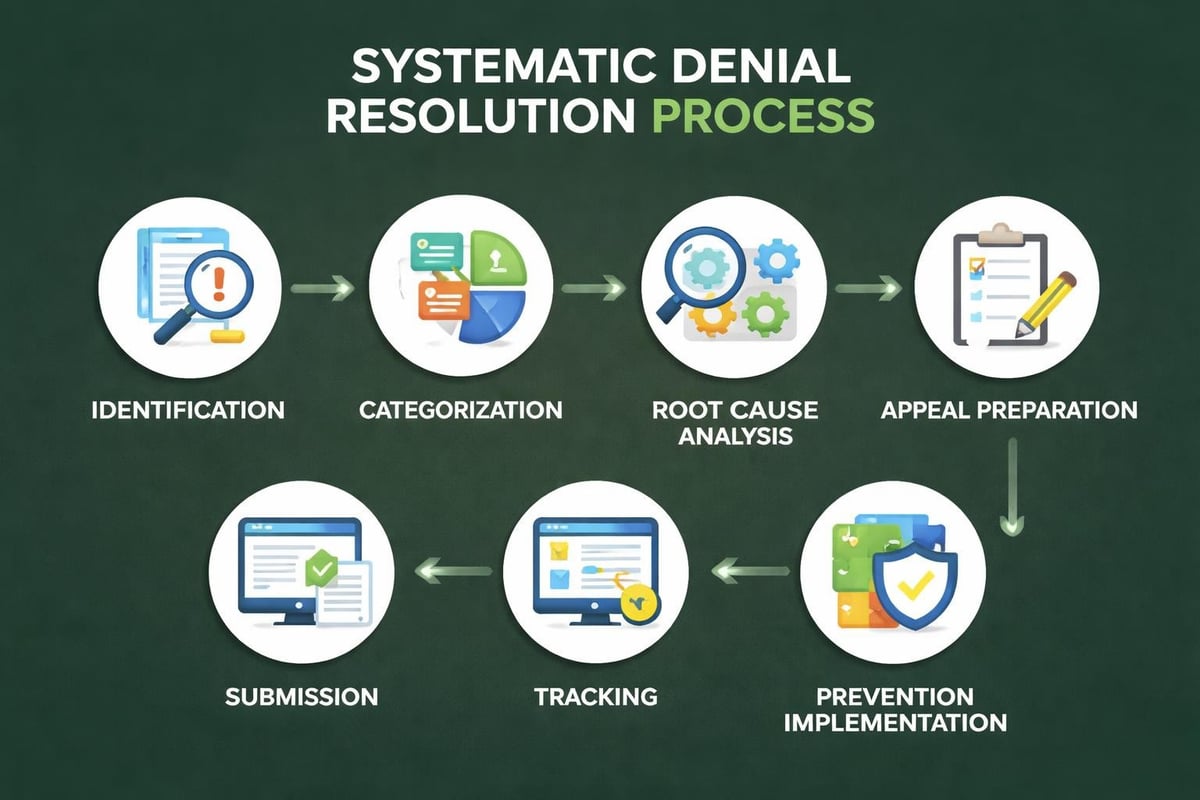
Despite best efforts, claim denials occur regularly in healthcare revenue cycle operations. Effective denial management transforms these setbacks into recovered revenue through systematic analysis and appeals processes.
Common Denial Categories
Healthcare providers encounter various denial types that require different resolution strategies:
- Technical denials from incorrect patient information or coding errors
- Authorization denials when prior approval was not obtained
- Timely filing denials for claims submitted after deadlines
- Medical necessity denials questioning clinical appropriateness
- Duplicate claim denials when services appear previously billed
- Non-covered service denials for services excluded from coverage
Research on denial management strategies highlights the importance of systematic approaches to prevention and resolution. Professional denial management services implement proven workflows that maximize recovery rates.
Understanding how denial management improves cash flow demonstrates the financial impact of effective appeals processes. Many denied claims can be overturned with proper documentation and persistent follow-up.
The Appeals Process
Successful appeals require structured workflows and thorough documentation:
- Identify the denial reason from the explanation of benefits
- Gather supporting documentation including clinical notes and policies
- Draft a compelling appeal letter addressing the specific denial rationale
- Submit within payer-specified timeframes to preserve appeal rights
- Track appeal status and escalate to higher levels if necessary
Each payer establishes specific appeal levels and timeframes. First-level appeals typically allow 30-90 days from denial receipt. If unsuccessful, providers can escalate to second-level appeals and potentially external review.
Compliance and Regulatory Considerations
Claims processing in healthcare operates within a complex regulatory environment that demands ongoing vigilance and adaptation. Healthcare providers must navigate federal regulations, payer-specific requirements, and industry standards simultaneously.
HIPAA Transaction Standards
The Health Insurance Portability and Accountability Act establishes standardized formats for electronic healthcare transactions. These standards ensure:
- Consistent data formats across all trading partners
- Enhanced security measures protecting patient information
- Streamlined processing through uniform structures
- Reduced administrative burden from standardization
Compliance with these standards is mandatory for all covered entities participating in electronic claims processing in healthcare. Non-compliance can result in significant penalties and transaction rejection.
Fraud and Abuse Prevention
Healthcare billing regulations aim to prevent fraudulent activities and inappropriate billing practices. Key considerations include:
- Accurate code assignment reflecting actual services provided
- Proper modifier usage indicating service circumstances
- Appropriate unbundling only when clinically justified
- Correct place of service matching actual care location
Understanding types of modifiers in medical billing helps prevent inadvertent billing errors that could be construed as fraudulent. Even unintentional errors can trigger audits and compliance reviews.
Common mistakes like errors with modifier 59 demonstrate how specific coding conventions require specialized knowledge. Proper education and quality assurance processes protect providers from compliance risks.
Technology and Automation in Claims Processing
Emerging technologies continue transforming claims processing in healthcare, offering unprecedented accuracy and efficiency. Healthcare providers increasingly leverage advanced tools to optimize their revenue cycle operations.
Artificial Intelligence and Machine Learning
Recent research on hybrid architectures for healthcare claim processing demonstrates how AI can improve accuracy and speed. These technologies enable:
- Automated coding suggestions based on clinical documentation
- Predictive denial analytics identifying high-risk claims
- Natural language processing extracting data from clinical notes
- Pattern recognition detecting coding inconsistencies
While these technologies show promise, human expertise remains essential for complex cases and nuanced decision-making. The optimal approach combines technological efficiency with professional judgment.
Blockchain and Enhanced Security
Innovative approaches like blockchain-integrated frameworks offer potential solutions for enhanced privacy and security in claims processing. These emerging technologies address growing concerns about data protection and transaction integrity.
Best Practices for Optimizing Claims Performance
Successful claims processing in healthcare requires systematic approaches and continuous improvement initiatives. Healthcare organizations that implement structured best practices achieve superior financial outcomes.
Front-End Revenue Cycle Excellence
Preventing claim issues begins before service delivery:
- Comprehensive staff training on registration and verification protocols
- Real-time eligibility verification at every patient encounter
- Prior authorization tracking with automated reminder systems
- Patient financial counseling establishing clear payment expectations
These proactive measures significantly reduce downstream claim issues and accelerate payment cycles.
Quality Assurance Programs
Systematic claim review processes identify errors before submission:
- Pre-submission claim scrubbing using automated editing software
- Random manual audits of coded claims for accuracy
- Coder education programs addressing common error patterns
- Feedback loops connecting denials to coding improvements
- Regular compliance reviews ensuring regulatory adherence
Professional medical coding audit services provide objective assessments of coding accuracy and compliance risks. These independent reviews identify improvement opportunities and mitigate audit exposure.
Performance Monitoring and Analytics
Data-driven decision-making requires robust reporting capabilities:
| Key Performance Indicator | Target Range | Significance |
|---|---|---|
| Clean claim rate | 95-98% | First-pass payment success |
| Days in A/R | 30-40 days | Collection efficiency |
| Denial rate | 5-10% | Process effectiveness |
| Appeal success rate | 50-65% | Denial management quality |
| Net collection rate | 95-99% | Overall revenue capture |
Professional reporting and analytics services transform raw data into actionable insights. Regular performance review enables targeted improvement initiatives and resource allocation.
Specialty-Specific Considerations
Different medical specialties face unique challenges in claims processing in healthcare. Understanding these specialty-specific requirements ensures optimal reimbursement.
High-Complexity Specialties
Certain specialties encounter particularly complex billing scenarios:
- Cardiology requires precise coding for multiple procedures and technical/professional components
- Surgery demands detailed operative note documentation and modifier expertise
- Radiology involves complex bundling rules and contrast administration coding
- Oncology necessitates chemotherapy administration tracking and medication coding
Specialty-focused billing expertise ensures compliance with specialty-specific guidelines and maximizes appropriate reimbursement.
Small Practice Challenges
Smaller healthcare practices face resource constraints that affect claims processing capabilities. Common challenges include:
- Limited billing staff handling multiple revenue cycle functions
- Technology constraints with outdated practice management systems
- Knowledge gaps in complex payer requirements
- Cash flow pressures from delayed payments
Solutions like medical billing services for small practices provide enterprise-level capabilities without the overhead of in-house departments. Outsourcing allows providers to focus on patient care while experts handle revenue cycle complexities.
Payer-Specific Requirements and Variations
Each insurance payer establishes unique requirements for claims processing in healthcare. Successful billing operations must accommodate this variation while maintaining efficient workflows.
Commercial Payer Considerations
Private insurance companies implement proprietary policies that affect claim handling:
- Unique claim formats beyond standard EDI requirements
- Proprietary medical policies governing coverage determinations
- Variable timely filing limits ranging from 90 to 365 days
- Specific documentation requirements for procedure authorization
Maintaining current knowledge of payer-specific requirements demands ongoing education and reference material updates.
Government Program Requirements
Medicare and Medicaid programs establish comprehensive regulations affecting claims submission:
- National Coverage Determinations (NCDs) defining covered services
- Local Coverage Determinations (LCDs) varying by geographic region
- Correct Coding Initiative (CCI) edits preventing inappropriate unbundling
- Medical necessity documentation standards supporting service provision
These programs undergo frequent policy updates requiring continuous monitoring and workflow adjustments.
Staff Training and Development
Human expertise remains the cornerstone of effective claims processing in healthcare. Investing in staff development yields measurable returns through improved accuracy and efficiency.
Essential Competencies
Successful billing and coding professionals require diverse skills:
- Medical terminology understanding clinical language
- Anatomy and physiology comprehending body systems and procedures
- Coding system mastery across CPT, ICD-10, and HCPCS
- Payer policy knowledge navigating coverage requirements
- Software proficiency operating practice management systems
- Attention to detail catching errors before submission
Understanding what billing and coding specialists do highlights the complexity of these professional roles. Many providers underestimate the expertise required for optimal performance.
Ongoing Education Requirements
The healthcare billing landscape evolves continuously, requiring commitment to ongoing learning:
- Annual coding updates implementing new CPT and ICD-10 codes
- Regulatory changes affecting billing practices and compliance
- Payer policy modifications changing coverage determinations
- Technology advancements introducing new tools and capabilities
Professional certification maintenance requires continuing education credits, ensuring certified professionals stay current with industry developments.
Mastering the complexities of claims processing in healthcare requires specialized knowledge, systematic workflows, and continuous attention to regulatory compliance. Healthcare providers who optimize these processes achieve stronger financial performance, reduced administrative burden, and improved cash flow stability. Greenhive Billing Solutions brings comprehensive revenue cycle management expertise to healthcare organizations across the United States, delivering specialized claims processing support that maximizes reimbursements while ensuring compliance. Our experienced team adapts to your existing systems and workflows, providing the professional capabilities needed to transform your revenue cycle performance without the overhead of expanding in-house departments.

