
Revenue codes serve as the backbone of accurate hospital billing, translating complex medical services into standardized categories that payers can process efficiently. Among these codes, rev code 360 stands out as one of the most frequently used yet commonly misunderstood billing designations in healthcare facilities. Understanding this code’s proper application ensures accurate reimbursement and prevents costly claim denials that can significantly impact your revenue cycle performance.
Understanding What Rev Code 360 Represents
Rev code 360 designates general operating room services on UB-04 claim forms submitted by hospitals and surgical centers. This classification encompasses the use of the operating room facility itself, including overhead costs associated with maintaining sterile surgical environments. The code specifically captures facility charges rather than professional services performed by surgeons or anesthesiologists.
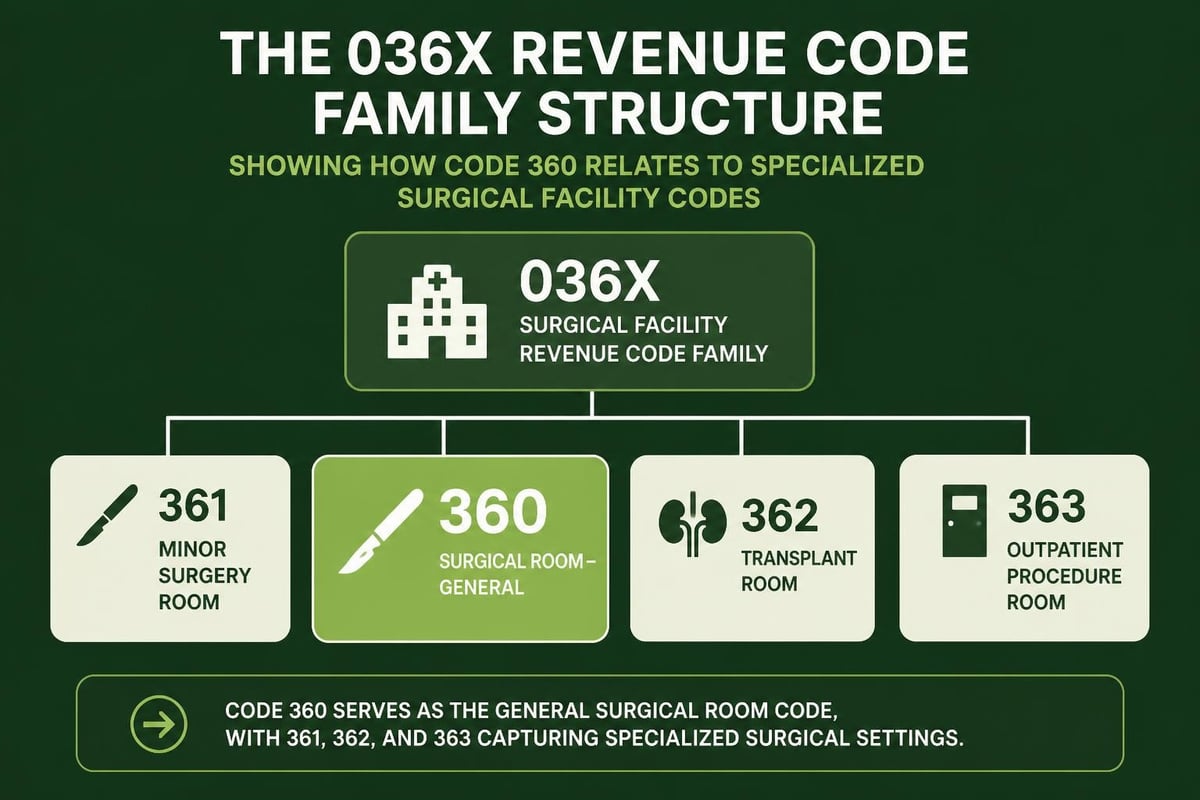
Healthcare providers must recognize that this code represents a broader category within the 036X series. According to the National Uniform Billing Committee (NUBC), which maintains official revenue code standards, the 360-369 range encompasses various operating room-related services. The general designation provides flexibility while maintaining standardized reporting across different facility types and surgical procedures.
The 036X Revenue Code Family
The operating room revenue code series includes several specific designations that work in conjunction with rev code 360:
- 360: General operating room classification
- 361: Minor surgery or treatment room charges
- 362: Operating room for organ transplantation procedures
- 367: Surgical procedure room for outpatient or ambulatory procedures
- 369: Other operating room services not classified elsewhere
Understanding these distinctions ensures proper claim categorization and supports successful revenue cycle management processes across your organization.
When Healthcare Facilities Should Apply Rev Code 360
Proper application timing determines whether claims process smoothly or trigger denials requiring extensive follow-up. Rev code 360 applies whenever a patient receives surgical services requiring a dedicated operating room with specialized equipment, sterile conditions, and appropriate staffing levels.
| Service Type | Use Rev Code 360 | Alternative Code |
|---|---|---|
| Major inpatient surgery | Yes | N/A |
| Complex outpatient procedures in OR | Yes | N/A |
| Minor procedures in treatment room | No | Use 361 |
| Organ transplant surgery | No | Use 362 |
| Ambulatory surgical center procedures | Varies | Use 367 if applicable |
The Centers for Medicare & Medicaid Services’ Medicare Claims Processing Manual provides detailed guidance on appropriate revenue code selection. Healthcare facilities must review these standards regularly to maintain compliance with evolving billing requirements.
Documentation Requirements for Rev Code 360
Supporting documentation determines whether claims withstand payer scrutiny during audits and reviews. Each rev code 360 charge requires comprehensive records including:
- Operative reports detailing the procedure performed and surgical approach
- Anesthesia records documenting time and medications administered
- Nursing documentation confirming patient preparation and intraoperative care
- Equipment logs tracking specialized instruments and devices utilized
- Time stamps verifying actual operating room utilization periods
These elements create the foundation for defensible claims that align with denial management best practices throughout your billing operations.
Common Billing Errors With Rev Code 360
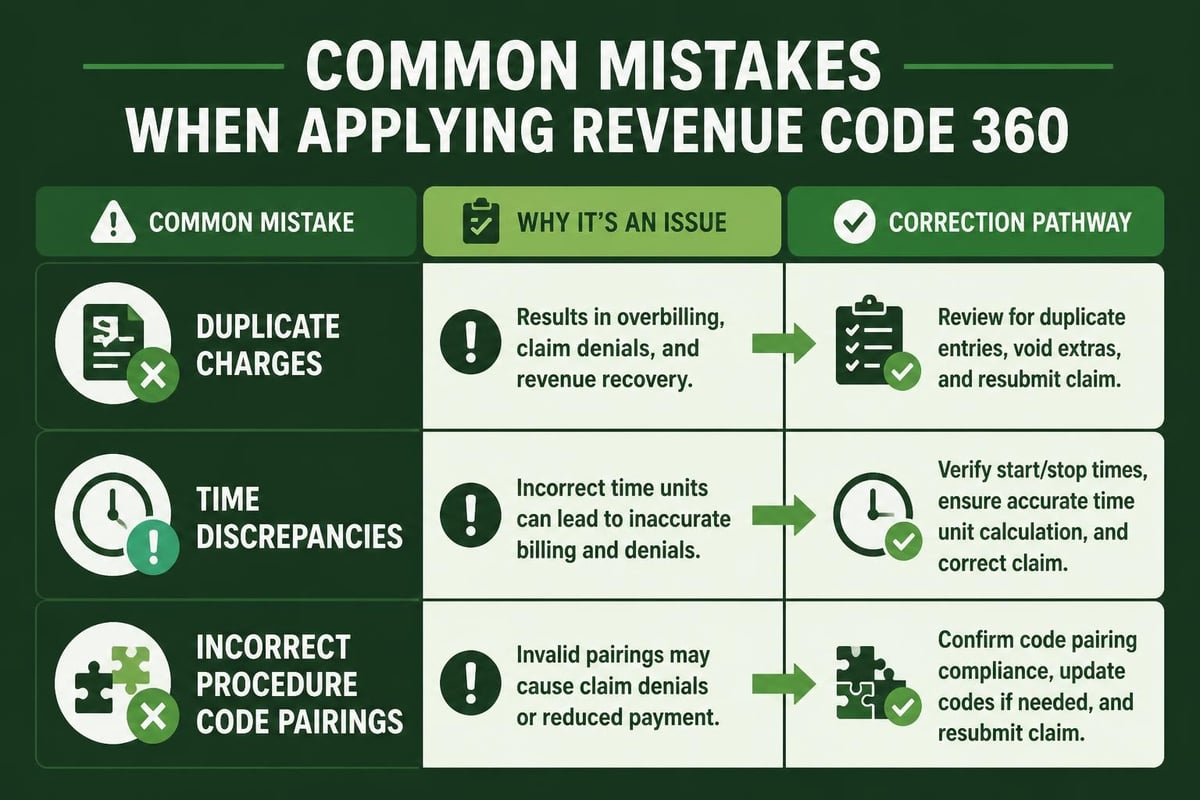
Healthcare facilities frequently encounter claim rejections stemming from preventable coding mistakes. Recognizing these patterns enables proactive correction before submission, reducing days in accounts receivable and accelerating cash flow.
Duplicate charging represents the most prevalent error. Facilities sometimes bill both rev code 360 for general operating room services and more specific codes within the same family. Payers typically reject such claims as duplicative, requiring resubmission with corrected coding.
Time-based discrepancies create another common problem. When billed operating room time conflicts with documented procedure duration or anesthesia records, claims trigger automatic reviews. Resolving these issues requires coordination between surgical services, anesthesia departments, and billing teams to ensure consistent documentation across all records.
Incorrect Code Pairing Issues
Rev code 360 must align with appropriate CPT codes representing the surgical procedures performed. Mismatches between facility codes and procedure codes signal billing errors to payer systems.
- Orthopedic procedures requiring specific equipment documentation
- Cardiovascular surgeries with specialized monitoring requirements
- Neurosurgical cases demanding particular sterile protocols
- Transplant services that should utilize code 362 instead
- Endoscopic procedures potentially performed outside traditional ORs
Understanding these relationships prevents denials and supports efficient claims processing workflows within your organization.
Rev Code 360 Versus Related Operating Room Codes
Distinguishing between similar revenue codes prevents confusion and ensures accurate claim submission. While rev code 360 serves as the general operating room designation, specific clinical scenarios require alternative codes from the same family.
Code 361 applies to minor surgical procedures performed in treatment rooms rather than full operating suites. These services typically involve lower overhead costs and less complex equipment requirements. Examples include simple laceration repairs, minor excisions, and basic endoscopic procedures not requiring general anesthesia.
| Revenue Code | Facility Type | Typical Procedures | Anesthesia Level |
|---|---|---|---|
| 360 | Major operating room | Complex surgeries | General/regional |
| 361 | Minor surgery room | Simple excisions | Local/moderate sedation |
| 362 | Transplant OR | Organ transplants | General |
| 367 | Ambulatory procedure room | Outpatient surgeries | Varies |
Code 362 specifically designates organ transplantation procedures requiring specialized facilities and extensive support systems. These cases involve unique documentation requirements and often trigger additional payer review due to their high-cost nature.
Ambulatory Surgery Center Considerations
Facilities operating as ambulatory surgery centers face unique coding decisions regarding rev code 360. The what are revenue codes in medical billing resource explains how facility classification influences code selection.
Outpatient departments within hospitals typically use code 360 for qualifying procedures, while freestanding ASCs may utilize code 367 depending on payer contracts and facility registration. Verifying correct classification with individual payers prevents future disputes and supports consistent reimbursement patterns.
Maximizing Reimbursement With Proper Rev Code 360 Usage
Strategic revenue code application directly impacts financial performance across surgical service lines. Healthcare facilities that implement systematic coding practices experience faster payment cycles and reduced denial rates compared to organizations with inconsistent approaches.
Pre-procedure verification establishes the foundation for accurate coding. Before scheduling surgical cases, facilities should confirm:
- Patient insurance coverage and authorization requirements
- Specific payer billing guidelines for the planned procedure
- Required documentation elements for the selected revenue code
- Appropriate time increments for operating room charges
- Bundling rules that may affect separate billing opportunities
This proactive approach aligns with comprehensive eligibility verification services that prevent downstream billing complications.
Time-Based Charging Strategies
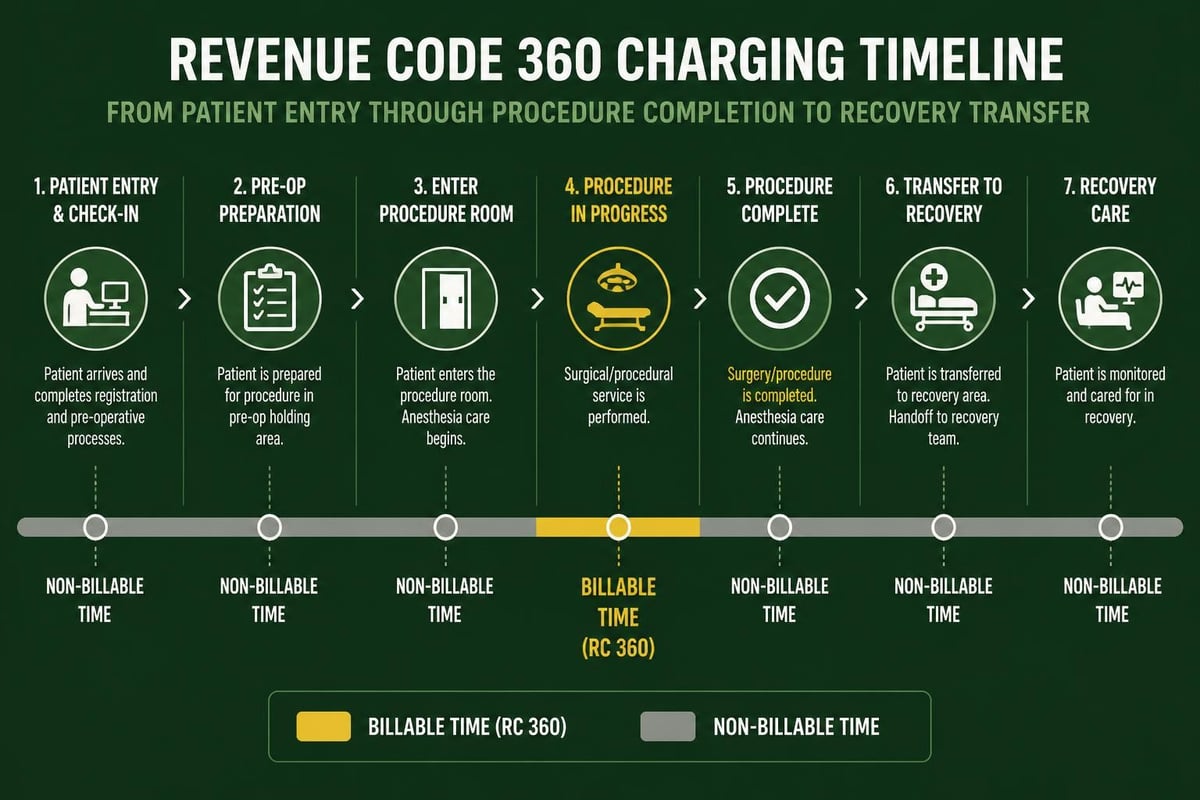
Most payers reimburse rev code 360 based on documented operating room time rather than flat facility fees. Accurate time capture maximizes legitimate reimbursement while maintaining compliance with billing regulations.
Operating room time typically begins when the patient enters the surgical suite and concludes when they depart for recovery areas. However, specific payer definitions may vary, requiring familiarity with individual contract terms. Some insurers exclude pre-procedure preparation time, while others incorporate it into reimbursable periods.
Handling Rev Code 360 Claim Denials
Despite careful coding practices, claim denials remain an inevitable aspect of healthcare revenue cycle management. Effective denial response protocols minimize financial impact and accelerate resolution timelines.
Medical necessity denials represent a frequent challenge with rev code 360 charges. Payers may question whether procedures required full operating room facilities or could have been performed in less intensive settings. Responding successfully requires comprehensive documentation demonstrating clinical justification for facility selection.
Supporting appeals should include:
- Physician attestation regarding medical necessity
- Clinical guidelines supporting operating room utilization
- Patient-specific factors necessitating enhanced monitoring
- Equipment requirements unavailable in alternative settings
- Complication risk factors requiring immediate surgical capability
These elements create compelling cases for overturning inappropriate denials through systematic denial management approaches.
Coding Audit Findings and Corrections
Regular internal audits identify patterns requiring corrective action before external reviews uncover compliance issues. When audits reveal rev code 360 misapplication, facilities should implement immediate remediation strategies.
Retrospective claim reviews determine whether coding errors represent isolated incidents or systematic problems requiring comprehensive staff retraining. Documentation improvements often resolve recurring issues more effectively than repeated individual claim corrections.
Training Staff on Rev Code 360 Best Practices
Consistent coding accuracy requires ongoing education for all team members involved in surgical billing processes. Revenue cycle staff, clinical documentation specialists, and surgical services personnel all contribute to proper rev code 360 application.
Role-specific training modules address unique perspectives and responsibilities:
- Surgical schedulers learn pre-authorization requirements and insurance verification protocols
- OR nurses understand documentation standards supporting facility charges
- Coders master revenue code selection criteria and payer-specific guidelines
- Billers recognize common denial triggers and prevention strategies
- Revenue cycle managers monitor key performance indicators tracking coding accuracy
This comprehensive approach ensures organizational alignment around billing best practices that support financial sustainability.
Creating Standardized Coding References
Quick reference guides placed strategically throughout surgical departments provide real-time support during critical decision points. These tools should outline:
- Decision trees for selecting between related revenue codes
- Payer-specific requirements for major insurance contracts
- Documentation checklist items required for each code
- Common denial reasons with prevention tips
- Contact information for coding support resources
Regular updates maintain relevance as billing requirements evolve and organizational processes improve through experience.
Technology Solutions Supporting Rev Code 360 Accuracy
Modern practice management and electronic health record systems incorporate features designed to enhance revenue code selection accuracy. Automated coding suggestions based on documented procedures reduce manual errors while accelerating claim preparation timelines.
Integration between clinical documentation and billing systems ensures consistency across patient records. When operative reports automatically populate billing screens, coders access complete information without manually searching multiple systems. This seamless data flow supports accurate rev code 360 application while reducing administrative burden on billing staff.
Charge capture automation prevents missed billing opportunities by systematically reviewing surgical cases against standard charge masters. These systems flag procedures lacking appropriate facility charges, prompting review before claims submission. The technology particularly benefits high-volume surgical programs where manual oversight becomes challenging.
| Technology Feature | Accuracy Benefit | Efficiency Gain |
|---|---|---|
| Automated code suggestions | Reduces selection errors | Faster claim creation |
| Clinical documentation integration | Improves coding support | Eliminates duplicate entry |
| Charge capture automation | Prevents missed charges | Systematic case review |
| Payer rule engines | Ensures contract compliance | Reduces denials |
| Analytics dashboards | Identifies coding patterns | Enables proactive correction |
Real-time eligibility verification integrated with scheduling workflows prevents authorization issues that later complicate rev code 360 reimbursement. When systems automatically confirm coverage before procedures occur, facilities avoid situations where services are provided but payment proves problematic due to insurance status problems.
Monitoring Rev Code 360 Performance Metrics
Strategic revenue cycle management requires systematic tracking of key performance indicators specific to surgical billing operations. Healthcare organizations should establish dashboards monitoring rev code 360 utilization patterns, denial rates, and reimbursement trends across different payer categories.
Clean claim rates measure the percentage of rev code 360 charges accepted upon initial submission without requiring additional information or corrections. Industry benchmarks suggest high-performing organizations achieve clean claim rates exceeding 95% for surgical facility charges. Lower performance indicates opportunities for process improvement through enhanced staff training or technology optimization.
Days in accounts receivable specifically related to operating room charges reveals collection efficiency. Extended timelines may signal coding issues requiring attention, authorization problems delaying payment, or payer-specific complications necessitating contract renegotiation.
Denial rate trending by specific payer identifies problematic relationships requiring focused attention. When particular insurers consistently reject rev code 360 charges that other payers routinely accept, the pattern suggests potential contract language ambiguity or systematic billing approach misalignment with that payer’s unique requirements.
Mastering rev code 360 application creates a foundation for successful surgical revenue cycle performance, ensuring your facility receives appropriate reimbursement for the complex services you provide. When healthcare organizations need expert support managing the intricacies of hospital billing, claims processing, and denial resolution, Greenhive Billing Solutions delivers comprehensive revenue cycle management services designed to optimize financial outcomes while allowing clinical teams to focus on patient care.

