
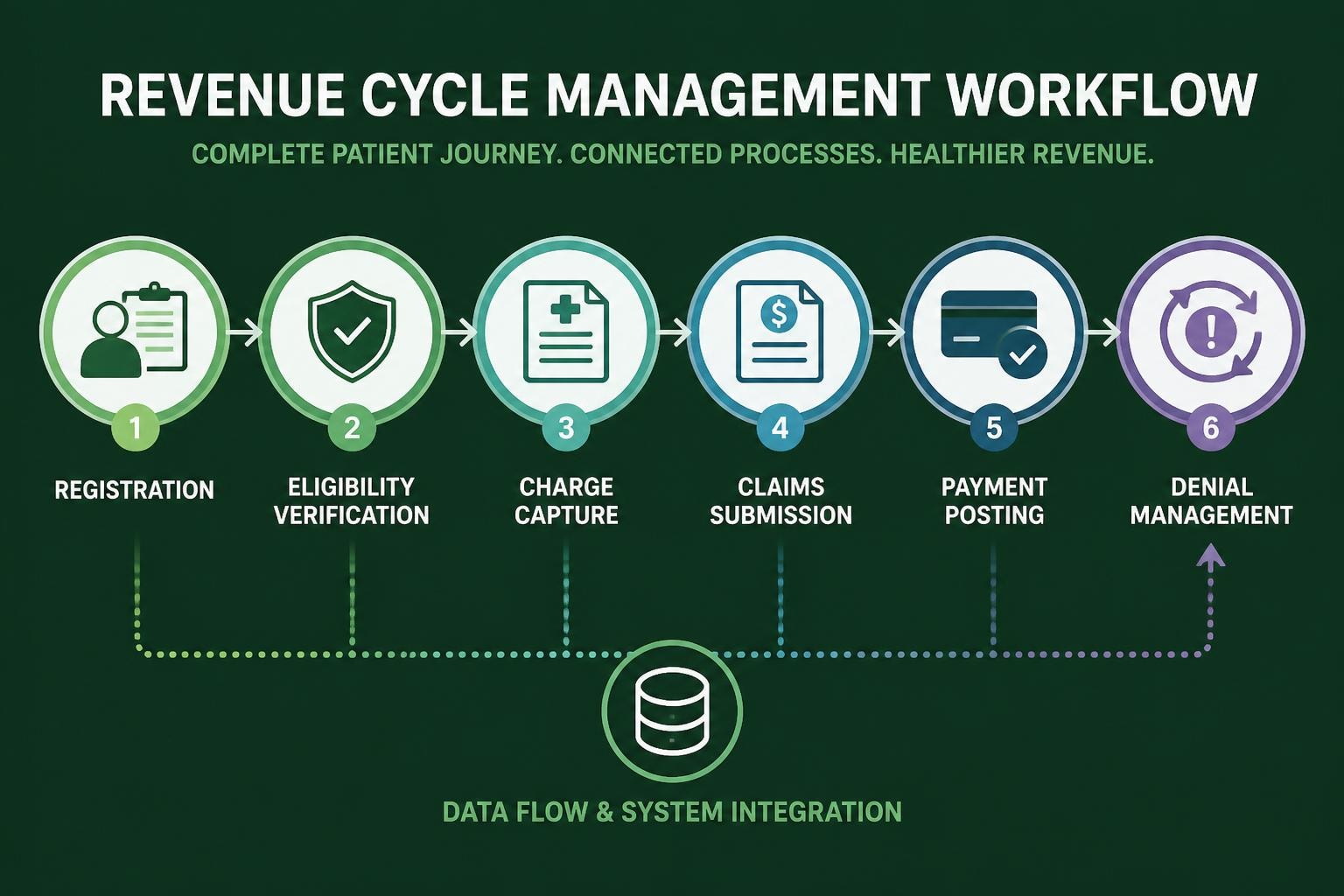
Healthcare providers face mounting pressure to maintain financial viability while delivering exceptional patient care. The complexity of insurance verification, claims submission, denial management, and payment collection demands specialized expertise that many practices struggle to maintain in-house. This is where rcm billing services become essential, offering comprehensive solutions that optimize every phase of the revenue cycle from patient registration through final payment reconciliation.
Understanding the Scope of RCM Billing Services
RCM billing services encompass far more than simply submitting claims to insurance companies. These comprehensive solutions address every touchpoint in the financial lifecycle of patient encounters, ensuring maximum reimbursement while minimizing administrative burden on clinical staff.
Core Components of Professional Revenue Cycle Management
The Healthcare Financial Management Association defines revenue cycle management as the financial process healthcare facilities use to track patient care episodes from registration through final payment. Professional rcm billing services build upon this foundation with specialized expertise across multiple domains.
Key service areas include:
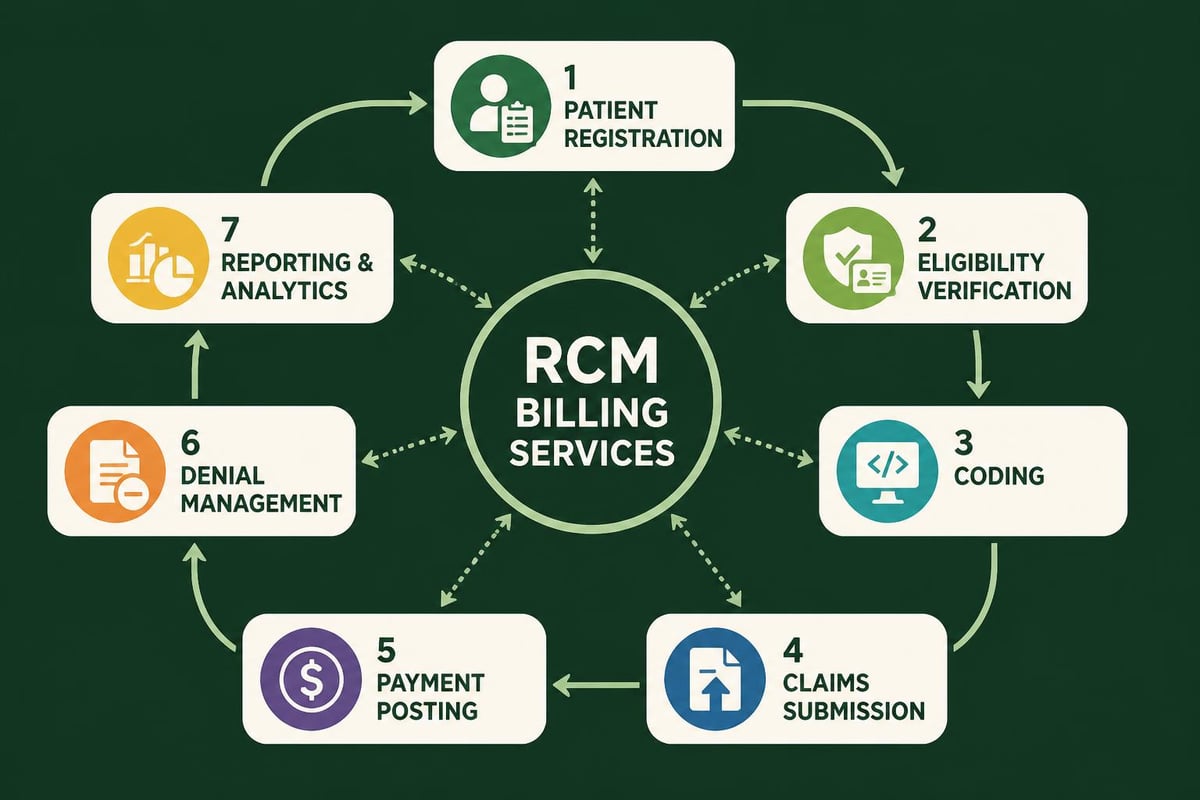
- Patient registration and demographic verification
- Insurance eligibility and benefits verification
- Prior authorization management
- Medical coding and charge capture
- Claims submission and tracking
- Payment posting and reconciliation
- Denial management and appeals
- Patient billing and collections
- Reporting and analytics
Each component requires specific knowledge of payer requirements, coding guidelines, and regulatory compliance standards. When healthcare providers partner with experienced billing service organizations, they gain access to dedicated teams who focus exclusively on these complex processes.
Eligibility Verification: The Foundation of Clean Claims
One of the most critical yet often overlooked aspects of rcm billing services is thorough insurance eligibility verification. Verifying coverage before services are rendered prevents claim denials and reduces patient billing disputes.
Professional verification services confirm:
- Active coverage status at the time of service
- Specific benefits applicable to the planned procedure or visit
- Copayment, deductible, and coinsurance requirements
- Prior authorization requirements for specific services
- Network status and any out-of-network limitations
This proactive approach significantly reduces downstream denial rates and accelerates payment cycles. Practices that implement comprehensive eligibility verification typically see denial rates drop by 15-25% within the first quarter of service implementation.
The Financial Impact of Professional RCM Billing Services
Healthcare organizations increasingly recognize that revenue cycle management directly affects their bottom line. According to industry research on outsourcing trends, 22% of revenue cycle leaders now outsource outpatient services, particularly in specialties requiring complex billing knowledge.
Measurable Benefits Across Practice Sizes
| Practice Size | Average Collection Rate Improvement | Days in A/R Reduction | Denial Rate Decrease |
|---|---|---|---|
| Small (1-5 providers) | 8-12% | 12-18 days | 20-30% |
| Medium (6-15 providers) | 10-15% | 15-22 days | 25-35% |
| Large (16+ providers) | 12-18% | 18-25 days | 30-40% |
These improvements translate directly to increased cash flow and reduced administrative costs. Practices that previously allocated 4-6 full-time employees to billing functions often reduce this to 1-2 oversight positions when partnering with professional rcm billing services.
Cost considerations extend beyond staffing:
- Reduced software licensing and maintenance expenses
- Elimination of ongoing training requirements
- Decreased compliance risk and audit exposure
- Lower overhead for workspace and equipment
The complexities of RCM in U.S. healthcare continue to increase as payer requirements evolve and regulatory standards become more stringent. Professional billing services absorb these ongoing changes, ensuring practices remain compliant without constant internal adjustments.
Denial Management: Recovering Lost Revenue
Even well-managed practices experience claim denials. The difference lies in how efficiently and effectively these denials are addressed. Professional denial management services employ systematic approaches to identify denial patterns and implement corrective measures.
A structured denial management process includes:
- Real-time denial tracking and categorization
- Root cause analysis to identify systemic issues
- Timely appeals submission with appropriate documentation
- Payer trend analysis to anticipate future denials
- Process improvement recommendations based on denial data
Practices working with specialized rcm billing services typically recover 60-75% of denied claims compared to the industry average of 40-50% for practices managing denials internally. This difference represents significant revenue that would otherwise be written off as uncollectible.
Choosing the Right RCM Billing Services Partner
Not all billing service providers offer the same level of expertise or service quality. Healthcare organizations must evaluate potential partners carefully to ensure alignment with their specific needs and practice culture.
Essential Evaluation Criteria
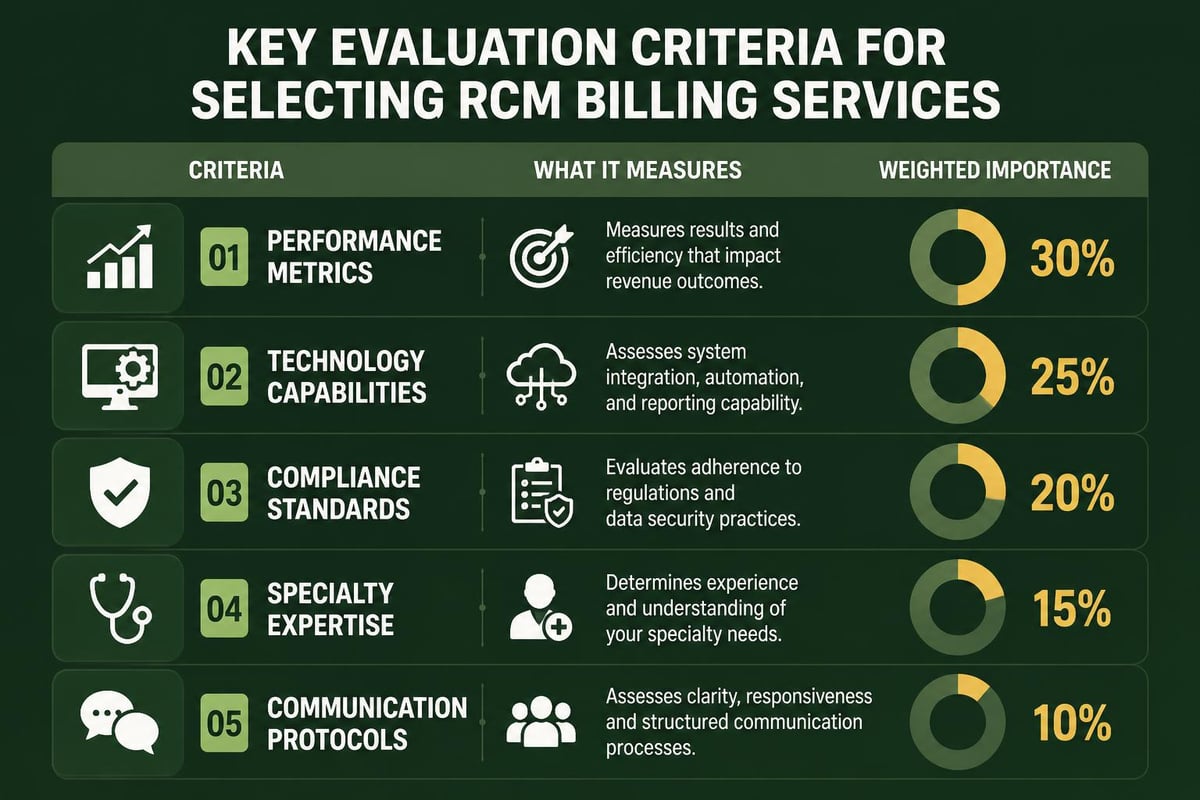
When comparing rcm billing services, consider both quantitative metrics and qualitative factors that affect long-term partnership success.
Performance metrics to request:
- Current client collection rates by specialty
- Average days in accounts receivable
- Clean claims submission percentage
- Denial rate and appeal success rate
- Client retention rates over 3+ years
Transparency in these metrics indicates a provider’s confidence in their service quality. Reputable organizations willingly share performance data and provide references from similar practices. When reviewing top medical billing companies, examine not just their capabilities but also their communication practices and reporting transparency.
Technology Integration and Reporting Capabilities
Modern rcm billing services leverage sophisticated technology platforms that integrate seamlessly with existing practice management and electronic health record systems. This integration eliminates duplicate data entry and ensures real-time information flow between clinical and financial systems.
| Technology Feature | Benefit to Practice | Implementation Priority |
|---|---|---|
| EHR Integration | Automated charge capture and coding | High |
| Patient Portal | Self-service billing and payments | Medium |
| Real-time Eligibility | Immediate coverage verification | High |
| Automated Payment Posting | Reduced manual entry errors | High |
| Advanced Analytics | Actionable financial insights | Medium |
| Denial Tracking | Systematic recovery processes | High |
The best medical billing software for small businesses varies based on specialty and workflow requirements, but professional rcm billing services should demonstrate proficiency across major platforms including Epic, Cerner, eClinicalWorks, and athenahealth.
Specialty-Specific Expertise Matters
Healthcare specialties face unique billing challenges that require specialized knowledge. Cardiology practices deal with complex procedure bundling rules, while behavioral health providers navigate different documentation requirements and payer policies.
Professional rcm billing services with specialty-specific experience bring invaluable knowledge:
- Specialty-specific coding expertise beyond general CPT and ICD-10 knowledge
- Payer policy familiarity for specialty-related procedures
- Documentation requirements that support medical necessity
- Modifier usage appropriate to specialty billing scenarios
- Benchmark data from similar practices for performance comparison
Practices should prioritize partners who demonstrate active engagement in their specialty’s professional organizations and maintain certified coding specialists with relevant credentials.
Implementation and Transition Strategies
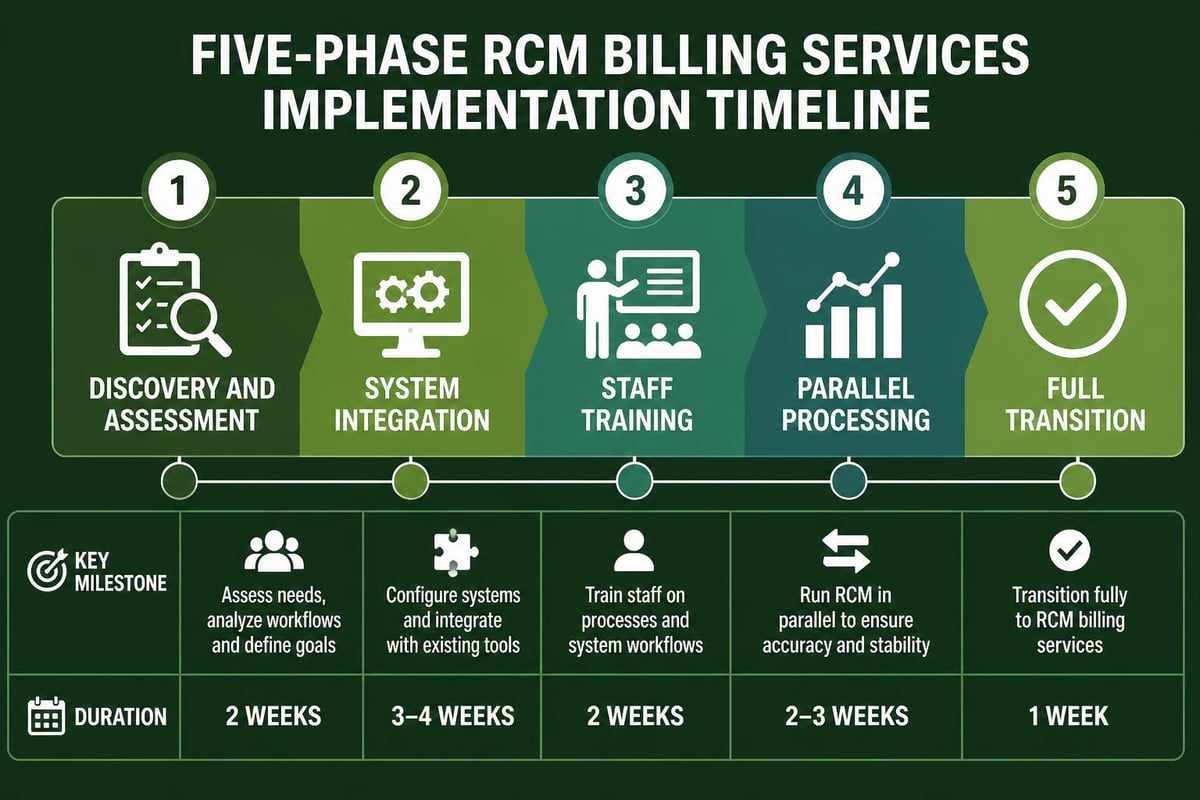
Transitioning to professional rcm billing services requires careful planning to minimize disruption and ensure continuity of revenue collection. A well-structured implementation process typically spans 60-90 days from contract signing to full operational transfer.
Step-by-Step Implementation Process
Step 1: Discovery and assessment phase (Days 1-14)
The billing service provider conducts a comprehensive assessment of current processes, technology systems, payer mix, and historical performance metrics. This phase identifies immediate opportunities and potential challenges.
Step 2: System integration and setup (Days 15-30)
Technical teams establish connections between the practice’s systems and the billing service’s platforms. User credentials are created, workflow rules are configured, and test transactions verify proper data flow.
Step 3: Staff training and knowledge transfer (Days 31-45)
Practice staff receive training on new procedures for charge entry, documentation requirements, and communication protocols. The billing service’s team learns practice-specific preferences and patient population characteristics.
Step 4: Parallel processing period (Days 46-60)
Both the practice and the billing service process claims simultaneously to ensure accuracy and identify any gaps in the transition. This redundancy prevents revenue disruption during the changeover.
Step 5: Full transition and optimization (Days 61-90)
The billing service assumes complete responsibility for revenue cycle management while the practice transitions to oversight and quality assurance roles. Regular check-ins ensure smooth operations.
Managing Change Within the Practice
Successful implementation of rcm billing services requires more than technical integration. Practice leadership must address staff concerns about role changes and job security while maintaining focus on patient care quality.
Communication strategies that support successful transitions:
- Early announcement of the partnership decision with clear rationale
- Transparent discussion of how staff roles will evolve
- Emphasis on refocusing internal resources on patient experience
- Regular updates throughout the implementation process
- Celebration of early wins and improvements in practice metrics
Many practices find that staff members previously dedicated to billing functions transition successfully into patient services, practice management, or clinical support roles that directly enhance the patient experience.
Compliance and Security in RCM Billing Services
Healthcare organizations remain legally responsible for protecting patient information even when partnering with external billing services. HIPAA compliance and data security protocols must be thoroughly vetted before engaging any rcm billing services provider.
HIPAA Compliance Requirements
Professional billing service organizations function as Business Associates under HIPAA regulations, requiring formal Business Associate Agreements (BAA) that specify:
- Permitted uses and disclosures of protected health information
- Safeguards to prevent unauthorized access or disclosure
- Breach notification procedures and timelines
- Return or destruction of PHI upon contract termination
- Subcontractor management and compliance requirements
Beyond contractual obligations, leading rcm billing services implement comprehensive security programs that exceed minimum regulatory standards. These programs include annual third-party security audits, penetration testing, and continuous monitoring for potential vulnerabilities.
Data Security Best Practices
| Security Measure | Implementation Standard | Verification Method |
|---|---|---|
| Data Encryption | AES-256 for data at rest and in transit | Annual security audit |
| Access Controls | Role-based with multi-factor authentication | Quarterly access reviews |
| Backup Systems | Daily automated with offsite storage | Monthly restoration testing |
| Incident Response | Documented plan with 24-hour notification | Annual tabletop exercises |
| Employee Training | HIPAA and security training upon hire and annually | Training completion tracking |
| Network Security | Firewall, intrusion detection, and monitoring | Continuous automated monitoring |
Practices should request copies of recent security audit reports and certifications such as SOC 2 Type II or HITRUST when evaluating potential rcm billing services partners. These independent validations provide assurance that security controls function as described.
Measuring Success and Ongoing Optimization
Engaging professional rcm billing services represents a significant practice decision that requires ongoing evaluation to ensure continued value delivery. Establishing clear performance metrics and regular review processes helps maintain alignment between the practice and its billing partner.
Key Performance Indicators to Monitor
Effective oversight requires tracking metrics across multiple dimensions of the revenue cycle. Monthly reporting should include both operational metrics and financial outcomes.
Essential operational metrics:
- Clean claim submission rate (target: 95%+)
- First-pass resolution rate (target: 85%+)
- Average days to submit claims (target: 2-3 days)
- Denial rate as percentage of claims submitted (target: <5%)
- Appeal success rate for denied claims (target: 65%+)
- Patient payment collection rate (target: 70%+)
Critical financial metrics:
- Net collection rate as percentage of allowed charges (target: 95%+)
- Days in accounts receivable (target: <35 days)
- Monthly gross charges and adjustments
- Bad debt write-offs as percentage of charges (target: <2%)
- Cost per claim processed
- Revenue per provider compared to specialty benchmarks
Professional rcm billing services should provide detailed reporting and analytics that enable practice leadership to identify trends and make informed decisions about service delivery, payer contracting, and resource allocation.
Continuous Improvement Through Partnership
The relationship between healthcare providers and their rcm billing services partners should evolve beyond transactional service delivery to strategic collaboration. Regular business reviews create opportunities to discuss performance trends, industry changes, and optimization opportunities.
Quarterly business reviews typically address:
- Performance against established benchmarks with trend analysis
- Payer-specific challenges and resolution strategies
- Coding and documentation improvement opportunities
- Technology upgrades and workflow enhancements
- Regulatory changes affecting billing and compliance
These structured conversations ensure both parties remain aligned on priorities and maintain focus on continuous improvement rather than simply maintaining the status quo.
The Future of RCM Billing Services
Healthcare reimbursement continues to evolve toward value-based care models that emphasize quality outcomes over service volume. This shift requires rcm billing services to expand beyond traditional fee-for-service billing expertise to support alternative payment arrangements.
Adapting to Value-Based Care
Value-based payment models introduce new complexities that many practices struggle to manage independently. Professional rcm billing services increasingly offer capabilities specifically designed for these alternative payment structures:
- Quality measure tracking and reporting for MIPS and APM programs
- Risk adjustment coding to ensure appropriate population risk documentation
- Care coordination billing for chronic care management and transitional care services
- Capitation reconciliation and variance analysis
- Shared savings calculation and distribution management
Practices participating in Medicare’s Quality Payment Program or commercial value-based contracts benefit significantly from rcm billing services with demonstrated expertise in these areas. The ability to maximize both fee-for-service revenue and value-based incentives creates a competitive advantage in increasingly complex reimbursement environments.
Technology-Enabled Service Delivery
Automation and artificial intelligence continue to transform revenue cycle management processes. Leading rcm billing services invest heavily in technology that reduces manual effort while improving accuracy and speed.
Emerging technologies reshaping billing services:
- Robotic process automation for repetitive data entry tasks
- Natural language processing for automated coding assistance
- Predictive analytics for denial prevention and cash flow forecasting
- Machine learning algorithms that identify optimal appeal strategies
- Patient engagement platforms that improve collection rates
Organizations that leverage AI and automation demonstrate significantly higher productivity levels while maintaining or improving accuracy rates. These efficiency gains translate to faster reimbursement cycles and reduced operating costs for client practices.
Understanding what Electronic Remittance Advice (ERA) means in medical billing becomes increasingly important as automation relies on standardized data formats. Professional rcm billing services excel at processing ERAs efficiently and integrating payment information seamlessly into practice management systems.
Specialty-Specific RCM Considerations
Different medical specialties face unique billing challenges that generic billing services may not adequately address. Specialized rcm billing services bring depth of knowledge in specific clinical areas that translates to superior financial performance.
High-Complexity Specialty Billing
Certain specialties require particularly sophisticated billing expertise due to complex coding rules, frequent payer policy changes, or high-volume procedure variations.
Cardiology billing challenges:
- Complex bundling edits for diagnostic and interventional procedures
- Modifier usage for multiple vessels and staged procedures
- Pre-authorization requirements that vary by payer and procedure
- Global period rules for surgical and catheterization procedures
- Technical versus professional component billing for facility-based services
Practices in these specialties benefit from rcm billing services with specialty-specific experience and dedicated coding teams who remain current on rapidly changing coding guidelines and payer policies.
Emerging Specialty Focus Areas
As healthcare delivery models evolve, new specialty areas require billing expertise that didn’t exist in traditional practice settings. Wound care, home health, and behavioral health represent growth areas where specialized billing knowledge delivers significant value.
For example, wound care billing services must navigate complex rules around ASP and non-ASP Q codes, while home health billing requires expertise in OASIS coding and Notice of Admission timing requirements.
Behavioral health practices face unique challenges including different documentation standards, varying payer credentialing requirements, and specific billing rules for telehealth services. Professional rcm billing services with behavioral health expertise understand these nuances and prevent costly billing errors that generic services might overlook.
Professional rcm billing services deliver measurable improvements in collection rates, denial reduction, and operational efficiency for healthcare practices of all sizes and specialties. By partnering with experienced billing professionals, providers can refocus internal resources on patient care while ensuring optimal financial performance. Greenhive Billing Solutions offers comprehensive revenue cycle management tailored to your practice’s specific needs, with transparent reporting, HIPAA-compliant processes, and a proven track record of improving collections while reducing administrative burden.

