

Health care pay has emerged as one of the most critical factors influencing the financial stability of medical practices across the United States. As compensation for physicians, nurses, billing specialists, and administrative staff continues to evolve, healthcare providers face mounting pressure to balance competitive wages with sustainable revenue streams. The intersection of rising labor costs, insurance reimbursement rates, and operational efficiency creates a complex challenge for practices of all sizes. Understanding how health care pay impacts your revenue cycle management strategy is essential for maintaining profitability while delivering quality patient care.
The Current Landscape of Health Care Pay
The healthcare industry is experiencing unprecedented shifts in compensation structures. Multiple factors converge to reshape how medical facilities budget for personnel expenses and project financial performance.
Rising Compensation Pressures Across All Positions
Healthcare organizations now compete in an increasingly expensive labor market. California’s healthcare worker minimum wage law represents just one example of legislative changes driving up baseline compensation requirements. These mandates affect not only clinical staff but also administrative personnel responsible for billing, coding, and revenue cycle operations.
The ripple effects extend beyond direct wages:
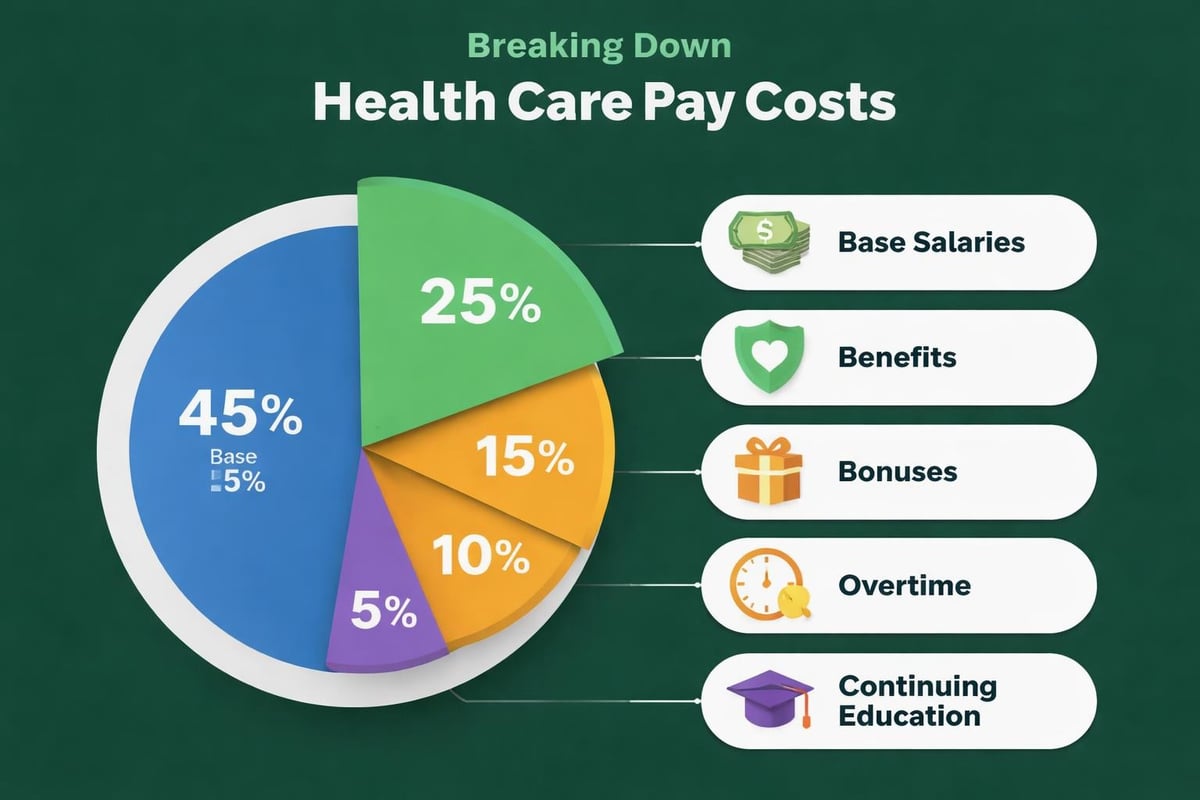
- Benefits packages now account for 25-35% of total compensation costs
- Signing bonuses and retention incentives add significant upfront expenses
- Continuing education requirements increase investment in staff development
- Overtime costs surge during staffing shortages
Medical practices must factor these expanding health care pay obligations into their financial planning. The challenge intensifies when reimbursement rates from payers fail to keep pace with rising operational costs.
Workforce Shortages and Competitive Recruitment
America’s healthcare workforce crisis continues to intensify competition for qualified professionals. Practices face difficult decisions about health care pay levels when recruiting billing specialists, medical coders, and front-office staff who directly impact revenue cycle performance.
The shortage affects different positions uniquely. While physician compensation often receives the most attention, the availability of skilled billing and coding professionals significantly influences collection rates and claim accuracy. Practices that underpay these critical positions risk higher denial rates, slower reimbursement cycles, and compliance issues that ultimately cost far more than competitive wages.
How Health Care Pay Affects Revenue Cycle Performance
Compensation decisions create direct and indirect impacts on your practice’s financial health. The relationship between what you pay staff and how efficiently you collect revenue deserves careful analysis.
Direct Cost Implications
Health care pay represents one of the largest line items in any medical practice budget. For primary care practices, labor costs typically consume 50-60% of total operating expenses. Specialty practices may see slightly lower percentages, but the absolute dollars remain substantial.
| Practice Size | Average Labor Cost % | Annual Health Care Pay Impact |
|---|---|---|
| Solo Practice | 55-65% | $180,000-$350,000 |
| Small Group (3-5 providers) | 50-60% | $600,000-$1.2M |
| Medium Group (6-15 providers) | 48-58% | $1.5M-$4.5M |
| Large Group (16+ providers) | 45-55% | $5M+ |
These figures demonstrate why practices must optimize every aspect of their revenue cycle to support sustainable health care pay levels. Even small improvements in collection rates or reductions in days in accounts receivable can fund meaningful compensation increases.
Billing Staff Compensation and Collection Efficiency
The quality of your billing team directly correlates with revenue capture. Experienced billing specialists command higher health care pay, but their expertise typically delivers substantial return on investment through:
- Higher first-pass claim acceptance rates (95%+ versus 80-85% for less experienced staff)
- Faster denial resolution reducing accounts receivable aging
- Better payer contract knowledge ensuring maximum reimbursement
- Proactive compliance monitoring preventing costly audits
Many practices partner with specialized providers like Greenhive Billing Solutions to access experienced billing professionals without the overhead of maintaining in-house staff. This approach can transform fixed health care pay obligations into variable costs that scale with practice volume.
Strategic Approaches to Managing Compensation Costs
Medical practices must develop sophisticated strategies for managing health care pay while maintaining operational excellence. Simple cost-cutting rarely succeeds without damaging quality or staff morale.
Step-by-Step Compensation Optimization
Step 1: Conduct a comprehensive analysis of current staffing costs and productivity metrics. Calculate revenue per full-time equivalent (FTE) for clinical and administrative positions.
Step 2: Benchmark your health care pay rates against regional and specialty-specific data. Identify positions where you’re significantly over or under market rates.
Step 3: Evaluate which functions require in-house staffing versus those that could be outsourced to specialized service providers. Consider eligibility verification services and claim submission services as candidates for external management.
Step 4: Implement performance-based compensation components that align staff incentives with practice financial goals. Tie bonuses to collection rates, claim accuracy, or patient satisfaction scores.
Step 5: Develop clear career pathways with defined health care pay progression to improve retention and reduce turnover costs.
Outsourcing as a Compensation Strategy
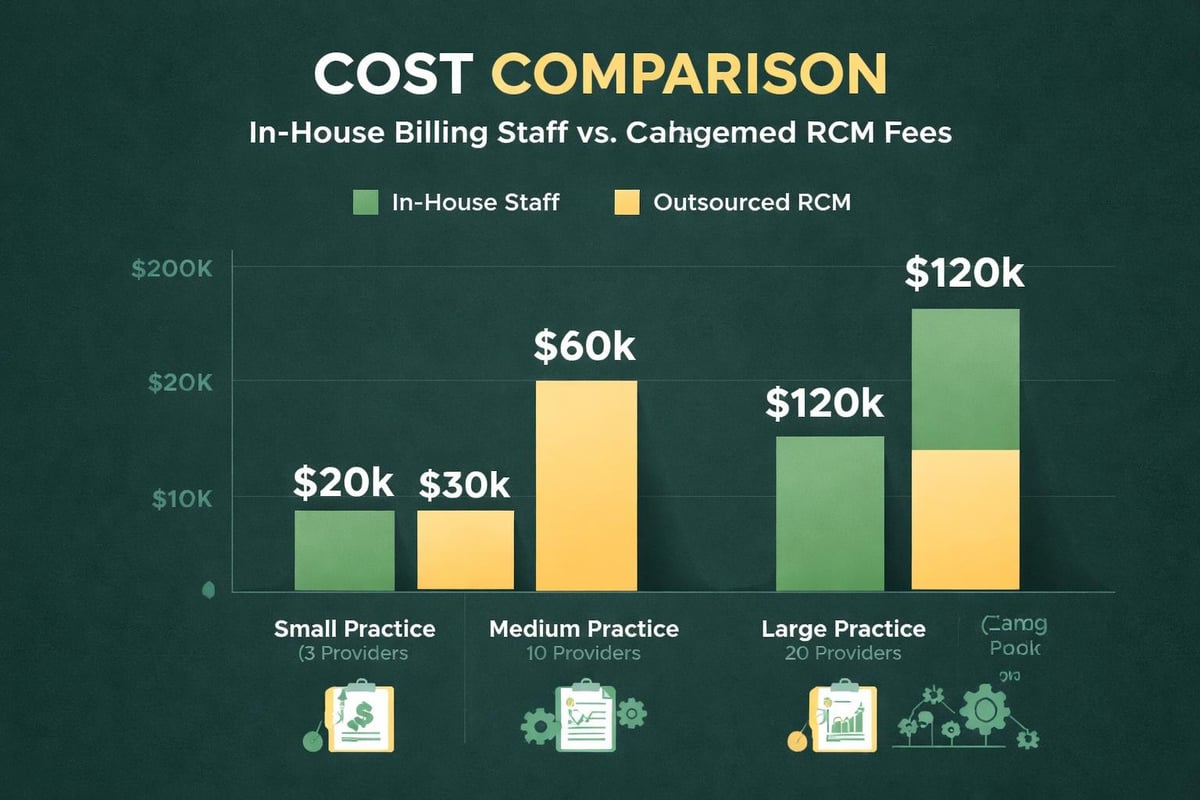
The decision to outsource revenue cycle functions fundamentally changes your health care pay structure. Rather than managing employee compensation, benefits, and turnover, you convert these fixed costs into predictable service fees.
This model offers several advantages:
- Elimination of recruitment and training expenses
- No liability for benefits, payroll taxes, or unemployment insurance
- Instant access to experienced professionals without market-rate health care pay
- Scalability without hiring delays or severance costs
- Reduced management overhead for billing operations
Professional denial management services illustrate this principle well. Maintaining an in-house denial management specialist requires competitive health care pay plus the infrastructure to support their work. Outsourcing provides expertise only when needed, with costs proportional to claim volume.
The Impact of Rising Insurance Costs on Practice Budgets
Health care pay decisions cannot be isolated from broader cost pressures. Sharp increases in health insurance costs affect practices from multiple directions.
Employee Health Benefits
Medical practices face the ironic challenge of providing competitive health insurance to their own employees. When employer-sponsored plan costs rise by 6.5-7.6%, practices must either:
- Absorb the increased expense, reducing funds available for base health care pay
- Shift more costs to employees through higher deductibles or premium contributions
- Reduce other benefits to maintain total compensation packages
- Generate additional revenue to fund the gap
Each option presents challenges. Reducing take-home pay through benefit cuts can trigger turnover, while absorbing costs squeezes already tight margins. The most sustainable approach involves improving revenue cycle efficiency to generate the incremental revenue needed.
Reimbursement Rate Pressures
While practice expenses including health care pay continue rising, payer reimbursement rates often lag or even decline. This growing disconnect forces practices to become increasingly efficient at capturing every dollar owed.
The mathematics are straightforward but unforgiving. If your total annual health care pay obligation increases by $100,000 while average reimbursement per encounter remains flat, you must either:
- Increase patient volume by the equivalent amount
- Reduce billing errors and denials to capture more from existing volume
- Improve payer contract terms through better negotiation
- Decrease other operational expenses
Most practices find that optimization of revenue cycle processes offers the most reliable path to bridging this gap without sacrificing quality of care.
Equity and Disparities in Health Care Pay
Compensation practices within healthcare organizations reflect and sometimes perpetuate broader disparities in healthcare. Understanding these dynamics helps practices develop more equitable health care pay structures.
Income-Based Utilization Patterns
Research on disparities in healthcare utilization between salary levels reveals how employee compensation affects their ability to access care. For medical practices, this creates a circular challenge. Staff members with lower health care pay may delay necessary treatment, leading to:
- Higher absenteeism from preventable conditions
- Reduced productivity due to untreated health issues
- Greater eventual healthcare costs when conditions worsen
- Lower employee satisfaction and engagement
Forward-thinking practices recognize that adequate health care pay for all positions, not just physicians, contributes to a healthier, more productive workforce. The investment in competitive compensation across all roles typically returns value through reduced turnover and improved performance.
Addressing Pay Equity Within Practices
Medical practices should regularly audit their health care pay structures for unexplained disparities. Transparent compensation frameworks based on role, experience, and performance help ensure fairness while supporting recruitment and retention.
Key considerations include:
- Geographic adjustments for practices with multiple locations
- Certification premiums for specialized credentials in billing and coding
- Experience-based progression with clear advancement criteria
- Performance incentives tied to measurable outcomes
Implementing these structures requires reliable financial data. Practices with inconsistent revenue capture struggle to commit to predictable health care pay scales. This creates another compelling reason to optimize revenue cycle management through either internal improvement or external partnerships.
Technology’s Role in Offsetting Health Care Pay Increases
Strategic technology investments can partially offset rising health care pay costs by improving staff productivity and reducing manual work.
Automation and Efficiency Gains
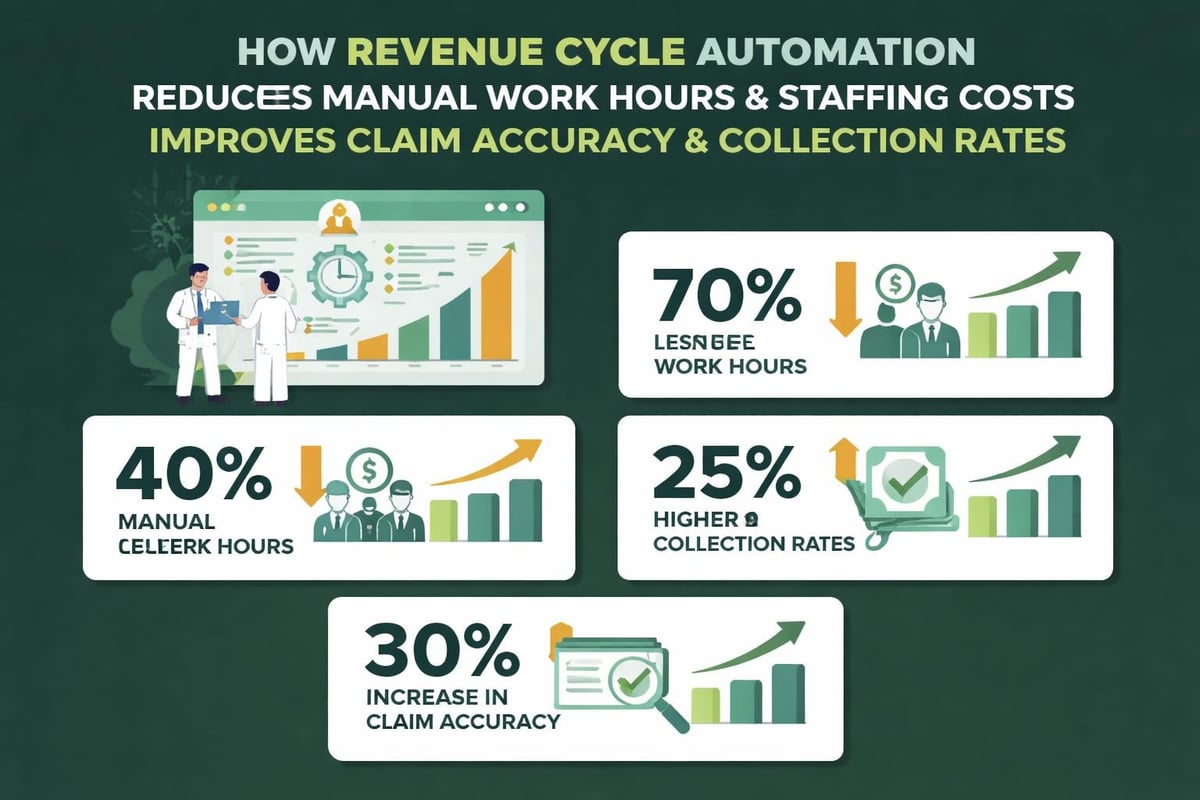
Modern revenue cycle technology eliminates many time-consuming manual tasks that once required significant staffing. Automated eligibility verification, claim scrubbing, and payment posting reduce the hours needed per claim, allowing practices to process more volume without proportional health care pay increases.
| Function | Manual Hours | Automated Hours | Efficiency Gain |
|---|---|---|---|
| Eligibility Verification | 15-20 min per patient | 2-3 min per patient | 75-85% |
| Claim Submission | 8-12 min per claim | 2-4 min per claim | 65-75% |
| Payment Posting | 5-8 min per payment | 1-2 min per payment | 70-80% |
| Denial Management | 25-40 min per denial | 10-15 min per denial | 50-60% |
These gains translate directly into reduced health care pay requirements for a given volume of claims. A practice processing 500 claims monthly might reduce billing staff needs from 3.5 FTE to 2.5 FTE through comprehensive automation, saving $60,000-$80,000 annually in compensation costs.
However, practices must be cautious about technology investments. Many billing software platforms require substantial upfront costs, ongoing license fees, and internal expertise to maintain. Understanding effective denial management in medical billing processes helps practices evaluate whether technology purchases will genuinely reduce total costs or simply shift expenses from health care pay to software subscriptions.
Building Sustainable Compensation Models
Long-term practice success requires compensation frameworks that adapt to changing market conditions without creating financial instability.
Variable Compensation Components
Fixed health care pay commitments create significant financial risk during volume fluctuations. Incorporating variable elements provides flexibility while maintaining staff engagement:
- Productivity bonuses tied to claims processed or collections achieved
- Quality incentives rewarding low denial rates or high first-pass acceptance
- Profit sharing distributing a percentage of practice financial performance
- Service-level rewards for patient satisfaction or efficiency metrics
These approaches align staff interests with practice success while creating natural expense scaling. When volume decreases, variable compensation automatically adjusts without requiring difficult conversations about base pay reductions.
The Role of Service Partnerships
Many practices find that hybrid staffing models optimize both cost and quality. Core clinical positions remain in-house with competitive health care pay, while specialized revenue cycle functions shift to expert service providers.
This approach allows practices to:
- Focus internal resources on patient care and clinical excellence
- Access specialized expertise in complex areas like payment posting services without maintaining full-time positions
- Scale administrative capacity quickly without recruitment delays
- Reduce health care pay obligations for functions requiring specialized but intermittent expertise
The key is identifying which functions truly require dedicated in-house staff versus those where professional service providers deliver better outcomes at lower total cost.
Financial Planning for Health Care Pay Growth
Prudent financial management requires planning for continued health care pay increases rather than hoping costs will stabilize.
Projecting Future Compensation Costs
Conservative financial planning assumes health care pay will increase 3-5% annually for most positions, with potentially higher growth for roles experiencing significant shortages. Practices should model these scenarios:
- Base case: 3.5% annual health care pay growth across all positions
- Moderate case: 5% for clinical staff, 4% for administrative staff
- Stress case: 7% for shortage positions, 5% for others
For each scenario, calculate the incremental revenue needed to maintain current margins. If your practice generates $2 million in annual revenue with $1.1 million in health care pay costs, a 5% increase requires finding an additional $55,000 in revenue or expense reduction.
Revenue Cycle Optimization as a Funding Source
Rather than simply increasing patient volume, many practices find that improving revenue cycle performance provides the most reliable path to funding health care pay increases. Even modest improvements yield significant financial impact:
- Reducing days in A/R from 45 to 38 improves cash flow and accelerates collection
- Increasing first-pass claim acceptance from 85% to 92% reduces rework costs
- Decreasing denial write-offs from 4% to 2.5% captures an additional 1.5% of revenue
- Improving charge capture to eliminate 2% of missed charges directly increases revenue
For a practice generating $2 million annually, capturing an additional 1.5% through better denial management yields $30,000, funding meaningful health care pay improvements without adding patient volume.
Professional services including prior authorization services help practices achieve these improvements without increasing internal staffing costs, creating a double benefit of enhanced revenue and controlled expenses.
Measuring Return on Health Care Pay Investment
Like any business investment, health care pay should be evaluated based on return. Simply matching market rates doesn’t guarantee you’re receiving commensurate value.
Key Performance Indicators for Billing Staff
Track these metrics to assess whether your health care pay investment in billing and coding staff generates appropriate returns:
- Net collection rate: Should exceed 95% for most specialties
- Days in accounts receivable: Target under 40 days for healthy cash flow
- Clean claim rate: First-pass acceptance should reach 92-95%
- Denial rate: Keep under 5%, ideally under 3%
- Cost to collect: Total billing costs should not exceed 6-8% of collections
If your metrics fall short of these benchmarks despite competitive health care pay, investigate whether process problems, technology limitations, or skill gaps prevent your team from performing effectively. Sometimes the issue isn’t compensation level but rather inadequate training, unclear workflows, or outdated systems.
Comparing In-House Versus Outsourced Economics
Calculate your true cost per claim for in-house billing, including all health care pay, benefits, technology, supplies, and management overhead. Compare this figure to the per-claim or percentage-based pricing from professional revenue cycle management providers.
Many practices discover their actual cost per claim ranges from $4 to $8 when all factors are included, while professional services might charge $3 to $5 per claim with better performance metrics. The difference stems from specialization, scale economies, and elimination of overhead.
Strategic Recommendations for Practice Leaders
Medical practice administrators and physician leaders should approach health care pay as a strategic investment requiring active management rather than a fixed overhead category.
Immediate Actions
Conduct a comprehensive health care pay audit comparing your current rates to market benchmarks. Identify positions where you’re significantly over or under market, understanding that both extremes create problems. Overpaying reduces funds available for other investments, while underpaying triggers costly turnover.
Evaluate your current revenue cycle performance metrics. If your clean claim rate falls below 90%, denial rate exceeds 5%, or days in A/R stretch beyond 45, improving these metrics likely offers better return than any other investment you could make.
Long-Term Strategic Planning
Develop a three-year financial model that projects health care pay increases alongside expected changes in reimbursement rates, patient volume, and payer mix. Identify the gap between projected expenses and revenue, then create specific initiatives to close it.
Consider whether your practice has the scale and expertise to maintain world-class billing operations in-house. Practices with fewer than 10 providers often find that partnerships with specialized service providers deliver better outcomes at lower total cost than maintaining dedicated billing staff.
Managing health care pay effectively requires balancing competitive compensation with sustainable financial performance, a challenge that grows more complex as labor markets tighten and reimbursement pressures intensify. By optimizing revenue cycle processes, carefully evaluating in-house versus outsourced staffing models, and implementing strategic compensation frameworks, practices can maintain the talent they need while protecting their financial health. Greenhive Billing Solutions helps healthcare providers navigate these challenges through comprehensive revenue cycle management services that improve collection rates, reduce administrative overhead, and free internal resources to focus on patient care rather than billing operations.

