
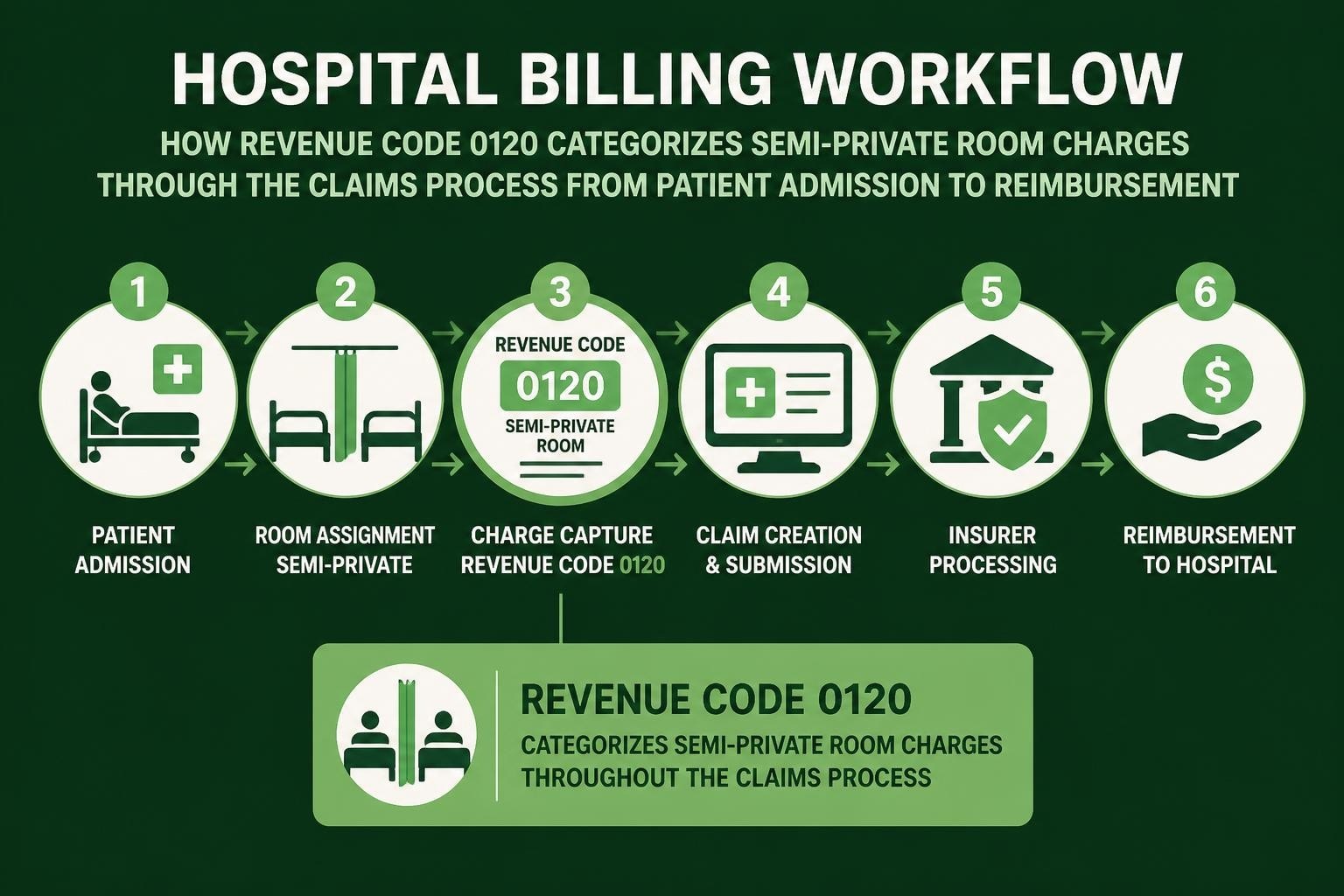
Hospital billing requires precision, especially when categorizing inpatient services for proper reimbursement. Revenue codes serve as essential identifiers that communicate specific services to payers, and among these, rev code 0120 plays a critical role in documenting room and board charges. Understanding this code’s proper application prevents claim denials, ensures accurate reimbursement, and maintains compliance with payer requirements. Healthcare providers who master the nuances of revenue code classification position themselves for stronger financial performance and smoother claims processing.
What Rev Code 0120 Represents in Hospital Billing
Rev code 0120 specifically designates semi-private room and board charges for inpatient stays with two-bed accommodations. This revenue code category falls under the broader room and board classification system used on UB-04 claim forms. Healthcare facilities use this code to bill for daily room charges, routine nursing care, minor medical supplies, and general patient services included in the room rate.
The code applies exclusively to inpatient settings where patients occupy semi-private rooms shared with one other patient. Unlike private room codes or intensive care classifications, rev code 0120 captures standard inpatient accommodations without specialized monitoring or enhanced nursing ratios.
Standard Components Included
When billing with rev code 0120, several standard services bundle into the daily room rate:
- Routine nursing assessments and care
- Room maintenance and housekeeping
- Dietary services for standard meal provision
- Linens and basic patient supplies
- General overhead costs associated with room occupancy
Medical supplies beyond routine items require separate revenue codes. Pharmaceuticals, specialized equipment, and therapeutic services each demand their own classification for accurate billing. Understanding these boundaries prevents unbundling issues that trigger payer audits.
Proper Application and Documentation Requirements
Using rev code 0120 correctly starts with verifying the patient’s admission status and room type. The code only applies when formal inpatient admission orders exist and the patient occupies a designated semi-private accommodation. Observation status, even in similar room types, requires different revenue codes entirely.
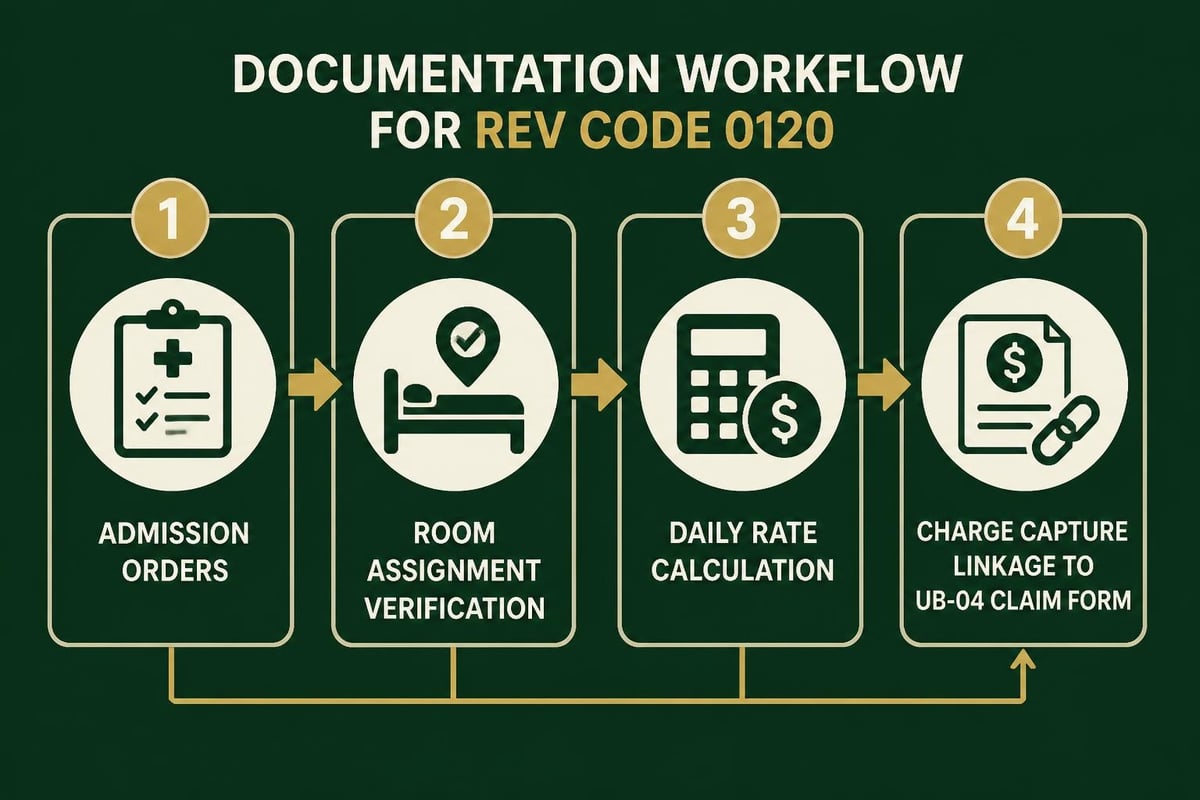
Documentation must support several key elements for each day billed under rev code 0120. Medical records should clearly indicate admission date and time, physician orders for inpatient status, nursing notes confirming room location, and daily progress notes justifying continued inpatient care.
Step-by-Step Billing Process
- Verify Admission Status: Confirm inpatient orders exist in the medical record before assigning rev code 0120 to any charges.
- Confirm Room Classification: Validate the patient occupies a semi-private two-bed room, not a private room, ward, or specialized unit.
- Calculate Daily Rates: Apply the facility’s established semi-private room rate, ensuring consistency with your chargemaster.
- Document Service Dates: Record each calendar day of occupancy separately, accounting for admission and discharge day policies.
- Review Payer Contracts: Check specific payer requirements for rev code 0120, as some contracts include special billing instructions.
The comprehensive guide on Revenue Code 0120 provides additional detail on billing procedures specific to various payer types. Following standardized processes reduces variation that leads to claim rejections.
Common Denial Triggers and Prevention Strategies
Revenue code mismatches represent one of the most frequent causes of claim denials involving rev code 0120. Payers reject claims when the billed revenue code contradicts the room type documented in medical records or when admission status doesn’t support inpatient billing.
| Denial Reason | Prevention Strategy | Impact Level |
|---|---|---|
| Incorrect admission status | Implement pre-bill audits verifying inpatient orders | High |
| Room type mismatch | Cross-reference chargemaster with actual room assignments | High |
| Missing medical necessity | Ensure clinical documentation supports admission level | Critical |
| Duplicate billing | Reconcile charge capture systems daily | Medium |
| Unbundling errors | Train staff on included versus separate services | Medium |
Medical necessity documentation proves essential for defending rev code 0120 charges during audits. Clinical notes must demonstrate why inpatient admission was appropriate rather than observation or outpatient care. Insufficient documentation often results in downcoding or full denial, even when the revenue code itself was correctly assigned.
Verification Before Claim Submission
Implementing verification checkpoints before claim submission dramatically reduces denials. Eligibility verification services confirm patient coverage and benefit levels, but internal audits should also review revenue code assignments against clinical documentation.
Pre-bill reviews should examine alignment between rev code 0120 and diagnosis codes, ensuring the clinical picture supports semi-private inpatient care. Conditions typically treated outpatient raise red flags when paired with inpatient room charges, prompting payer scrutiny.
Reimbursement Rates and Payer Variations
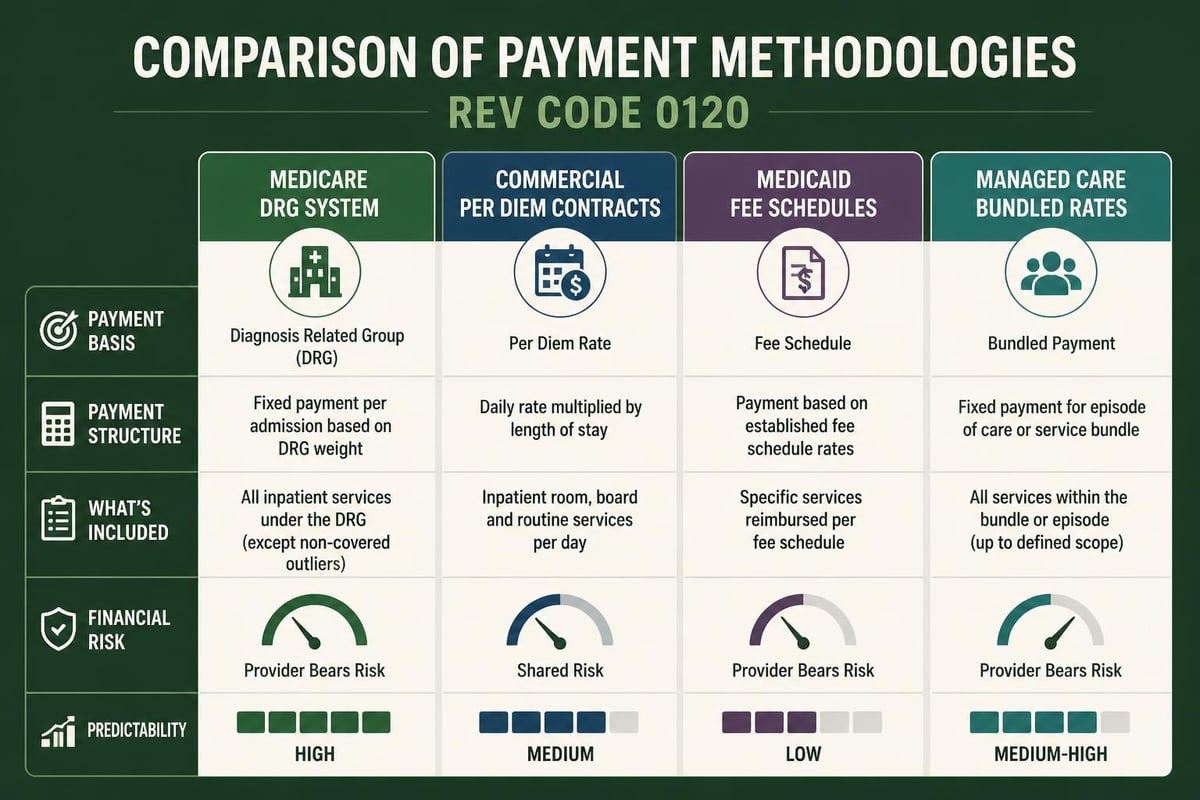
Understanding reimbursement for rev code 0120 requires familiarity with different payment methodologies. Medicare typically reimburses inpatient stays through Diagnosis-Related Groups (DRGs) rather than itemized room charges, though the revenue code still appears on claims for statistical tracking. Commercial payers vary significantly in their approach.
The fee schedule for Revenue Code 0120 shows substantial variation across payers and geographic regions. Some commercial insurers pay per diem rates explicitly tied to revenue codes, while others use case rates or bundled payments similar to Medicare’s DRG system.
Payment Model Considerations
Different payment structures affect how rev code 0120 impacts overall reimbursement:
- DRG-based payments: Room charges contribute to overall case cost but don’t directly determine payment amount
- Per diem contracts: Daily rates may explicitly reference semi-private room codes for payment calculation
- Case rates: Bundled payments include room charges regardless of specific revenue code used
- Fee-for-service: Each day billed under rev code 0120 generates separate line-item reimbursement
Analyzing your payer mix helps prioritize accuracy efforts. Facilities with high commercial volume and per diem contracts benefit most from precise rev code 0120 application, as errors directly impact payment amounts.
Integration with Revenue Cycle Management
Rev code 0120 accuracy connects to broader revenue cycle management processes that span patient admission through final payment. Effective management requires coordination across multiple departments and systems.
Chargemaster maintenance ensures rev code 0120 links to appropriate service descriptions and pricing. Regular audits identify discrepancies between billed codes and actual services provided, catching issues before payers flag them. Denial management strategies should track rev code 0120 rejection patterns to identify systemic problems.
System Configuration and Training
| Component | Configuration Requirement | Training Focus |
|---|---|---|
| Registration | Admission status flags | Inpatient versus observation distinctions |
| Charge capture | Room type validation | Matching codes to physical locations |
| Coding | Revenue code assignment | Medical necessity documentation review |
| Billing | Pre-submission edits | Payer-specific requirements |
Technology plays a significant role in rev code 0120 accuracy. Automated charge capture systems should validate room types against master facility files, flagging mismatches for review. Integration between admission, discharge, transfer (ADT) systems and billing platforms reduces manual entry errors.
Staff training must address the clinical distinctions that determine appropriate revenue code selection. Understanding when semi-private accommodations qualify versus private rooms or specialized units prevents fundamental classification errors. The application of Revenue Code 0120 in hospital settings requires this clinical knowledge foundation.
Compliance Considerations and Audit Preparedness
Regulatory compliance for rev code 0120 encompasses multiple frameworks. Medicare guidelines established in CMS billing manuals provide baseline requirements that often influence commercial payer policies. State Medicaid programs may impose additional documentation standards.
HIPAA-compliant billing practices protect patient information while ensuring claims contain necessary detail for processing. Rev code 0120 appears on institutional claims alongside other protected health information, requiring appropriate security measures throughout the billing cycle.
Audit Documentation Standards
Preparing for payer audits means maintaining comprehensive support for every rev code 0120 charge. Auditors typically request:
- Admission orders with documented inpatient status
- Daily nursing notes confirming room location
- Physician documentation supporting medical necessity
- Facility room assignment logs matching billed codes
- Chargemaster excerpts showing rate structures
Organizing documentation by patient encounter streamlines audit responses. Digital document management systems with revenue code indexing allow quick retrieval of supporting materials when payers request validation.
Relationship to Other Revenue Codes
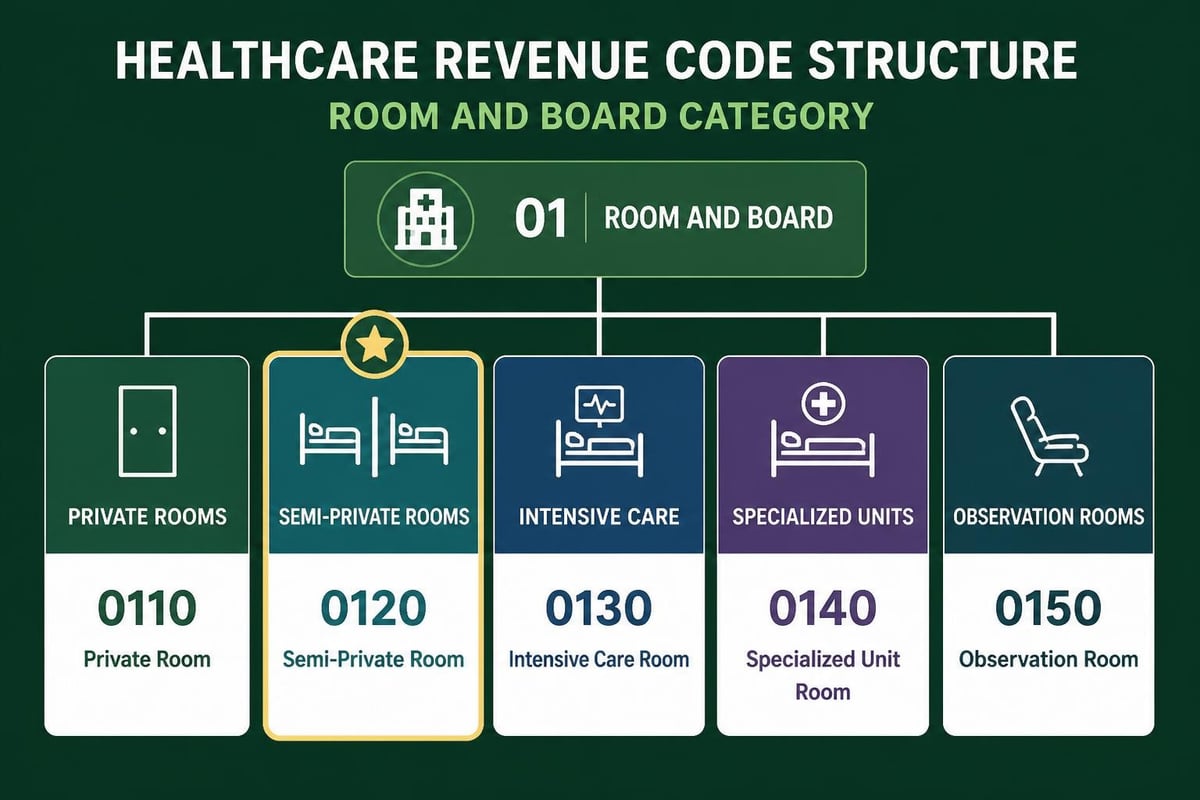
Rev code 0120 exists within a broader classification system for room and board charges. Understanding related codes prevents confusion and supports accurate billing across various accommodation types.
Private room charges use different revenue codes, as do intensive care units, coronary care, and specialized treatment areas. The official UB-04 revenue code description clarifies these distinctions, though practical application requires familiarity with your facility’s specific room classifications.
Transitioning patients between room types during a single stay requires careful charge capture. A patient might move from intensive care to semi-private accommodations, generating multiple revenue codes on one claim. Accurate date tracking ensures each code bills for the correct service period.
Revenue Code Hierarchy
Understanding how revenue codes function in medical billing provides context for rev code 0120’s role. The coding system organizes services hierarchically, with room and board forming one major category among ancillary services, supplies, and procedures.
This hierarchical structure means rev code 0120 typically generates the largest volume of charges on inpatient claims, even if not the highest dollar amounts. Multiple days of semi-private room charges accumulate across extended stays, making accuracy essential for financial performance.
Best Practices for Healthcare Providers
Implementing best practices for rev code 0120 management strengthens overall billing operations. Regular training keeps staff updated on payer policy changes and coding guidelines. Monthly audits identify trends before they become systemic problems.
Cross-departmental communication ensures clinical teams understand how documentation affects revenue code assignment. When nursing staff accurately record room locations and admission staff properly classify inpatient status, billing teams receive better source data for code selection.
Creating standard operating procedures specifically for rev code 0120 reduces reliance on institutional knowledge. Written protocols guide new staff and provide reference material during complex scenarios. These procedures should address payer-specific requirements, particularly for high-volume contracts.
Quality Assurance Measures
- Implement random claim reviews sampling rev code 0120 charges monthly
- Track denial rates specifically related to room and board coding
- Monitor days between service and billing to catch charge capture delays
- Compare room assignment records to billed revenue codes weekly
- Review chargemaster updates quarterly for rate accuracy
Quality metrics tied to rev code 0120 performance help identify improvement opportunities. Tracking clean claim rates, first-pass resolution, and average days in accounts receivable for inpatient accounts reveals coding accuracy’s impact on cash flow.
Technology Solutions and Automation
Modern revenue cycle technology offers sophisticated tools for managing rev code 0120 billing. Automated charge capture systems interface with ADT platforms to generate room charges based on patient location, reducing manual intervention. These systems apply rev code 0120 when patients occupy designated semi-private rooms, adjusting automatically when room changes occur.
Rules engines validate revenue code assignments before claim submission, checking for common errors like observation status paired with inpatient room codes. Alerts notify billing staff of questionable combinations, prompting review before payers reject claims.
Data analytics platforms identify patterns in rev code 0120 usage, comparing your facility’s coding distribution to national benchmarks. Significant deviations may indicate systematic misapplication requiring process correction. Healthcare revenue cycle analytics provides visibility into these patterns.
Integration Points
Effective systems integration ensures rev code 0120 data flows accurately between platforms:
- Electronic health records provide admission status and clinical documentation
- Patient accounting systems apply charges based on room assignments
- Claim scrubbers validate code combinations before submission
- Remittance processing tracks denials for continuous improvement
Breaking down information silos between these systems eliminates discrepancies that cause billing errors. When clinical and financial systems share real-time data, rev code 0120 accuracy improves substantially.
Strategic Financial Planning
Rev code 0120 performance affects broader financial planning and contract negotiation. Analyzing reimbursement rates for semi-private room charges across your payer mix identifies opportunities for contract improvement. Payers offering below-market rates for room and board become targets for renegotiation.
Volume analysis shows how frequently rev code 0120 appears on claims, helping forecast revenue based on census projections. Seasonal variations in inpatient admissions translate to predictable patterns in room and board charges, supporting cash flow planning.
Understanding your cost structure for semi-private accommodations relative to reimbursement reveals margin opportunities. If contracted rates for rev code 0120 don’t cover actual costs, strategic conversations with payers become necessary to maintain financial viability.
Contract Negotiation Leverage
| Metric | Application in Negotiations | Data Source |
|---|---|---|
| Volume of rev code 0120 charges | Demonstrate value to payer networks | Billing system reports |
| Cost per semi-private day | Justify rate increase requests | Cost accounting |
| Market rate comparisons | Benchmark against regional standards | Industry data |
| Quality outcomes | Link superior care to value proposition | Clinical quality metrics |
Presenting data-driven arguments about rev code 0120 reimbursement strengthens negotiating positions. Payers respond better to objective analysis than general requests for rate increases.
Mastering rev code 0120 requires attention to clinical documentation, payer requirements, and systematic quality controls that ensure accurate billing. Healthcare providers who implement comprehensive processes for room and board coding position themselves for improved cash flow and reduced denials. Greenhive Billing Solutions specializes in revenue cycle management services that optimize revenue code accuracy, streamline claims processing, and maximize reimbursements for healthcare providers nationwide. Our experienced team works within your existing systems to enhance billing precision and financial performance.

