
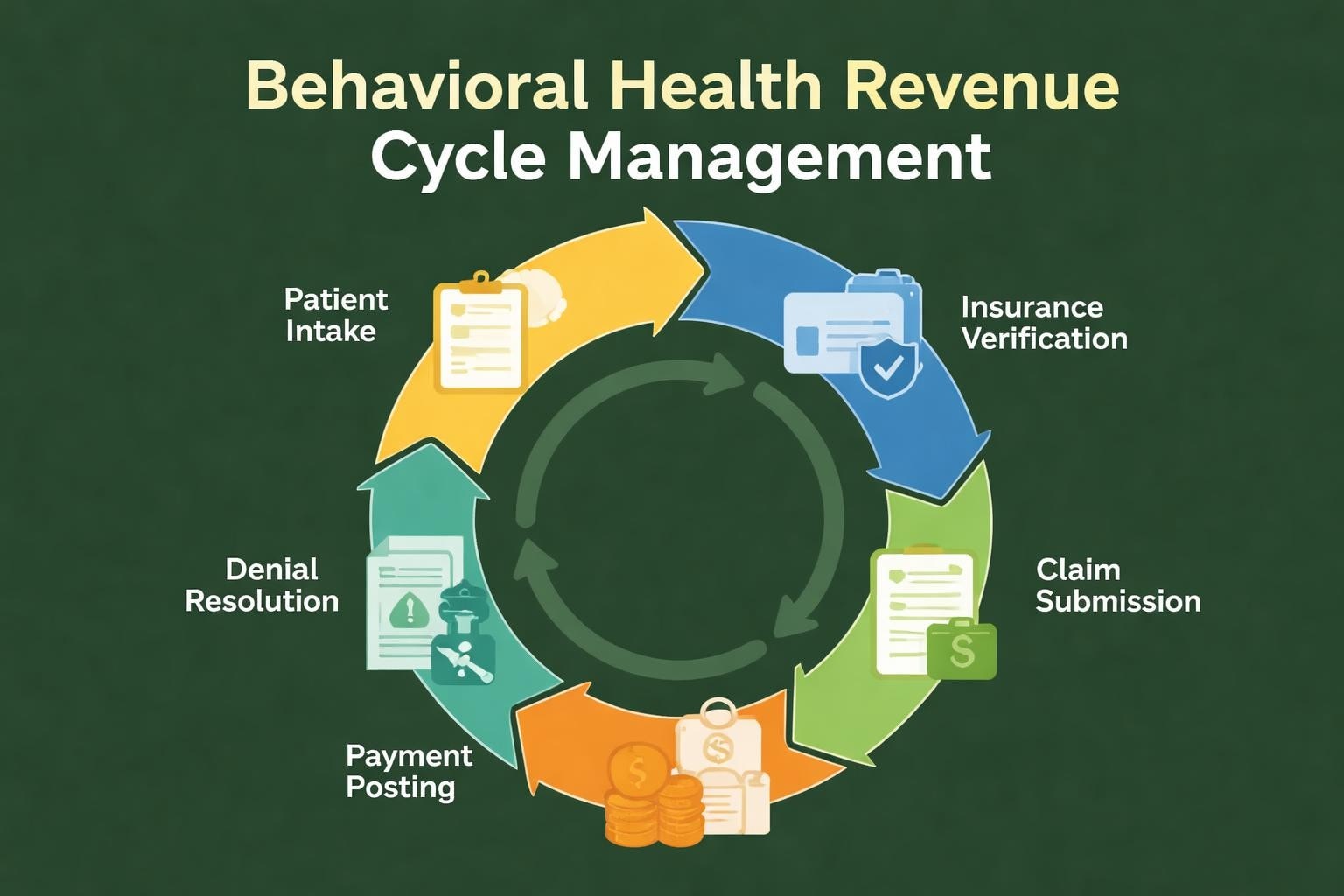
Managing the financial health of behavioral health practices requires specialized expertise and attention to industry-specific challenges. Unlike traditional medical practices, behavioral health providers face unique billing complexities including time-based coding structures, frequent prior authorization requirements, and higher denial rates. Behavioral health revenue cycle management addresses these challenges through tailored strategies that optimize every stage of the financial workflow, from patient registration through final payment collection.
Understanding the Unique Financial Landscape of Behavioral Health
Behavioral health revenue cycle management encompasses all administrative and clinical functions that contribute to the capture, management, and collection of patient service revenue. The complexity of mental health and substance abuse treatment billing creates distinct challenges that generic medical billing approaches cannot adequately address.
Mental health providers must navigate intricate payer requirements that differ significantly from other medical specialties. Time-based coding requires precise documentation of therapy session duration, while medical necessity criteria demand detailed clinical justification for continued treatment. These factors contribute to denial rates that can significantly impact practice revenue if not properly managed.
Specialized Coding Requirements
Behavioral health services rely heavily on CPT codes that measure time increments rather than discrete procedures. A 45-minute therapy session uses different coding than a 30-minute session, requiring meticulous documentation and billing accuracy. Providers must also distinguish between individual, family, and group therapy sessions, each with specific coding conventions.
The intersection of medical coding and revenue cycle management becomes particularly critical in behavioral health settings where proper code selection directly influences reimbursement rates and audit risk.
Core Components of Effective Revenue Cycle Management
A comprehensive approach to behavioral health revenue cycle management addresses multiple operational stages, each requiring specialized knowledge and systematic processes.
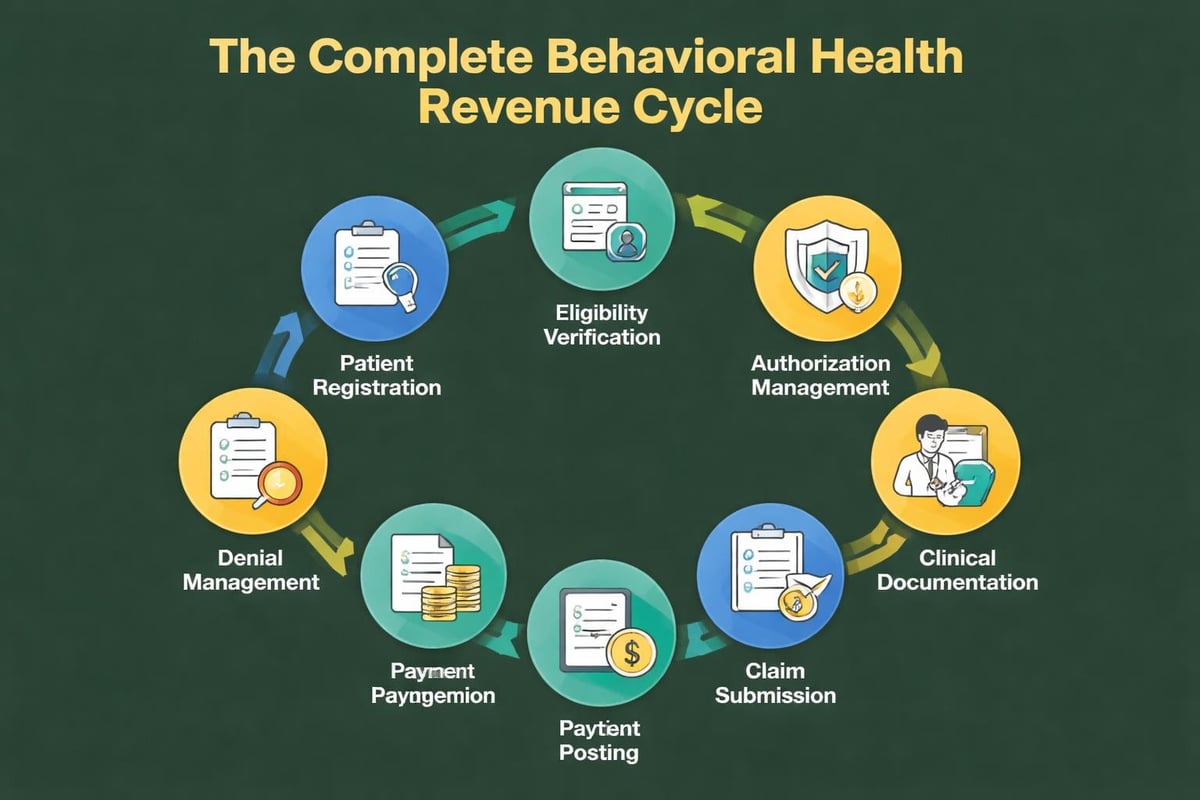
Patient Registration and Insurance Verification
The revenue cycle begins at the initial patient contact. Accurate demographic information and thorough insurance verification prevent downstream billing issues that can delay or prevent payment. Behavioral health practices must verify not only basic coverage but also specific mental health benefits, session limits, and authorization requirements.
Essential verification steps include:
- Confirming active coverage status and effective dates
- Identifying in-network versus out-of-network benefits
- Determining copayment, coinsurance, and deductible amounts
- Verifying prior authorization requirements for specific services
- Checking session limits and medical necessity criteria
Many insurance plans impose visit limits or require periodic treatment plan reviews for mental health services. Understanding these requirements early prevents unexpected denials and patient billing disputes.
Authorization Management and Documentation
Prior authorization represents one of the most significant administrative burdens in behavioral health revenue cycle management. Payers frequently require authorization for initial evaluations, ongoing therapy sessions, intensive outpatient programs, and medication management services.
Successful authorization management requires clinical staff coordination to submit required documentation within payer timeframes. Treatment plans must clearly articulate medical necessity, measurable goals, and expected treatment duration. Missing authorization deadlines or submitting incomplete clinical information leads directly to claim denials.
| Authorization Type | Typical Timeframe | Common Requirements |
|---|---|---|
| Initial Evaluation | 1-3 business days | Intake assessment, diagnosis |
| Ongoing Individual Therapy | 5-10 business days | Treatment plan, progress notes |
| Intensive Outpatient Program | 3-7 business days | Clinical assessment, level of care justification |
| Medication Management | 2-5 business days | Prescriber credentials, diagnosis codes |
Optimizing Claims Submission and Processing
Clean claim submission is fundamental to efficient behavioral health revenue cycle management. Claims must contain accurate patient demographics, valid insurance information, appropriate diagnosis codes, correct procedure codes with proper modifiers, and complete provider credentials.
Time-Based Coding Accuracy
Behavioral health services predominantly use time-based CPT codes requiring documentation of actual face-to-face time with patients. Providers must understand the coding thresholds for different time increments and apply codes according to documented minutes.
For example, individual psychotherapy codes differentiate between:
- 90832: 30 minutes (16-37 minutes documented time)
- 90834: 45 minutes (38-52 minutes documented time)
- 90837: 60 minutes (53+ minutes documented time)
Selecting codes based on scheduled appointment time rather than actual documented time represents a common error that triggers audits and payment recoupment. Custom software solutions designed for behavioral health can automate proper code selection based on documented session duration.
Modifier Usage and Add-On Codes
Behavioral health billing frequently requires modifiers to indicate service circumstances or additional procedures performed during the same session. The HO modifier identifies services delivered by a master’s-level therapist, while the HA modifier indicates child/adolescent programs.
When medication management occurs during the same session as psychotherapy, providers must append modifier 25 to the evaluation and management code to indicate a separately identifiable service. Incorrect modifier usage leads to claim denials or underpayment.
Denial Management Strategies for Behavioral Health
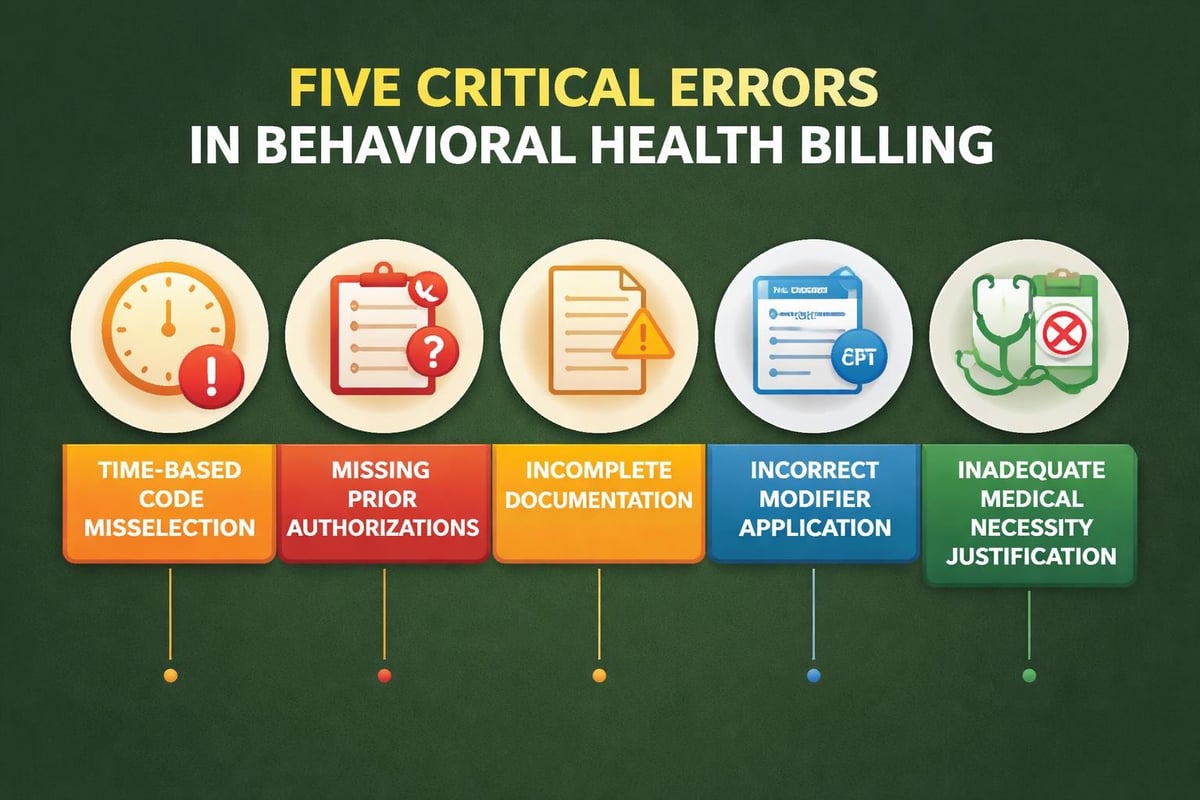
Denial rates in behavioral health practices often exceed those in other medical specialties due to complex coverage limitations and stringent medical necessity requirements. Effective denial management in medical billing requires systematic tracking, root cause analysis, and proactive prevention strategies.
Common Denial Categories
Authorization-related denials occur when services are provided without obtaining required pre-authorization or when treatment extends beyond authorized sessions. These denials are often preventable through robust front-end processes and ongoing authorization tracking.
Medical necessity denials challenge whether the level or frequency of services is appropriate for the patient’s condition. Successfully appealing these denials requires comprehensive clinical documentation demonstrating symptom severity, functional impairment, and treatment progress.
Coding denials result from incorrect CPT code selection, missing modifiers, or diagnosis codes that don’t support the billed service. Regular audits and staff training reduce these technical errors.
Building an Effective Appeal Process
A structured appeal process recovers revenue from denied claims and provides valuable data for process improvement. Documentation review should occur within 24-48 hours of denial receipt to ensure timely appeal filing within payer deadlines.
Step-by-step appeal workflow:
- Initial denial review – Examine denial reason codes and compare against claim documentation
- Clinical record retrieval – Gather relevant progress notes, treatment plans, and assessment documentation
- Appeal letter preparation – Draft comprehensive response addressing specific denial reasons with clinical justification
- Supporting documentation compilation – Attach relevant clinical records highlighting medical necessity
- Timely submission – Submit appeals within payer-specified timeframes (typically 30-90 days)
- Follow-up tracking – Monitor appeal status and escalate to peer-to-peer review if necessary
Technology Integration and Process Automation
Modern behavioral health revenue cycle management leverages technology to reduce manual errors, accelerate workflows, and improve financial outcomes. Comprehensive RCM services for behavioral health facilities increasingly incorporate specialized software platforms designed specifically for mental health billing requirements.
Electronic health record systems with integrated billing functionality streamline documentation and coding by automatically suggesting appropriate CPT codes based on session duration and service type. Real-time eligibility verification tools identify coverage issues before services are rendered, preventing denied claims.
Automation Opportunities
Automated claim scrubbing identifies common errors before submission, including missing information, invalid code combinations, and documentation gaps. These tools significantly reduce initial denial rates by catching mistakes during the internal review process.
Payment posting automation accelerates cash application by electronically processing remittance advice and matching payments to outstanding claims. This reduces staff time spent on manual data entry while improving payment posting accuracy.
| Process Area | Manual Approach | Automated Solution | Time Savings |
|---|---|---|---|
| Eligibility Verification | Phone calls, payer websites | Real-time API integration | 80-90% |
| Claim Scrubbing | Manual review checklists | Rules-based validation engine | 70-85% |
| Payment Posting | Manual ERA review and entry | Automated payment matching | 60-75% |
| Denial Tracking | Spreadsheet monitoring | Automated workflow management | 50-65% |
Financial Reporting and Performance Monitoring
Data-driven decision-making distinguishes high-performing behavioral health practices from those struggling with revenue cycle inefficiencies. Regular monitoring of key performance indicators enables proactive identification of problems before they significantly impact cash flow.
Critical Metrics for Behavioral Health Practices
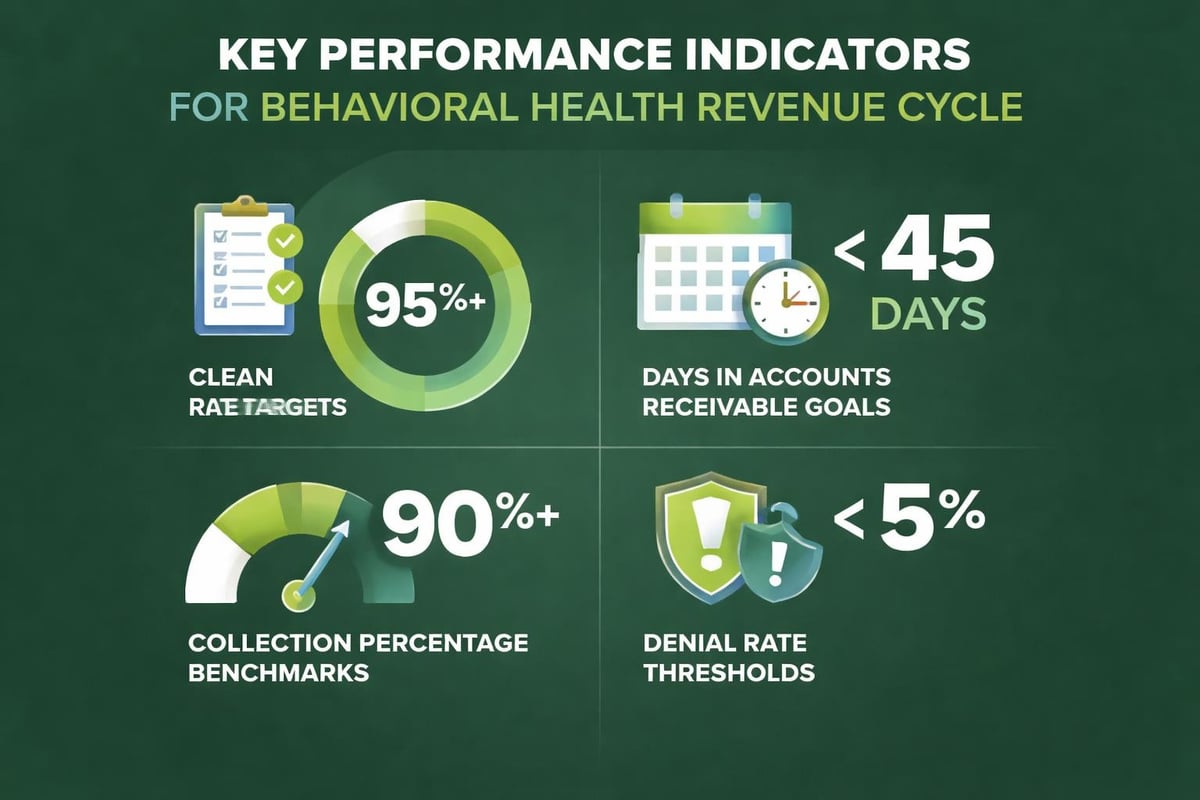
Days in accounts receivable measures the average time between service delivery and payment collection. Behavioral health practices should target 30-40 days, though this varies by payer mix. Increasing days in A/R signals collection problems requiring immediate attention.
Clean claim rate tracks the percentage of claims accepted without errors on first submission. Industry benchmarks suggest behavioral health practices should achieve 90-95% clean claim rates. Lower rates indicate systemic coding, documentation, or credentialing issues.
Collection rate compares actual collections against expected reimbursement after contractual adjustments. This metric reveals whether the practice effectively collects what payers owe. Collection rates below 95% suggest denial management or patient collection weaknesses.
Authorization approval rate monitors the percentage of authorization requests approved on first submission. Low approval rates may indicate clinical documentation deficiencies or misalignment between requested services and medical necessity criteria.
Staff Training and Compliance Requirements
Behavioral health revenue cycle management requires continuous staff education to maintain compliance with evolving regulations and payer requirements. HIPAA privacy rules impose additional considerations when handling mental health information, which carries stronger confidentiality protections than general medical records.
Credential Verification and Provider Enrollment
Maintaining current provider credentials with all contracted payers prevents claim denials and payment delays. Comprehensive healthcare revenue cycle management includes systematic tracking of license renewals, malpractice insurance updates, and payer re-credentialing deadlines.
Provider enrollment processes vary by payer and can take 60-180 days for completion. New providers or those joining existing practices must enroll with all relevant payers before submitting claims to avoid denied payments.
Documentation Standards and Audit Readiness
Clinical documentation must satisfy both clinical care standards and billing compliance requirements. Progress notes should clearly document session start and stop times, interventions provided, patient response to treatment, and clinical rationale for continued services.
Regular internal audits identify documentation deficiencies before external payers discover them during claims reviews. Random sampling of clinical charts ensures consistent adherence to documentation standards across all providers and service types.
Patient Payment Collection Strategies
Patient responsibility continues increasing as high-deductible health plans become more prevalent. Effective patient collection strategies balance financial necessity with the therapeutic relationship’s sensitivity, particularly important in behavioral health settings where financial stress can affect treatment outcomes.
Upfront Collection Policies
Collecting patient payments at the time of service significantly improves collection rates compared to billing after the appointment. Practices should establish clear financial policies communicated during intake and reinforced before each session.
Payment plans allow patients to continue necessary treatment while managing their financial obligations over time. Structured payment arrangements should include written agreements specifying payment amounts, due dates, and consequences of non-payment.
Technology-Enabled Payment Options
Online payment portals provide convenient options for patients to manage their financial responsibilities. Automated payment reminders reduce the administrative burden of manual collection calls while maintaining consistent communication about outstanding balances.
Text message payment reminders achieve higher response rates than traditional paper statements or email notifications. However, practices must ensure HIPAA compliance when sending electronic communications containing protected health information.
Payer Contract Negotiation and Rate Management
Understanding contracted reimbursement rates enables behavioral health practices to make informed decisions about network participation and service offerings. Efficient back-office operations in behavioral health practices include regular rate comparisons and contract performance analysis.
Rate Analysis and Benchmarking
Comparing contracted rates across different payers reveals which contracts provide optimal reimbursement for specific services. This analysis should consider not only base reimbursement rates but also administrative requirements, denial rates, and payment timeliness.
Some payers reimburse significantly below Medicare rates while imposing substantial administrative burdens through frequent authorization requirements and aggressive claim reviews. Practices may choose to terminate underperforming contracts when network adequacy allows.
Contract Negotiation Leverage
Demonstrating practice value through quality metrics, patient satisfaction scores, and access availability strengthens negotiating positions during contract renewal discussions. Practices with specialized expertise in evidence-based treatments or underserved populations can leverage unique capabilities to secure favorable rates.
Multi-year contracts should include annual rate increases tied to inflation indices or Medicare fee schedule updates. Without automatic adjustments, fixed rates lose purchasing power over time, effectively reducing practice income.
Scalability and Growth Considerations
As behavioral health practices expand through additional providers, locations, or service lines, revenue cycle processes must scale accordingly. Scalable RCM solutions for behavioral health clinics support growth without proportional increases in administrative overhead.
Multi-Location Management
Practices operating across multiple sites face additional complexity in credentialing, billing, and financial reporting. Centralized revenue cycle management ensures consistent processes while providing location-specific performance visibility.
Cloud-based billing platforms enable remote access from all practice locations while maintaining data security and regulatory compliance. Centralized oversight combined with distributed service delivery optimizes both clinical care and financial performance.
Service Line Diversification
Adding specialized services such as intensive outpatient programs, psychiatric medication management, or psychological testing requires corresponding revenue cycle adaptations. Each service type carries unique coding requirements, authorization processes, and documentation standards.
Practices should pilot new services with thorough revenue cycle planning addressing payer coverage policies, reimbursement rates, and administrative requirements before full-scale implementation.
Regulatory Compliance and Risk Management
Behavioral health revenue cycle management operates within a complex regulatory environment including federal anti-fraud laws, state mental health parity requirements, and professional licensing standards. Compliance failures risk substantial financial penalties, payer termination, and reputational damage.
Documentation Audits and Quality Reviews
Regular documentation audits verify that clinical records support billed services and meet payer requirements for medical necessity. Audit programs should include random sampling across all providers, service types, and payers to identify systemic issues.
External coding consultants provide objective assessment of documentation and coding accuracy. Third-party reviews often identify improvement opportunities that internal staff overlook due to familiarity with existing processes.
Fraud and Abuse Prevention
Billing practices must comply with federal False Claims Act provisions prohibiting knowingly submitting incorrect claims for payment. Common risk areas include upcoding to higher reimbursement codes without documentation support, billing for services not rendered, and unbundling procedures that should be reported together.
Establishing clear billing policies and providing regular staff training creates a compliance culture that prevents inadvertent violations. Written policies should address time-based coding accuracy, medical necessity determination, and appropriate modifier usage.
Partnering with Specialized Revenue Cycle Management Services
Many behavioral health practices lack the internal resources and expertise to optimize all revenue cycle functions. Specialized revenue cycle management companies bring industry-specific knowledge, dedicated staff, and proven processes that improve financial performance.
Professional billing services designed for behavioral health handle complex authorization management, coding accuracy, denial resolution, and patient collections while allowing clinical staff to focus on patient care. The investment in outsourced services often yields significant returns through increased collections and reduced administrative costs.
When evaluating potential partners, practices should assess behavioral health experience, technology capabilities, transparency in reporting, and cultural alignment with practice values. References from similar-sized practices provide valuable insights into service quality and responsiveness.
Mastering behavioral health revenue cycle management requires specialized knowledge, systematic processes, and ongoing attention to evolving payer requirements and regulatory standards. By implementing the strategies outlined above, behavioral health practices can reduce denials, accelerate collections, and establish sustainable financial operations. Greenhive Billing Solutions provides comprehensive revenue cycle management services specifically designed for healthcare providers, combining expert billing teams with proven processes to maximize reimbursements while ensuring HIPAA compliance and operational efficiency. Our tailored approach addresses the unique challenges of behavioral health billing, allowing your practice to focus on delivering quality patient care while we optimize your financial performance.

