
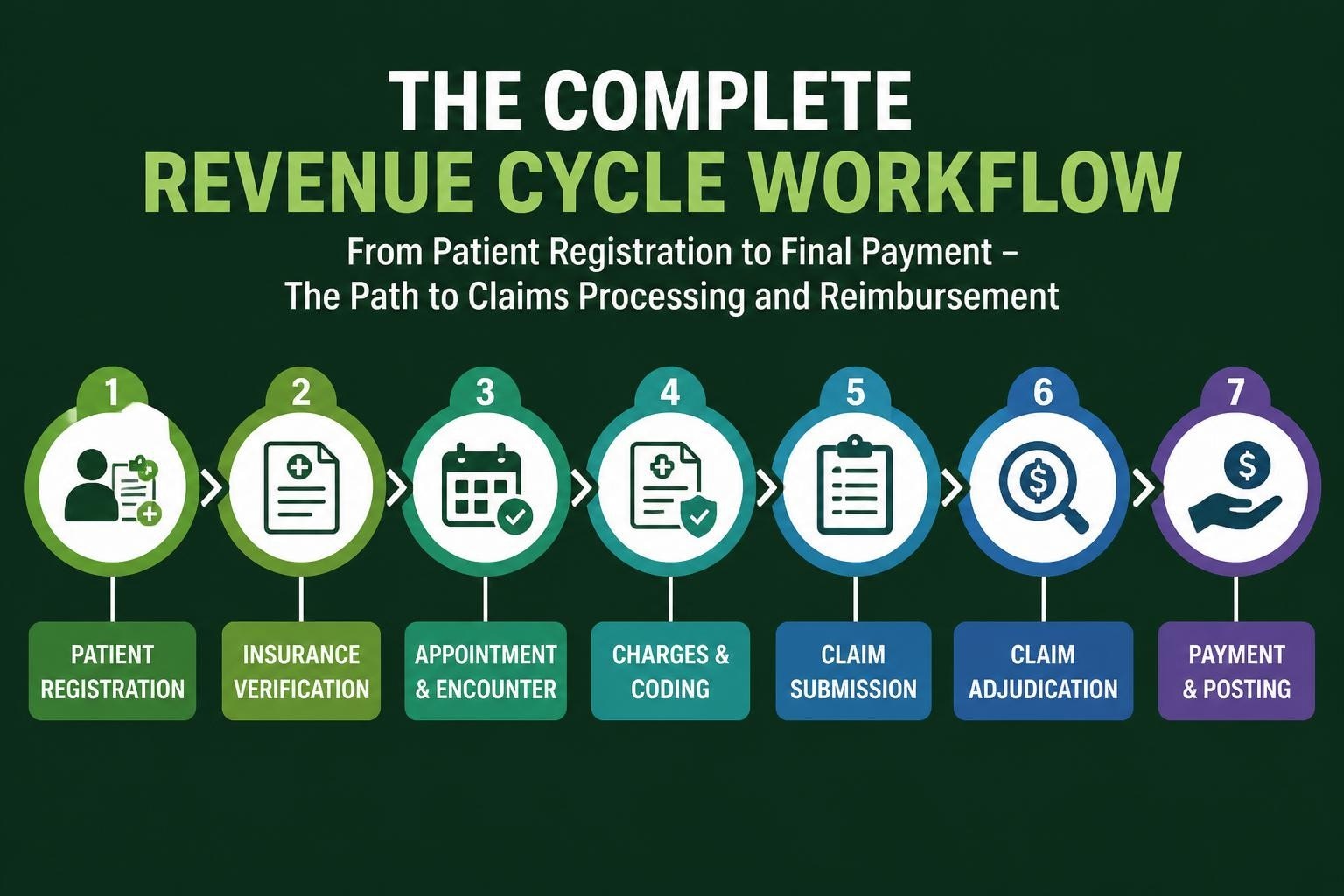
The financial health of any healthcare practice depends on a well-structured revenue cycle workflow. This systematic approach encompasses every step from initial patient contact to final payment collection, ensuring that providers receive appropriate reimbursement for services rendered. Understanding and optimizing this workflow has become increasingly critical as reimbursement models grow more complex and claim denials rise across the industry.
Understanding the Core Components of Revenue Cycle Workflow
A comprehensive revenue cycle workflow consists of multiple interconnected stages that work together to maximize financial performance. Each component plays a vital role in the overall success of revenue collection.
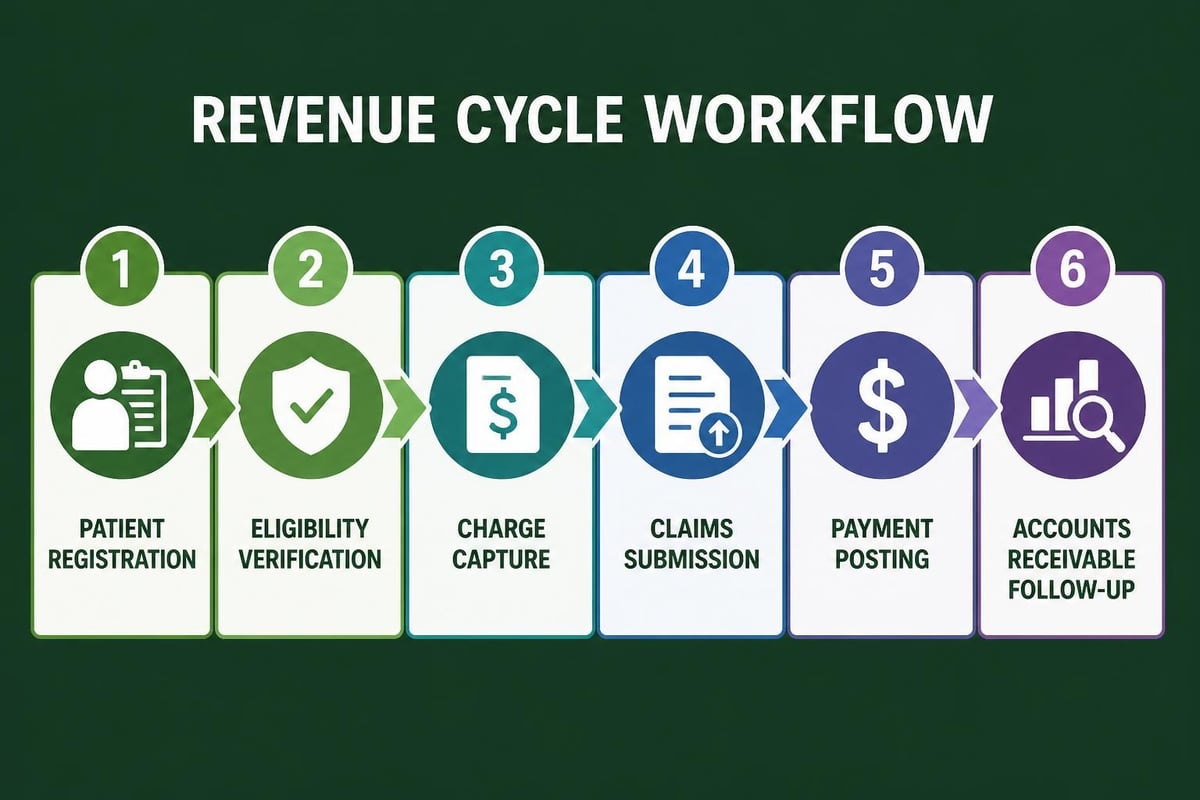
The American Hospital Association provides valuable insights into how healthcare organizations structure their revenue cycle processes. The workflow typically begins with patient registration and insurance verification, progresses through charge capture and claims submission, and concludes with payment posting and accounts receivable management.
Front-End Revenue Cycle Processes
The front-end portion of the revenue cycle workflow establishes the foundation for successful reimbursement. This phase includes several critical activities:
- Patient registration and demographic data collection
- Insurance eligibility and benefits verification
- Prior authorization acquisition when required
- Patient financial responsibility estimation
- Copayment and deductible collection at point of service
Effective insurance eligibility verification prevents downstream complications that can delay payment. Verification must occur before service delivery whenever possible, ensuring that coverage is active and services are covered under the patient’s plan.
Pre-service collections significantly improve overall collection rates. When practices clearly communicate patient financial responsibility upfront and collect applicable amounts before or during the visit, they reduce the burden on back-end collection efforts.
Middle Revenue Cycle Workflow Operations
The middle phase of the revenue cycle workflow encompasses charge capture, coding, and claims generation. These processes translate clinical services into billable transactions.
Accurate Charge Capture and Documentation
Charge capture represents a critical juncture where clinical documentation transforms into revenue opportunity. Missed charges directly impact practice profitability, making systematic charge capture essential.
Healthcare providers must implement robust processes to ensure all billable services are captured. This includes procedures, supplies, pharmaceuticals, and ancillary services. Understanding what CPT codes represent helps clinical staff recognize billable activities.
Key charge capture best practices include:
- Real-time charge entry whenever possible
- Regular charge reconciliation against clinical schedules
- Automated charge capture systems integration
- Staff training on documentation requirements
- Periodic audits to identify capture gaps
Medical Coding Within the Workflow
Medical coding serves as the language of reimbursement within the revenue cycle workflow. Professional coders translate clinical documentation into standardized diagnosis and procedure codes that payers recognize.
The different types of medical coding each serve specific purposes within the billing process. Diagnosis codes justify medical necessity, while procedure codes describe services provided. Accurate coding directly impacts claim acceptance rates and appropriate reimbursement levels.
| Coding Element | Purpose | Impact on Revenue |
|---|---|---|
| Diagnosis codes (ICD-10) | Establish medical necessity | Prevents denials for lack of justification |
| Procedure codes (CPT) | Describe services rendered | Determines reimbursement amount |
| Modifiers | Clarify special circumstances | Affects payment calculation |
| Revenue codes | Categorize services for facilities | Required for institutional claims |
Understanding revenue codes in medical billing ensures comprehensive claim preparation, particularly for hospital-based services.
Back-End Revenue Cycle Workflow Processes
The back-end revenue cycle workflow focuses on claims submission, payment processing, and collections. The Healthcare Financial Management Association emphasizes the importance of streamlined back-end operations for financial success.
Claims Submission and Scrubbing
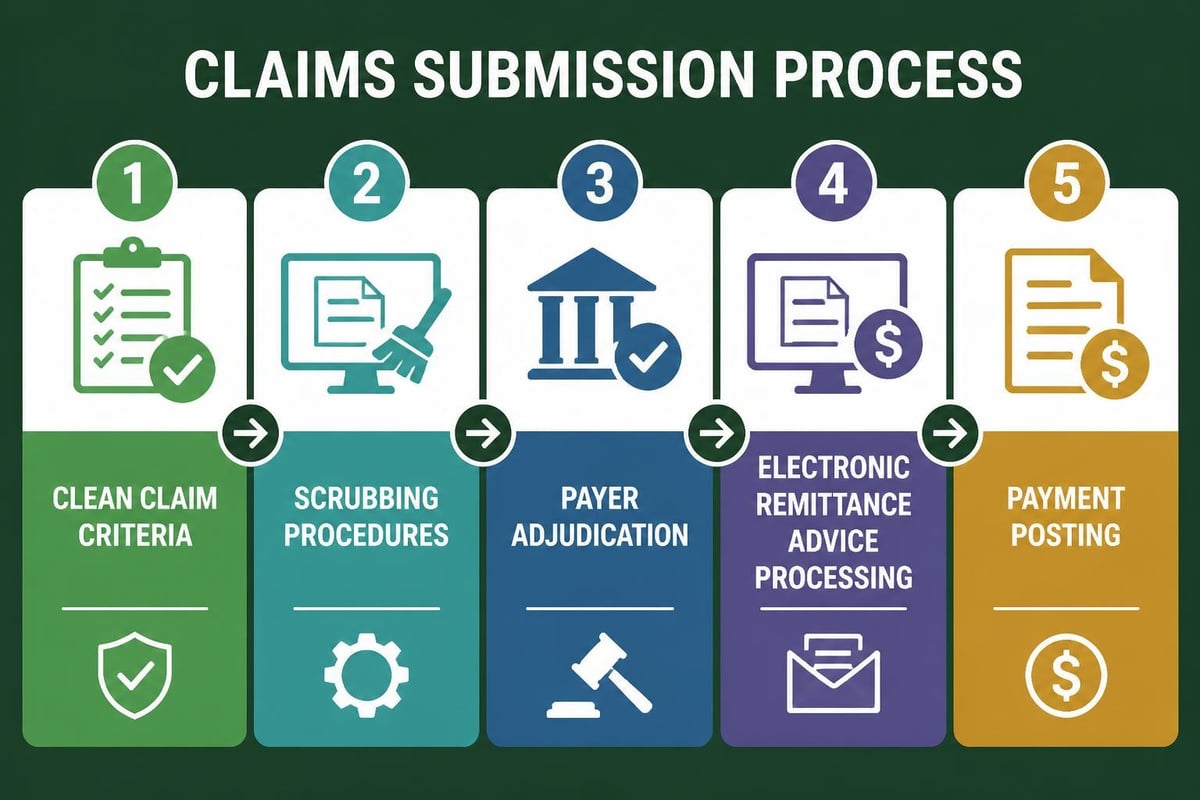
Submitting clean claims represents a primary objective within any revenue cycle workflow. Clean claims contain no errors or omissions that would prevent processing, allowing for faster payment and reduced administrative costs.
Claims scrubbing technology identifies potential issues before submission. These systems check for common errors including missing information, invalid codes, and coverage inconsistencies. TechTarget explores various revenue cycle technologies that enhance operational efficiency.
Establishing a systematic approach to charge entry in medical billing prevents errors that lead to claim rejections. Accuracy at this stage significantly reduces rework and accelerates payment cycles.
Denial Management Integration
Denial management constitutes an essential component of the revenue cycle workflow. Even well-managed practices experience claim denials, making effective response processes critical.
Successful denial management in medical billing requires systematic analysis of denial patterns, root cause identification, and process improvements to prevent recurring issues. Quick response to denials increases successful appeal rates and maintains healthy cash flow.
Common denial categories requiring workflow attention:
- Missing or invalid patient information
- Lack of prior authorization
- Medical necessity questions
- Coding errors or inconsistencies
- Timely filing limit violations
- Coordination of benefits issues
Optimizing Revenue Cycle Workflow Performance
Performance optimization requires continuous monitoring and improvement efforts. The HFMA’s MAP Initiative provides standardized metrics that organizations can use to benchmark their revenue cycle workflow effectiveness.
Key Performance Indicators
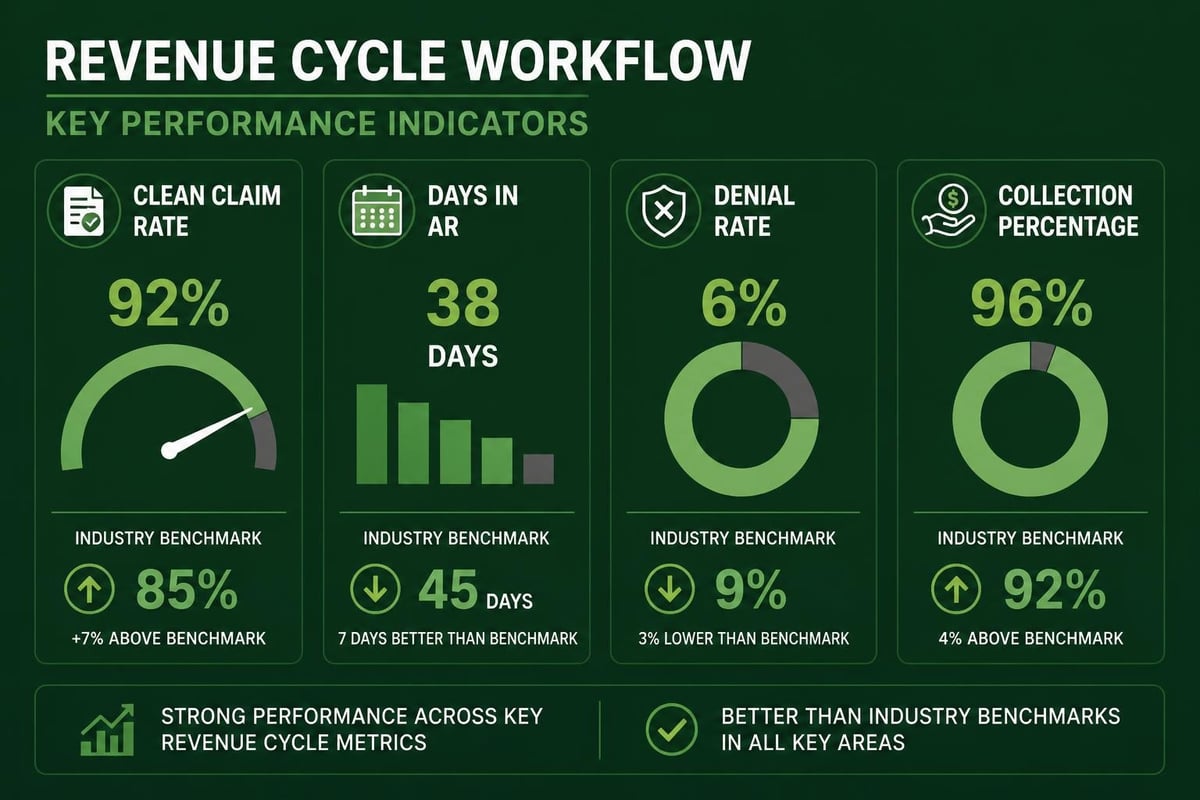
Tracking specific metrics helps identify workflow bottlenecks and opportunities for enhancement. Essential KPIs for revenue cycle workflow monitoring include:
| Metric | Target Range | What It Measures |
|---|---|---|
| Clean claim rate | 95% or higher | Initial submission accuracy |
| Days in accounts receivable | 30-40 days | Collection efficiency |
| Denial rate | Below 5% | Overall process effectiveness |
| Collection rate | 95% or higher | Revenue capture success |
| Cost to collect | 2-4% of collections | Operational efficiency |
Regular analysis of these indicators reveals trends and areas requiring intervention. Practices should establish baseline measurements and set improvement targets aligned with industry benchmarks.
Technology Integration Strategies
Modern revenue cycle workflow management increasingly relies on technology integration. Electronic health records, practice management systems, and specialized billing platforms must communicate seamlessly to support efficient operations.
Automated eligibility verification, electronic claims submission, and electronic remittance advice processing reduce manual tasks and accelerate cash flow. Understanding what ERA means in medical billing helps practices leverage automation for payment posting efficiency.
Specialized Workflow Considerations
Different practice types require tailored revenue cycle workflow approaches. Hospital revenue cycle management involves additional complexity compared to physician practices, including facility coding and charge description master maintenance.
Specialty-specific requirements also influence workflow design. Medical billing for behavioral health presents unique challenges related to authorization requirements and payer-specific documentation standards.
The American Medical Association offers strategies for effective revenue cycle management across various practice settings. Adapting these strategies to specific circumstances enhances workflow performance.
Staff Training and Communication
Human expertise remains central to revenue cycle workflow success despite technological advances. Comprehensive training ensures staff understand their roles within the larger process and how their work impacts overall financial performance.
Cross-functional communication between clinical and administrative teams prevents disconnects that lead to revenue leakage. Regular meetings to review metrics, discuss challenges, and share improvements foster a culture of continuous enhancement.
Investing in professional development for billing staff, including certification programs and continuing education, strengthens the knowledge base supporting your revenue cycle workflow. Well-trained teams make fewer errors and resolve issues more efficiently.
Optimizing your revenue cycle workflow requires expertise, dedication, and systematic processes across every stage from patient registration through final payment. Healthcare providers who partner with experienced revenue cycle management specialists gain access to industry best practices, advanced technologies, and skilled professionals dedicated to maximizing reimbursement. Greenhive Billing Solutions delivers comprehensive revenue cycle management services tailored to your practice’s unique needs, helping you streamline operations, reduce denials, and improve financial performance through proven workflows and transparent communication.

