
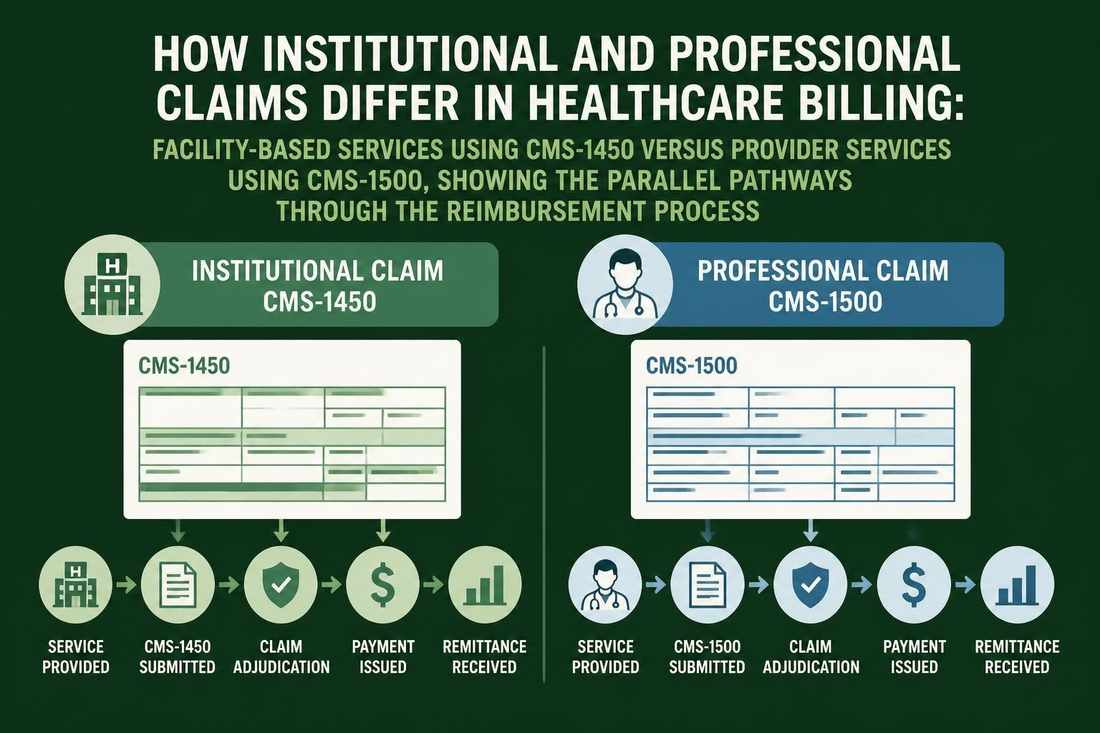
Understanding the difference between claim types fundamentally affects how healthcare practices receive reimbursement. The distinction between institutional vs professional claims shapes billing workflows, documentation requirements, and payment timelines. For healthcare organizations, recognizing these differences ensures accurate submissions and maximizes revenue potential.
Understanding the Core Distinction
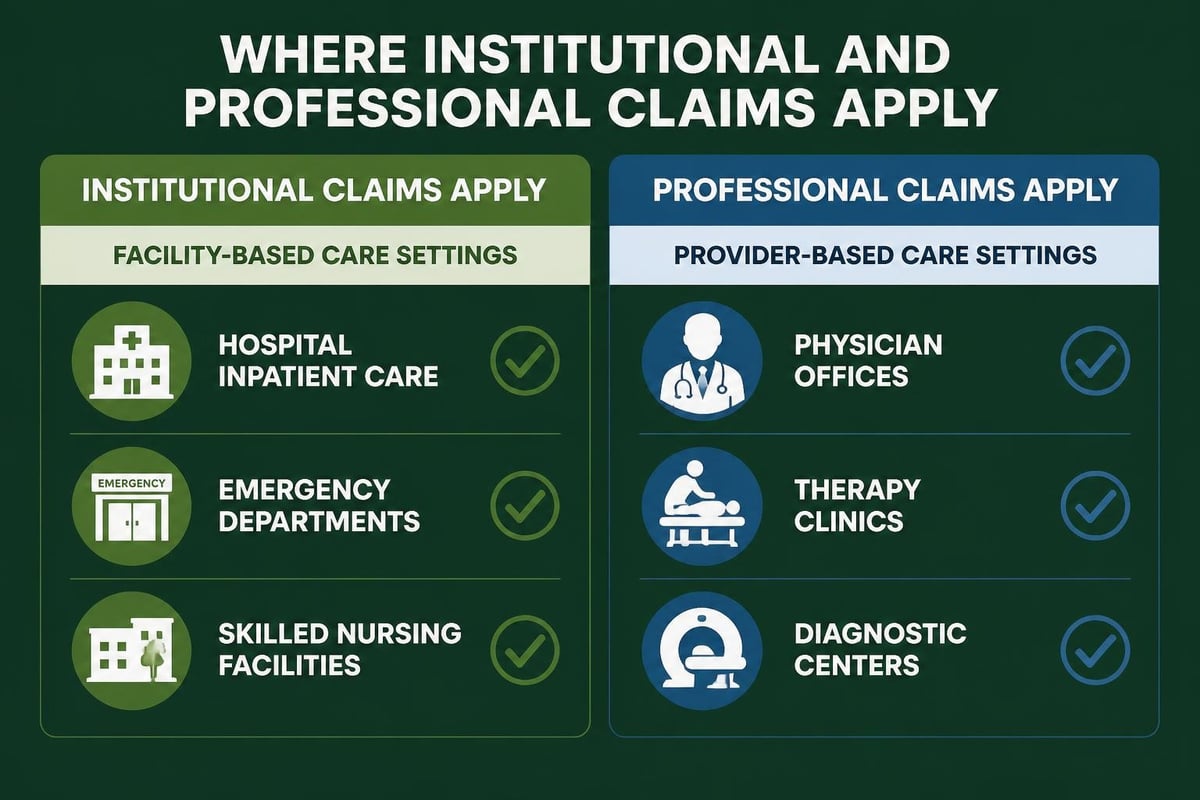
The fundamental difference between institutional vs professional claims lies in where services occur and who provides them. Professional claims originate from individual practitioners, including physicians, therapists, and other licensed providers who deliver care in outpatient settings. These claims use the CMS-1500 form and focus on specific procedures performed by individual providers.
Institutional claims represent services delivered by facilities such as hospitals, nursing homes, and rehabilitation centers. Understanding institutional versus professional claims requires recognizing that these submissions use the CMS-1450 form (also called UB-04) and encompass broader facility-based services. The institutional claim captures room charges, supplies, equipment usage, and facility fees rather than individual provider services.
Provider Types and Service Settings
Professional claims typically involve:
- Private practice physicians and specialists
- Physical therapists working in outpatient clinics
- Chiropractors providing office-based care
- Independent diagnostic testing facilities
- Mental health professionals in private practice
Institutional providers include hospitals (inpatient and outpatient), skilled nursing facilities, hospice centers, home health agencies, and rehabilitation facilities. The setting determines which claim type applies, though some providers may submit both types depending on service location.
Form Requirements and Documentation Standards
The CMS-1500 form serves professional claims with fields designed for individual provider information, procedure codes, and diagnosis codes. This form requires National Provider Identifier (NPI) numbers, place of service codes, and specific CPT codes identifying each procedure performed.
| Form Element | CMS-1500 (Professional) | CMS-1450 (Institutional) |
|---|---|---|
| Primary Use | Individual providers | Healthcare facilities |
| Procedure Codes | CPT codes | Revenue codes + CPT |
| Bill Type | Not applicable | Three-digit identifier |
| Accommodation | Not included | Room and board details |
| Form Lines | 6 service lines | Multiple service lines |
The UB-04 form accommodates institutional complexity with revenue codes, condition codes, occurrence codes, and value codes. Professional versus institutional billing demonstrates how institutional claims capture facility overhead costs, while professional claims focus on practitioner expertise and time.
Coding Differences That Impact Reimbursement
Professional claims rely heavily on Current Procedural Terminology (CPT) codes paired with diagnosis codes to justify medical necessity. Medical coding professionals must ensure accurate code selection to prevent denials.
Institutional claims use revenue codes alongside CPT codes, creating a two-layer coding system. Revenue codes identify the department or service area (pharmacy, laboratory, radiology), while CPT codes specify the actual procedures. This dual-coding approach provides payers with comprehensive facility service details.
Processing and Reimbursement Structures
Professional claims typically process faster due to their straightforward nature. Reimbursement rates follow fee schedules that assign specific dollar amounts to procedure codes. Medicare uses the Physician Fee Schedule, while private insurers negotiate contracted rates with providers.
Institutional reimbursement operates differently, often using Diagnosis Related Groups (DRGs) for inpatient stays or Ambulatory Payment Classifications (APCs) for outpatient services. These methodologies bundle related services into single payment amounts rather than paying per procedure.
Revenue Cycle Implications
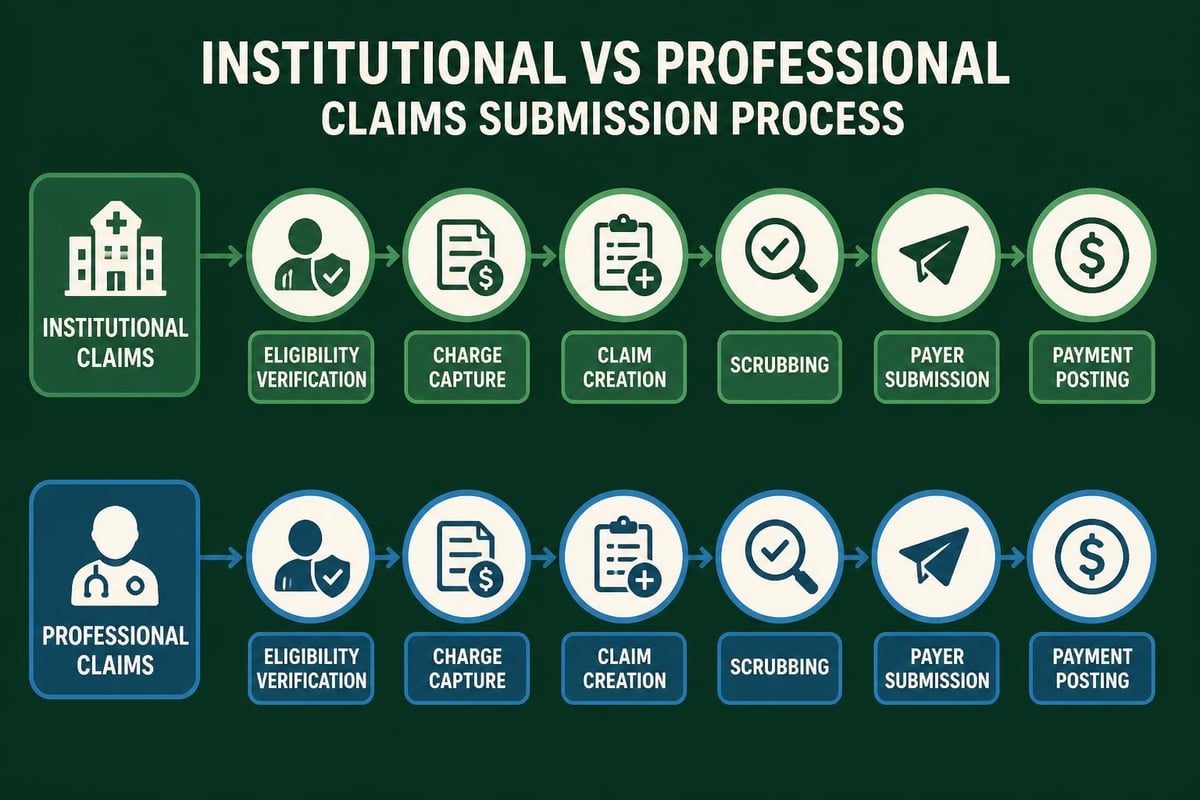
The institutional vs professional claims distinction significantly affects revenue cycle management strategies. Professional claims generally involve:
- Simpler charge capture with individual procedure documentation
- Shorter claim lifecycle from submission to payment
- Lower complexity in denial management
- Direct provider accountability for documentation quality
Institutional claims require more extensive coordination:
- Complex charge capture systems tracking multiple departments
- Extended processing timelines due to higher claim values
- Multi-departmental coordination for accurate coding
- Comprehensive documentation covering entire patient stays
Common Challenges and Error Prevention
Denial rates differ between claim types, with institutional claims facing unique challenges. Common institutional denials include missing admission dates, incorrect bill types, and insufficient medical necessity documentation for facility-level services. Professional claim denials often stem from coding errors, missing modifiers, or incomplete documentation.
Understanding which claim type applies prevents costly submission errors. A hospital-employed physician performing outpatient procedures might generate both claim types-the facility submits an institutional claim for resources used, while the physician group submits a professional claim for services rendered.
Coordination of Benefits Scenarios
When patients receive care involving both claim types, coordination becomes critical. A surgical procedure generates an institutional claim from the hospital and professional claims from the surgeon, anesthesiologist, and pathologist. Clean claim submission requires accurate coordination to prevent duplicate billing or missed charges.
The institutional vs professional claims framework also affects how practices handle denial management. Different appeal processes, documentation requirements, and payer communication channels apply to each claim type.
Regulatory Compliance Considerations
Both claim types must comply with HIPAA regulations, but institutional claims face additional scrutiny due to higher dollar amounts and complex service bundling. Claims processing compliance requires understanding payer-specific requirements that vary between claim types.
Professional claims emphasize individual provider credentials, license verification, and scope of practice documentation. Institutional claims focus on facility accreditation, department-level certifications, and compliance with condition of participation requirements.
| Compliance Area | Professional Focus | Institutional Focus |
|---|---|---|
| Documentation | Provider notes | Multi-departmental records |
| Credentials | Individual licenses | Facility accreditation |
| Quality Metrics | Provider outcomes | Facility-wide measures |
| Audit Risk | Individual claims | High-value episodes |
Technology and System Requirements
Modern revenue cycle operations require different technological capabilities for each claim type. Professional billing systems prioritize scheduling integration, encounter-based charging, and straightforward claim generation. Medical billing software solutions for professional claims emphasize efficiency and volume.
Institutional billing platforms need sophisticated charge capture from multiple departments, complex edit checking for UB-04 requirements, and DRG calculation capabilities. These systems integrate with clinical documentation improvement programs and case management workflows.
How institutional and professional billing systems connect: patient registration, clinical documentation, charge capture, coding workflow, claim scrubbing, and submission showing integration points for both claim types
The institutional vs professional claims distinction extends beyond forms and codes to fundamentally different business models. Hospitals operate with higher overhead costs, longer payment cycles, and complex payer contracts. Professional practices maintain leaner operations with faster cash flow but face pressure on reimbursement rates.
Understanding these dynamics helps practices optimize their revenue cycle processes and financial performance. Whether managing professional claims from a multi-specialty group or institutional claims from a hospital system, recognizing the unique requirements of each claim type drives successful reimbursement outcomes.
Mastering the differences between institutional vs professional claims enables healthcare organizations to optimize their billing operations and maximize reimbursements. Whether your practice handles individual provider services or manages complex facility-based billing, expert support makes the difference between financial success and constant revenue challenges. Greenhive Billing Solutions delivers comprehensive revenue cycle management services designed to handle both professional and institutional claims with precision, ensuring your practice receives maximum reimbursement while maintaining full compliance. Our experienced team adapts to your existing systems and workflows, providing the expertise needed to navigate the complexities of modern medical billing.

