
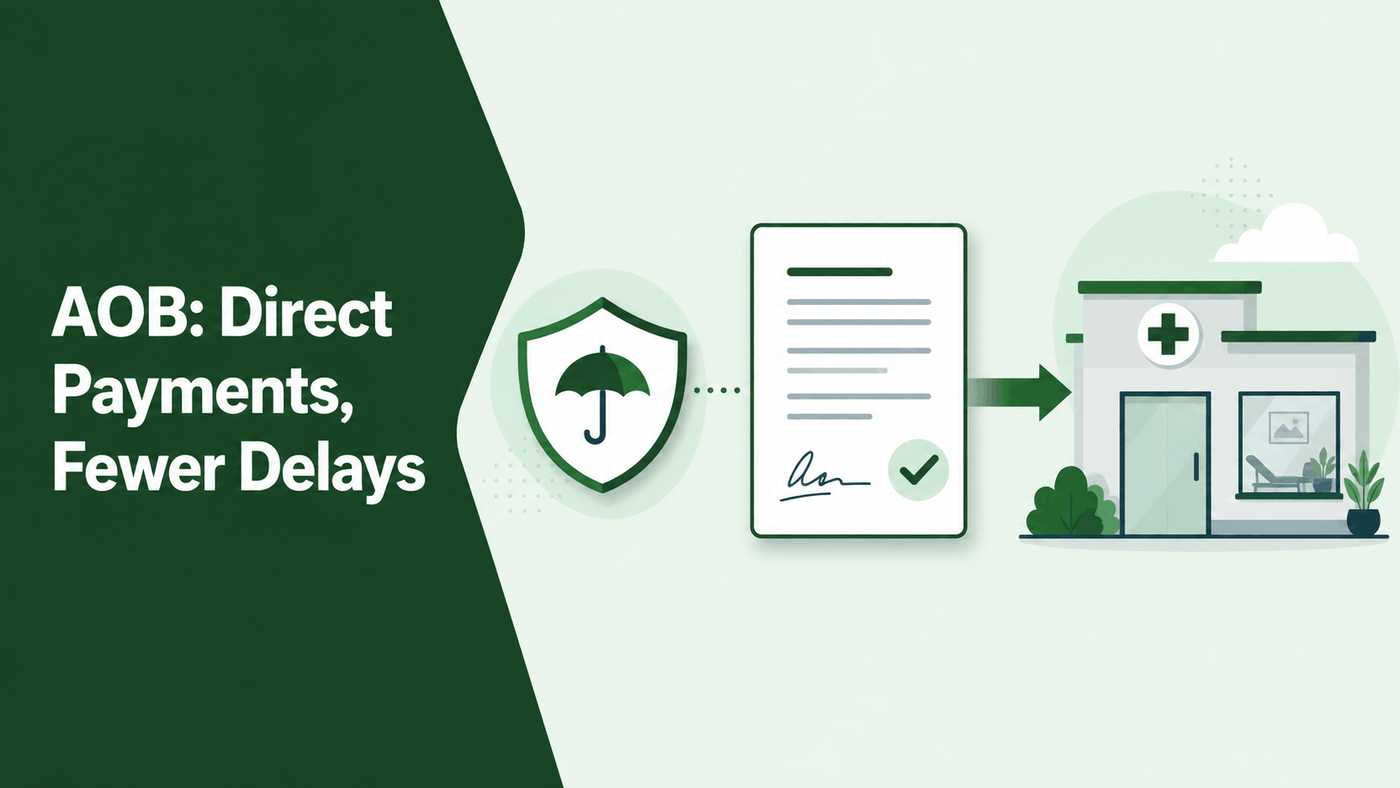
An assignment of benefits allows a healthcare provider to receive insurance payments directly for covered services instead of having the insurer send payment to the patient. Although the concept sounds straightforward, incomplete forms, conflicting payer requirements, state restrictions, and confusion about patient responsibility can create claim delays and compliance risks.
For providers, understanding AOB in medical billing is therefore about more than obtaining a signature. It requires a controlled process connecting patient registration, benefit verification, claim submission, payment posting, and follow-up.
This guide explains how an assignment of benefits works, what it does—and does not—authorize, and how medical practices can manage it responsibly.
Important: This article provides general educational information for U.S. healthcare providers. Assignment rules vary by payer, plan, provider contract, service, and state. Practices should consult their payer agreements and qualified legal or compliance professionals before adopting or revising an AOB policy.
What Is Assignment of Benefits in Medical Billing?
An assignment of benefits, commonly abbreviated as AOB, is an arrangement through which a patient or insured person authorizes a health plan to pay covered benefits directly to a healthcare provider.
Without an effective assignment, an insurer may send reimbursement to the policyholder, leaving the provider responsible for collecting payment from the patient. When the payer recognizes the assignment, it may issue payment directly to the provider, subject to the patient’s coverage, the provider’s network status, contractual terms, and applicable law.
The standard professional claim form illustrates this concept. Item 13 of the CMS-1500 claim form states that the insured or authorized person assigns payment of medical benefits to the physician or supplier.
However, signing an AOB does not guarantee that:
- The payer will cover the service
- The claim will be approved
- The provider will receive the full billed amount
- Prior authorization requirements have been satisfied
- The patient has no remaining financial responsibility
- The payer must recognize the assignment in every circumstance
An AOB primarily addresses who may receive an available insurance payment. It does not create coverage that the patient’s plan does not provide.
How Does an AOB Work?
A typical assignment-of-benefits workflow follows these steps:
- The provider collects insurance information.
Registration staff record the patient’s demographic, subscriber, and plan details. - The patient reviews and signs the authorization.
The AOB language may be included in the practice’s financial policy, intake forms, or a separate document. - The provider verifies benefits.
Staff confirm eligibility, network status, coverage limitations, deductibles, coinsurance, copayments, and authorization requirements. A structured benefit verification process can help staff identify these conditions before non-emergency services are delivered. - The provider delivers and documents the service.
Clinical documentation must support the diagnoses, procedures, supplies, and medical necessity reported on the claim. - The claim is submitted to the payer.
The claim indicates that payment has been assigned to the provider when required by the applicable transaction or form. Accurate claim submission in medical billing remains essential because an AOB cannot correct incomplete patient information, coding errors, or missing documentation. - The payer processes the claim.
The payer applies the patient’s benefits, contract terms, medical policies, claim edits, and cost-sharing obligations through the claim adjudication process. - Payment and remittance information are issued.
If the assignment is recognized, the payer generally sends the allowed payment to the provider. The practice then posts the payment, adjustments, denials, and patient responsibility shown on the remittance advice.
The exact process may differ among commercial insurers, Medicare, Medicaid programs, workers’ compensation plans, and auto insurance arrangements.
Why Assignment of Benefits Matters to Providers
A properly managed AOB process can support several parts of the revenue cycle.
More Direct Payment Routing
When benefits are paid directly to the provider, the practice does not have to depend on the patient to forward an insurance check. This can reduce collection delays and simplify payment reconciliation.
A Clearer Billing Relationship
A well-written AOB helps explain that the provider may bill the patient’s insurer and receive eligible benefits directly. When paired with a transparent financial policy, it can also clarify that the patient remains responsible for valid deductibles, copayments, coinsurance, noncovered services, and other amounts permitted by law and contract.
Better Administrative Continuity
Standardized AOB procedures help front-desk, billing, and accounts-receivable teams follow the same rules. This is particularly valuable for organizations managing multiple locations or payers.
Fewer Avoidable Payment Problems
An AOB cannot prevent every denial. However, collecting complete, valid information before the service may reduce administrative problems involving missing signatures, outdated insurance details, or unclear payment authorization.
Assignment of Benefits vs. Authorization to Release Information
These authorizations are related but serve different purposes.
| Document or authorization | Primary purpose |
|---|---|
| Assignment of benefits | Directs eligible insurance payments to the provider |
| Authorization or acknowledgment concerning information disclosure | Addresses the use or disclosure of health information |
| Consent to treatment | Documents the patient’s agreement to receive care |
| Financial responsibility agreement | Explains the patient’s payment obligations |
| Prior authorization | Represents a payer’s advance review under plan rules |
The CMS-1500 form demonstrates the distinction. Item 12 addresses the release of information needed to process a claim, while Item 13 addresses payment of benefits to the provider.
Providers should also distinguish an AOB from authorization in medical billing. An AOB concerns payment direction, whereas prior authorization is a payer’s review of whether a proposed service meets applicable coverage requirements. Having one does not replace the other.
Under HIPAA, covered entities may generally use or disclose protected health information for treatment, payment, and healthcare operations without obtaining a separate authorization, subject to the Privacy Rule and other applicable requirements. The U.S. Department of Health and Human Services provides further guidance on these permitted uses and disclosures.
What Should an Assignment-of-Benefits Form Include?
There is no universal wording appropriate for every provider and jurisdiction. A form developed with compliance or legal guidance will commonly address:
- Patient and insured-person identification
- Health plan or policy information
- Authorization for direct payment to the provider
- The services or claims covered by the assignment
- The assignment’s effective period
- Patient responsibility for applicable cost sharing and noncovered charges
- Authorization for the provider to submit claims and related documentation
- Any revocation terms permitted by law and contract
- Patient or authorized representative signature
- The representative’s authority, when someone signs for the patient
- Signature date
- Required notices under state law or payer rules
The language should be readable and specific. Broad terms such as “irrevocably assigns all rights” may not be enforceable in every jurisdiction and could create patient-trust or compliance concerns.
Providers should avoid copying generic online templates without reviewing the applicable state requirements, federal program rules, and payer contracts.
Is an AOB the Same as Accepting Medicare Assignment?
No. These concepts overlap in terminology but are not identical.
A patient’s assignment of benefits generally authorizes direct payment to the provider. In Original Medicare, “accepting assignment” also concerns the amount the provider agrees to accept.
According to Medicare.gov, a provider that accepts assignment agrees to accept the Medicare-approved amount as full payment for a covered service. The provider may generally collect only the applicable deductible and coinsurance from the beneficiary.
CMS further explains that:
- Participating physicians and suppliers agree to accept assignment on all Medicare-covered claims.
- Nonparticipating physicians and suppliers may accept assignment on a claim-by-claim basis.
- Providers that have formally opted out of Medicare operate under separate private-contracting rules, except in limited circumstances.
The CMS Medicare participation guidance should be reviewed before making operational decisions. Practices should not use a general commercial-insurance AOB form as a substitute for compliance with Medicare enrollment, participation, claim-submission, or private-contracting requirements.
Does an AOB Eliminate Patient Responsibility?
No. An assignment of benefits does not automatically remove the patient’s financial obligations.
Depending on the plan and applicable protections, the patient may still owe:
- Deductibles
- Copayments
- Coinsurance
- Noncovered services
- Services exceeding plan limitations
- Charges arising from inaccurate or outdated insurance information
- Other amounts permitted under payer contracts and law
Providers should calculate patient balances from the payer’s remittance advice or explanation of benefits rather than treating the original billed charge as automatically collectible. A consistent patient billing process can help practices communicate valid balances clearly and avoid premature collection activity.
Contractual write-offs, Medicare rules, Medicaid restrictions, state balance-billing laws, and federal protections may limit what a provider can bill. Practices must also distinguish patient responsibility from a contractual adjustment in medical billing, which generally cannot be transferred to the patient when prohibited by the provider’s agreement.
An AOB does not override these limitations.
AOB and Out-of-Network Billing
Assignment-of-benefits disputes commonly arise in out-of-network care. Some plans may send payment to the patient even if the provider has obtained an assignment. Other plans may restrict assignments through plan language, although the enforceability of such provisions can depend on governing law and the type of health plan.
Providers should verify:
- Whether the plan recognizes assignments to out-of-network providers
- Whether payment will be sent to the provider or subscriber
- Whether the plan is fully insured or self-funded
- Whether state assignment or prompt-payment laws apply
- Whether federal surprise-billing protections affect the service
- Whether the provider may balance bill the patient
The No Surprises Act restricts surprise billing in several situations, including certain emergency services and some non-emergency services delivered by out-of-network providers at participating facilities. It also establishes notice, consent, disclosure, and dispute-resolution requirements in applicable cases.
Providers should consult the current CMS No Surprises Act resources instead of assuming that an AOB permits unrestricted balance billing.
Common Assignment-of-Benefits Mistakes
Treating AOB as a Payment Guarantee
A payer may deny a claim because the service is excluded, not medically necessary under the plan, incorrectly coded, untimely, or missing required authorization. The assignment does not correct these issues.
Failing to Verify Who Can Sign
A minor, dependent adult, or incapacitated patient may require an authorized representative. Staff should document the representative’s identity and authority according to organizational policy and applicable law.
Using One Form for Every Payer and Service
Commercial plans, Medicare, Medicaid, workers’ compensation, and auto insurers may follow different rules. A standardized form is useful only if it is reviewed against the requirements that apply to the practice.
Confusing Eligibility Verification With Authorization
Eligibility indicates that coverage appears active at the time of verification. It does not guarantee payment or replace prior authorization, referral, medical-necessity, or documentation requirements.
Collecting an Outdated or Unreadable Signature
Practices should define when a new signature is required and how long an existing assignment remains effective. The record should clearly show who signed and when.
Billing the Patient Before Reviewing the Remittance
Premature billing may produce inaccurate balances, unnecessary complaints, refunds, or violations of payer agreements and billing protections.
Ignoring Anti-Assignment Language
Some health plans contain clauses intended to limit or prohibit the assignment of benefits. Their application can be legally complex, especially when federal and state rules intersect. Providers should escalate these cases rather than assuming the payer must send payment directly.
Best Practices for Managing AOB in Medical Billing
Use Legally Reviewed, Plain-Language Forms
The form should accurately describe the arrangement without overstating the provider’s rights or the patient’s obligations. Review it whenever payer requirements or relevant laws change.
Verify Benefits Before Non-Emergency Services
Where operationally possible, confirm eligibility, network status, benefit limits, prior authorization, referral requirements, and expected cost sharing before treatment.
Explain That Estimates Are Not Guarantees
Benefit information may change when the payer processes the claim. Written estimates should state their assumptions and explain that final responsibility depends on adjudication and applicable billing rules.
Keep the Signed Form Accessible
Store the assignment in the patient’s record and make it retrievable for claim follow-up, payer requests, audits, and appeals. Access should be controlled according to the organization’s privacy and security policies.
Align Front-Office and Billing Procedures
Registration staff should know when to request a signature, while billing staff should know where to find the form and how to respond when a payer disputes the assignment.
Follow the Remittance Advice
Post contractual adjustments and patient responsibility accurately. Effective payment posting in medical billing helps staff identify underpayments, incorrect adjustments, denials, and balances that require further review.
Do not transfer denied or adjusted amounts to the patient automatically without confirming that the balance is billable.
Audit the Process
Periodic audits can identify:
- Missing or undated forms
- Signatures from unauthorized individuals
- Incorrect insurance information
- Payments sent to patients
- Inconsistent patient-balance transfers
- Payer-specific assignment issues
- Outdated form language
Audit findings should lead to documented training and workflow improvements.
What to Do When an Insurer Pays the Patient
When a payer sends payment to the patient despite an AOB, the practice should first confirm:
- Whether the payer received and recognized the assignment
- Whether the claim indicated assignment correctly
- Whether the plan contains an anti-assignment provision
- Whether network status affected payment routing
- Whether state or federal law changes the outcome
- Whether the payer requires a specific form or appeal process
The billing team may then submit the signed assignment, request reprocessing, or follow the payer’s appeal procedure. Communications should remain factual and should not misrepresent that direct payment is guaranteed.
If the payment cannot be redirected, the provider’s options for collecting from the patient will depend on the financial agreement, payer rules, applicable law, and the amount legally owed. Complex or recurring cases should be reviewed by qualified counsel.
What Happens When an AOB-Related Claim Is Denied?
An AOB-related issue may appear as a denial, a payment-routing problem, or a request for additional documentation. Before appealing, determine whether the payer rejected the assignment itself or denied the underlying service.
The billing team should review:
- The claim and assignment indicator
- The signed AOB form
- Eligibility and benefit-verification records
- Provider participation status
- Prior authorization records
- The payer’s remittance reason
- Applicable plan provisions
- Claim filing and appeal deadlines
A structured denial management process can help the practice separate assignment disputes from coding, authorization, coverage, and documentation denials. This distinction matters because each problem requires different supporting evidence and corrective action.
Frequently Asked Questions
Is Assignment of Benefits Mandatory?
Not universally. Whether it is required or useful depends on the payer, plan, provider relationship, and service. Some programs and contracts impose their own claim-assignment requirements.
Can a Patient Revoke an AOB?
Possibly. The answer depends on the document, applicable state law, payer rules, and whether claims have already been submitted or paid. The form should clearly explain any permitted revocation process.
Does AOB Give the Provider Appeal Rights?
Not automatically in every case. The right to appeal may depend on the plan, governing law, provider contract, and whether the assignment validly transfers the relevant rights. Payment assignment should not be assumed to transfer every legal or administrative right.
Does the Provider Need a New AOB for Every Visit?
Requirements vary. Some providers use an assignment that applies to an episode of care or remains effective until revoked, while certain payers or situations may require a claim-specific or updated form.
Can an Electronic Signature Be Used?
Electronic signatures may be accepted when they comply with applicable federal and state laws, payer requirements, and the provider’s authentication and record-retention policies. Practices should preserve evidence linking the signer, document, date, and signature event.
Can an AOB Override a Payer Contract?
No. An assignment does not automatically override network agreements, reimbursement terms, utilization-management requirements, balance-billing restrictions, or other enforceable plan provisions.
Key Takeaway
The assignment of benefits in medical billing gives a provider a basis for receiving eligible insurance payments directly, but it is only one part of a compliant revenue-cycle process. It does not guarantee coverage, eliminate patient cost sharing, replace prior authorization, or override payer contracts and billing laws.
Providers can reduce risk by using reviewed forms, verifying coverage, distinguishing payment assignment from other authorizations, maintaining complete records, and following payer-specific and jurisdiction-specific requirements.
Practices experiencing recurring payment-routing, posting, or claim-follow-up problems may benefit from a broader review of their medical billing services and revenue-cycle workflows. When an assignment affects appeals, out-of-network reimbursement, balance billing, or disputed plan language, legal or compliance review remains the safest next step.
Last reviewed: August 2026. Regulations, payer policies, and state laws may change; verify current requirements before relying on this information.

