
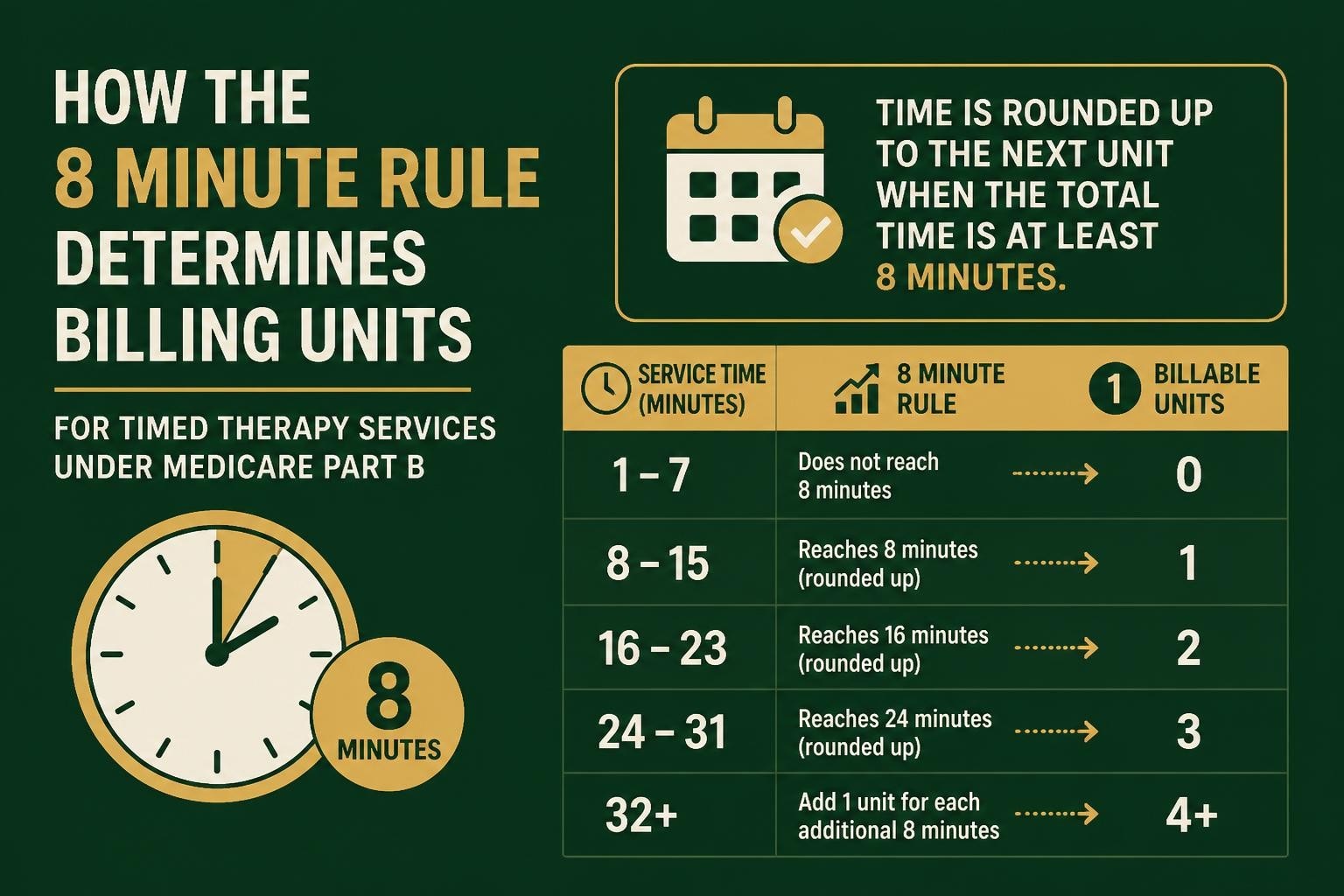
Healthcare providers offering physical therapy, occupational therapy, and speech-language pathology services must understand one of Medicare’s most critical billing requirements. The 8 minute rule establishes how practitioners calculate billable units for time-based therapy services, directly impacting reimbursement accuracy and compliance. Errors in applying this rule can lead to claim denials, payment delays, and potential audit flags, making it essential for revenue cycle management teams to master its application.
Understanding the Foundation of the 8 Minute Rule
The 8 minute rule, formally known as the Medicare unit-based billing rule, dictates how healthcare providers bill for time-based therapy services under Medicare Part B. This regulation requires providers to deliver at least eight minutes of direct, one-on-one therapy to bill for one unit of service. The Centers for Medicare & Medicaid Services implemented this standard to ensure consistency across therapy billing and prevent overcharging.
Key characteristics of services subject to this rule include:
- Direct patient contact required
- Time-based services explicitly listed in billing codes
- Constant attendance by the qualified professional
- Therapeutic interventions with measurable outcomes
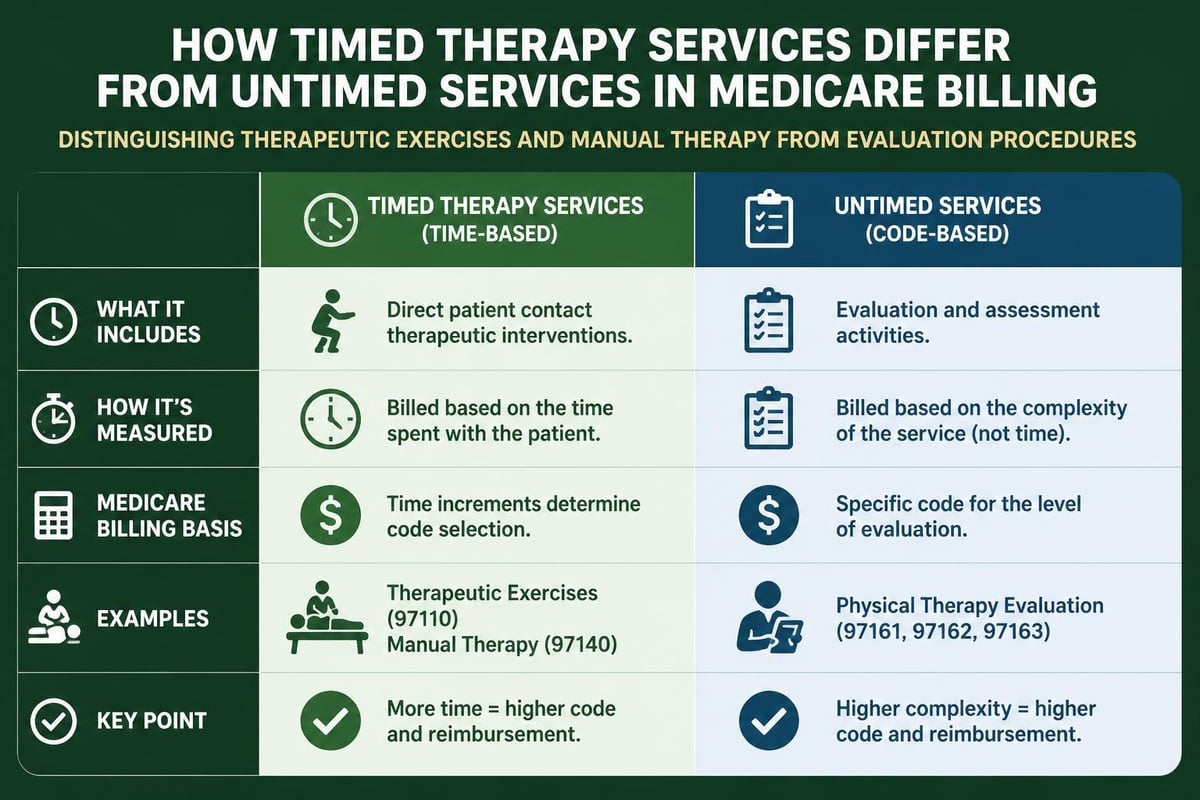
Services such as therapeutic exercises, manual therapy, neuromuscular reeducation, and gait training all fall under this billing methodology. Unlike untimed services that are billed per encounter regardless of duration, timed services require precise documentation of minutes spent with each patient.
Timed versus Untimed Services
Understanding which services require unit-based billing versus flat-rate billing is fundamental to proper claims submission. Timed services require practitioners to track and document exact minutes, while untimed services receive one unit per encounter.
| Service Type | Billing Method | Examples |
|---|---|---|
| Timed Services | Unit-based (8-minute rule) | Therapeutic exercises, manual therapy, neuromuscular reeducation |
| Untimed Services | Per encounter | Evaluations, re-evaluations, hot/cold packs |
| Mixed Sessions | Combination | Both timed and untimed services documented separately |
Calculating Billable Units Correctly
The 8 minute rule follows a specific formula that determines the number of units providers can bill based on total timed service minutes. Many billing errors occur because staff members misunderstand how to aggregate time across multiple services or round inappropriately.
The calculation method uses the midpoint principle. To bill one unit, providers must deliver at least eight minutes of service. For two units, the minimum is 23 minutes. This pattern continues, with each additional unit requiring an additional 15 minutes beyond the first unit.
Standard unit calculation thresholds:
- 1 unit: 8-22 minutes
- 2 units: 23-37 minutes
- 3 units: 38-52 minutes
- 4 units: 53-67 minutes
- 5 units: 68-82 minutes
When a therapy session includes multiple timed services, practitioners must add all timed service minutes together first, then calculate total billable units. After determining the total units, providers allocate those units to individual services based on which service consumed the most time.
Step-by-Step Calculation Process
Step 1: Document exact minutes spent on each timed service during the patient encounter.
Step 2: Add all timed service minutes together to get the total timed minutes.
Step 3: Use the threshold table to determine total billable units based on aggregate time.
Step 4: Assign units to individual services, starting with the service that took the most time.
Step 5: Continue allocating remaining units to other services in descending order of time spent.
For example, if a therapist provides 15 minutes of therapeutic exercises, 10 minutes of manual therapy, and 12 minutes of gait training, the total timed minutes equal 37 minutes. According to the rule, 37 minutes equals two billable units. The provider would bill two units for therapeutic exercises (the longest service) and zero units for the other services, though all services should still be documented in clinical notes.
Common Billing Errors and Compliance Risks
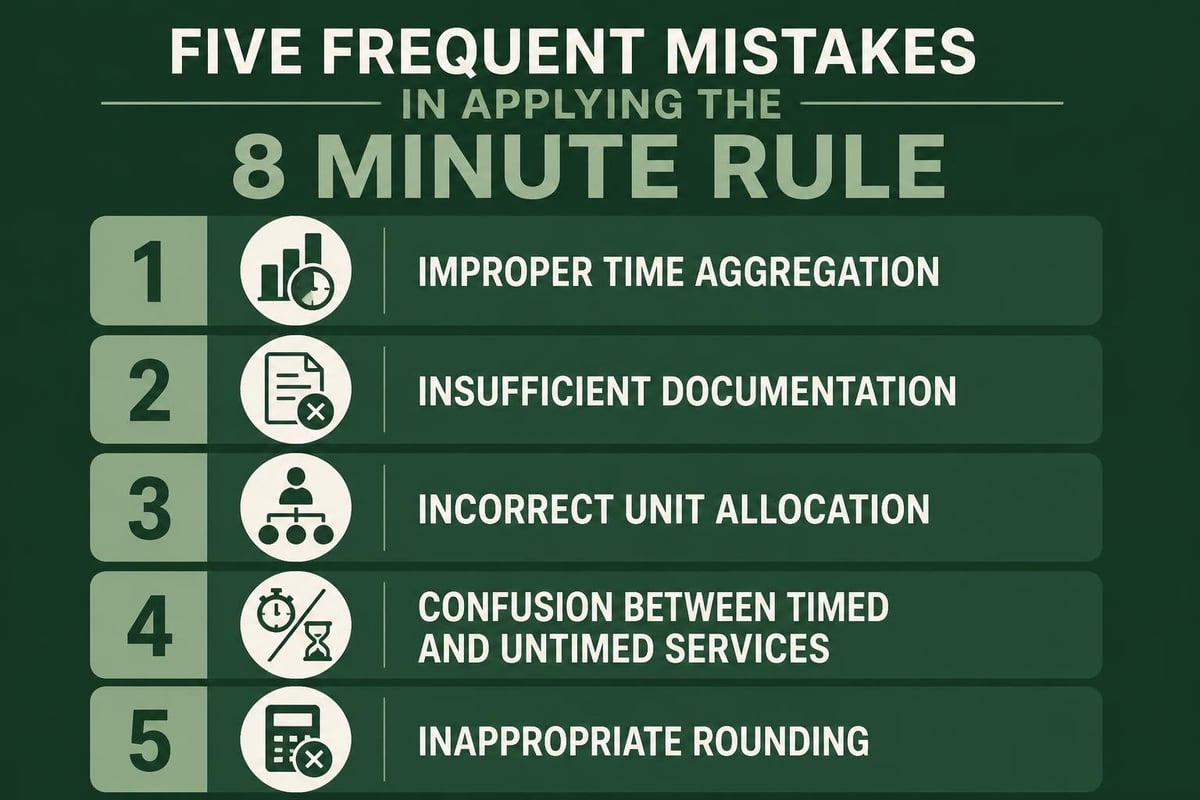
Revenue cycle management teams frequently encounter errors related to the 8 minute rule that result in claim denials or compliance issues. Understanding these common pitfalls helps practices maintain accurate billing and avoid revenue loss.
One prevalent mistake involves billing each timed service separately without aggregating total time. This approach violates Medicare guidelines and can trigger audits. Another error occurs when staff members round up inappropriately, billing for units not supported by documented time.
| Error Type | Impact | Prevention Strategy |
|---|---|---|
| Failing to aggregate time | Overbilling, claim denials | Implement mandatory time aggregation in workflow |
| Insufficient documentation | Unable to support billed units | Require minute-by-minute service logs |
| Incorrect unit allocation | Payment delays | Train staff on allocation hierarchy |
| Billing untimed services as timed | Compliance violations | Regular coding audits and staff education |
Documentation deficiencies represent another significant risk area. Medicare requires contemporaneous documentation that clearly shows the exact minutes spent on each timed service. Vague notations like “approximately 45 minutes” or “about an hour” do not meet documentation standards and cannot support billed units during an audit.
Documentation Best Practices
Proper documentation serves as the foundation for defensible billing under the 8 minute rule. Clinical notes must include start and stop times or total minutes for each timed service, along with detailed descriptions of therapeutic interventions performed. Many practices integrate specialized medical billing software that includes built-in calculators and validation checks to prevent common errors.
Electronic health record systems should feature templates that prompt clinicians to enter exact minutes and automatically calculate billable units. This automation reduces human error while ensuring consistency across providers. Additionally, implementing regular internal audits helps identify patterns of documentation deficiencies before they result in payer audits or denials.
Special Scenarios and Exceptions
Certain clinical situations create complexity when applying the 8 minute rule. Understanding how to handle these scenarios ensures accurate billing while maintaining compliance with Medicare guidelines.
Group therapy sessions require special consideration. When a therapist works with multiple patients simultaneously, the time must be divided among all participants. If a 30-minute group session includes four patients, each patient receives credit for only 7.5 minutes of therapy time, which falls below the eight-minute threshold for billing one unit.
Additional complex scenarios include:
- Co-treatment sessions involving multiple disciplines
- Services interrupted by medical emergencies
- Therapy sessions spanning different calendar days
- Services provided in multiple settings during one encounter
Medicare’s specific guidelines for physical therapy billing address many of these scenarios, but practices should maintain clear policies for handling edge cases. When uncertainty exists, consulting with experienced revenue cycle management professionals ensures proper claim submission.
Modifier Usage and the 8 Minute Rule
Certain modifiers interact with the 8 minute rule to communicate specific service circumstances to payers. The GP modifier indicates physical therapy services, while GO denotes occupational therapy and GN represents speech-language pathology. These modifiers help payers process claims correctly but do not change how the 8 minute rule applies to unit calculation.
Understanding various types of modifiers in medical billing becomes essential when therapy services overlap with other procedures or occur in unique circumstances. Proper modifier application combined with accurate unit calculation ensures clean claim submission and optimal reimbursement.
Technology Solutions for Accurate Application
Modern healthcare practices leverage technology to streamline 8 minute rule compliance and reduce billing errors. Automated systems calculate billable units in real-time as clinicians document services, providing immediate feedback and preventing mistakes before claims submission.
Healthcare revenue cycle analytics platforms can identify patterns in unit calculation errors, documentation deficiencies, and denial trends related to therapy billing. These insights enable proactive corrections and staff training to address systemic issues. Many practices also implement pre-claim scrubbing software that validates unit calculations against documented time before claims reach payers.
Integration between clinical documentation systems and billing platforms creates seamless data flow while maintaining accuracy. When therapists complete their clinical notes, the system automatically extracts service minutes, calculates units according to the 8 minute rule, and populates claim forms with correct billing codes and units. This automation significantly reduces the manual data entry that often introduces errors.
Training and Quality Assurance Programs
Consistent application of the 8 minute rule across an organization requires comprehensive training programs for both clinical and billing staff. Therapists must understand documentation requirements, while billing specialists need expertise in unit calculation and claims submission.
Effective training programs include case studies demonstrating correct calculation methods, common error scenarios, and documentation standards. Regular refresher sessions help staff stay current with any regulatory updates or payer-specific variations. Many successful practices implement competency assessments to verify that staff members can accurately calculate units in various scenarios.
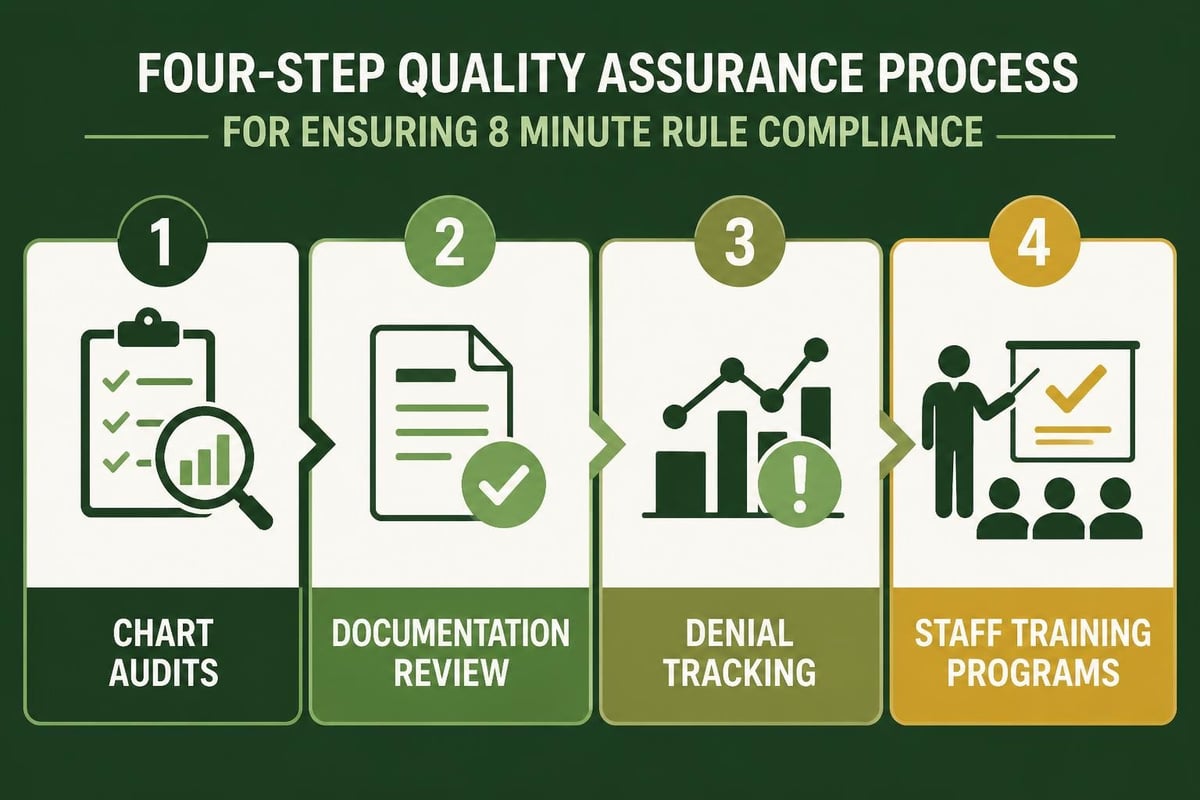
Quality assurance processes should include regular chart audits comparing documented time to billed units. These audits identify both underbilling and overbilling patterns that impact revenue and compliance. When audits reveal errors, immediate corrective action and additional training prevent recurring mistakes.
Essential components of a quality assurance program:
- Monthly random sampling of therapy claims
- Comparison of clinical documentation to submitted claims
- Tracking of denial rates related to unit calculation
- Peer review sessions for complex billing scenarios
- Regular updates to policies and procedures
Denial management services become particularly valuable when practices face frequent rejections related to the 8 minute rule. Experienced specialists can identify root causes of denials, implement corrective measures, and appeal inappropriate denials with proper documentation support.
Payer-Specific Variations and Considerations
While Medicare established the 8 minute rule, not all payers follow identical guidelines. Commercial insurance companies may apply different standards for unit-based billing, creating complexity for practices that serve diverse patient populations. Some payers accept the substantial portion methodology, while others follow Medicare’s midpoint approach strictly.
Understanding these variations requires maintaining current knowledge of each payer’s specific billing requirements. Medical claim submission services often include payer-specific edits and validation to ensure claims meet individual payer standards before submission. This proactive approach reduces denials and accelerates reimbursement.
Medicaid programs vary by state, with some states adopting Medicare’s 8 minute rule and others implementing alternative methodologies. Practices serving Medicaid patients must verify their state’s specific requirements and adjust billing processes accordingly. Workers’ compensation programs also maintain distinct billing rules that may differ from Medicare standards.
Maintaining compliance across multiple payer types demands robust systems and knowledgeable staff. Many practices partner with specialized revenue cycle management providers who maintain expertise across all major payers and stay current with regulatory changes. This partnership model allows clinical staff to focus on patient care while ensuring billing accuracy and compliance.
Mastering the 8 minute rule is essential for therapy practices seeking to optimize revenue while maintaining compliance with Medicare and other payer requirements. Accurate unit calculation, thorough documentation, and robust quality assurance processes create a foundation for successful therapy billing. Greenhive Billing Solutions provides comprehensive revenue cycle management services specifically designed for healthcare providers, offering expert guidance on complex billing rules, denial management, and claims optimization to maximize your practice’s reimbursements while ensuring full compliance with all regulatory requirements.

