
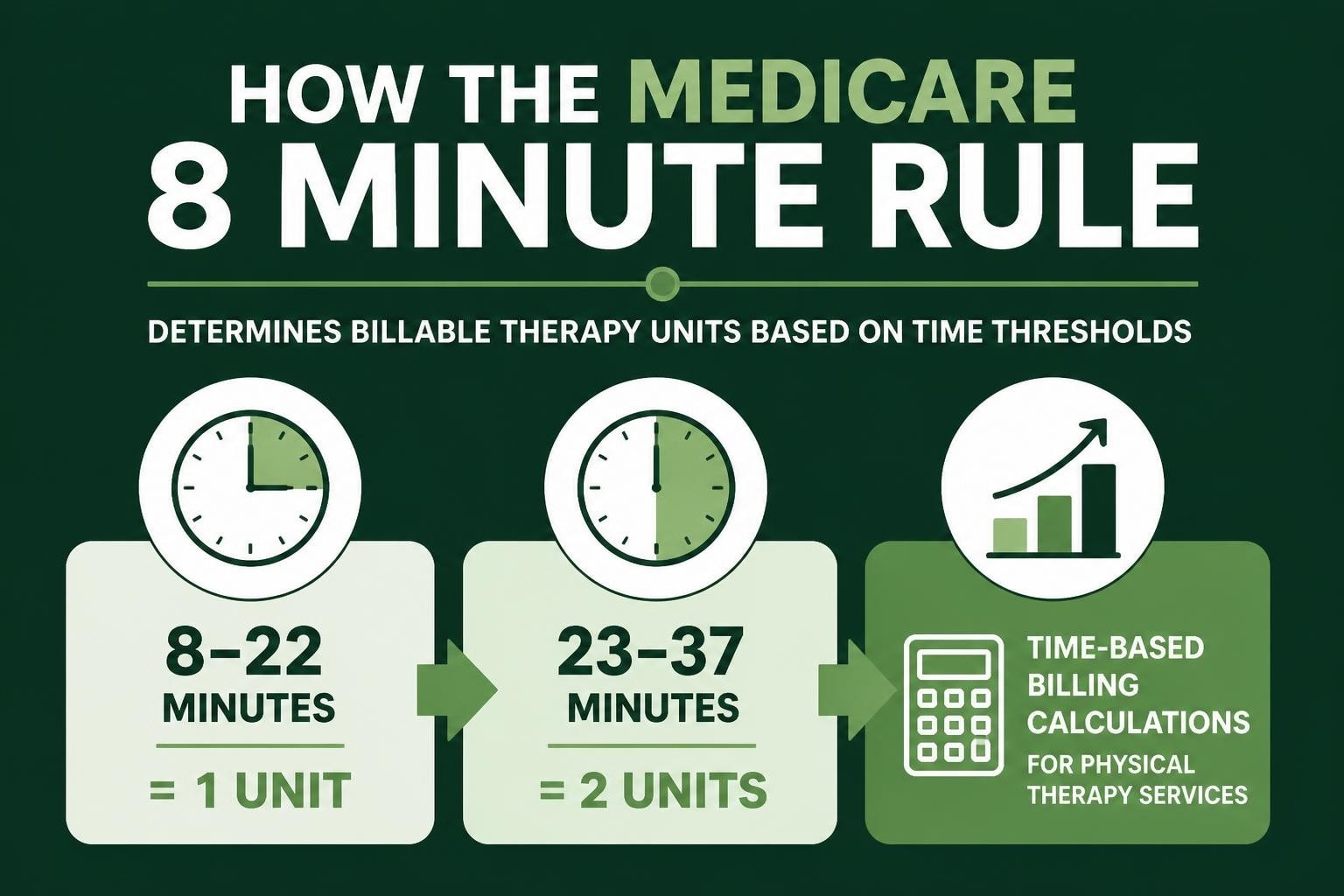
Understanding proper billing protocols remains essential for healthcare providers delivering therapy services to Medicare beneficiaries. The medicare 8 minute rule represents one of the most critical billing guidelines that impacts reimbursement accuracy for physical therapy, occupational therapy, and speech-language pathology services. This time-based billing standard determines how providers calculate billable units for timed procedures, directly affecting revenue cycle outcomes and compliance status.
Understanding the Medicare 8 Minute Rule Framework
The medicare 8 minute rule, formally known as the “Rule of Eights,” establishes minimum time thresholds for billing timed therapy services under Medicare Part B. This regulation specifies that providers must deliver at least eight minutes of direct therapy service to bill one unit of a timed Current Procedural Terminology (CPT) code.
Medicare divides time into 15-minute increments, with each unit representing one billing unit. However, the critical distinction lies in how partial units are calculated. According to Medicare’s 8-minute rule guidelines, providers can only bill for units when the total treatment time reaches specific minute thresholds.
Time Threshold Breakdown
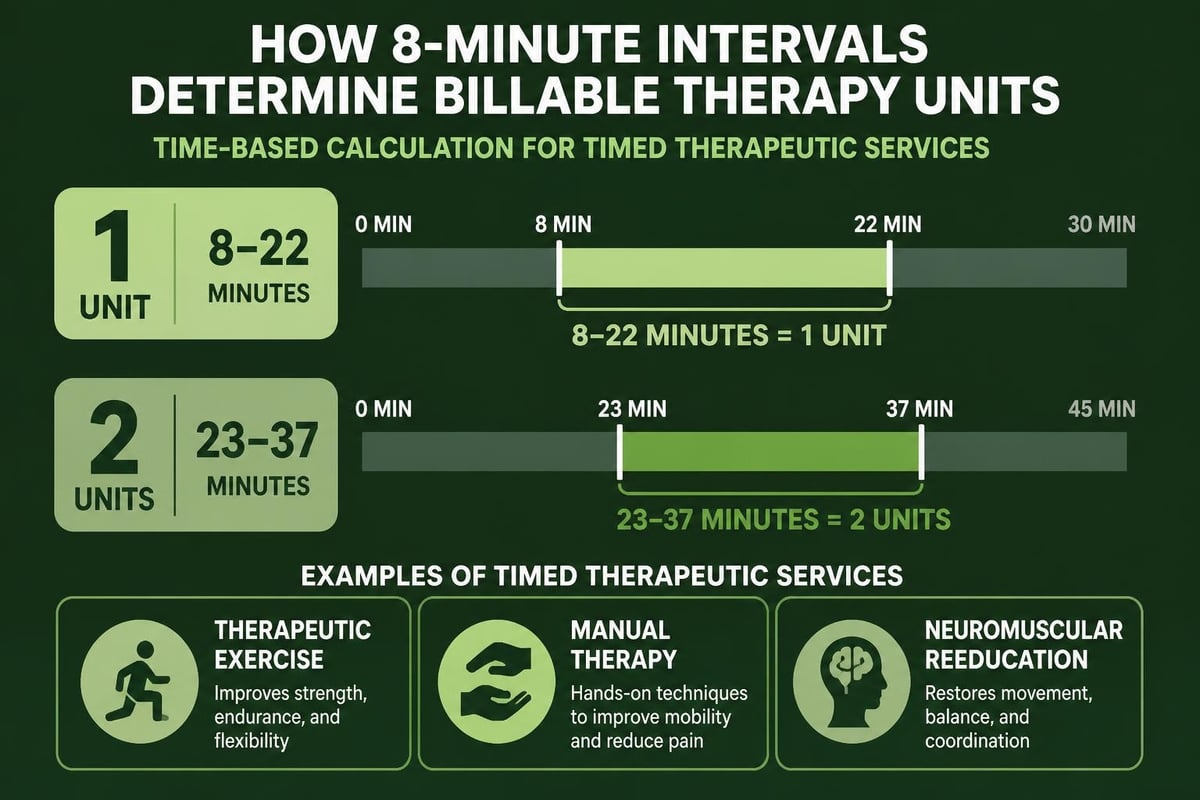
The calculation follows a specific pattern that determines billable units:
| Total Minutes | Billable Units |
|---|---|
| 8-22 minutes | 1 unit |
| 23-37 minutes | 2 units |
| 38-52 minutes | 3 units |
| 53-67 minutes | 4 units |
| 68-82 minutes | 5 units |
Understanding these thresholds prevents underbilling or overbilling situations that could trigger audits or revenue loss. Revenue cycle management teams must verify that documentation supports the time claimed for each billable unit.
Distinguishing Timed Versus Untimed Services
Not all therapy services fall under the medicare 8 minute rule. Medicare categorizes therapy services into two distinct groups: timed codes and service-based (untimed) codes. Timed codes require direct patient contact for the specified duration, while untimed codes bill as single units regardless of time spent.
Common timed CPT codes include:
- 97110 (Therapeutic exercises)
- 97112 (Neuromuscular reeducation)
- 97116 (Gait training)
- 97140 (Manual therapy techniques)
- 97530 (Therapeutic activities)
Common untimed CPT codes include:
- 97161-97163 (Physical therapy evaluation)
- 97535 (Self-care management training)
- 97750 (Physical performance test)
- 97760 (Orthotic management and training)
Providers must document the exact start and stop times for each timed service. This documentation becomes critical during audits and supports denial management efforts when payers question billing accuracy.
Calculating Total Treatment Time Under the Rule
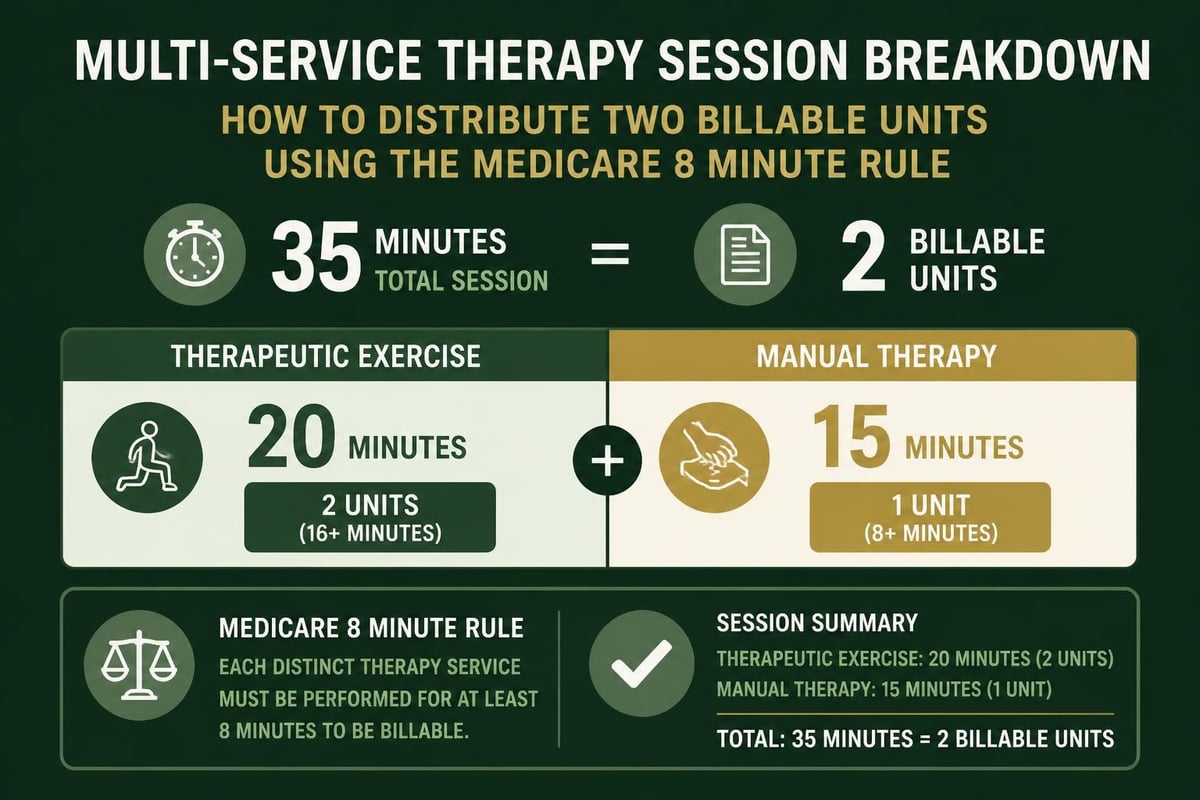
Proper calculation requires summing all timed service minutes before applying the medicare 8 minute rule. This approach differs from calculating each service independently, which represents a common billing error that can lead to compliance issues.
Step-by-Step Calculation Process
Step 1: Document individual service times with start and stop times for each timed procedure performed during the treatment session.
Step 2: Total all timed service minutes by adding the duration of each qualifying timed CPT code delivered during the encounter.
Step 3: Apply the threshold table to determine total billable units based on the cumulative time spent on all timed services.
Step 4: Distribute units appropriately across the timed services provided, prioritizing services with the longest duration first.
For example, if a therapist provides 15 minutes of therapeutic exercise (97110) and 12 minutes of manual therapy (97140), the total timed service equals 27 minutes. According to the rule, 27 minutes allows billing for two units total. These units should be distributed as one unit of 97110 and one unit of 97140.
The guide to calculating therapy units provides additional examples demonstrating how to handle complex scenarios involving multiple timed services.
Common Billing Mistakes and Compliance Risks
Errors in applying the medicare 8 minute rule create significant financial and compliance risks. Underbilling reduces legitimate revenue, while overbilling exposes practices to recoupment demands, audits, and potential fraud allegations.
Frequent calculation errors include:
- Billing each timed service independently instead of totaling all timed minutes first
- Rounding up partial units that don’t meet the eight-minute threshold
- Failing to document exact start and stop times for each service
- Confusing timed and untimed service categories
- Using the rule for services that don’t qualify as direct patient contact
Compliance with the medicare 8 minute rule requires consistent staff training and robust quality assurance processes. Regular internal audits help identify patterns of incorrect billing before external auditors discover them. Healthcare providers working with experienced revenue cycle management services benefit from expert oversight that catches these errors proactively.
Documentation Requirements for Audit Defense
Strong documentation provides the foundation for defending medicare 8 minute rule claims during audits. Medicare requires specific elements in therapy documentation to support time-based billing.
| Documentation Element | Requirement |
|---|---|
| Service date | Exact date of service delivery |
| Start/stop times | Specific clock times for each timed service |
| Service description | Detailed explanation of interventions performed |
| Patient response | Objective measures of patient progress |
| Medical necessity | Justification linking services to treatment goals |
Many practices utilize electronic health record systems with built-in timers and templates designed to capture required elements. However, the technology alone doesn’t ensure compliance. Providers must verify that documentation accurately reflects services delivered and supports the units billed.
Understanding what CPT codes represent helps ensure proper code selection and documentation alignment. The connection between clinical documentation and billing accuracy directly impacts claim acceptance rates.
Impact on Revenue Cycle Performance
The medicare 8 minute rule significantly influences practice revenue and cash flow patterns. Incorrect application creates claim denials, delayed payments, and administrative burden managing appeals. Conversely, accurate billing under the rule optimizes legitimate reimbursement while maintaining compliance.
Revenue cycle teams should implement specific controls around eight-minute rule compliance. These include automated time calculation tools, regular coder training sessions, and systematic claim reviews before submission. The healthcare revenue cycle analytics process should track denial patterns related to time-based billing to identify improvement opportunities.
Medicare Administrative Contractors conduct post-payment audits specifically targeting therapy services billed under the medicare 8 minute rule. Practices with high volumes of therapy claims face increased scrutiny. Maintaining meticulous documentation and accurate calculations becomes essential for surviving these audits without significant financial impact.
Effective revenue cycle management extends beyond simple billing mechanics. Understanding how denial management improves cash flow connects directly to preventing eight-minute rule errors that trigger denials.
Best Practices for Implementation
Healthcare organizations should establish comprehensive policies governing medicare 8 minute rule application. These policies ensure consistency across providers and reduce variation in billing practices.
Key implementation strategies include:
- Standardized training programs covering calculation methods, documentation requirements, and common error prevention
- Template optimization ensuring electronic health records capture all required time elements automatically
- Regular auditing schedules with monthly internal reviews of therapy billing accuracy
- Clear escalation procedures for handling complex scenarios requiring billing expertise
- Performance monitoring tracking key metrics like denial rates for time-based therapy codes
Technology platforms streamline eight-minute rule compliance by calculating total time and distributing units automatically based on documented service durations. However, clinicians must understand the underlying principles to recognize when automated calculations require manual review.
Resources like the comprehensive 8-minute rule guide offer detailed explanations that support ongoing education efforts. Staying current with Medicare policy updates ensures practices maintain compliance as regulations evolve.
Mastering the medicare 8 minute rule represents a fundamental requirement for therapy providers seeking optimal reimbursement and compliance outcomes. The detailed time thresholds, calculation methods, and documentation standards require consistent application and regular oversight to prevent costly errors. Greenhive Billing Solutions provides specialized revenue cycle management services that ensure accurate therapy billing while maintaining full compliance with Medicare regulations. Our experienced team handles the complexities of time-based billing, allowing your providers to focus on delivering quality patient care while we maximize your legitimate reimbursements.

