
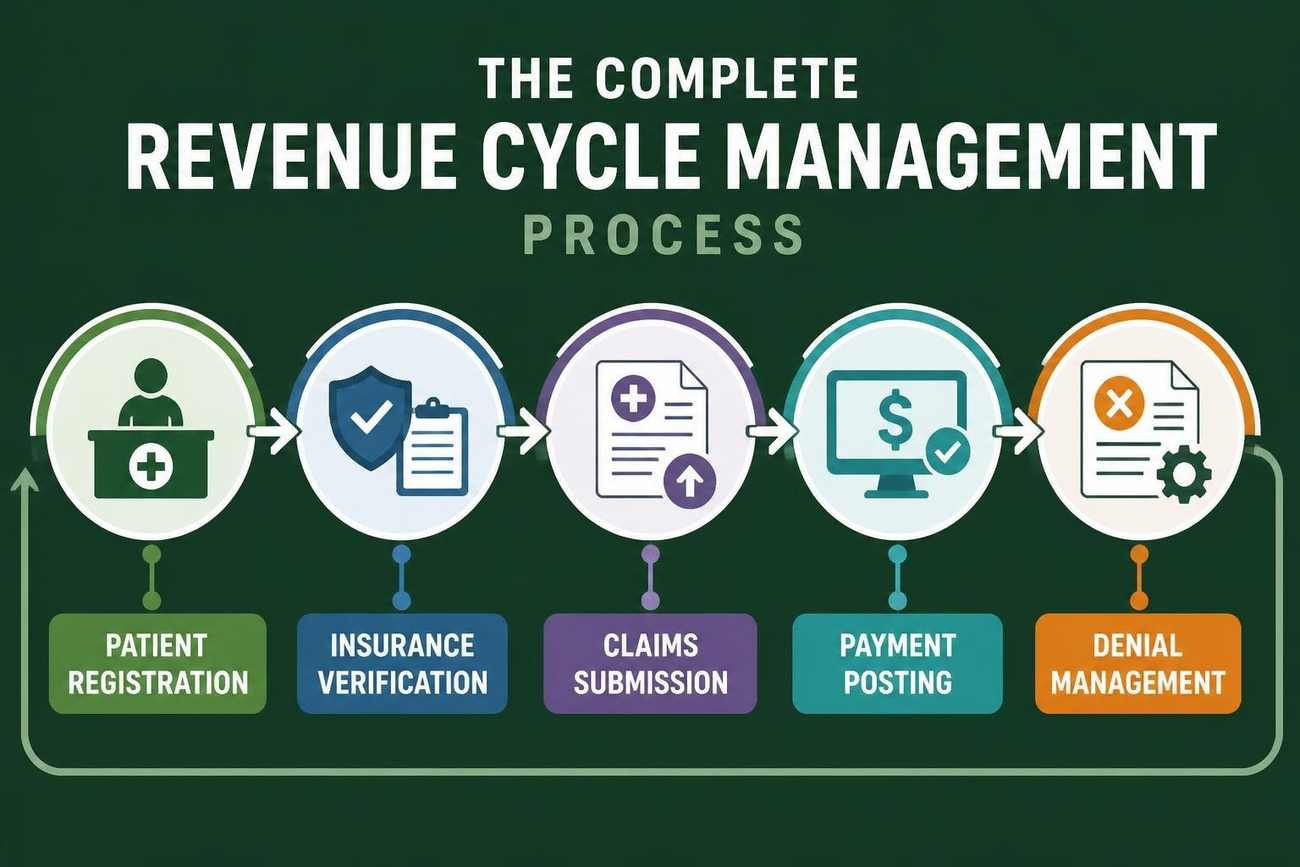
Healthcare providers frequently encounter confusion when discussing financial operations, particularly when comparing medical billing vs revenue cycle management. While these terms are often used interchangeably, they represent distinctly different aspects of healthcare financial administration. Understanding the relationship between these two critical functions can dramatically impact a practice’s bottom line, operational efficiency, and long-term sustainability.
Understanding Medical Billing as a Core Function
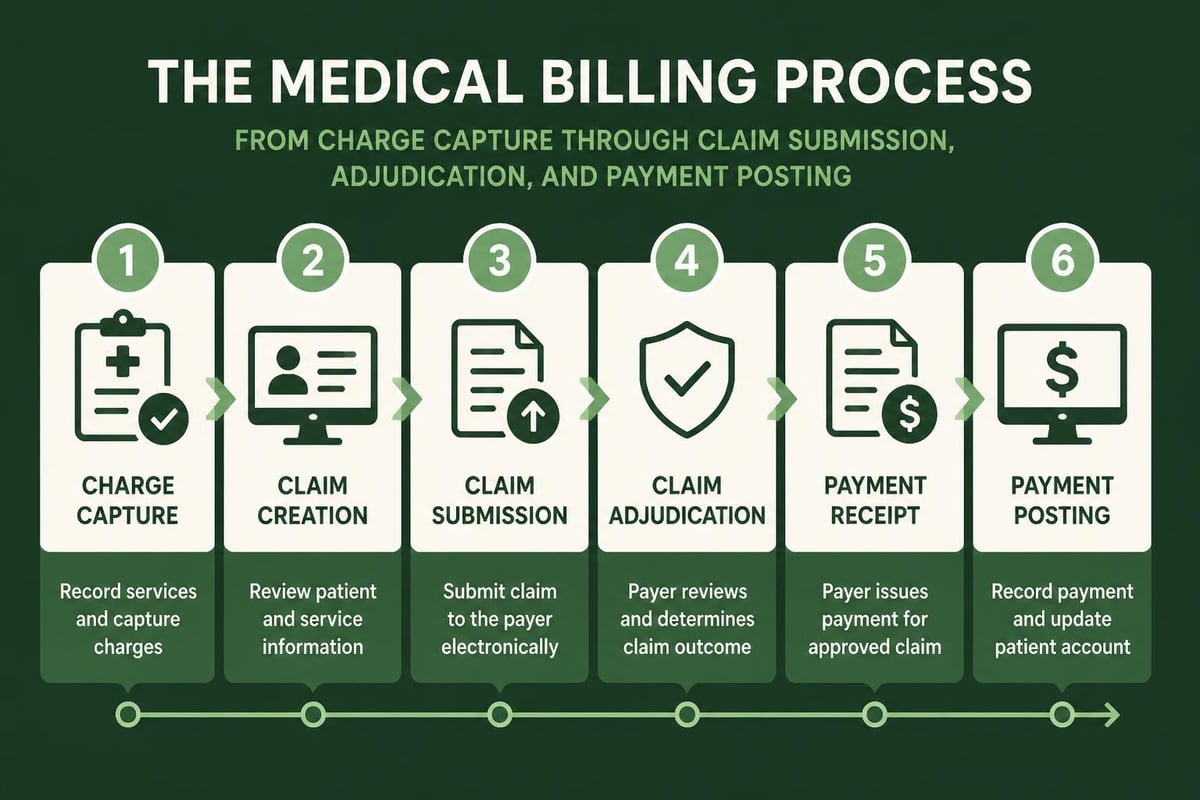
Medical billing represents a specific subset of financial operations within healthcare organizations. This process focuses primarily on translating healthcare services into billable claims and submitting them to insurance payers for reimbursement.
The medical billing function encompasses several essential tasks:
- Charge capture for services rendered during patient encounters
- Claim creation using appropriate CPT codes and modifiers
- Claim submission to insurance companies and government payers
- Payment posting when reimbursements arrive
- Patient billing for remaining balances after insurance processing
The Tactical Nature of Medical Billing
Medical billing operates as a transactional function that focuses on the mechanics of getting paid. Billing and coding specialists work diligently to ensure claims contain accurate information, proper documentation supports each service, and submissions meet payer requirements.
This process typically begins after a patient encounter concludes. The billing team receives documentation from providers, assigns appropriate procedure and diagnosis codes, and generates claims. These claims then travel through clearinghouses to insurance companies, where they undergo review and adjudication before payment issues.
Defining Revenue Cycle Management’s Broader Scope
Revenue cycle management represents a comprehensive approach to healthcare financial operations that begins before a patient arrives and continues until the practice collects all payments owed. According to industry experts who define revenue cycle management, this holistic strategy encompasses every financial aspect of patient care.
The distinction between medical billing vs revenue cycle management becomes clear when examining RCM’s full scope:
| RCM Stage | Key Activities | Financial Impact |
|---|---|---|
| Pre-Service | Patient scheduling, insurance verification, benefit determination | Reduces claim denials, improves collections |
| Point of Service | Registration accuracy, copay collection, authorization verification | Accelerates cash flow, minimizes bad debt |
| Claims Management | Coding, billing, submission, follow-up | Maximizes reimbursement, reduces delays |
| Payment Processing | Posting, reconciliation, patient statements | Improves accuracy, enhances reporting |
| Denial Management | Appeals, root cause analysis, process improvement | Recovers lost revenue, prevents future denials |
Strategic Financial Oversight
Revenue cycle management adopts a strategic perspective on practice finances. Rather than simply processing claims, comprehensive RCM services analyze patterns, identify bottlenecks, and implement systematic improvements across the entire financial lifecycle.
This broader approach includes insurance eligibility verification before appointments, ensuring clean claims pass through on the first submission, and establishing protocols that minimize errors before they occur.
Critical Differences That Impact Practice Performance
When healthcare administrators compare medical billing vs revenue cycle management, several fundamental differences emerge that directly affect financial outcomes.
Timeframe and Scope
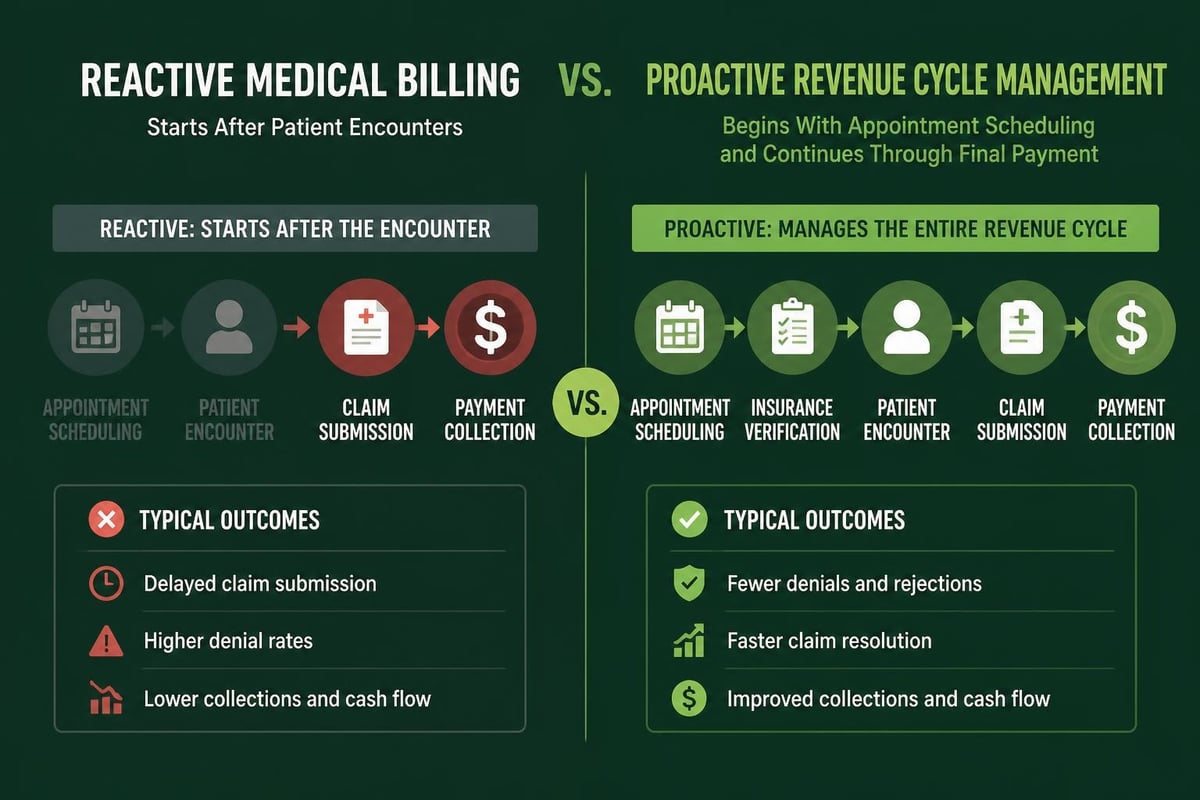
Medical billing begins after service delivery and ends when payment posts. Revenue cycle management starts when patients schedule appointments and continues through final payment collection, potentially spanning months for complex cases.
Proactive vs. Reactive Approach
Billing teams react to completed patient encounters by processing claims. RCM teams proactively prevent problems through front-end processes like insurance verification and eligibility checks that catch issues before services occur.
Performance Metrics
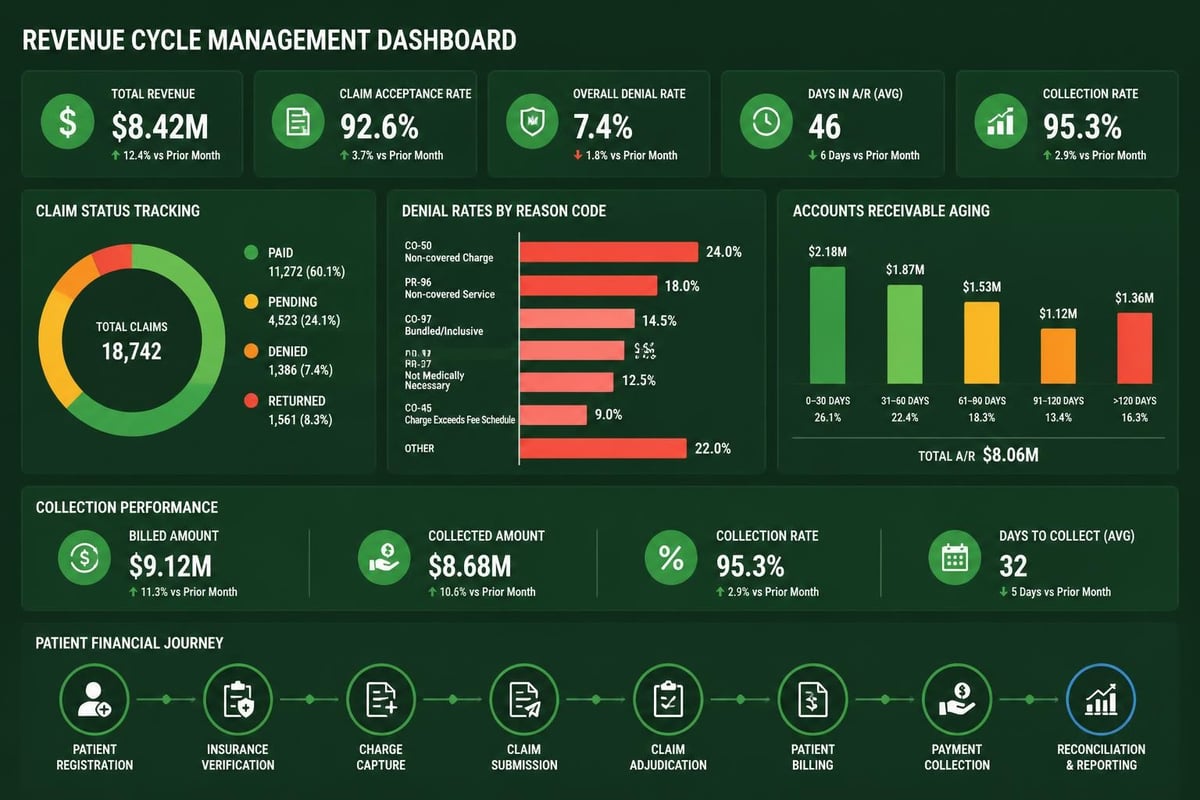
- Medical billing tracks: claim submission volume, rejection rates, days in accounts receivable
- Revenue cycle management monitors: first-pass acceptance rates, point-of-service collections, net collection rates, denial rates by category, patient satisfaction scores
Financial Optimization Opportunities
Healthcare organizations that understand the real differences between these approaches discover significant optimization opportunities. For instance, robust denial management processes within RCM frameworks identify patterns causing claim rejections, then implement preventive measures that reduce future denials.
According to research examining medical billing versus revenue cycle management distinctions, practices implementing comprehensive RCM strategies typically see 15-25% improvements in net collection rates compared to those focusing solely on billing operations.
Integration Benefits for Healthcare Practices
The discussion of medical billing vs revenue cycle management shouldn’t position these as competing alternatives. Instead, medical billing functions as an essential component within the larger RCM framework.
Modern healthcare practices benefit from integrated approaches that:
- Establish front-end protocols ensuring accurate patient demographics and insurance information
- Implement real-time eligibility verification preventing coverage surprises
- Optimize coding accuracy through ongoing education and audit processes
- Streamline claims submission using technology and clearinghouse partnerships
- Monitor denial patterns and implement corrective actions systematically
Technology’s Role in Unified Operations
Sophisticated revenue cycle billing systems bridge the gap between tactical billing activities and strategic RCM oversight. These platforms provide visibility across all stages, enabling teams to identify where revenue leakage occurs and implement targeted interventions.
Healthcare revenue cycle analytics transform raw data into actionable insights, revealing which insurance contracts generate optimal reimbursement, which service lines produce the strongest margins, and where operational improvements deliver maximum return on investment.
Choosing the Right Approach for Your Practice
Healthcare organizations evaluating medical billing vs revenue cycle management should consider their current challenges, growth objectives, and resource constraints. Smaller practices with limited staff might initially focus on strengthening core billing operations before expanding into comprehensive RCM. Larger organizations or those experiencing significant denial rates benefit from implementing full-spectrum revenue cycle management processes immediately.
Key decision factors include:
- Current denial rates exceeding industry benchmarks
- Days in accounts receivable extending beyond 40-50 days
- First-pass claim acceptance rates below 90%
- Point-of-service collection percentages under 50% of patient responsibility amounts
- Staff capacity for managing both tactical and strategic financial functions
Practices specializing in specific care models require tailored approaches. Urgent care revenue cycle management demands rapid claims processing and high-volume transaction handling, while behavioral health practices need expertise in medical billing for behavioral health services with their unique authorization and documentation requirements.
Implementation Considerations
Transitioning from basic medical billing to comprehensive revenue cycle management requires careful planning and resource allocation. Organizations should assess current performance baselines, identify priority improvement areas, and establish realistic timelines for implementation.
Many healthcare providers partner with specialized service organizations that deliver complete RCM solutions without requiring massive internal investments in technology or personnel. These partnerships provide access to experienced professionals, proven processes, and established payer relationships that accelerate results.
The debate between medical billing vs revenue cycle management ultimately resolves when practices recognize that optimal financial performance requires both tactical execution and strategic oversight working in harmony.
Understanding the distinction between medical billing vs revenue cycle management empowers healthcare providers to make informed decisions about their financial operations and identify opportunities for sustainable improvement. Whether you need support with specific billing functions or comprehensive revenue cycle oversight, Greenhive Billing Solutions delivers tailored services designed to maximize reimbursements, reduce denials, and streamline operations for practices nationwide. Our experienced team integrates seamlessly with your existing systems while maintaining strict HIPAA compliance and transparent communication throughout every stage of the revenue cycle.

