
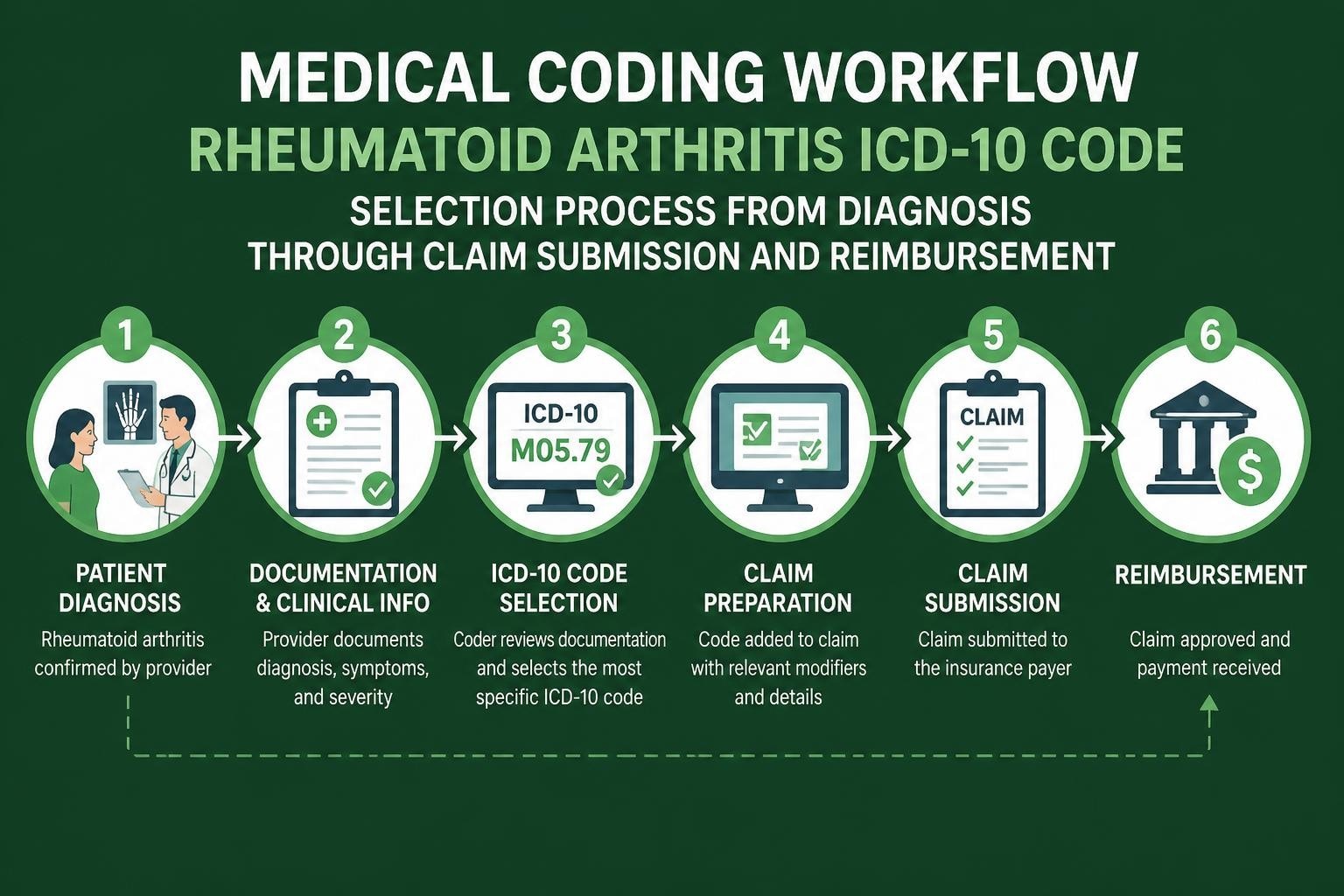
Accurate medical coding remains the foundation of successful claims processing and reimbursement in healthcare practices. For conditions like rheumatoid arthritis, selecting the correct diagnostic code directly impacts revenue cycle performance, claim acceptance rates, and compliance. Understanding the icd 10 code rheumatoid arthritis requires knowledge of both the classification system and the clinical nuances that differentiate one code from another. For revenue cycle management professionals and healthcare providers, mastering these distinctions translates into fewer denials, faster payments, and improved financial outcomes.
Understanding Rheumatoid Arthritis ICD-10 Code Structure
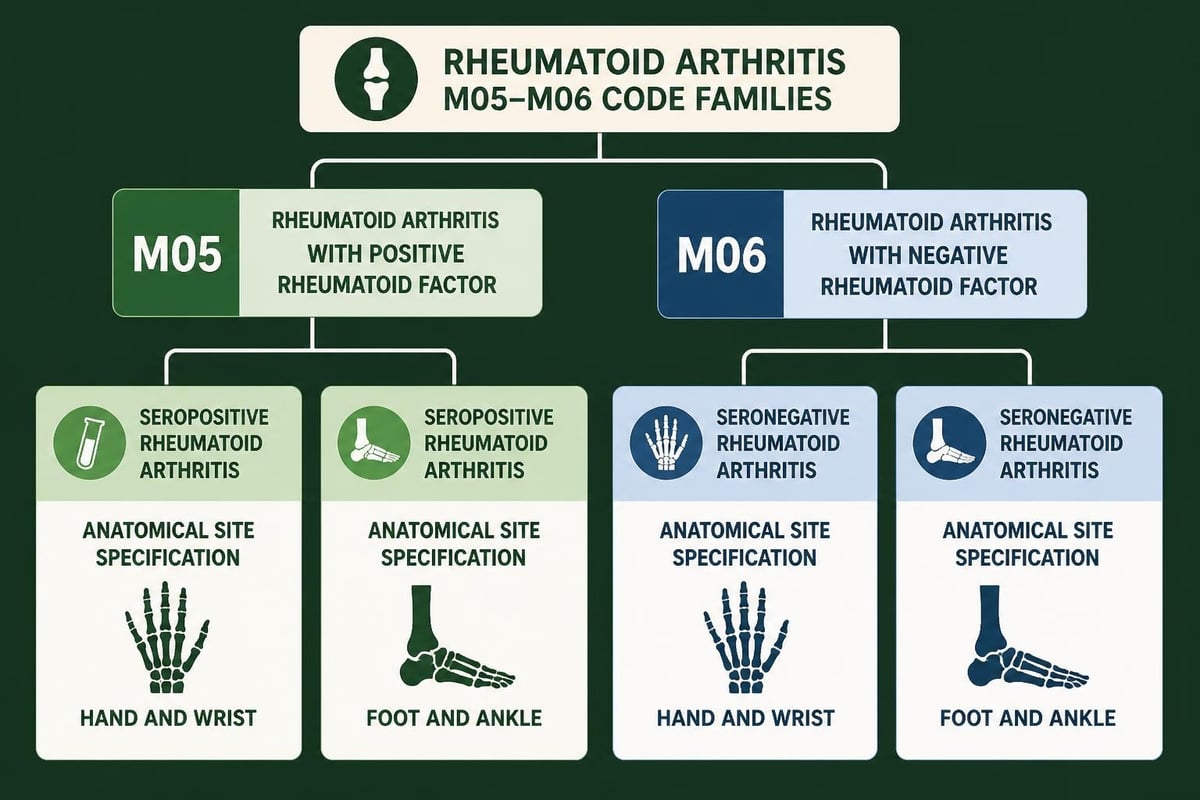
The ICD-10-CM system organizes rheumatoid arthritis codes within the M05-M14 range, specifically focusing on inflammatory polyarthropathies. The icd 10 code rheumatoid arthritis falls primarily under two categories: M05 for seropositive rheumatoid arthritis and M06 for other rheumatoid arthritis.
Primary Code Categories
M05 codes identify rheumatoid arthritis with rheumatoid factor present, while M06 codes cover seronegative cases and other specified types. The AAPC resource on M05 codes provides detailed subcategories that billing professionals must navigate.
Key distinctions include:
- M05.00-M05.09: Felty’s syndrome
- M05.10-M05.19: Rheumatoid lung disease
- M05.20-M05.29: Rheumatoid vasculitis
- M05.30-M05.39: Rheumatoid heart disease
- M05.40-M05.49: Rheumatoid myopathy
- M05.50-M05.59: Rheumatoid polyneuropathy
- M05.60-M05.69: Rheumatoid arthritis with involvement of other organs and systems
- M05.70-M05.79: Rheumatoid arthritis with rheumatoid factor without organ or systems involvement
- M05.80-M05.89: Other seropositive rheumatoid arthritis
Anatomical Site Specificity Requirements
The icd 10 code rheumatoid arthritis requires precise anatomical location documentation. Unlike older coding systems, ICD-10-CM demands sixth and seventh character specificity for accurate classification.
Sixth Character Specifications
Each primary rheumatoid arthritis code extends to identify the affected joint location:
| Code Extension | Joint Location |
|---|---|
| 0 | Multiple sites |
| 1 | Shoulder region |
| 2 | Upper arm |
| 3 | Forearm |
| 4 | Hand |
| 5 | Pelvic region and thigh |
| 6 | Lower leg |
| 7 | Ankle and foot |
| 9 | Unspecified site |
This granularity supports more accurate claims processing and aligns with different types of medical coding practices that emphasize specificity.
For bilateral conditions, documentation must specify laterality where applicable. The seventh character, when required, typically indicates encounter type (initial, subsequent, or sequela).
Common Coding Scenarios and Solutions
Healthcare billing professionals encounter several typical scenarios when assigning the icd 10 code rheumatoid arthritis. Each situation demands careful review of clinical documentation and understanding of coding guidelines.
Scenario 1: Seropositive RA without organ involvement
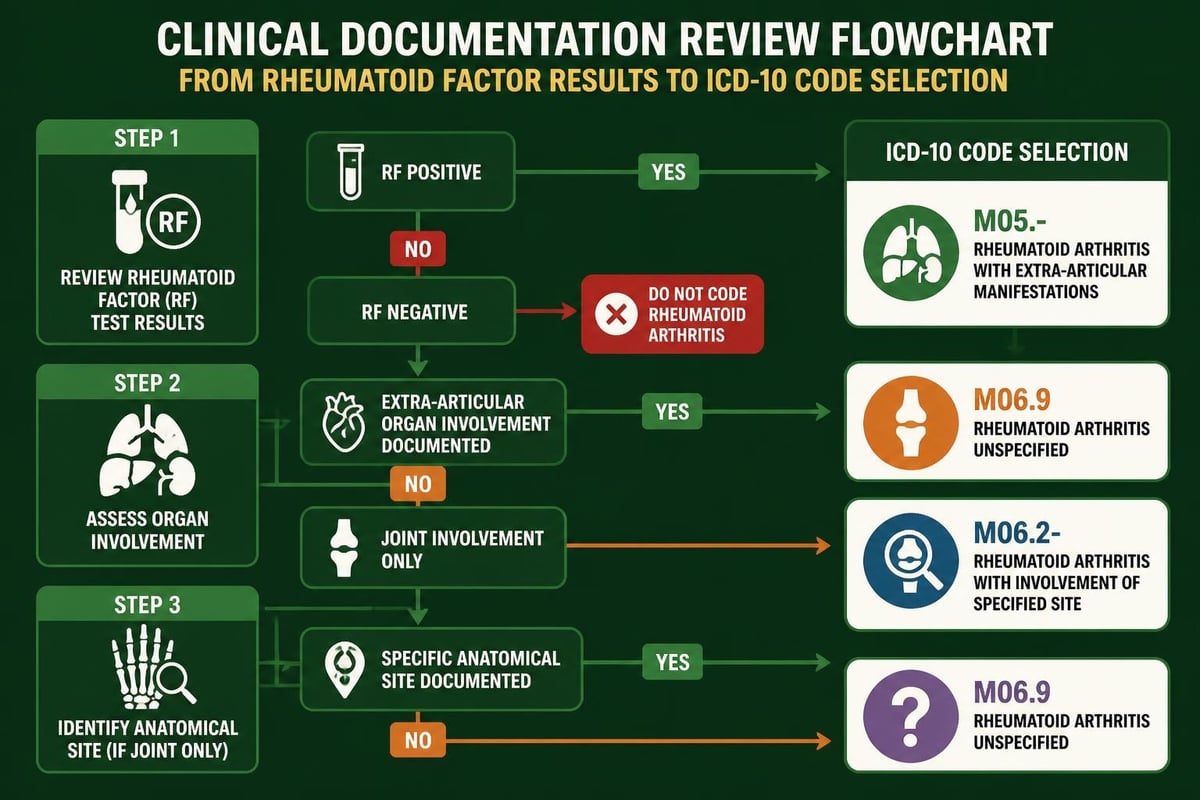
When laboratory results confirm rheumatoid factor presence but show no systemic complications, code M05.7- becomes appropriate. The sixth character then specifies the joint location based on physical examination findings.
Scenario 2: Seronegative rheumatoid arthritis
Laboratory results showing negative rheumatoid factor testing direct coders toward M06.0- codes. Understanding what coding specialists handle helps clarify these diagnostic distinctions.
Scenario 3: Rheumatoid arthritis with systemic involvement
Cases involving rheumatoid lung disease, vasculitis, or cardiac complications require M05.1-, M05.2-, or M05.3- codes respectively, followed by anatomical site specification.
Documentation Requirements for Accurate Coding
Proper code assignment depends on complete clinical documentation. Providers must document:
- Rheumatoid factor serology results (positive or negative)
- Specific joint involvement with laterality
- Any organ system complications
- Disease severity indicators
- Treatment response history
Research on automated ICD-10 code association highlights the challenges of coding accuracy, emphasizing why human expertise remains essential in complex cases.
Impact on Revenue Cycle Management
Selecting the correct icd 10 code rheumatoid arthritis directly influences multiple revenue cycle stages. Code accuracy affects initial claim acceptance, payer adjudication speed, and reimbursement amounts.
Claims Processing Efficiency
| Coding Accuracy Level | Average Days to Payment | Denial Rate |
|---|---|---|
| Highly specific codes | 14-21 days | 5-8% |
| Generic/unspecified codes | 28-45 days | 18-25% |
| Incorrect codes | 45+ days or denial | 60-75% |
Practices implementing robust coding protocols experience measurably better financial performance. Understanding how denial management improves cash flow demonstrates the downstream impact of accurate initial coding.
Medical necessity justification becomes stronger with precise codes. Payers evaluating treatment authorizations for biologic therapies or specialty care referrals scrutinize diagnostic coding carefully. Specific codes like M05.71 (rheumatoid arthritis with rheumatoid factor of right shoulder without organ or systems involvement) support medical necessity better than unspecified alternatives.
Compliance and Audit Considerations
The icd 10 code rheumatoid arthritis selection carries compliance implications that extend beyond individual claims. Auditors review coding patterns to identify potential upcoding, unbundling, or documentation deficiencies.
Best Practices for Compliance
- Match code specificity to documentation depth: Never code beyond what clinical notes support
- Apply official coding guidelines consistently: Reference current-year ICD-10-CM guidelines
- Maintain coder education: Regular training on rheumatology coding updates
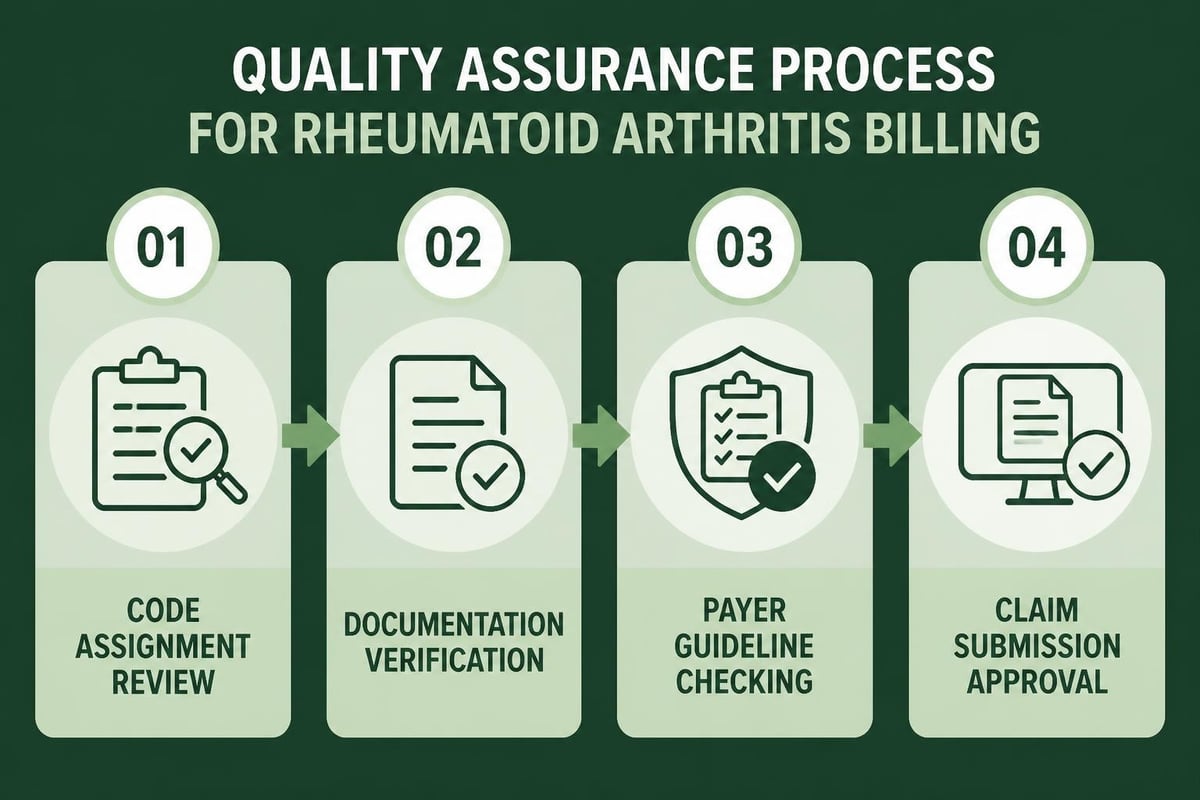
- Implement quality assurance reviews: Pre-submission claim audits catch errors early
- Document medical necessity clearly: Link diagnostic codes to treatment plans
Studies on ICD-10 administrative data validity confirm that accurate coding supports population health management and quality reporting beyond billing functions.
Integrating Coding Accuracy into Revenue Cycle Operations
Healthcare organizations maximizing reimbursement integrate rheumatoid arthritis coding expertise throughout their revenue cycle management processes. This includes front-end insurance verification, charge capture, coding, billing, and denial management.
Technology solutions support but don’t replace human expertise. While practice management systems may suggest codes based on encounter documentation, experienced coders verify appropriateness based on payer-specific requirements and clinical context. Professionals working with healthcare revenue cycle analytics recognize that coding accuracy metrics directly correlate with financial performance indicators.
Cross-Functional Coordination
Effective rheumatoid arthritis coding requires collaboration between clinical staff, coding specialists, and billing professionals. Providers documenting encounters must capture sufficient detail about joint involvement, disease progression, and treatment response. Coders translate this documentation into appropriate diagnostic codes. Billing staff then ensure these codes align with procedure codes and medical necessity requirements before claim submission.
Accurate ICD-10 code assignment for rheumatoid arthritis directly impacts claim acceptance rates, reimbursement speed, and compliance outcomes. The complexity of rheumatoid arthritis coding demands ongoing education, thorough documentation practices, and quality assurance protocols that protect revenue while maintaining regulatory compliance. Greenhive Billing Solutions provides comprehensive revenue cycle management services that include expert medical coding, claims processing, and denial management tailored specifically for healthcare providers managing complex conditions like rheumatoid arthritis. Our experienced team ensures your practice captures every dollar earned while maintaining full HIPAA compliance and transparent communication throughout the billing process.

