
Understanding provider identification requirements is essential for accurate medical billing and claims processing. Healthcare administrators and billing professionals frequently encounter questions about which providers need National Provider Identifiers (NPIs), particularly when it comes to nursing staff. The question “do nurses have NPI numbers” doesn’t have a simple yes or no answer, as the requirement depends on specific nursing roles, responsibilities, and billing activities within your healthcare organization.
Understanding National Provider Identifiers for Nursing Professionals
The National Provider Identifier standard established by the Centers for Medicare & Medicaid Services (CMS) creates a uniform identification system for healthcare providers. An NPI is a unique 10-digit identification number assigned to healthcare providers who conduct HIPAA-standard electronic transactions.
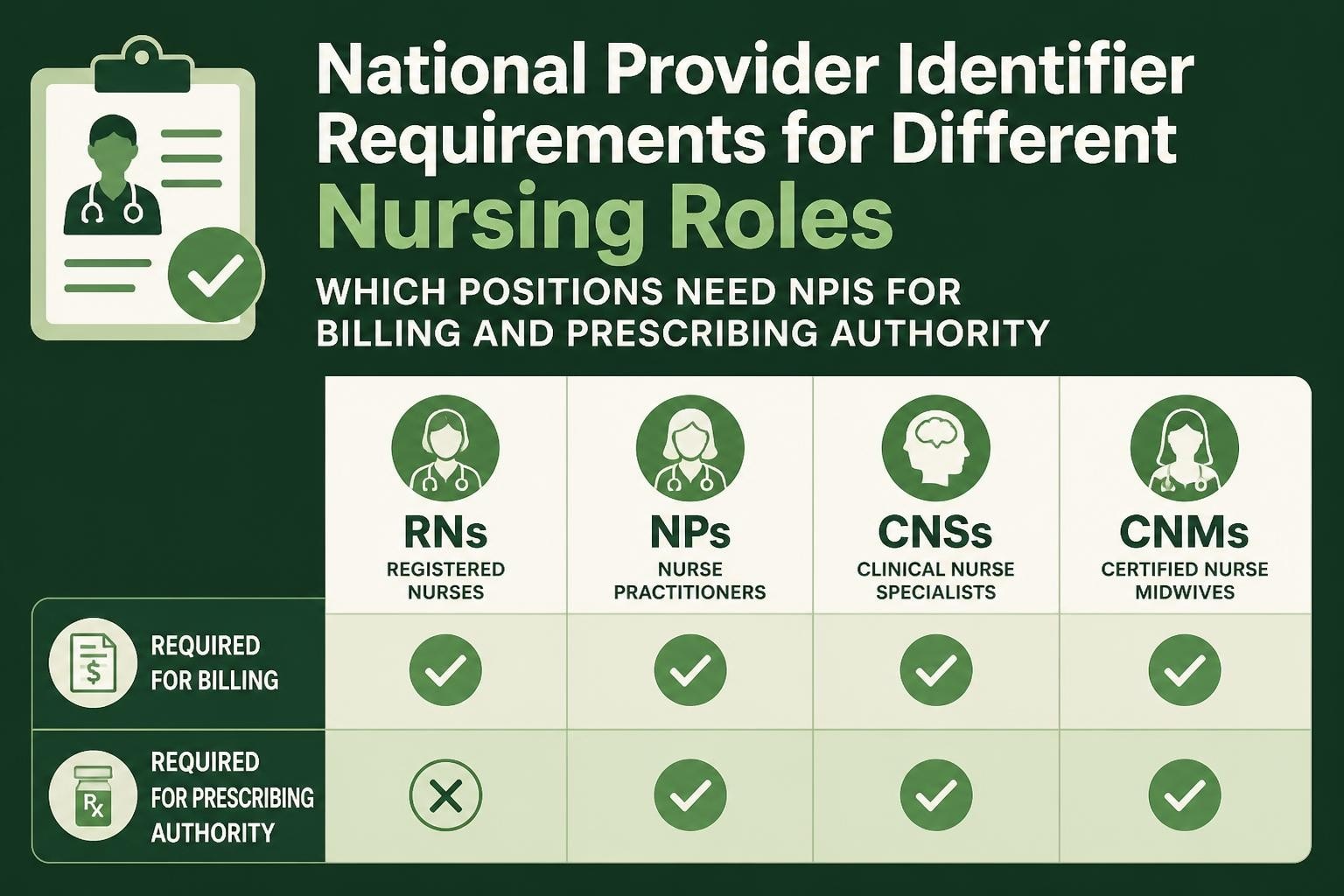
Not all nurses require an NPI. The determining factor is whether the nurse independently bills for services, prescribes medications, or operates as a standalone healthcare provider. Registered Nurses (RNs) who work under physician supervision typically do not need individual NPIs, as their services are billed under the supervising physician or facility’s NPI.
Which Nursing Roles Require NPI Numbers
Advanced Practice Registered Nurses (APRNs) generally need NPIs because they provide direct patient care independently and bill insurance carriers for their services. The American Nurses Association emphasizes how NPIs promote transparency in nursing care payments and benefit both practitioners and patients.
| Nursing Role | NPI Required | Primary Reason |
|---|---|---|
| Nurse Practitioner (NP) | Yes | Independent billing and prescribing authority |
| Clinical Nurse Specialist (CNS) | Yes | Direct patient care and independent billing |
| Certified Nurse Midwife (CNM) | Yes | Independent practice and Medicare billing |
| Certified Registered Nurse Anesthetist (CRNA) | Yes | Anesthesia services billing |
| Registered Nurse (RN) | Usually No | Services billed under supervising provider |
| Licensed Practical Nurse (LPN) | No | Works under supervision, no independent billing |
APRNs who prescribe controlled substances, order diagnostic tests, or submit claims to Medicare, Medicaid, or private insurance companies must obtain an NPI. This requirement ensures proper tracking of healthcare services and enables accurate revenue cycle management for practices employing these advanced nursing professionals.
Type 1 Versus Type 2 NPIs for Nursing Practices
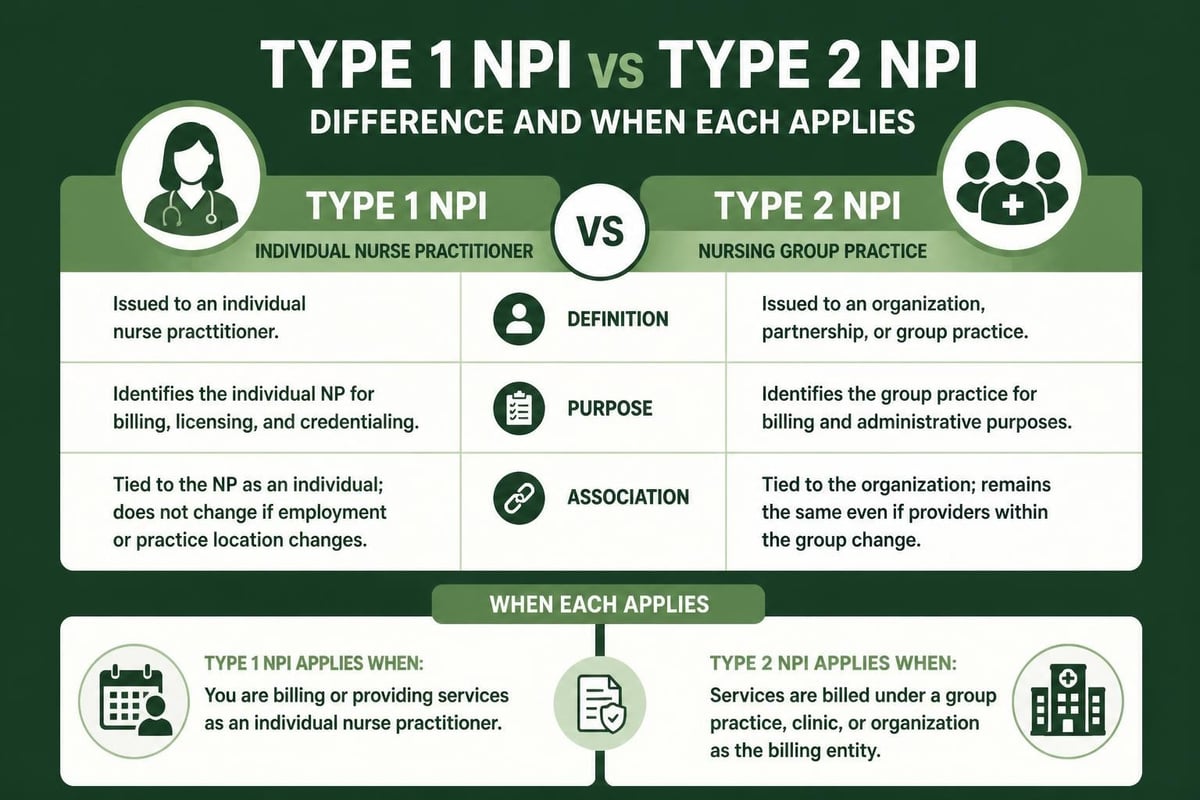
When evaluating whether nurses have NPI numbers, understanding the two NPI types is crucial for proper credentialing and billing. The HIPAA administrative simplification standards distinguish between individual and organizational identifiers.
Type 1 NPIs are assigned to individual healthcare providers, including nurse practitioners and other APRNs who bill independently for their services. Each qualifying nurse receives a single Type 1 NPI that follows them throughout their career, regardless of employment changes or practice locations.
Type 2 NPIs identify healthcare organizations such as hospitals, nursing homes, group practices, or clinics. A nursing group practice would obtain a Type 2 NPI for organizational billing purposes, while individual NPs within that practice would maintain their own Type 1 NPIs.
Benefits of NPI Numbers for Advanced Practice Nurses
Beyond regulatory compliance, NPIs provide several operational advantages:
- Streamlined credentialing across multiple insurance networks and healthcare systems
- Efficient HIPAA-compliant information exchange between providers and payers
- Professional identity maintenance independent of employment status
- Simplified claims processing and reduced billing errors
- Enhanced reimbursement tracking for individual provider productivity
The question of do nurses have NPI numbers becomes particularly relevant when implementing denial management strategies, as incorrect provider identifiers frequently trigger claim rejections.
Obtaining an NPI Number: Step-by-Step Process
Advanced practice nurses who determine they need an NPI can apply through the National Plan and Provider Enumeration System (NPPES). The application process is straightforward and free of charge.
Step 1: Gather Required Documentation
Collect your professional credentials, including your nursing license number, DEA number (if applicable), practice location addresses, and taxonomy codes for your nursing specialty.
Step 2: Access the NPPES Application
Visit the NPPES website and select the appropriate application type (individual provider for Type 1 NPI). Resources like the NPI public database can help verify existing NPIs and understand the required information format.
Step 3: Complete the Application
Provide accurate information about your professional qualifications, practice locations, and contact details. Ensure all data matches your official licensing and credentialing documents to avoid processing delays.
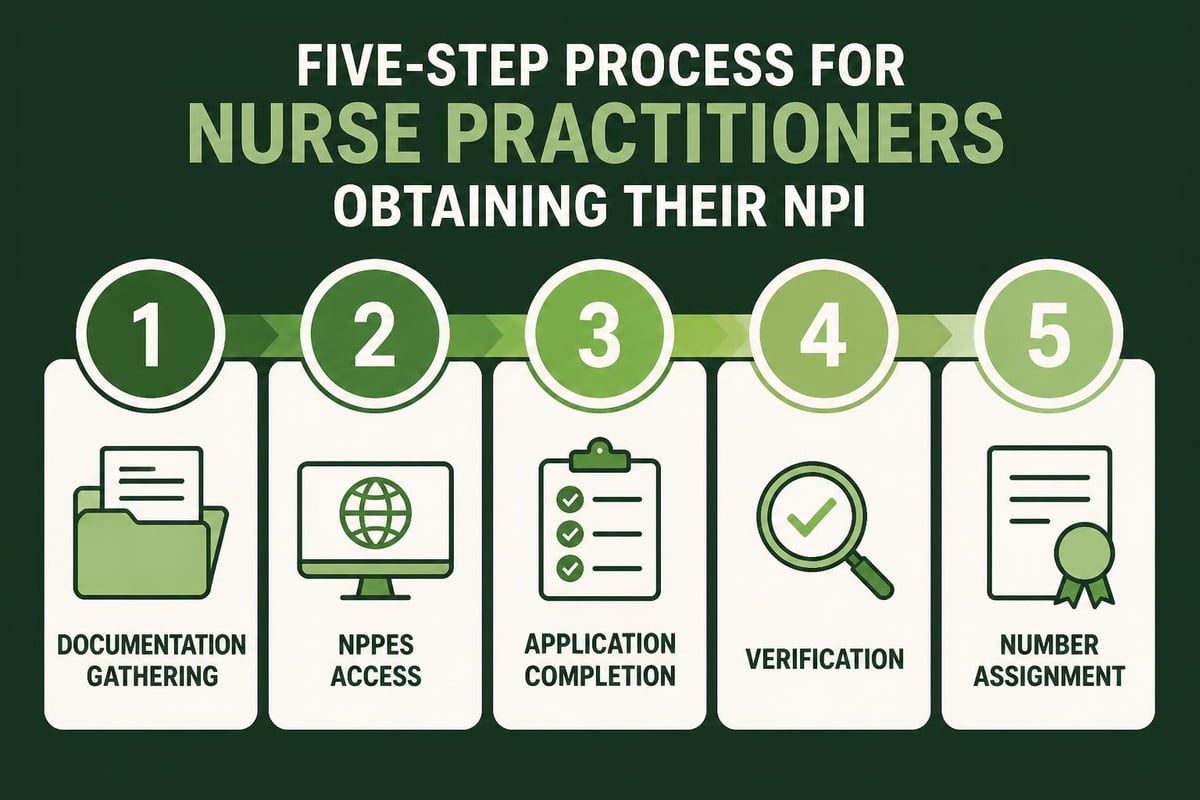
Step 4: Submit and Track Your Application
Electronic applications typically process within 10 business days. Paper applications may take up to 4 weeks. You’ll receive your NPI via email or mail once approved.
Step 5: Update Your NPI Information
Maintain current contact information, practice locations, and credentials through the NPPES system. Changes in practice address, name, or taxonomy codes require prompt updates to ensure accurate medical billing.
Common Scenarios When Nurses Need NPIs
Understanding practical applications helps clarify when the question “do nurses have NPI numbers” becomes relevant for your billing operations.
Medicare and Medicaid Billing: APRNs who submit claims directly to these programs must include their NPI on all claims forms. This requirement extends to both primary care and specialty nursing services.
Private Insurance Credentialing: Most commercial payers require NPIs during the credentialing process for nurse practitioners seeking in-network status. Without an NPI, APRNs cannot bill independently or receive direct reimbursement.
Prescription Authority: Nurses authorized to prescribe medications in their state typically need NPIs for pharmacy processing and controlled substance tracking through state prescription monitoring programs.
Referral Documentation: When nurse practitioners refer patients to specialists or order diagnostic services, their NPI ensures proper documentation and facilitates care coordination across healthcare revenue cycle analytics systems.
Impact on Revenue Cycle Management Operations
For healthcare organizations employing both nurses and APRNs, understanding NPI requirements directly affects billing accuracy and reimbursement rates. Billing staff must distinguish between services rendered by RNs (billed under supervising physicians or facility NPIs) and those provided by nurse practitioners (billed under individual APRNs’ NPIs).
Incorrect provider identification represents a common cause of claim denials. Services performed by an NP but billed under a physician’s NPI may trigger payer audits or reimbursement adjustments. Conversely, attempting to bill RN services under an individual RN’s name (when no NPI exists) will result in automatic claim rejection.
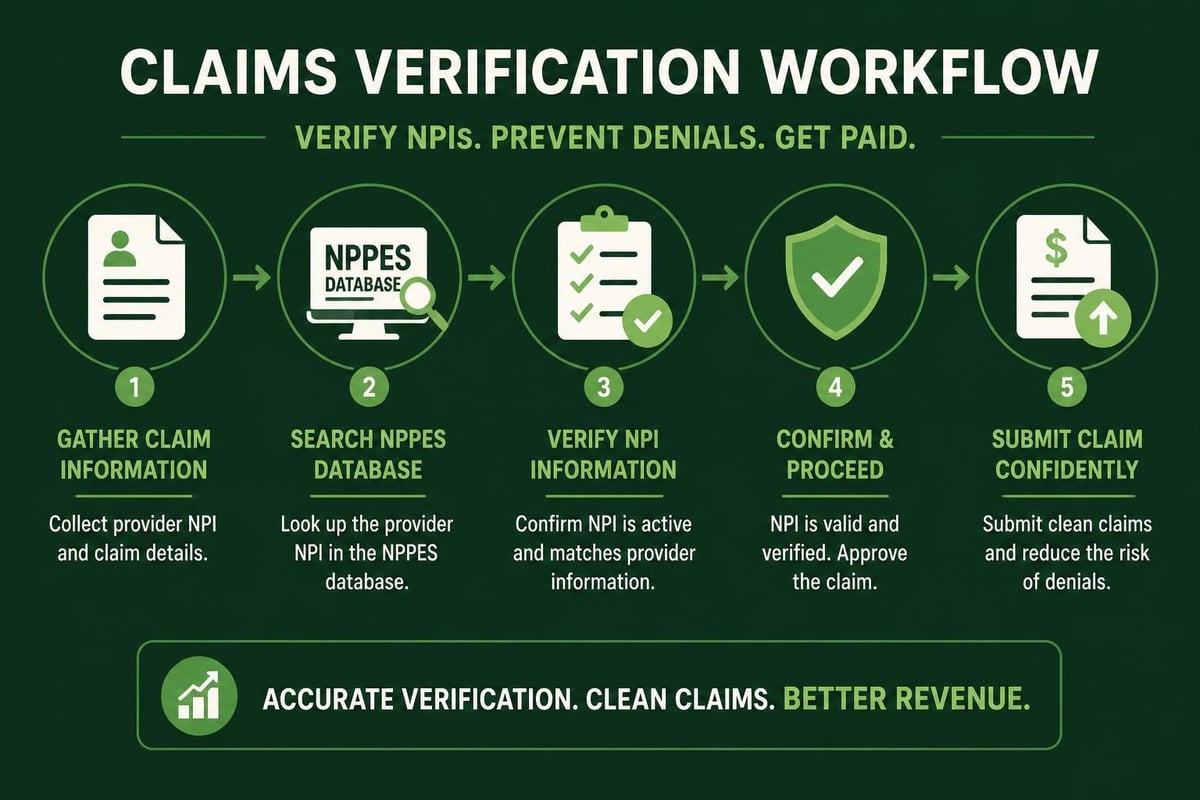
Organizations can verify provider NPIs using the NPI public database before submitting claims, reducing errors and improving first-pass resolution rates. This verification step integrates seamlessly into clean claim processes and supports overall revenue optimization.
NPI Management Best Practices
Healthcare practices should implement systematic approaches to NPI management:
- Maintain a current provider roster documenting each clinician’s NPI, credentials, and billing authority
- Update practice management systems immediately when new APRNs join or existing staff changes roles
- Conduct regular audits comparing billed services against appropriate provider NPIs
- Train billing staff on distinguishing between nursing roles requiring NPIs and those that don’t
- Establish verification protocols for new provider onboarding and credentialing activities
Proper NPI management supports compliance with HIPAA regulations and reduces the administrative burden associated with claim corrections and appeals. Integration with comprehensive physician RCM strategies ensures consistent billing practices across all provider types within your organization.
Understanding whether nurses have NPI numbers depends on their specific roles and billing responsibilities within your healthcare organization. Advanced practice registered nurses require NPIs for independent billing and prescribing authority, while most RNs and LPNs do not. Proper NPI management directly impacts claim acceptance rates, reimbursement accuracy, and overall financial performance. Greenhive Billing Solutions helps healthcare providers navigate complex credentialing and billing requirements through comprehensive revenue cycle management services, ensuring accurate provider identification, efficient claims processing, and maximum reimbursements for all provider types in your practice.

