
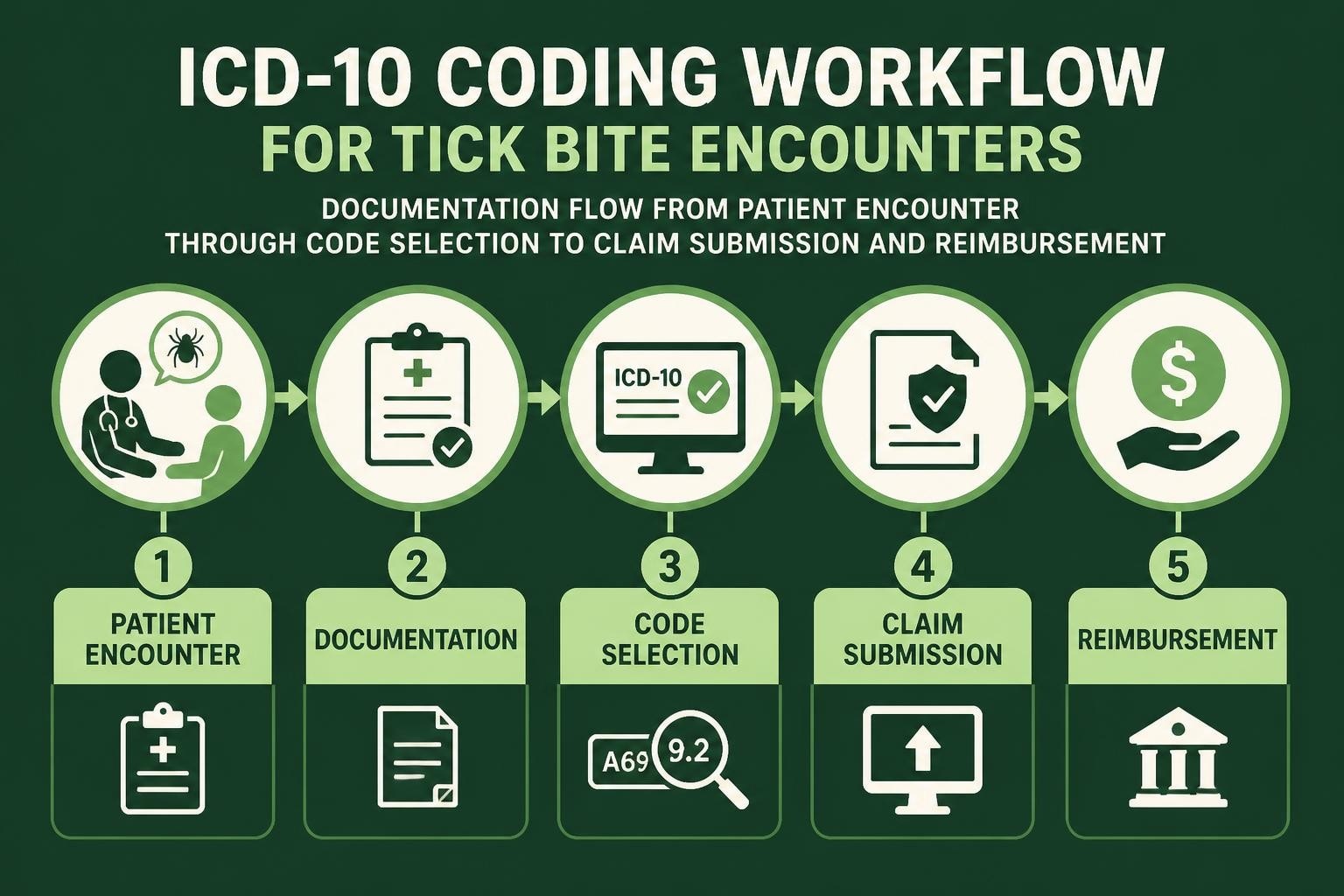
Healthcare providers frequently encounter patients presenting with tick bites, particularly during warmer months when outdoor activity increases. Accurate coding for these encounters directly impacts reimbursement and claims processing efficiency. Understanding the appropriate tick bite ICD 10 code ensures proper documentation, reduces claim denials, and maintains compliance with payer requirements. For revenue cycle management teams and billing professionals, mastering these codes represents a critical component of financial success for medical practices.
Understanding the Primary Tick Bite ICD 10 Code
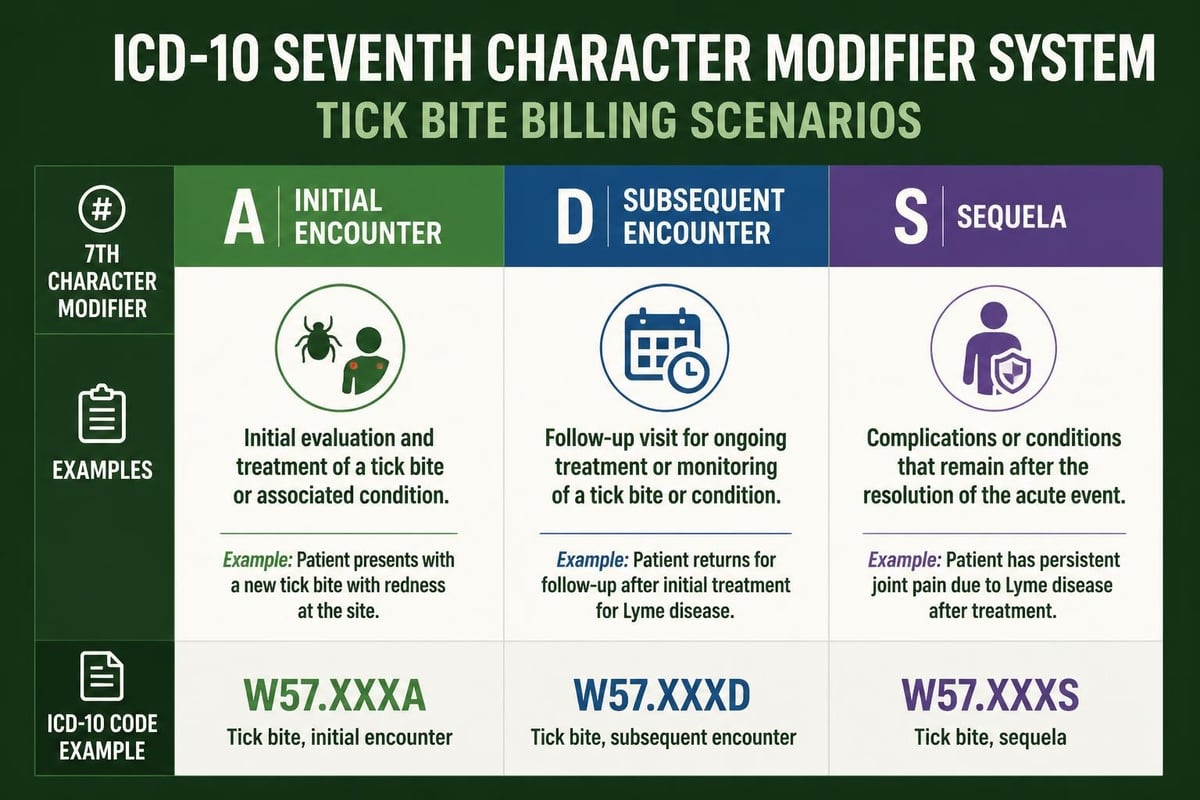
The primary tick bite ICD 10 code falls under the category W57.XXXA, which designates “bitten or stung by nonvenomous insect and other nonvenomous arthropods, initial encounter.” This external cause code requires a seventh character to indicate the encounter type, with “A” representing initial encounter, “D” for subsequent encounter, and “S” for sequela.
Healthcare facilities must pair this external cause code with an appropriate diagnosis code that describes the patient’s condition. Common pairings include codes for skin inflammation, infection, or other complications resulting from the tick bite. The ICD-10-CM coding system provides comprehensive guidelines for proper code selection and sequencing.
Encounter-Specific Coding Requirements
Different patient encounters require specific seventh character modifiers to ensure accurate claim submission:
- Initial encounter (A): First treatment for the tick bite
- Subsequent encounter (D): Follow-up visits for ongoing treatment
- Sequela (S): Treatment of long-term effects or complications
Understanding these distinctions prevents claim denials and supports proper revenue cycle management processes. Each encounter type triggers different reimbursement rates and documentation requirements that billing specialists must navigate carefully.
Common Clinical Scenarios and Code Selection
Healthcare providers encounter various tick bite presentations that require specific coding approaches. Selecting the correct tick bite ICD 10 code depends on clinical presentation, complications, and treatment provided during the encounter.
| Clinical Scenario | Primary Code | External Cause Code | Documentation Required |
|---|---|---|---|
| Uncomplicated tick bite | L50.9 (Urticaria) | W57.XXXA | Location, appearance, treatment |
| Infected tick bite | L08.9 (Local infection) | W57.XXXA | Culture results, antibiotic orders |
| Allergic reaction | T78.40XA (Allergy) | W57.XXXA | Reaction severity, medications given |
| Tick removal only | Z48.02 (Encounter for removal) | W57.XXXA | Removal method, counseling provided |
Professional coders and billing specialists working on medical coding revenue cycle management must review clinical documentation thoroughly to determine which codes accurately reflect services rendered. This attention to detail minimizes audit risk and maximizes appropriate reimbursement.
Disease Transmission Considerations
When tick bites result in disease transmission, coding becomes more complex. Conditions like Lyme disease, Rocky Mountain spotted fever, or tick-borne encephalitis require separate, specific diagnosis codes. The AAPC provides detailed guidance on tick-borne viral encephalitis codes within the A84 category.
These cases necessitate careful documentation of laboratory results, clinical symptoms, and treatment protocols. Billing teams must coordinate with clinical staff to ensure all relevant diagnoses receive proper coding attention for complete claim submission.
Documentation Requirements for Accurate Billing
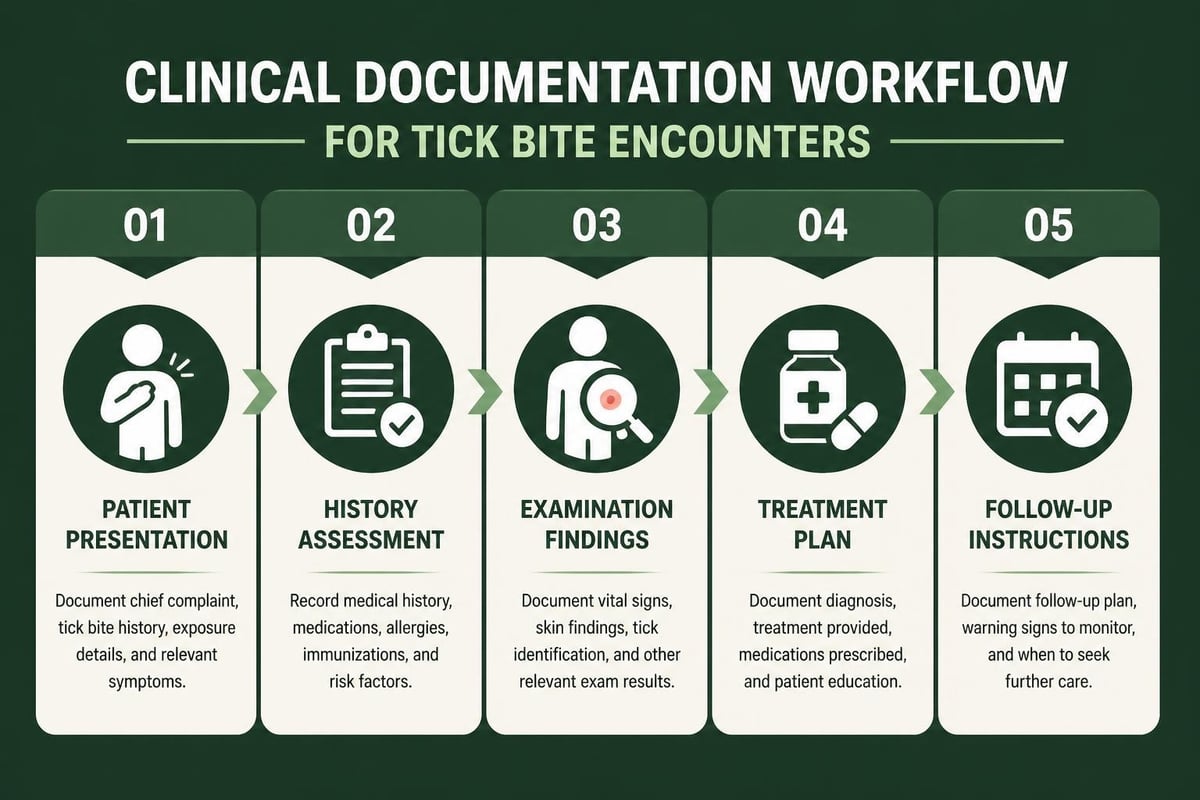
Comprehensive clinical documentation forms the foundation for correct code assignment and successful claim adjudication. Providers must record specific details about tick bite encounters to support the tick bite ICD 10 code selection and justify services billed.
Essential documentation elements include:
- Anatomical location: Specific body part affected by the tick bite
- Clinical presentation: Redness, swelling, signs of infection
- Treatment rendered: Tick removal, wound care, medications prescribed
- Patient history: Time since bite occurred, previous tick exposures
- Follow-up plans: Return visit instructions, signs of complications to monitor
Quality documentation supports denial management in medical billing by providing auditors and payers with clear justification for services rendered. Incomplete records frequently trigger claim denials that require time-consuming appeals and documentation requests.
Linking Diagnosis to Procedures
Proper code linkage ensures claims demonstrate medical necessity for services provided. When billing for tick removal (CPR code 10120 or 10121), the tick bite ICD 10 code must clearly support the procedure. Understanding what is a CPT code for insurance purposes helps billing teams create defensible claims that withstand payer scrutiny.
Research on automatic association of ICD-10 codes with clinical texts demonstrates the complexity involved in accurate medical coding, highlighting why experienced billing professionals remain essential for revenue cycle success.
Place of Service and Modifier Considerations
The setting where tick bite treatment occurs influences coding and reimbursement. Place of service (POS) codes specify whether care was delivered in an office, emergency department, urgent care center, or other facility type. These codes affect payment rates and must align with supporting documentation.
Urgent care centers frequently treat tick bites, making proper urgent care revenue cycle management practices essential for these facilities. Emergency department visits for tick bites require different coding approaches than routine office visits, particularly when patients present with complications or allergic reactions.
Modifier Application for Multiple Procedures
When providers perform multiple procedures during a tick bite encounter, appropriate types of modifiers in medical billing ensure proper reimbursement. Modifier 25 may apply when a separately identifiable evaluation and management service occurs on the same day as a minor procedure like tick removal.
Billing teams must understand payer-specific modifier requirements to prevent unnecessary claim denials and payment delays that impact practice cash flow.
Challenges in ICD-10 Code Classification
Healthcare organizations face ongoing challenges in maintaining coding accuracy as clinical encounters grow increasingly complex. Studies examining supervised learning in the presence of noise for ICD-10 code classification reveal how coding errors propagate through billing systems, creating downstream revenue cycle problems.
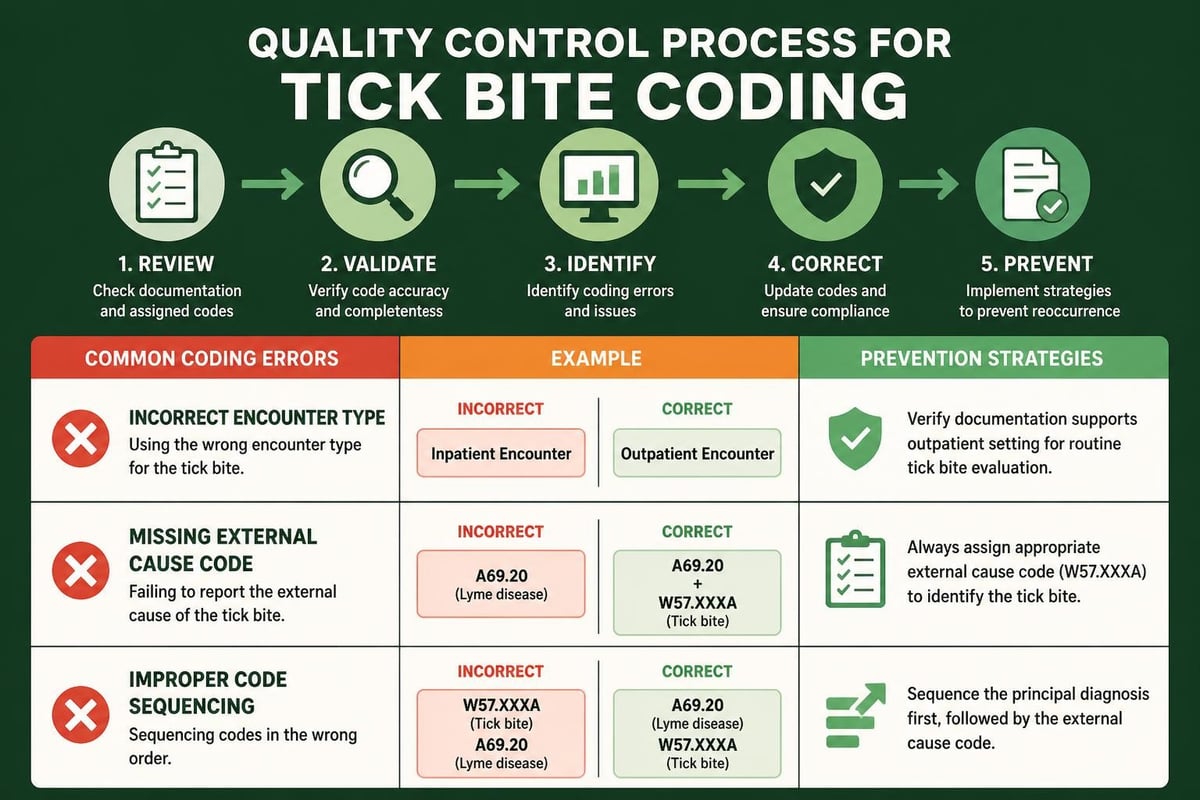
Professional billing specialists and billing and coding specialists provide essential quality control to identify and correct coding discrepancies before claim submission. Their expertise prevents denials and ensures practices receive maximum appropriate reimbursement for services rendered.
Technology and Coding Accuracy
While technology assists with coding tasks, research on the sufficiency of ICD codes for machine learning datasets demonstrates that human expertise remains crucial for accurate code selection. Automated systems cannot replace the clinical judgment and contextual understanding that experienced coders bring to complex cases.
Healthcare practices benefit from partnering with revenue cycle management teams that combine technology capabilities with human expertise to achieve optimal coding accuracy and financial performance.
Best Practices for Revenue Cycle Optimization
Implementing standardized workflows for tick bite encounters improves coding consistency and reduces claim denials. Practices should develop protocols that guide clinical staff through proper documentation requirements while the patient is still present, eliminating gaps that create coding challenges later.
Regular training sessions keep clinical and billing staff current on coding updates and documentation requirements. Creating feedback loops between coders and providers helps identify recurring documentation deficiencies that impact claim success rates.
Monitoring key performance indicators related to tick bite encounters provides valuable insights:
- Clean claim rate: Percentage of tick bite claims accepted on first submission
- Days in A/R: Average time from service date to payment receipt
- Denial rate: Frequency of tick bite claims rejected by payers
- Appeal success rate: Percentage of denied claims overturned on appeal
These metrics guide continuous improvement efforts and highlight areas requiring additional staff education or process refinement. Understanding what are adjustments on medical bills helps practices track actual reimbursement against expected payment.
Accurate tick bite ICD 10 code selection requires clinical knowledge, attention to documentation detail, and understanding of payer-specific requirements. Healthcare practices that prioritize coding accuracy and comprehensive documentation achieve better financial outcomes through reduced denials and faster payment cycles. Greenhive Billing Solutions delivers expert revenue cycle management services that optimize coding accuracy, streamline claims processing, and maximize reimbursements for healthcare providers across the United States.

