
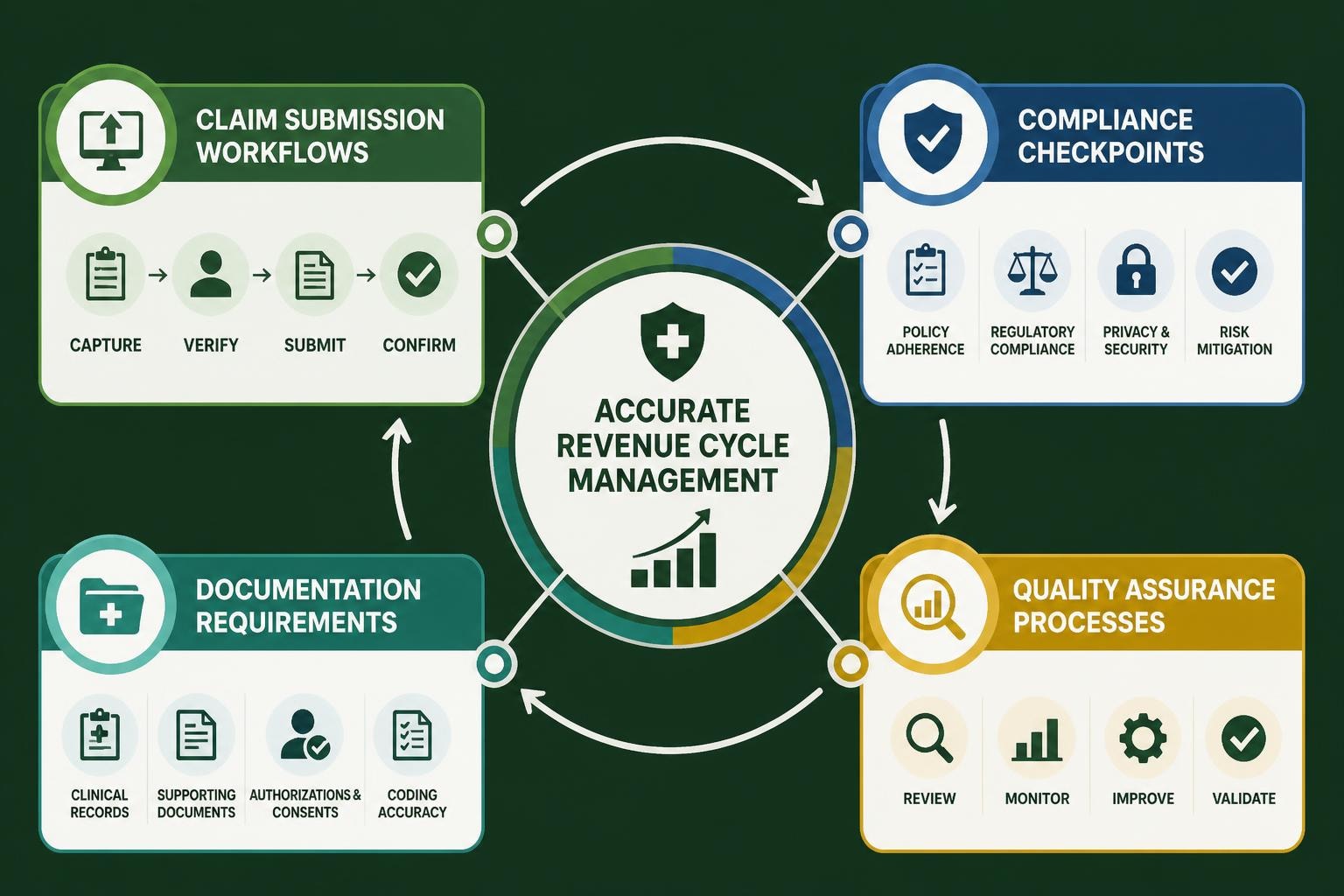
Establishing and maintaining comprehensive billing guidelines represents a fundamental component of successful revenue cycle management for healthcare providers. These standardized protocols govern how medical services are documented, coded, and billed to insurance payers, directly impacting a practice’s financial health and operational efficiency. Without clear billing guidelines, healthcare organizations face increased claim denials, compliance risks, and revenue leakage that can compromise their ability to deliver quality patient care. Understanding and implementing effective billing guidelines ensures consistent practices across your organization while maintaining regulatory compliance and optimizing reimbursement rates.
Understanding the Foundation of Billing Guidelines
Billing guidelines serve as the operational blueprint that connects clinical documentation to accurate claim submission. These comprehensive frameworks establish the rules and standards your billing team follows when translating medical services into billable claims. The American Medical Association provides essential resources through their CPT coding resources that form the backbone of procedural coding standards nationwide.
Core Elements of Effective Billing Guidelines
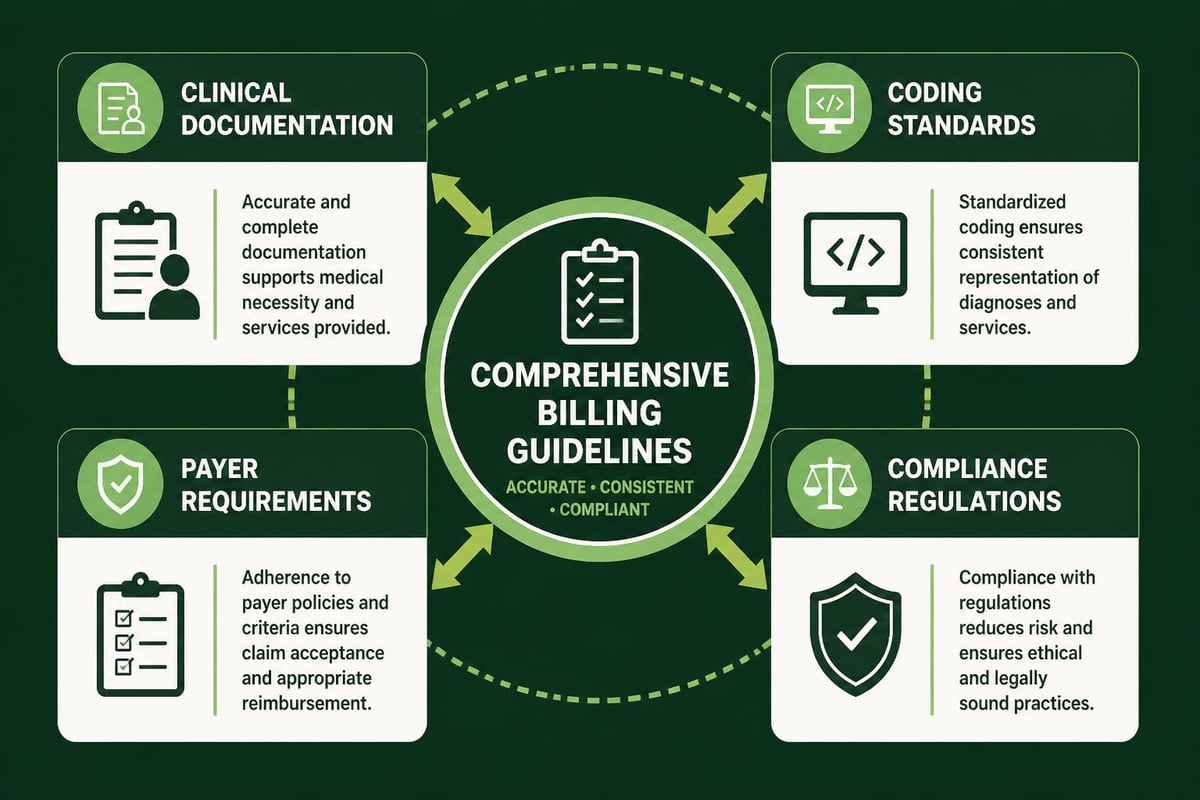
Every healthcare organization needs billing guidelines that address specific operational requirements while maintaining industry standards. These elements create the structure necessary for consistent revenue cycle performance:
- Documentation standards that specify what information clinicians must record for each service type
- Coding protocols that define how services are translated into CPT and ICD-10 codes
- Claim submission procedures outlining timelines, formats, and payer-specific requirements
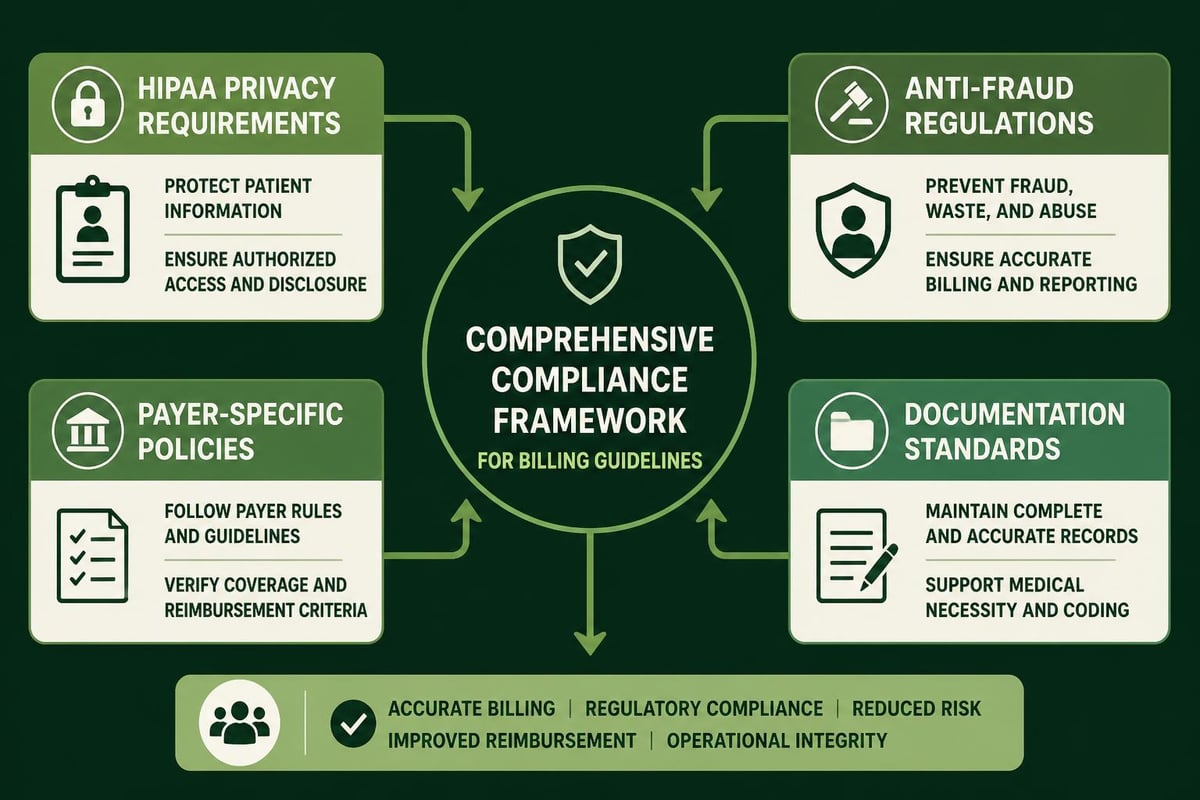
- Compliance checkpoints ensuring adherence to HIPAA, federal regulations, and payer policies
- Quality assurance processes for reviewing claims before submission
The implementation of standardized billing guidelines directly correlates with improved clean claim rates. Organizations that maintain detailed, regularly updated protocols typically see first-pass acceptance rates exceeding 95%, compared to industry averages hovering around 75-80% for practices without formalized guidelines.
Documentation Requirements Within Billing Guidelines
Proper documentation represents the foundation upon which all billing activities rest. Your billing guidelines must clearly articulate what constitutes sufficient documentation for each service category your practice provides. According to SUNY Downstate’s guidelines on coding and billing documentation, accurate medical records are essential for proper reimbursement and compliance.
Medical Necessity and Supporting Documentation
Medical necessity forms the cornerstone of justifiable billing. Your billing guidelines should establish clear criteria for documenting why each service was clinically appropriate and necessary. This includes:
- Chief complaint documentation with specific patient symptoms and concerns
- History of present illness detailing the progression and severity of conditions
- Physical examination findings supporting the medical decision-making process
- Assessment and plan clearly linking diagnoses to treatment interventions
- Follow-up instructions demonstrating continuity of care
When your billing guidelines incorporate these documentation standards, your team can confidently support every claim with appropriate clinical justification. This reduces denial rates and protects your practice during audits or appeals processes.
| Documentation Component | Required Elements | Impact on Billing |
|---|---|---|
| Chief Complaint | Patient’s stated reason for visit | Establishes medical necessity |
| History | HPI, ROS, PFSH as appropriate | Supports level of service |
| Examination | Body systems examined and findings | Justifies procedure codes |
| Medical Decision Making | Complexity of diagnosis and management | Determines E/M level |
| Time Documentation | Total time when billing time-based codes | Enables alternative billing method |
Diagnosis Coding Precision
Billing guidelines must address the specificity required for ICD-10 diagnosis coding. With over 72,000 available codes, your protocols should guide clinicians and coders toward selecting the most accurate and specific codes available. This precision directly impacts claim acceptance, as payers increasingly reject claims with unspecified or incomplete diagnosis codes.
Payer-Specific Billing Guidelines
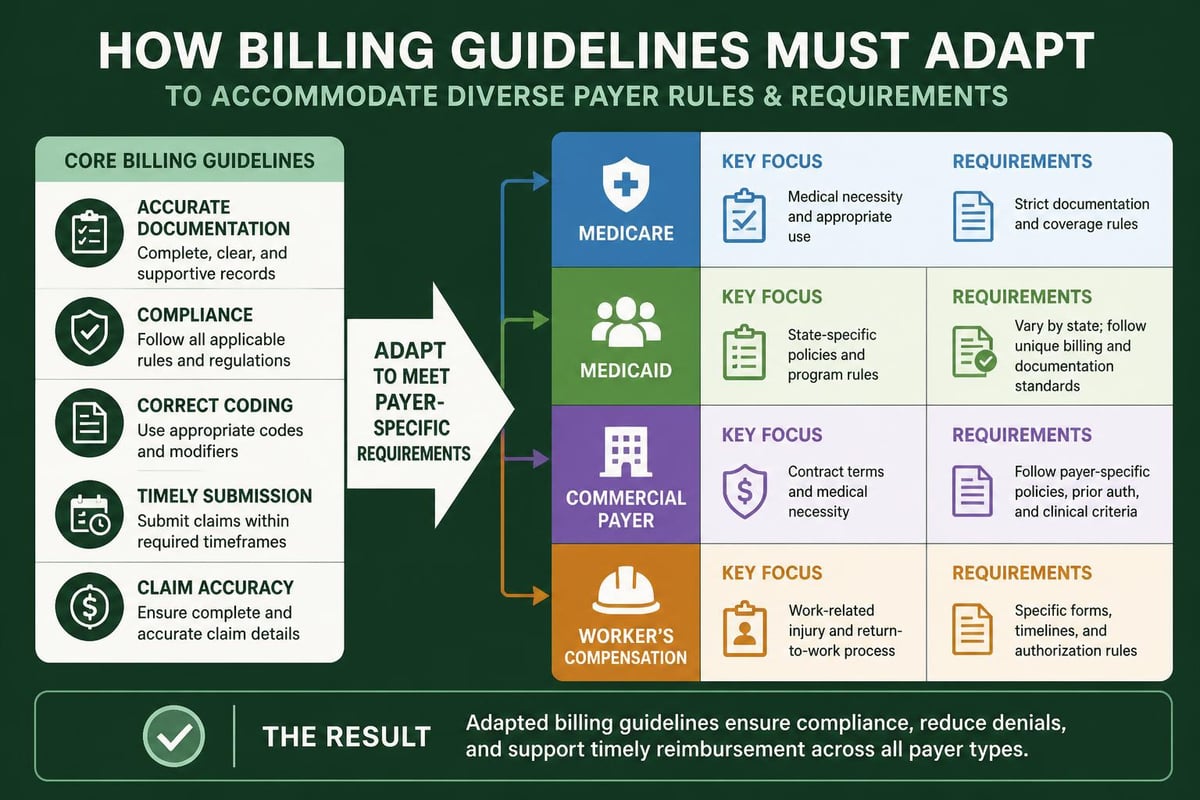
Different insurance carriers maintain unique requirements that your billing guidelines must accommodate. Commercial payers, Medicare, Medicaid, and individual state programs each implement distinct rules regarding coverage, documentation, and submission protocols. Understanding these variations prevents unnecessary denials and accelerates payment cycles.
Commercial Insurance Requirements
Commercial payers often establish proprietary billing guidelines that differ from government programs. Your protocols should account for:
- Prior authorization requirements specific to each carrier and service type
- Timely filing limits that vary from 90 days to one year depending on the contract
- Coordination of benefits procedures when patients have multiple coverage sources
- Network participation status affecting allowed amounts and patient responsibility
The Washington State Health Care Authority’s billing guides demonstrate how state-specific requirements layer additional complexity onto standard billing practices.
Medicare and Medicaid Compliance
Government payers maintain the most stringent billing guidelines, with severe penalties for non-compliance. Your protocols must address Medicare’s National Coverage Determinations (NCDs) and Local Coverage Determinations (LCDs), which dictate when specific services are considered medically necessary and covered.
Medicare billing guidelines require particular attention to:
- Medical necessity requirements as defined by NCDs and LCDs
- Modifier usage to communicate special circumstances affecting services
- Bundling and unbundling rules preventing inappropriate code combinations
- Place of service codes accurately reflecting where services occurred
- Advance Beneficiary Notices (ABNs) when services may not be covered
Implementing Billing Guidelines Across Your Organization
Even the most comprehensive billing guidelines fail without proper implementation and staff adherence. Your approach to rolling out these protocols determines whether they become operational assets or ignored documents collecting digital dust.
Training and Education Programs
Effective billing guidelines require ongoing education for both clinical and administrative staff. Physicians and clinical staff must understand how their documentation choices directly impact billing accuracy and reimbursement. Consider our medical billing services approach, where continuous education forms part of revenue cycle optimization.
Training programs should address:
- New hire orientation covering fundamental billing guidelines and compliance requirements
- Quarterly updates on payer policy changes affecting documentation and coding
- Annual comprehensive reviews of all billing guidelines with competency assessments
- Specialty-specific sessions addressing unique billing challenges and opportunities
- Real-world case studies demonstrating proper application of billing guidelines
Quality Assurance and Monitoring
Your billing guidelines must include robust quality assurance mechanisms that identify problems before claims reach payers. This proactive approach prevents denials rather than merely managing them after they occur.
| QA Component | Frequency | Responsible Party | Outcome Measured |
|---|---|---|---|
| Pre-submission review | 100% of claims | Billing specialists | Coding accuracy |
| Peer documentation audit | Monthly sample | Clinical leadership | Documentation quality |
| Denial analysis | Weekly | Revenue cycle manager | Root cause identification |
| Compliance audit | Quarterly | Compliance officer | Regulatory adherence |
| Payer policy review | Monthly | Billing manager | Guideline currency |
Regular monitoring through these quality checkpoints ensures your billing guidelines remain effective and current. The American Hospital Association’s billing and collections resources provide valuable benchmarking data for evaluating your performance against industry standards.
Technology Integration in Billing Guidelines
Modern revenue cycle management relies heavily on technology platforms that automate and enforce billing guidelines. Your protocols should leverage these tools while maintaining the flexibility to handle exceptions and unique situations that require human judgment.
Practice Management and EHR Systems
Electronic health record systems and practice management platforms can embed billing guidelines directly into clinical workflows. This real-time guidance helps providers document services appropriately from the initial patient encounter. Integrating compliance checks into your systems prevents common billing errors before they occur.
When selecting or optimizing systems, ensure they support:
- Real-time eligibility verification through automated payer connections
- Coding assistance tools suggesting appropriate CPT and ICD-10 codes based on documentation
- Claim scrubbing software identifying errors before electronic submission
- Electronic remittance advice (ERA) processing to understand how our ERA processing services streamline payment posting
Automation and Artificial Intelligence
Advanced billing guidelines increasingly incorporate automation and AI-powered tools that identify patterns, predict denials, and recommend corrective actions. These technologies analyze historical data to refine your billing practices continuously.
Compliance Considerations in Billing Guidelines
Regulatory compliance represents a non-negotiable aspect of billing guidelines. Healthcare providers face substantial penalties for billing violations, making comprehensive compliance protocols essential for long-term operational viability.
HIPAA and Privacy Standards
Your billing guidelines must incorporate HIPAA requirements governing protected health information (PHI) throughout the revenue cycle. This includes secure transmission of claims data, appropriate access controls for billing systems, and proper disposal of documentation containing PHI.
Key HIPAA considerations for billing guidelines:
- Encrypted electronic claim submission channels meeting security standards
- Role-based access controls limiting PHI exposure to necessary personnel only
- Business associate agreements with all third-party billing service providers
- Audit trails documenting who accessed patient billing information and when
- Breach notification procedures if unauthorized PHI disclosure occurs
Anti-Fraud and Abuse Regulations
Billing guidelines must actively prevent fraud and abuse scenarios that could trigger investigations by the Office of Inspector General (OIG). The American Hospital Association’s patient billing guidelines emphasize equitable treatment and transparent communication as foundational principles.
Your protocols should explicitly prohibit practices such as:
- Upcoding services to higher-paying codes not supported by documentation
- Unbundling procedures that should be billed as comprehensive services
- Duplicate billing for the same service to multiple payers
- Phantom billing for services never actually provided
- Kickback arrangements influencing referral patterns inappropriately
Denial Management Through Billing Guidelines
Even with excellent billing guidelines, some claim denials are inevitable. However, comprehensive protocols significantly reduce denial rates while streamlining the appeals process for those denials that do occur. Our denial management services demonstrate how systematic approaches improve cash flow.
Common Denial Categories
Understanding why claims are denied helps refine your billing guidelines to prevent similar issues. The most frequent denial categories include:
- Registration and eligibility errors accounting for approximately 30% of denials
- Authorization and referral problems representing about 20% of rejections
- Coding and billing errors causing roughly 25% of claim denials
- Medical necessity denials comprising approximately 15% of rejections
- Timely filing violations accounting for the remaining 10% of denials
Prevention Through Guidelines
Effective billing guidelines address each denial category with specific preventive measures:
| Denial Type | Prevention Strategy | Guideline Component |
|---|---|---|
| Eligibility | Real-time verification at scheduling and check-in | Eligibility verification protocols |
| Authorization | Automated tracking with provider alerts | Prior auth requirements by payer and service |
| Coding errors | Pre-submission claim scrubbing | Coding validation rules and edit checks |
| Medical necessity | Documentation templates ensuring completeness | Diagnosis-to-procedure linking requirements |
| Timely filing | Aging reports with escalation procedures | Submission deadline tracking by payer |
Keeping Billing Guidelines Current
Healthcare billing regulations, payer policies, and coding standards constantly evolve. Your billing guidelines require regular updates to remain accurate and effective. Stale protocols lead to increased denials, compliance risks, and revenue leakage.
Regular Review Cycles
Establish systematic review processes ensuring your billing guidelines stay current:
- Annual comprehensive review covering all guidelines with stakeholder input
- Quarterly updates addressing significant payer policy changes
- Monthly bulletins communicating minor adjustments and clarifications
- Immediate updates for critical regulatory changes affecting compliance
Designate specific individuals responsible for monitoring changes from key sources including CMS, commercial payers, professional associations, and regulatory bodies. The National Uniform Billing Committee provides essential standardization resources that should inform your guideline updates.
Version Control and Communication
When updates occur, maintain clear version control and ensure all staff receive timely notification. Previous versions should remain accessible for reference during the transition period, particularly when addressing claims for services rendered under earlier guidelines.
Measuring Billing Guidelines Effectiveness
Your billing guidelines should establish specific metrics for evaluating revenue cycle performance. These key performance indicators (KPIs) reveal whether your protocols achieve their intended objectives or require refinement.
Critical Performance Metrics
Track these essential KPIs to gauge billing guidelines effectiveness:
- Clean claim rate measuring first-pass acceptance without errors
- Days in accounts receivable indicating collection efficiency
- Denial rate as percentage of submitted claims rejected
- Appeal success rate showing effectiveness of documentation and justification
- Net collection rate revealing actual payment versus contractual expectations
Benchmark targets for well-managed practices:
| Metric | Industry Average | Best Practice Target |
|---|---|---|
| Clean Claim Rate | 75-80% | >95% |
| Days in A/R | 45-50 days | <35 days |
| Denial Rate | 10-15% | <5% |
| Appeal Success | 40-50% | >65% |
| Net Collection Rate | 92-95% | >98% |
Regular review of these metrics identifies which billing guidelines drive positive outcomes and which areas need strengthening. When specific metrics underperform, conduct root cause analysis to determine whether guideline gaps, training deficiencies, or technology limitations contribute to the problem.
Specialized Billing Guidelines by Practice Type
Different medical specialties face unique billing challenges requiring tailored billing guidelines. While foundational principles remain consistent, specialty-specific protocols address the nuances of particular service types and payer requirements.
Considerations for Specialty Practices
Specialty practices benefit from customized billing guidelines addressing their unique circumstances. For instance, our cardiology billing services recognize the complexity of cardiovascular procedures and diagnostic testing that require specialized coding knowledge.
Specialty-specific guideline components include:
- Procedure-specific coding guidance for complex interventions unique to the specialty
- Modifier application rules addressing split/shared visits or bilateral procedures
- Global period management for surgical specialties with post-operative care components
- Diagnostic testing protocols addressing technical and professional component separation
- Supply and material billing procedures for implants, drugs, or specialized equipment
Small Practice Adaptations
Smaller practices face resource constraints that affect how they implement billing guidelines. The approach detailed in our medical billing services for small practices demonstrates how comprehensive guidelines can be scaled appropriately.
Small practices should prioritize:
- Essential compliance requirements that prevent regulatory violations
- High-volume service protocols covering the most common procedures
- Payer-specific guidelines for their largest revenue sources
- Technology solutions that automate guideline enforcement
- Outsourcing options when internal resources cannot maintain comprehensive protocols
Regional and State-Specific Billing Guidelines
Healthcare billing regulations vary significantly by state, particularly for Medicaid programs and state-mandated insurance requirements. Your billing guidelines must account for geographic variations affecting your practice locations.
State Medicaid Programs
Each state administers Medicaid differently, creating unique billing guidelines for providers serving this population. Coverage policies, reimbursement rates, prior authorization requirements, and documentation standards vary dramatically across state lines.
Practices operating in multiple states must maintain separate billing guidelines for each jurisdiction. For providers in Arizona, understanding medical billing and coding in Arizona requires familiarity with AHCCCS-specific requirements that differ from other state programs.
Commercial Insurance Regional Variations
Commercial payers often implement regional policies that affect billing guidelines. A national carrier may apply different coverage policies, reimbursement rates, or documentation requirements in different geographic markets based on local medical practice patterns and cost structures.
Comprehensive billing guidelines form the operational foundation for successful revenue cycle management, directly impacting your practice’s financial performance and compliance posture. By establishing clear protocols, training staff thoroughly, leveraging technology appropriately, and maintaining current standards, healthcare organizations optimize reimbursement while minimizing risk. At Greenhive Billing Solutions, our team of experienced revenue cycle professionals helps healthcare providers implement and maintain effective billing guidelines tailored to their specific practice needs, ensuring maximum reimbursements while maintaining full compliance with evolving regulations.

