
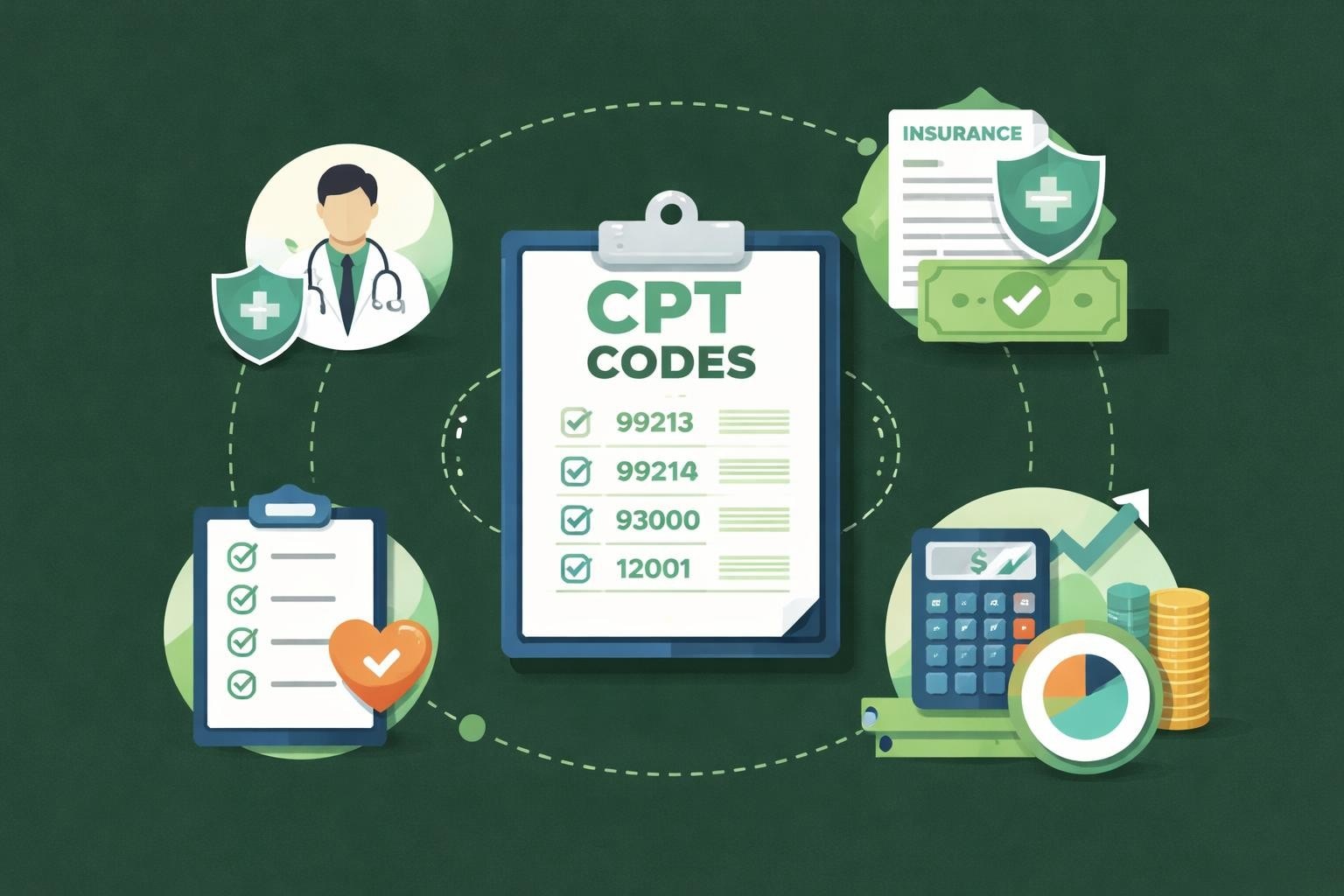
Understanding cpt codes healthcare is fundamental to revenue cycle management success. These standardized codes serve as the universal language between healthcare providers, insurance companies, and billing specialists, ensuring that medical services are accurately documented, billed, and reimbursed. For medical practices and billing organizations, mastering CPT codes translates directly to improved cash flow, reduced claim denials, and streamlined operations. Whether you're overseeing a multi-specialty clinic or managing billing operations for independent practitioners, comprehensive knowledge of CPT coding principles remains essential for financial sustainability.
What Are CPT Codes in Healthcare Billing
Current Procedural Terminology (CPT) codes are five-digit numeric codes that describe medical, surgical, and diagnostic services provided to patients. Developed and maintained by the American Medical Association (AMA), CPT codes provide a comprehensive overview of procedures and services across all medical specialties. These codes create a standardized method for healthcare professionals to communicate with payers about the services rendered.
The cpt codes healthcare system encompasses over 10,000 individual codes that cover everything from routine office visits to complex surgical procedures. Each code represents a specific service, allowing insurance companies to process claims consistently and accurately.
The Role of CPT Codes in Revenue Cycle Management
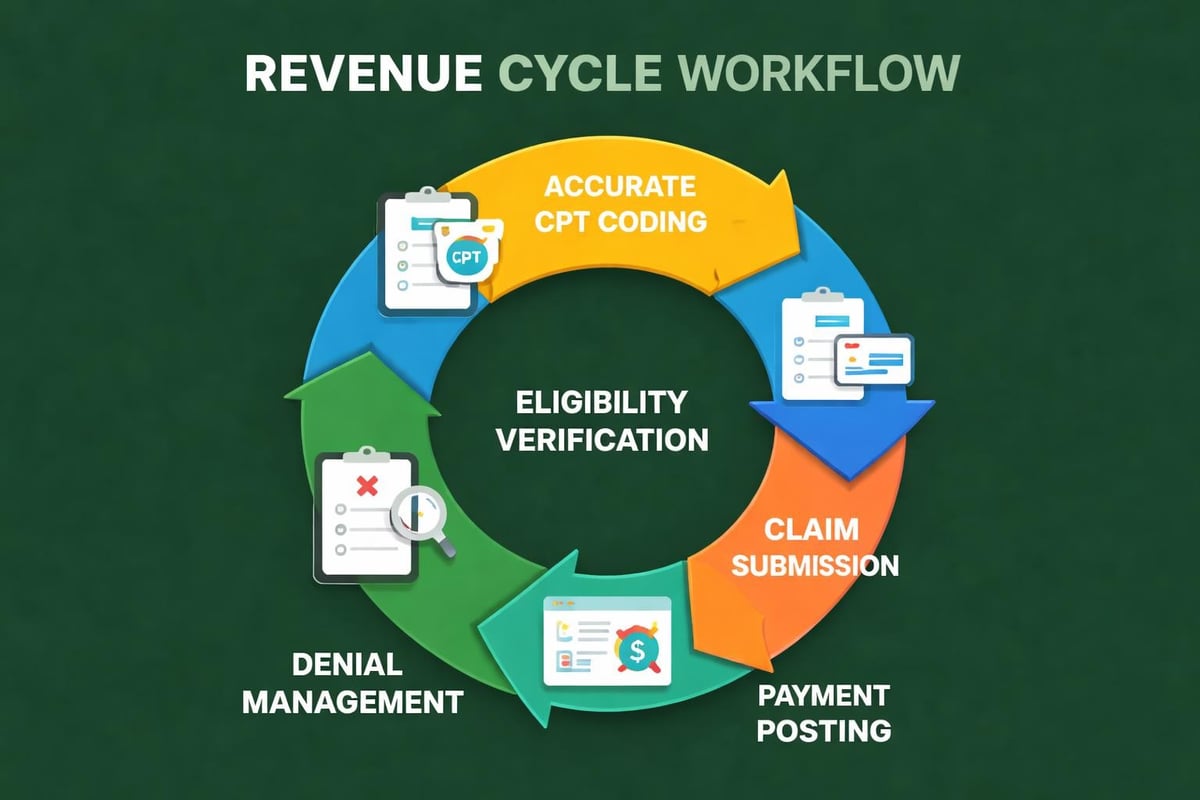
CPT codes form the backbone of medical billing operations. When a provider delivers care, the appropriate CPT code must be assigned to document that service. This code then appears on the claim submitted to the insurance company, triggering payment according to the payer's fee schedule.
Accurate CPT coding impacts several critical areas:
- Claim acceptance rates – Correct codes reduce immediate rejections
- Reimbursement levels – Precise coding ensures appropriate payment amounts
- Compliance standards – Proper code usage meets regulatory requirements
- Audit preparation – Well-documented coding withstands payer scrutiny
- Revenue optimization – Complete coding captures all billable services
Professional billing services, such as those offered through comprehensive medical billing services, rely on expert knowledge of cpt codes healthcare to maximize reimbursements while maintaining compliance standards.
Understanding the Three Categories of CPT Codes
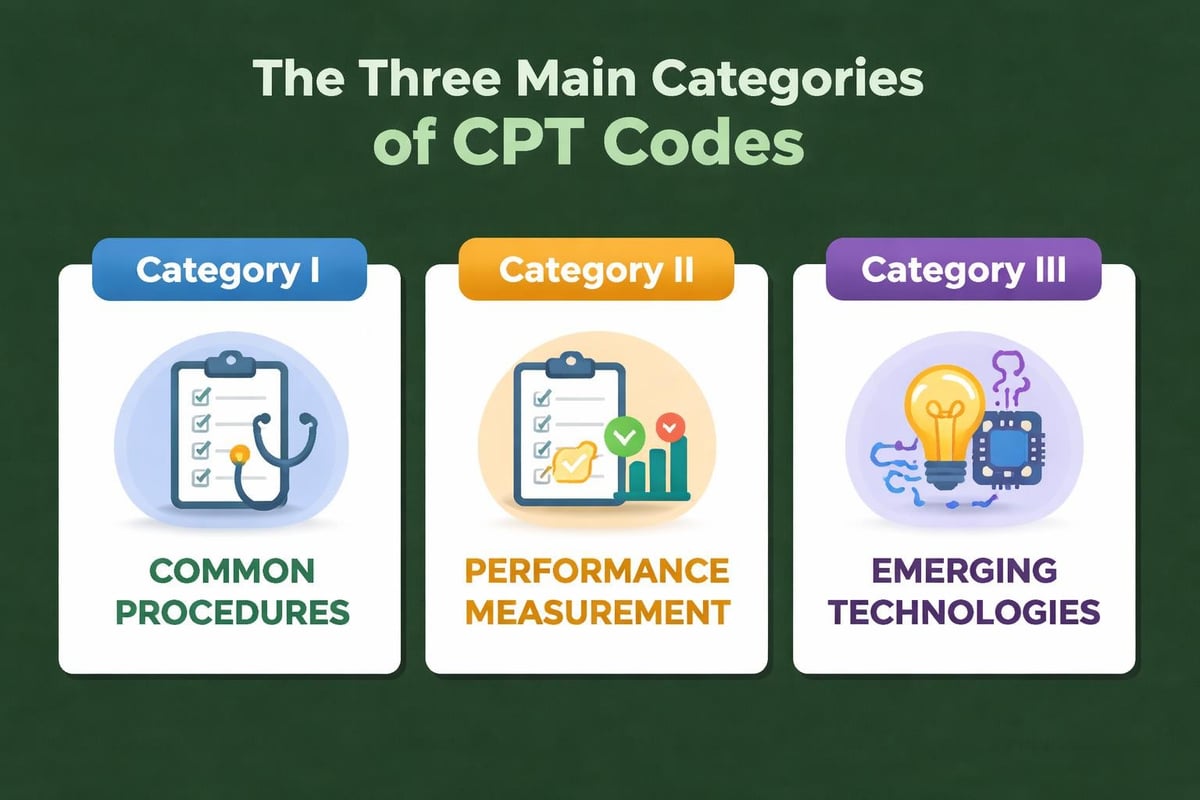
The CPT code set divides into three distinct categories, each serving specific documentation and billing purposes. Understanding these divisions helps billing professionals select appropriate codes and maintain accurate records.
Category I Codes: Standard Procedural Codes
Category I codes represent the largest segment of cpt codes healthcare and describe established medical procedures and services. These five-digit codes divide into six main sections based on service type:
| Section | Code Range | Description |
|---|---|---|
| Evaluation and Management | 99202-99499 | Office visits, consultations, hospital care |
| Anesthesia | 00100-01999 | Anesthesia services for surgical procedures |
| Surgery | 10004-69990 | Surgical procedures across all body systems |
| Radiology | 70010-79999 | Diagnostic imaging and radiation therapy |
| Pathology and Laboratory | 80047-89398 | Laboratory tests and pathology services |
| Medicine | 90281-99607 | Non-surgical diagnostic and therapeutic services |
Updated annually, Category I codes reflect current medical practice and technological advances. Billing teams must stay current with these changes to ensure accurate claim submission.
Category II Codes: Performance Measurement
Category II codes are optional supplemental tracking codes used primarily for performance measurement and quality reporting programs. These alphanumeric codes help healthcare organizations demonstrate adherence to clinical guidelines and quality metrics.
While Category II codes don't generate direct reimbursement, they support value-based care initiatives and quality reporting requirements. Many practices use these codes to participate in programs like the Merit-based Incentive Payment System (MIPS).
Category III Codes: Emerging Technology
Category III codes represent temporary codes for emerging technologies, services, and procedures. These codes allow data collection and assessment for services not yet widely adopted or proven. After sufficient evidence accumulates, Category III codes may transition to Category I status.
Understanding the Healthcare Common Procedure Coding System (HCPCS) provides additional context for how CPT codes fit within the broader coding landscape used by Medicare and Medicaid programs.
How CPT Codes Work With Other Coding Systems
The cpt codes healthcare system doesn't operate in isolation. Effective medical billing requires coordination between multiple coding systems, each serving distinct documentation purposes.
Key coding systems working alongside CPT codes include:
- ICD-10-CM codes – Diagnoses that justify the medical necessity of procedures
- HCPCS Level II codes – Supplies, equipment, and non-physician services
- Revenue codes – Facility charging mechanisms for hospital billing
- Modifier codes – Additional information about how services were performed
Each CPT code on a claim must link to appropriate diagnosis codes that establish medical necessity. Without this connection, payers routinely deny claims for lack of justification. Professional medical coding services ensure these relationships are properly documented.
The interaction between coding systems creates complexity that requires specialized knowledge. For instance, certain CPT codes bundle related services together, while others require separate reporting with specific modifiers.
Common CPT Code Selection Challenges
Selecting the correct cpt codes healthcare for each encounter presents numerous challenges that can impact reimbursement and compliance. Billing professionals encounter these issues regularly across specialties and practice settings.
Specificity Requirements
Modern payer requirements demand increasingly specific code selection. General codes that once sufficed now face routine denials in favor of more detailed alternatives. This specificity extends to documentation requirements, where the medical record must support the level of service coded.
Consider office visit codes (99202-99215), where five levels of complexity exist for both new and established patients. Selecting between these levels requires careful evaluation of history, examination, and medical decision-making components.
Bundling and Unbundling Issues
Insurance companies maintain comprehensive edits that determine which services can be billed together. National Correct Coding Initiative (NCCI) edits prevent inappropriate unbundling of services that should be reported with a single comprehensive code.
Common bundling scenarios include:
- Surgical procedures that include routine post-operative care
- Diagnostic tests performed as part of a comprehensive panel
- Minor procedures included in more extensive surgical services
- Evaluation and management services on the same day as procedures
Understanding these relationships prevents claim denials and compliance risks. Organizations focused on denial management services regularly analyze bundling issues to prevent revenue loss.
Modifier Application
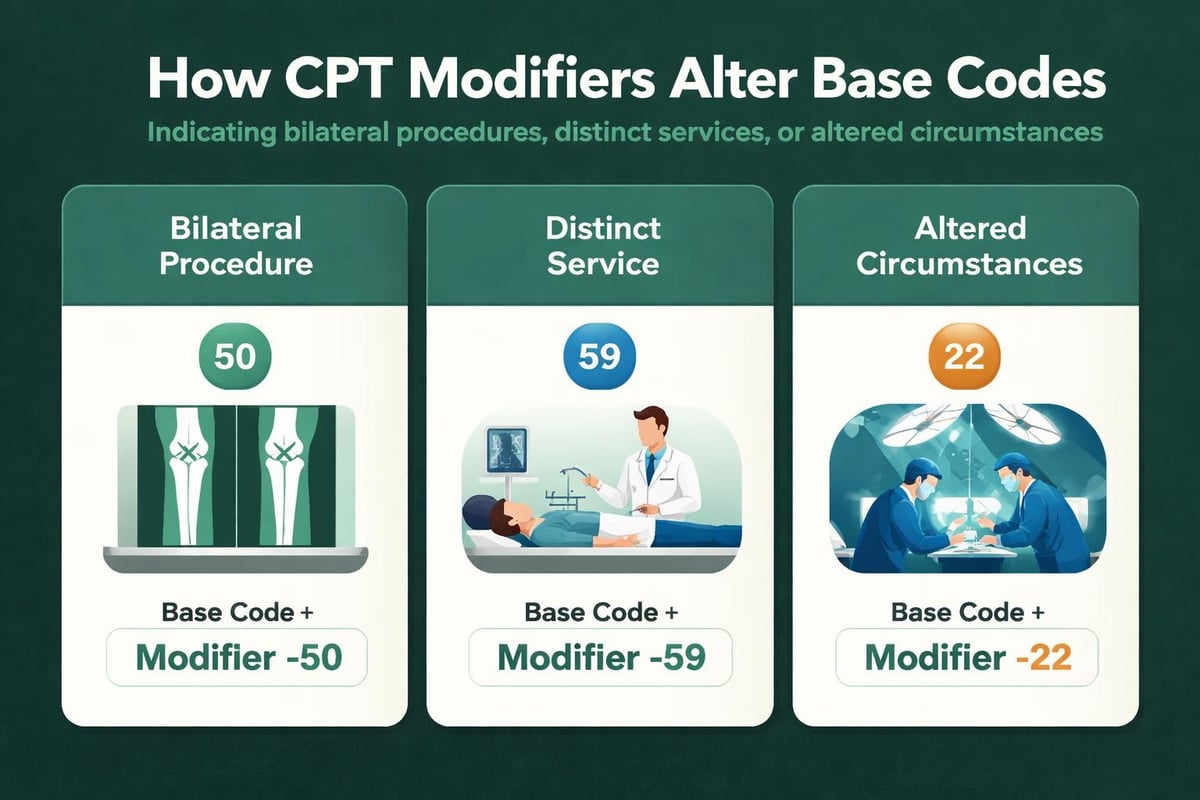
Modifiers are two-digit codes appended to CPT codes to provide additional information about how a service was performed. Proper modifier usage can mean the difference between payment and denial.
Critical modifiers include:
| Modifier | Purpose | Usage Example |
|---|---|---|
| 25 | Significant, separately identifiable E/M service | Office visit on same day as procedure |
| 59 | Distinct procedural service | Separate procedure at different anatomic site |
| 26 | Professional component | Physician interpretation of diagnostic test |
| TC | Technical component | Equipment and technician for diagnostic test |
| 50 | Bilateral procedure | Service performed on both sides of body |
Incorrect modifier usage triggers automatic denials from payer systems. The importance of understanding modifier applications cannot be overstated for revenue cycle success.
Best Practices for CPT Code Management
Effective management of cpt codes healthcare requires systematic processes, ongoing education, and quality assurance measures. Organizations that excel in coding accuracy implement comprehensive programs addressing multiple dimensions of code management.
Documentation Standards
Strong documentation provides the foundation for accurate coding. Providers must document services completely and specifically, creating a clear record that supports the codes selected.
Essential documentation elements include:
- Chief complaint and history of present illness
- Review of systems appropriate to the complexity level
- Physical examination findings relevant to the visit
- Medical decision-making process and complexity
- Treatment plans and follow-up instructions
When documentation lacks specificity, coders must query providers rather than assume information. This collaborative approach between clinical and billing teams ensures coding accuracy while maintaining compliance.
Regular Code Updates and Training
The AMA updates CPT codes annually, with changes taking effect each January. These updates include new codes, deleted codes, and revised code descriptions. Billing teams must integrate these changes immediately to avoid claim rejections.
Ongoing education keeps coding staff current with regulatory changes, payer policies, and specialty-specific coding guidelines. Investment in professional development pays dividends through improved first-pass claim acceptance rates.
Quality Assurance Programs
Regular coding audits identify patterns of errors before they result in significant revenue loss or compliance issues. Both internal and external audits serve important roles in quality assurance.
Internal audits allow organizations to catch and correct errors proactively. External audits by certified professionals provide objective assessment and credibility for compliance programs. Combining both approaches creates a robust quality framework that protects revenue and reduces risk.
Organizations providing medical coding audit services help practices identify improvement opportunities and implement corrective action plans.
CPT Codes and Payer-Specific Requirements
While CPT codes provide standardization, individual payers often maintain unique policies affecting code acceptance and reimbursement. Understanding these variations is critical for maximizing collections.
Medicare and Medicaid Policies
Government payers implement specific coverage determinations that limit when certain CPT codes qualify for reimbursement. Local Coverage Determinations (LCDs) and National Coverage Determinations (NCDs) establish medical necessity criteria for services.
Medicare also maintains the Physician Fee Schedule, which assigns relative value units (RVUs) to each CPT code. These values determine reimbursement rates based on geographic location and other factors.
Commercial Payer Variations
Private insurance companies negotiate individual fee schedules with providers and implement proprietary medical policies. A service covered by one commercial payer may face denial from another despite identical CPT coding.
Payer-specific considerations include:
- Prior authorization requirements for specific CPT codes
- Frequency limitations on preventive services
- Excluded services regardless of medical necessity
- Preferred code selections for similar services
- Documentation requirements beyond standard guidelines
Successful revenue cycle management requires maintaining current knowledge of multiple payer policies. Services like eligibility verification help identify coverage limitations before services are rendered.
Technology and CPT Code Management
Modern billing operations leverage technology to improve CPT code accuracy and efficiency. From electronic health records to specialized billing platforms, technology solutions streamline cpt codes healthcare management.
Electronic Health Records Integration
EHR systems increasingly incorporate coding assistance features that suggest appropriate CPT codes based on documentation. These tools use natural language processing and clinical decision support to match services with codes.
However, technology serves as an assistant rather than a replacement for human expertise. Coders must verify suggestions and ensure documentation supports the codes selected.
Claim Scrubbing Software
Before submission, claims pass through scrubbing software that checks for common errors, missing information, and coding inconsistencies. These systems identify issues such as:
- Missing or invalid CPT codes
- Diagnosis codes that don't support medical necessity
- Bundling violations and NCCI edits
- Modifier requirements for specific code combinations
- Payer-specific policy violations
Automated scrubbing catches errors that would otherwise result in denials, improving first-pass acceptance rates. When combined with expert oversight, technology significantly enhances billing accuracy.
Analytics and Reporting
Advanced analytics platforms track coding patterns, denial reasons, and reimbursement trends. These insights help organizations identify improvement opportunities and optimize revenue capture.
Key performance indicators for CPT code management include:
| Metric | Description | Target Range |
|---|---|---|
| Clean claim rate | Percentage of claims accepted on first submission | 95-98% |
| Coding accuracy rate | Percentage of codes correctly assigned | 98-99% |
| Denial rate by code | Claims denied by specific CPT codes | <5% |
| Days in A/R | Time from service to payment collection | <30 days |
| Net collection rate | Percentage of expected payments collected | >95% |
Organizations focused on reporting and analytics use data to drive continuous improvement in coding operations.
Compliance and Risk Management
Improper use of cpt codes healthcare creates significant compliance risks including audits, recoupment demands, and potential fraud allegations. Proactive compliance programs protect organizations from these consequences.
Common Compliance Risks
Several coding practices trigger particular scrutiny from payers and regulatory agencies:
Upcoding occurs when a provider bills for a higher level of service than documentation supports. This inflates reimbursement inappropriately and constitutes fraud when done intentionally.
Unbundling involves separately billing components of a service that should be reported with a comprehensive code. This practice circumvents bundling edits to increase payment.
Duplicate billing happens when the same service is billed multiple times for a single encounter. While sometimes occurring accidentally, repeated patterns suggest systemic problems.
Organizations should understand coding and payment principles to maintain ethical billing practices that withstand regulatory scrutiny.
Documentation to Support Code Selection
Every CPT code billed must have corresponding documentation in the medical record. During audits, payers request records to verify that services were actually performed and medically necessary.
Insufficient documentation leads to claim denials and payment recoupment even when services were legitimately provided. The documentation must be contemporaneous, meaning created at or near the time of service rather than added retrospectively.
Audit Response Strategies
When payers initiate audits, organized response protocols minimize disruption and protect revenue. Effective audit responses include:
- Designating a response coordinator to manage the process
- Gathering requested documentation completely and timely
- Reviewing records before submission to identify potential issues
- Preparing clear explanations for coding decisions
- Engaging legal or consulting support when appropriate
Professional revenue cycle management partners bring experience navigating audit processes and defending appropriate coding decisions.
Specialty-Specific CPT Code Considerations
Different medical specialties face unique challenges with cpt codes healthcare based on the services they provide. Understanding specialty-specific nuances ensures accurate billing across practice types.
Primary Care Coding
Primary care practices primarily use evaluation and management codes, with occasional minor procedures. The challenge lies in accurately capturing the complexity of visits where multiple chronic conditions are managed.
Preventive visit codes (99381-99397) require careful distinction from problem-oriented visits. When both occur during the same encounter, modifier 25 must be appended to the problem-oriented service.
Surgical Specialty Coding
Surgical practices navigate complex global period rules, where post-operative care is included in the surgical fee. Understanding what's bundled versus separately billable prevents both under-coding and compliance issues.
Surgical codes often require anatomic site specificity and laterality indicators. Incomplete coding results in claim denials for missing information.
Diagnostic and Imaging Services
Radiology and laboratory services require understanding of professional versus technical components. Many diagnostic services can be billed as a complete service (both components) or split between the physician interpretation (modifier 26) and the technical performance (modifier TC).
Emerging Telehealth Services
Virtual care has expanded significantly, bringing new CPT code applications. While some codes were specifically designed for telehealth, others have been modified to allow virtual delivery with appropriate place of service codes.
Understanding which services qualify for telehealth billing and documentation requirements for virtual encounters has become essential for modern practices.
The Financial Impact of CPT Code Accuracy
Precise cpt codes healthcare management directly affects practice financial performance. The relationship between coding accuracy and revenue optimization cannot be overstated.
Revenue Optimization Through Complete Coding
Under-coding occurs when providers fail to capture all billable services or select codes that don't reflect the full complexity of care delivered. This conservative approach protects against compliance risk but leaves significant revenue on the table.
Comprehensive charge capture processes ensure every billable service receives appropriate coding. This requires coordination between clinical staff who provide services and billing staff who translate those services into codes.
Cost of Coding Errors
Coding errors create costs beyond lost revenue. Claim rework, appeals processing, and audit response consume staff time and resources. Repeated denials damage payer relationships and slow cash flow.
Financial impacts of coding errors include:
- Lost revenue from under-coding and missed charges
- Delayed payments from claim denials and rejections
- Staff time spent on rework and appeals
- Compliance costs from audits and investigations
- Potential penalties and recoupment demands
Organizations that invest in coding accuracy see returns through improved cash flow, reduced administrative burden, and lower compliance risk. Professional support through medical claim submission services helps practices optimize these outcomes.
Measuring Coding Performance
Tracking coding performance metrics provides visibility into operational effectiveness. Regular monitoring allows quick identification and correction of problems before they impact revenue significantly.
Benchmarking against industry standards helps practices understand their relative performance. While internal improvement is important, knowing how your organization compares to peers provides valuable context for setting goals.
Future Trends in CPT Code Development
The cpt codes healthcare landscape continues evolving in response to medical advances, regulatory changes, and payment model innovations. Understanding emerging trends helps organizations prepare for future requirements.
Value-Based Care Integration
As healthcare payment shifts from volume to value, CPT codes are adapting to support quality measurement and outcome tracking. Category II codes gain importance for demonstrating adherence to evidence-based practices.
New codes specifically designed for care coordination, chronic care management, and remote patient monitoring reflect the industry's movement toward comprehensive rather than episodic care models.
Technology and Innovation Codes
Medical technology advances faster than coding systems can accommodate. Category III codes provide temporary solutions while new procedures and technologies gain acceptance and prove effectiveness.
Artificial intelligence, robotic surgery, and advanced imaging techniques all require code development to ensure appropriate payment for these innovations.
Increased Specificity Requirements
The trend toward greater coding specificity continues. Payers demand more detailed information about services, often requiring codes that specify laterality, complexity, time, and other service characteristics.
This increased granularity improves data collection for research and quality improvement but adds complexity to the coding process. Organizations must balance documentation burden against the need for detailed information.
Mastering cpt codes healthcare is essential for financial success in today's complex medical billing environment. From understanding the three code categories to navigating payer-specific requirements, accurate CPT coding impacts every aspect of revenue cycle performance. Healthcare organizations that prioritize coding accuracy through robust documentation, ongoing training, and quality assurance programs position themselves for sustained financial health. Greenhive Billing Solutions specializes in comprehensive revenue cycle management, bringing expert CPT coding knowledge and proven processes that maximize reimbursements while ensuring compliance. Our experienced team works seamlessly with your existing systems to optimize coding accuracy, reduce denials, and improve cash flow for your practice.

