
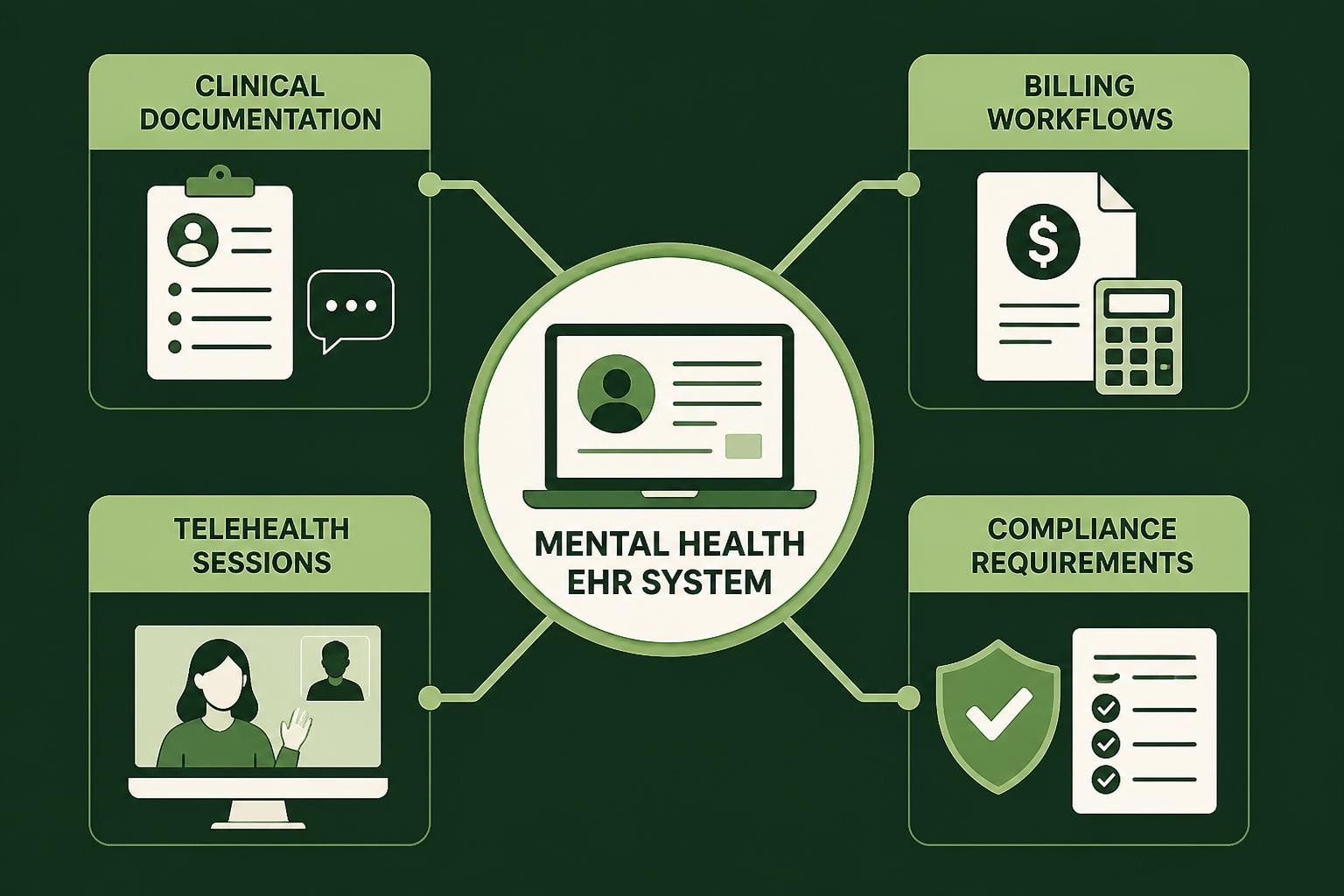
Choosing the best EHR for mental health private practice isn’t about finding the platform with the most features — it’s about finding the one that fits your practice’s clinical workflow, billing process, and growth plans. With dozens of EHR for mental health private practice options on the market, the right choice depends on your practice size, specialty, and how tightly you need clinical documentation to connect with your revenue cycle.
This guide walks through exactly how to evaluate your options, without pushing you toward any single vendor.
Quick Answer: How to Choose an EHR for Your Mental Health Practice
- Define your practice profile first — solo, group, or psychiatric — before comparing any software.
- Rank your must-have features using the scorecard below (documentation, billing, telehealth, compliance).
- Test claims and billing accuracy during a trial, not just clinical documentation.
- Ask vendors the 10 questions in the checklist section before signing anything.
- Confirm total cost of ownership, not just the advertised monthly price.
Why Choosing the Right EHR Matters for Mental Health Practices
Mental health documentation and billing work differently than general medical practices. Session-based CPT codes, time-based billing, modifier rules for group therapy, and strict psychotherapy note privacy protections all create requirements that a generic EHR often can’t handle well.
Picking the wrong system doesn’t just slow down documentation — it directly affects your revenue cycle. Practices using a poorly matched EHR tend to see more claim denials, slower reimbursement, and more manual rework for billing staff. That’s why EHR selection should be treated as a financial decision as much as a clinical one, especially for practices working with a revenue cycle management partner.
Step 1: Define Your Practice’s Needs Before You Start Comparing
Before you look at any software, get clear on your practice profile. Your needs will look very different depending on where you fall here:
| Practice Type | Primary Needs | Lower Priority |
|---|---|---|
| Solo therapist / cash-pay practice | Simplicity, low cost, client portal, easy scheduling | Multi-provider permissions, complex reporting |
| Small group practice (2–10 providers) | Shared records, provider-level permissions, consolidated billing | Enterprise-level reporting |
| Larger group / multi-location practice | Advanced reporting, supervisor co-signature, payer-mix analytics | Simplicity over configurability |
| Psychiatric practice | E-prescribing, EPCS, PDMP integration, prior auth workflows | Group therapy documentation |
| Practice using an outsourced billing/RCM partner | Clean data export, clearinghouse integration, claims automation | Built-in payment processing |
Write down which column you fall into before you request a single demo. It changes what “best” actually means for your practice.
Step 2: Score Each EHR Against These Core Categories
Use this scorecard during demos. Rate each platform 1–5 in each category based on your own practice’s priorities — don’t assume every category matters equally.
| Category | What to Evaluate | Why It Matters |
|---|---|---|
| Clinical documentation | SOAP, DAP, BIRP note templates; treatment plan tracking; voice-to-text or AI-assisted notes | Reduces time spent on notes and keeps documentation payer-compliant |
| Billing & claims | Auto CPT/modifier assignment, eligibility checks, electronic claims submission, denial tracking | Directly affects reimbursement speed and denial rate |
| Telehealth | Built-in video, automatic visit documentation, state compliance tracking | Avoids third-party subscription costs and documentation gaps |
| Compliance & security | HIPAA compliance, audit logs, role-based access, BAA availability, encryption | Non-negotiable for behavioral health records |
| Prescribing (if applicable) | EPCS certification, PDMP integration, formulary checks, drug interaction alerts | Required for psychiatric prescribing workflows |
| Reporting & analytics | Denial rates, days in A/R, no-show tracking, clinician utilization | Supports data-driven decisions on staffing and payer contracts |
| Implementation & support | Data migration help, training, ongoing support model | Determines how smooth (or painful) your transition will be |
| Total cost of ownership | Base fee, per-provider fee, telehealth add-on, payment processing fees, support fees | Advertised pricing rarely reflects the real monthly cost |
Step 3: Match Features to Your Practice Type
Solo and Small Practices
Prioritize ease of use and cost transparency over configurability. A simpler system with strong client-portal and scheduling tools will usually serve a solo practice better than an enterprise platform with features you’ll never touch.
Group Practices
Look for granular, provider-level permissions, multi-provider scheduling that avoids double-booking, and consolidated billing across the group. Confirm the system can scale if you plan to add clinicians in the next 1–2 years — switching EHRs later is expensive and disruptive.
Psychiatric Practices
E-prescribing is non-negotiable. Confirm EPCS certification for controlled substances, state-specific PDMP integration, and formulary/insurance checking before a prescription is sent. Ask specifically how the system handles prior authorization for specialty medications, since delays here directly affect patient care and billing.
Practices Using a Billing or RCM Partner
If you outsource billing, your priority shifts from “does the EHR process payments” to “does the EHR produce clean, exportable data that a billing team can work with.” Ask whether the system integrates directly with your clearinghouse, how it flags denial patterns, and how easily documentation maps to CPT/modifier requirements. Medical billing for behavioral health depends heavily on how well your EHR structures this data before it ever reaches a biller.
Compliance and Security Checklist
Every mental health EHR you evaluate should be able to confirm, in writing:
- End-to-end encryption for data in transit and at rest
- Audit logs tracking every user action on a patient record
- Role-based access controls limiting staff to only what they need
- Automatic session timeouts
- A signed Business Associate Agreement (BAA)
- Documented uptime and data backup practices
If a vendor can’t answer these clearly during a sales call, treat that as a red flag, not an oversight.
10 Questions to Ask Every EHR Vendor Before You Sign
- What’s included in the base subscription, and what costs extra (telehealth, e-prescribing, advanced reporting)?
- Is pricing per-provider or practice-wide?
- What does implementation and data migration actually involve, and is it included?
- How does the system auto-generate CPT codes and modifiers for therapy sessions?
- Can I see real denial-rate or claims-acceptance data from current customers?
- What’s the average support response time, and is support included or billed per incident?
- Is there a contract lock-in period, and what’s the cancellation policy?
- Can the system integrate with our current clearinghouse or billing partner?
- How is patient data handled if we switch systems later?
- What does a signed BAA cover, specifically?
Common Mistakes Practices Make When Choosing an EHR
- Choosing based on price alone, then discovering telehealth, e-prescribing, or reporting are separate add-ons
- Skipping the billing team’s input — clinicians often choose based on documentation ease, while billing staff inherit the consequences of poor claims automation
- Not testing the claims workflow during the trial period, only the note-taking experience
- Underestimating implementation time, which can disrupt scheduling and cash flow for weeks
- Choosing a system that doesn’t scale, forcing a costly migration in 1–2 years as the practice grows
Frequently Asked Questions
What’s the difference between an EHR and an EMR for mental health practices? An EMR is generally a digital version of paper charts within a single practice. An EHR is broader — designed to support clinical workflows, billing, and often interoperability with other systems. For mental health specifically, most platforms marketed today function as combined EHR/practice management systems.
Do I need a mental-health-specific EHR, or will a general EHR work? A general EHR can work for basic documentation, but it typically lacks built-in templates for therapy notes (SOAP/DAP/BIRP), session-based CPT logic, and psychotherapy note privacy handling — all of which a behavioral-health-specific system handles natively.
How much does mental health EHR software typically cost? Pricing varies widely based on provider count, and features like telehealth or e-prescribing are often billed separately. Rather than comparing sticker prices, request a full cost breakdown covering base subscription, implementation, and any per-transaction fees before comparing platforms.
How long does it take to implement a new EHR? Timelines vary by practice size and data migration complexity, but plan for several weeks between contract signing and full go-live, including staff training and a testing period.
Does my EHR choice affect my claim denial rate? Yes. Systems with automated CPT/modifier assignment and built-in eligibility verification typically reduce the manual errors that cause claim rejections. This is one of the biggest — and most overlooked — factors in EHR selection.
Choosing the best EHR for mental health private practice comes down to matching the system to your practice type, testing the billing workflow (not just documentation), and confirming total cost before you sign. For practices that want their EHR choice to directly support stronger reimbursements, Greenhive Billing Solutions provides revenue cycle management services that integrate with whichever platform you choose — handling claims, denial management, and reporting so your EHR decision pays off in your bottom line, not just your workflow.
Contact us to talk through how your EHR choice affects your practice’s billing performance.

