
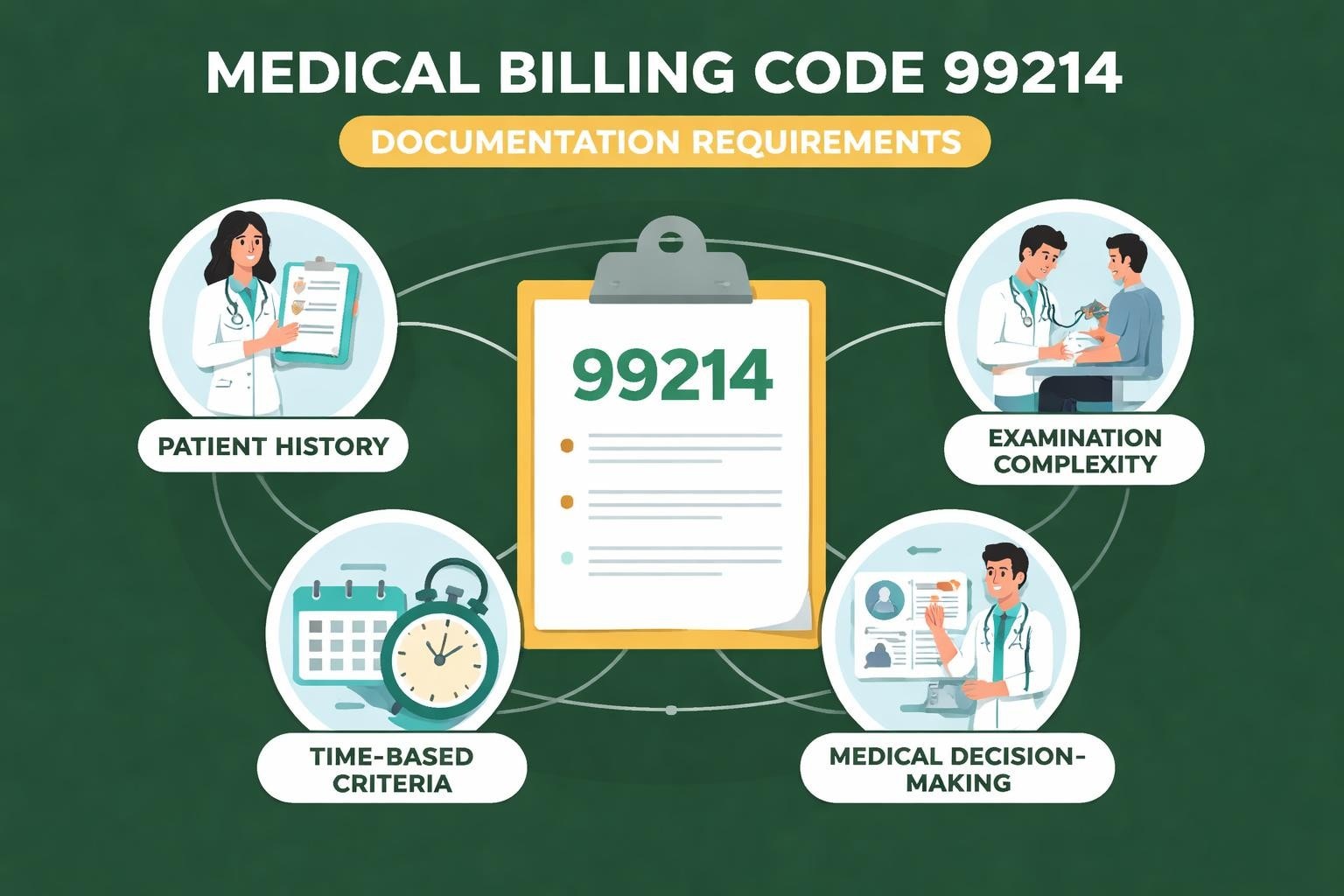
Medical billing code 99214 represents one of the most frequently used evaluation and management (E/M) codes in outpatient settings, yet it remains among the most commonly audited and denied codes by payers. This CPT code applies to established patient office visits involving moderate complexity and medical decision-making. Understanding the proper application of this code is essential for healthcare providers seeking to optimize reimbursement while maintaining compliance with payer requirements. For revenue cycle management professionals and practice administrators, ensuring accurate use of this code directly impacts financial performance and reduces the risk of audits or recoupment actions.
Understanding the Definition and Requirements
Medical billing code 99214 specifically describes an office or other outpatient visit for the evaluation and management of an established patient. The American Medical Association defines CPT code 99214 as requiring a medically appropriate history and examination, along with moderate complexity in medical decision-making.
The established patient designation means the individual has received professional services from the physician or another physician of the same specialty within the same group practice during the previous three years. This distinction separates 99214 from new patient codes, which carry different documentation and reimbursement requirements.
Time-Based Criteria for Code Selection
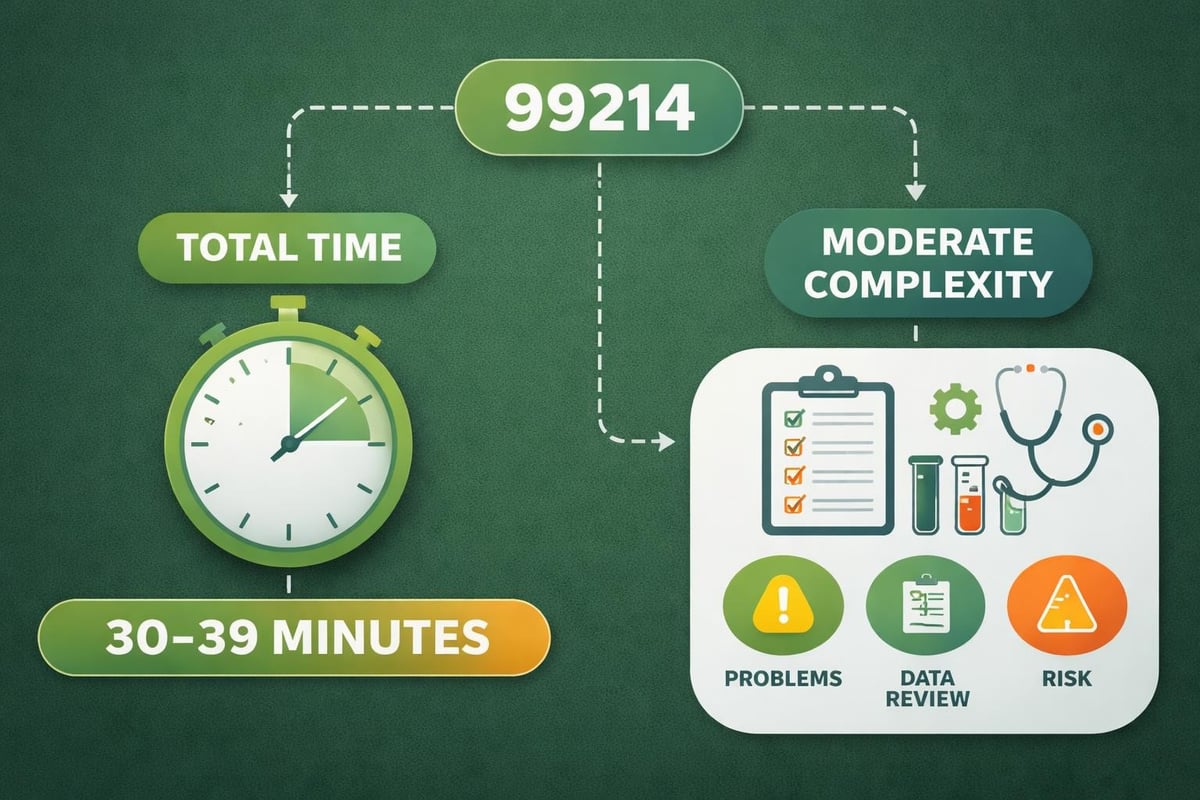
As of recent coding guideline updates, providers can select evaluation and management codes based on either total time spent on the date of encounter or the level of medical decision-making. For medical billing code 99214, the time threshold stands at 30 to 39 minutes of total time on the date of the encounter.
Total time includes both face-to-face and non-face-to-face activities performed by the billing provider on the date of service. These activities encompass:
- Preparing to see the patient
- Obtaining and reviewing separately obtained history
- Performing the examination and counseling
- Ordering medications, tests, or procedures
- Referring and communicating with other healthcare professionals
- Documenting clinical information in the electronic health record
- Independently interpreting results
- Communicating results to the patient or family
Medical Decision-Making Components
When not using time as the determining factor, providers must demonstrate moderate complexity in medical decision-making. This complexity assessment involves three core elements that work together to establish the appropriate code level.
Number and Complexity of Problems Addressed
Moderate complexity requires addressing one or more chronic illnesses with exacerbation, progression, or side effects of treatment. Alternatively, it may involve two or more stable chronic illnesses, one undiagnosed new problem with uncertain prognosis, or one acute illness with systemic symptoms.
The documentation must clearly reflect the nature of the presenting problems and how they impact treatment decisions. Simply listing diagnoses without describing their status or management plan fails to meet documentation requirements.
Amount and Complexity of Data Reviewed
For moderate complexity, providers must review and analyze at least one of three categories of data. The first category involves review of prior external notes from each unique source, an independent historian, or discussion of management with external providers. The second category requires independent interpretation of tests. The third involves ordering and reviewing unique tests from Category 2 or Category 3.
Understanding these data categories helps medical coding services professionals ensure proper documentation supports code selection.
Risk of Complications and Management Options
The risk table categorizes management decisions as minimal, low, moderate, or high. Medical billing code 99214 requires moderate risk, which includes prescription drug management, decision regarding minor surgery with identified patient or procedure risk factors, or diagnosis or treatment significantly limited by social determinants of health.
| MDM Element | Moderate Complexity Requirement |
|---|---|
| Problems Addressed | 1 chronic illness with exacerbation OR 2+ stable chronic illnesses OR 1 undiagnosed new problem |
| Data Reviewed | Category 1: External notes/independent historian OR Category 2: Independent interpretation OR Category 3: Unique test ordering |
| Risk Level | Prescription drug management OR Minor surgery with risk factors OR Social determinants limiting care |
Reimbursement Rates and Financial Impact
National Medicare reimbursement for medical billing code 99214 varies by geographic location due to the Medicare Physician Fee Schedule's locality-based adjustments. The national average facility rate typically ranges from $110 to $130, while non-facility rates generally fall between $165 and $185.
Commercial payers often reimburse at rates 120% to 200% of Medicare rates, though this varies significantly by contract negotiation and regional market dynamics. Understanding these reimbursement patterns helps practices evaluate their revenue potential and identify opportunities for contract renegotiation.
Volume and Revenue Implications
Given that medical billing code 99214 represents a significant portion of established patient encounters, even small changes in coding accuracy can substantially impact practice revenue. A practice seeing 100 established patients weekly could see annual revenue differences exceeding $50,000 between appropriate use of 99214 versus down-coding to 99213 or up-coding to 99215.
Revenue cycle management teams must balance aggressive but compliant coding with documentation support. Denial management services become particularly important when payers challenge code selection through prepayment or post-payment audits.
Documentation Best Practices
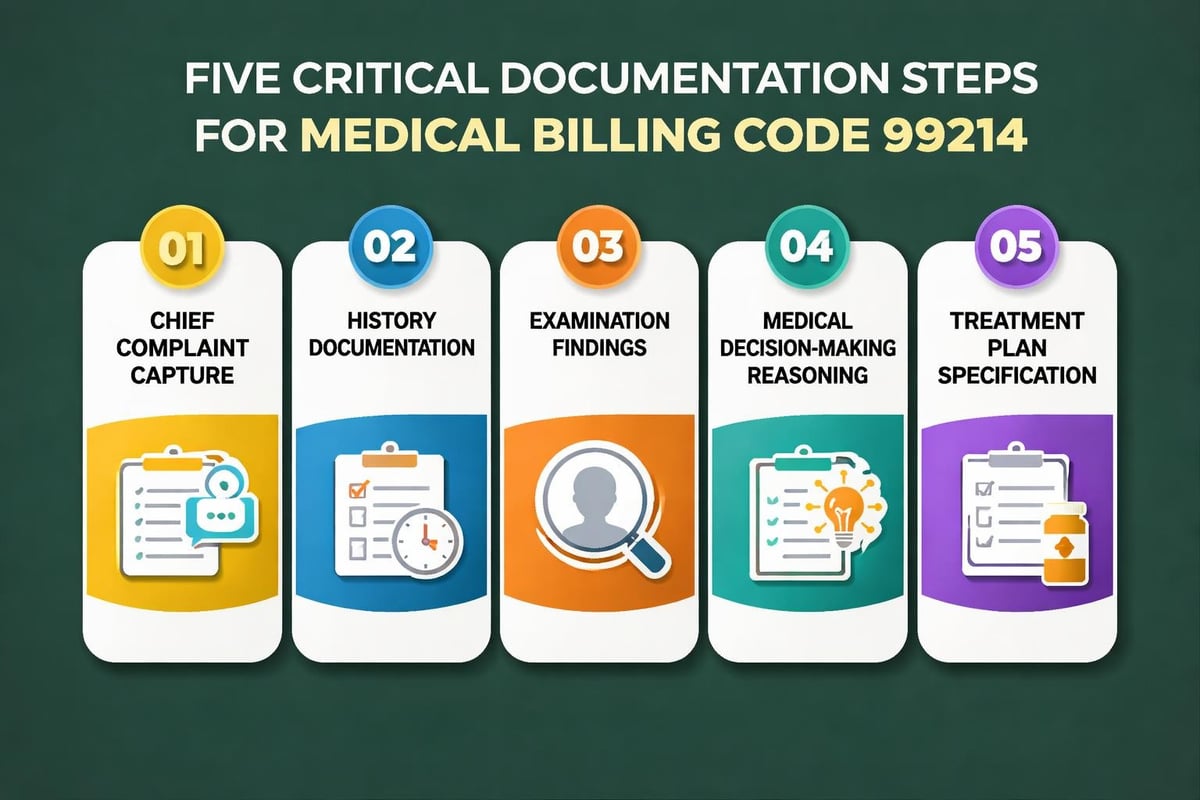
Comprehensive documentation serves as the foundation for defending medical billing code 99214 selection during audits. The medical record must paint a clear picture of the patient encounter, the clinical reasoning, and the complexity of care provided.
Essential Documentation Elements
-
Chief complaint and history of present illness: Document the reason for the visit and detailed information about the presenting problem, including location, quality, severity, duration, timing, context, modifying factors, and associated signs and symptoms.
-
Review of systems: While no longer required for code selection under current guidelines, documenting pertinent positive and negative findings strengthens the clinical picture and demonstrates thoroughness.
-
Physical examination: Document relevant body areas or organ systems examined, with specific findings rather than general statements.
-
Assessment and medical decision-making: Clearly document the differential diagnosis, complexity of data reviewed, risk assessment, and clinical reasoning behind treatment decisions.
-
Plan of care: Specify medications prescribed, tests ordered, referrals made, patient education provided, and follow-up arrangements.
Common Documentation Deficiencies
Research from the Centers for Medicare & Medicaid Services identifies several recurring documentation issues that trigger denials or downgrades. Vague statements like "patient doing well" or "continue current medications" fail to demonstrate the complexity required for 99214.
Template-based documentation systems sometimes create false impressions of comprehensive examinations when providers merely check boxes without performing or documenting actual findings. Payers increasingly scrutinize such documentation patterns during audits.
Audit Triggers and Compliance Risks
Medical billing code 99214 faces heightened scrutiny from both government and commercial payers. Pre-payment audits have expanded to include this code due to high utilization rates and historical error rates.
High-Risk Utilization Patterns
Certain billing patterns automatically trigger audit flags. These include providers billing 99214 for more than 70% of established patient visits, sudden increases in 99214 utilization compared to historical patterns, or practices where multiple providers show identical coding distributions.
Payers also monitor for inappropriate time-based coding where documentation fails to specify actual minutes spent or where recorded times seem inconsistent with the documented services. Claims for exactly 30 minutes (the minimum threshold) receive particular attention.
Error Rate Statistics
According to analysis from health oversight agencies, CPT code 99214 shows elevated rates of improper Medicare payments, often due to insufficient documentation of medical necessity or complexity. These error rates underscore the importance of robust internal auditing processes.
Practices should implement regular chart reviews focusing on 99214 encounters to identify documentation gaps before payers discover them. This proactive approach protects revenue and reduces compliance risk.
Comparison with Related E/M Codes
Understanding how medical billing code 99214 differs from neighboring codes helps providers select the appropriate level consistently. The established patient office visit codes range from 99211 through 99215, each reflecting increasing complexity and resource intensity.
| CPT Code | Time Range | MDM Complexity | Key Differentiator |
|---|---|---|---|
| 99212 | 10-19 min | Straightforward | Minimal problems, minimal data, low risk |
| 99213 | 20-29 min | Low | Self-limited problems OR stable chronic illness |
| 99214 | 30-39 min | Moderate | Chronic illness exacerbation OR multiple stable conditions |
| 99215 | 40-54 min | High | Severe exacerbation OR new problem with high risk |
The distinction between 99213 and 99214 causes particular confusion. The key differentiator lies in problem complexity and medical decision-making intensity rather than simply time spent. A 35-minute visit addressing stable chronic conditions without management changes would still warrant 99213 if medical decision-making remains at low complexity.
Conversely, a visit addressing an acute exacerbation of a chronic condition requiring prescription changes and ordering of diagnostic tests would support 99214 even if completed in 28 minutes, provided the documentation demonstrates moderate complexity medical decision-making.
Strategies for Correct Code Selection
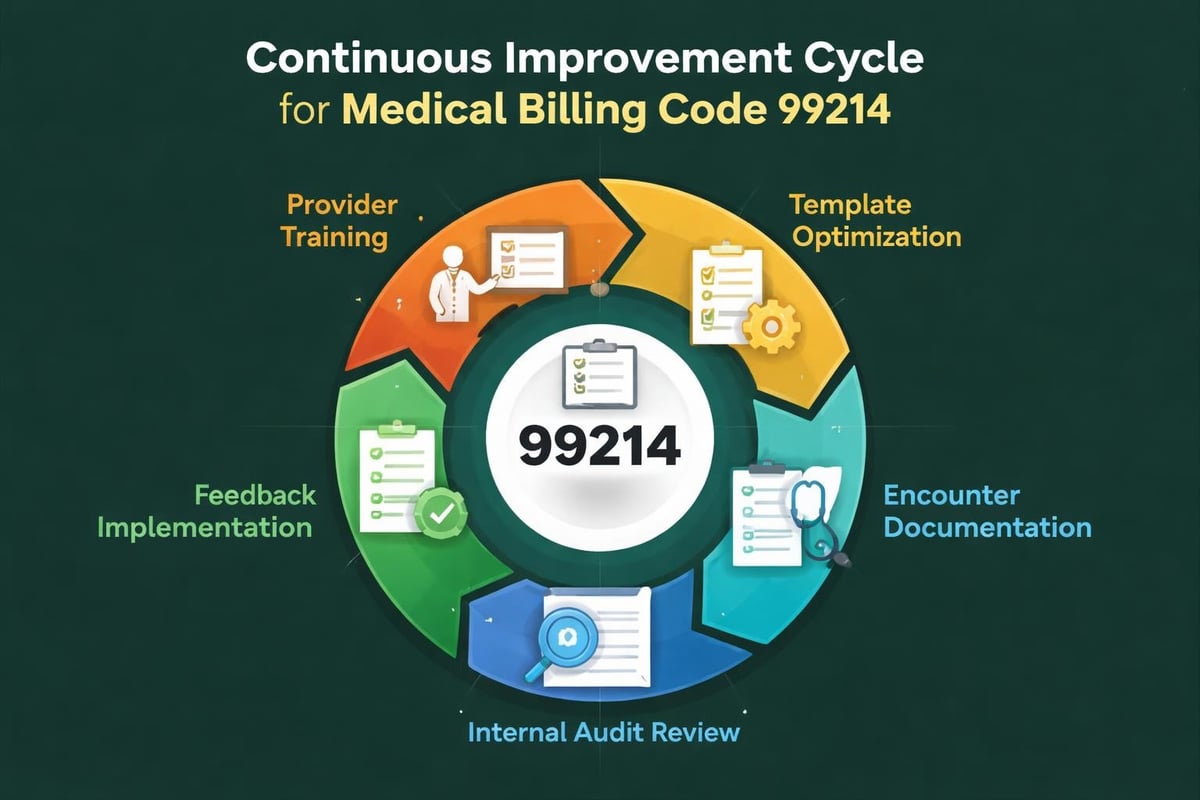
Healthcare organizations benefit from implementing systematic approaches to code selection that reduce variability among providers while ensuring compliance. These strategies combine provider education, documentation tools, and quality assurance processes.
Provider Education and Training
Regular training sessions focusing on E/M guidelines help providers understand current requirements. Many physicians trained before recent guideline changes continue using outdated criteria, leading to either over-coding or under-coding.
Case-based learning exercises where providers review sample encounters and justify code selection prove particularly effective. These exercises reveal common misconceptions and create opportunities for peer learning.
Documentation Templates and Tools
Well-designed electronic health record templates guide providers toward capturing necessary elements without creating checkbox compliance issues. Templates should prompt for specific clinical details rather than generic check-boxes.
Smart documentation tools can alert providers when their documentation appears insufficient for the code selection, though final responsibility always rests with the billing provider. These tools serve as safety nets rather than decision-makers.
Internal Audit Programs
Regular internal audits identify patterns requiring correction before they trigger external audits. Medical coding audit services review a sample of encounters monthly or quarterly, providing feedback to individual providers.
Audit results should drive targeted education rather than punitive measures. When providers understand specific documentation improvements needed, compliance rates improve significantly.
Payer-Specific Considerations
While CPT codes maintain consistent definitions across payers, individual insurance companies may apply different medical necessity criteria or documentation requirements. Understanding these variations helps prevent denials and accelerates reimbursement.
Medicare Guidelines and LCD Requirements
Medicare Administrative Contractors sometimes publish Local Coverage Determinations that specify documentation requirements beyond CPT guidelines. These LCDs may require particular elements in the history, examination, or medical decision-making for specific diagnosis codes.
Providers billing Medicare must remain current with their MAC's specific requirements, as these create additional compliance obligations beyond the CPT code definitions.
Commercial Payer Policies
Commercial insurers increasingly conduct pre-payment reviews for medical billing code 99214, requesting medical records before processing claims. These reviews assess both medical necessity and documentation adequacy.
Some commercial contracts specify that certain services included in 99214 must be billed separately or cannot be billed on the same day as the E/M service. Understanding these contractual nuances prevents claim denials and payment delays.
Technology and Coding Accuracy
Modern revenue cycle management leverages technology to improve coding accuracy and reduce manual review burden. While humans make final coding decisions, technology assists throughout the process.
Computer-Assisted Coding
Computer-assisted coding (CAC) systems analyze clinical documentation and suggest appropriate codes based on documented content. These systems identify when documentation supports medical billing code 99214 versus higher or lower-level codes.
CAC technology works best when integrated with comprehensive provider education, as it cannot replace clinical judgment or correct insufficient documentation. The technology serves as a decision support tool rather than an autonomous coder.
Natural Language Processing
Advanced natural language processing examines unstructured clinical notes, extracting relevant clinical concepts and matching them to coding criteria. This technology helps identify documentation gaps in real-time, allowing providers to supplement notes before finalizing encounters.
Denial Prediction Analytics
Predictive analytics examine historical denial patterns to identify claims at high risk of rejection before submission. When these systems flag a 99214 claim as high-risk, billing teams can conduct additional review or request documentation clarification from providers.
Understanding healthcare revenue cycle analytics helps organizations implement these technologies effectively while maintaining appropriate human oversight.
Special Scenarios and Modifier Usage
Certain clinical scenarios require additional considerations when billing medical billing code 99214. Understanding these situations prevents claim denials and ensures appropriate reimbursement.
Same-Day E/M and Procedure
When providers perform both an E/M service and a procedure on the same day, modifier 25 indicates that the E/M service was significant and separately identifiable from the procedure. The documentation must clearly establish that the E/M service went beyond the usual pre-procedure assessment.
Simply performing a procedure after a standard office visit does not automatically justify both the procedure code and 99214. The evaluation must address issues beyond those inherent in the procedure itself.
Multiple Providers in Group Practice
When different providers from the same group practice see the same patient on the same day, careful coordination prevents duplicate billing. Only one E/M service can typically be billed per day unless the encounters address completely distinct problems with separate documentation.
Telehealth and Virtual Visits
Recent expansions in telehealth coverage allow medical billing code 99214 for virtual encounters meeting the same criteria as in-person visits. Place of service code 02 indicates synchronous telehealth services delivered via real-time audio and video.
Documentation requirements remain identical whether services occur in-person or virtually. Time calculations for telehealth 99214 services follow the same total time methodology as traditional office visits.
Training Staff and Providers
Successful implementation of proper 99214 coding practices requires organizational commitment extending beyond individual providers. Staff throughout the revenue cycle must understand their roles in supporting accurate code selection.
Front Office Training
Registration staff who schedule appointments should understand approximate time requirements for different visit types. Scheduling 99214-level appointments in 15-minute slots creates documentation and patient satisfaction problems.
Appropriate scheduling allows providers adequate time to address complex issues without feeling rushed, improving both documentation quality and patient care.
Medical Assistant Documentation
Medical assistants often enter preliminary information into the health record, including vital signs, medication reconciliation, and reason for visit. Training these team members to capture detailed chief complaints and relevant history provides providers with strong documentation foundations.
Clear, specific information from medical assistants reduces the provider's documentation burden while ensuring completeness.
Billing Team Expertise
Billing professionals must understand E/M guidelines to identify questionable code selections before claim submission. Medical billing services teams should query providers when documentation appears insufficient for the selected code.
This pre-submission review process catches errors when they are easiest to correct, preventing denials and reducing accounts receivable days.
Financial Optimization Strategies
Beyond simply coding encounters correctly, healthcare organizations can optimize revenue through strategic approaches to E/M services and medical billing code 99214 utilization.
Appropriate Upcoding Opportunities
Many providers habitually undercode established patient visits, selecting 99213 when documentation clearly supports 99214. This conservative approach costs practices significant revenue without reducing audit risk.
Regular coding education helps providers recognize when their clinical work genuinely meets 99214 criteria, eliminating unnecessary undercoding while maintaining compliance.
Documentation Improvement Initiatives
Focused initiatives to improve documentation quality simultaneously support appropriate coding and enhance patient care continuity. Specific, detailed documentation creates better clinical records while justifying appropriate code selection.
Denial Prevention Programs
Implementing robust denial prevention programs specific to E/M codes reduces revenue cycle friction. These programs combine provider education, pre-submission claim review, and payer communication to minimize rejections.
Understanding common denial triggers helps practices address issues proactively rather than reactively.
Regulatory Compliance Framework
Healthcare organizations must maintain compliance with multiple regulatory frameworks when billing medical billing code 99214. These requirements extend beyond simple coding accuracy to encompass broader organizational practices.
HIPAA Compliance
All documentation supporting medical billing code 99214 contains protected health information requiring safeguarding under HIPAA regulations. Organizations must implement appropriate physical, technical, and administrative safeguards.
Billing staff accessing medical records for coding verification must receive HIPAA training and follow minimum necessary standards when reviewing documentation.
False Claims Act Considerations
Knowingly billing medical billing code 99214 when documentation fails to support this level of service creates False Claims Act liability. "Knowingly" includes reckless disregard or deliberate ignorance of coding requirements.
Robust compliance programs demonstrating good faith efforts to bill correctly provide important protection against False Claims Act allegations, even when inadvertent errors occur.
Stark Law and Anti-Kickback Considerations
While less directly related to code selection, compensation arrangements that incentivize specific coding patterns may trigger Stark Law or Anti-Kickback statute concerns. Provider compensation should reward appropriate documentation and coding rather than simply maximizing code levels.
Mastering medical billing code 99214 requires understanding documentation requirements, medical decision-making criteria, time-based selection options, and payer-specific policies. Healthcare practices that invest in provider education, robust documentation practices, and systematic quality assurance processes see improved reimbursement rates and reduced denial rates. Greenhive Billing Solutions partners with healthcare providers nationwide to optimize E/M coding accuracy through comprehensive revenue cycle management services, including expert coding review, denial management, and staff training tailored to your practice's specific needs. Our experienced team ensures your practice captures appropriate reimbursement for the complex care you provide while maintaining full compliance with payer requirements and regulatory standards.

