
Healthcare providers today face growing challenges in managing the revenue cycle, from increasing billing complexity to rising operational costs. Navigating these pressures can strain internal teams and impact financial performance.
Offshore revenue cycle management is emerging as a strategic approach for healthcare organizations aiming to achieve greater efficiency, cost savings, and scalability. By leveraging specialized offshore teams, providers can streamline workflows and focus more on patient care.
In this guide, we explore the latest trends, core benefits, essential offshore RCM functions, step-by-step implementation, top global destinations, compliance considerations, and the future outlook for providers. Discover how offshoring can help your organization optimize revenue cycle management and stay ahead in a competitive landscape.
Market Trends and Growth Drivers in Offshore RCM
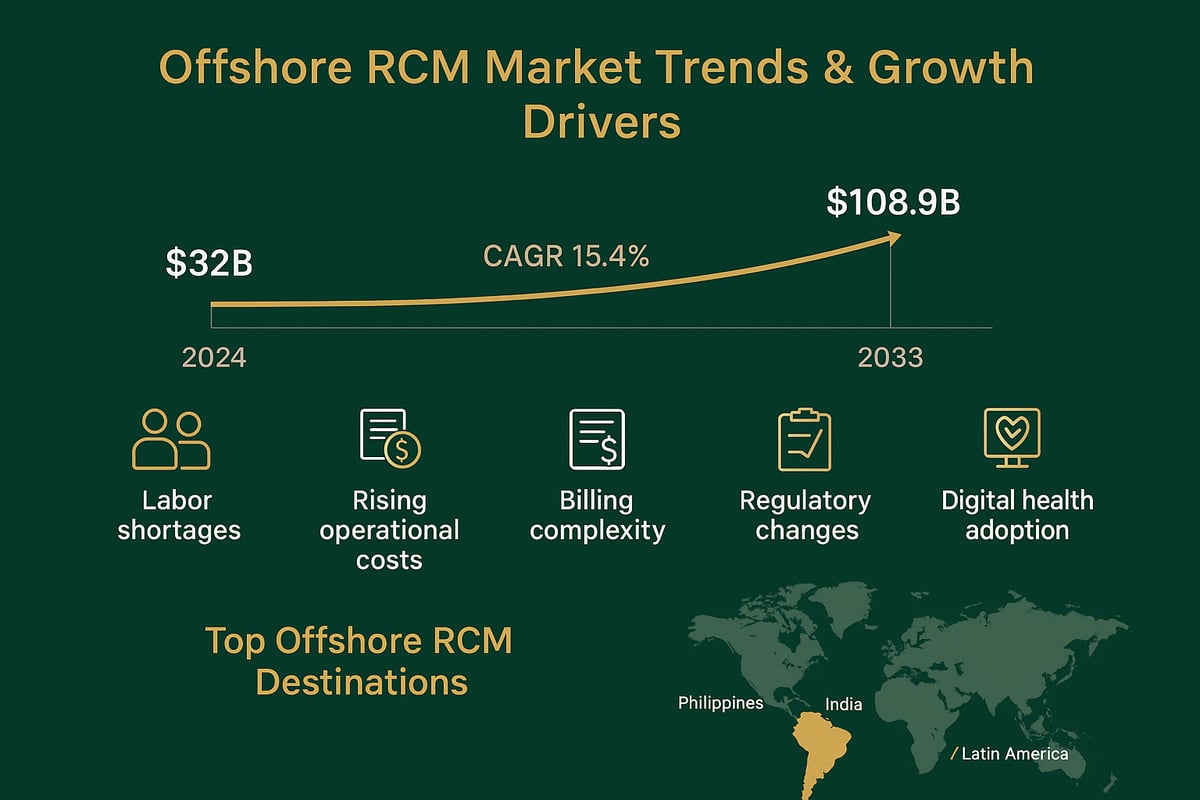
The offshore revenue cycle management market is experiencing rapid global expansion, fueled by the need for operational efficiency and specialized expertise. In 2024, the market reached $32 billion, with projections estimating growth to $108.9 billion by 2033 at a CAGR of 14.6%. According to Revenue Cycle Management Market Growth Projections, U.S. medical billing outsourcing alone is expected to climb to $16.9 billion, driven by a 12.5% CAGR.
Several key factors are driving this surge in offshore revenue cycle management. Labor shortages within the healthcare sector, rising operational costs, and increased billing complexity are pushing providers to seek efficient solutions. Regulatory changes and evolving payer requirements also contribute to the demand for experienced offshore partners. The rapid adoption of telemedicine and digital health is accelerating the shift, as clinics leverage offshore teams to improve claim turnaround and maintain compliance.
Providers in the U.S. are increasingly viewing offshore revenue cycle management as a strategic advantage. Many are partnering with teams in the Philippines, India, and Latin America, taking advantage of robust talent pools and cost-effective services. This trend enables healthcare organizations to remain competitive, streamline workflows, and focus resources on delivering quality patient care.
Core Functions and Services in Offshore Revenue Cycle Management
Offshore revenue cycle management covers a comprehensive suite of services designed to streamline healthcare operations and maximize financial performance. By delegating these critical tasks, providers can reduce administrative burden and focus more on delivering quality patient care.
Core RCM Functions
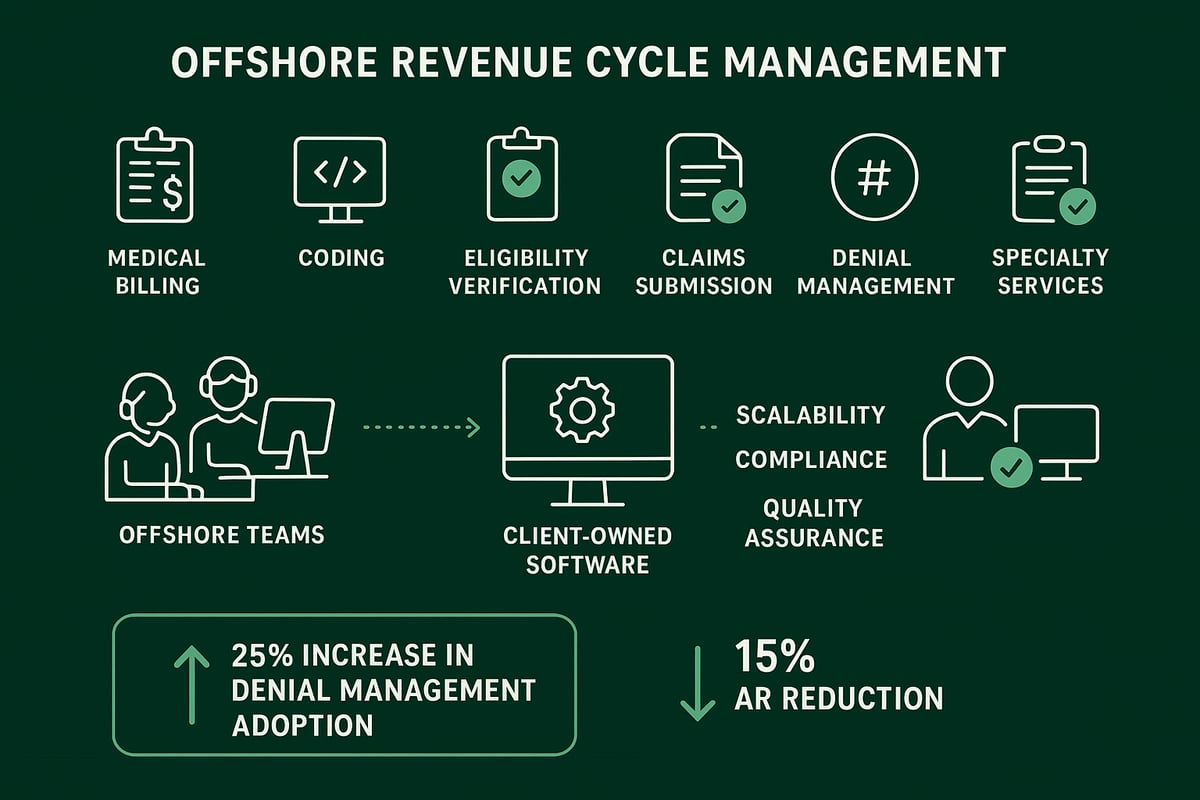
Offshore teams manage the entire revenue cycle, including:
- Medical billing
- Medical coding
- Insurance eligibility verification
- Claims submission
- Payment posting
- Denial management
- Accounts receivable (AR) follow-up
Each function is handled by skilled professionals trained to work within client-owned systems, ensuring seamless integration and adherence to U.S. healthcare standards.
Specialty and Value-Added Services
Beyond core functions, offshore revenue cycle management providers deliver specialty services such as prior authorization, provider credentialing, advanced analytics, and customized reporting. For example, offshore AR specialists help multi-specialty clinics significantly reduce days in AR, improving cash flow and operational efficiency.
Quality Assurance and Customization
Every offshore engagement is tailored to the provider’s size and specialty. This includes scalable team structures, certified coders, regular compliance audits, and real-time KPI tracking. Many healthcare organizations partner with offshore teams for revenue cycle management outsourcing to achieve faster denial resolution and higher claim accuracy.
With robust quality controls and flexible workflows, offshore revenue cycle management solutions empower healthcare providers to redirect resources from administrative tasks to patient-focused initiatives.
Step-by-Step Guide to Offshoring Your Revenue Cycle Management
Offshoring your offshore revenue cycle management requires a structured approach to maximize efficiency and compliance. Below is a step-by-step guide designed for healthcare organizations seeking to streamline their RCM operations and boost revenue performance.
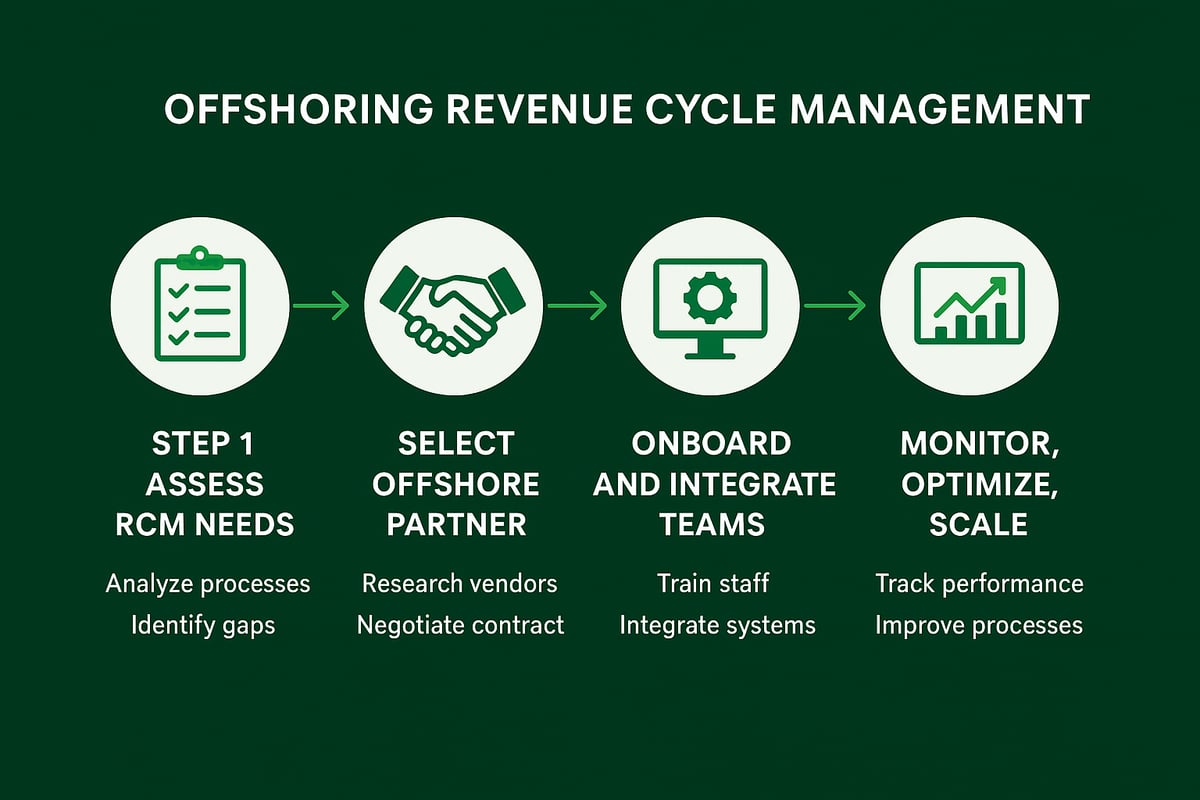
Step 1: Assess Your RCM Needs and Goals
Begin by evaluating your current RCM workflows, identifying pain points, and setting measurable objectives. Consider which functions to offshore, such as billing, AR follow-up, or eligibility verification. For a detailed overview of workflow steps, see the revenue cycle process in healthcare.
For example, a clinic may focus on reducing AR days and administrative workload. Document your goals to guide provider selection and measure success in offshore revenue cycle management.
Step 2: Select the Right Offshore Partner
Choose a partner with proven expertise in offshore revenue cycle management, certifications, and a strong compliance record. Evaluate technology compatibility, transparent communication, and cultural alignment. Look for vendors with U.S. healthcare experience and references.
Providers often prioritize offshore partners with a history of high-quality results and adaptability to specialty needs.
Step 3: Onboard and Integrate Offshore Teams
Define clear workflows and data protocols, ensuring seamless integration with your existing software. Establish KPIs, reporting structures, and escalation paths for issue resolution.
A successful onboarding process should minimize disruption, allowing offshore teams to support your revenue cycle seamlessly from day one.
Step 4: Monitor, Optimize, and Scale
Continuously track performance using regular audits and KPI reviews. Adjust processes as needed, and scale your offshore revenue cycle management team up or down based on volume and specialty requirements.
Ongoing optimization ensures your RCM remains efficient, compliant, and responsive to evolving business needs.
Top Offshore Destinations for Healthcare RCM
Choosing the right location for offshore revenue cycle management is essential for healthcare organizations aiming to optimize service quality, compliance, and cost efficiency. Three regions consistently stand out as preferred hubs for U.S. providers seeking reliable offshore RCM solutions.
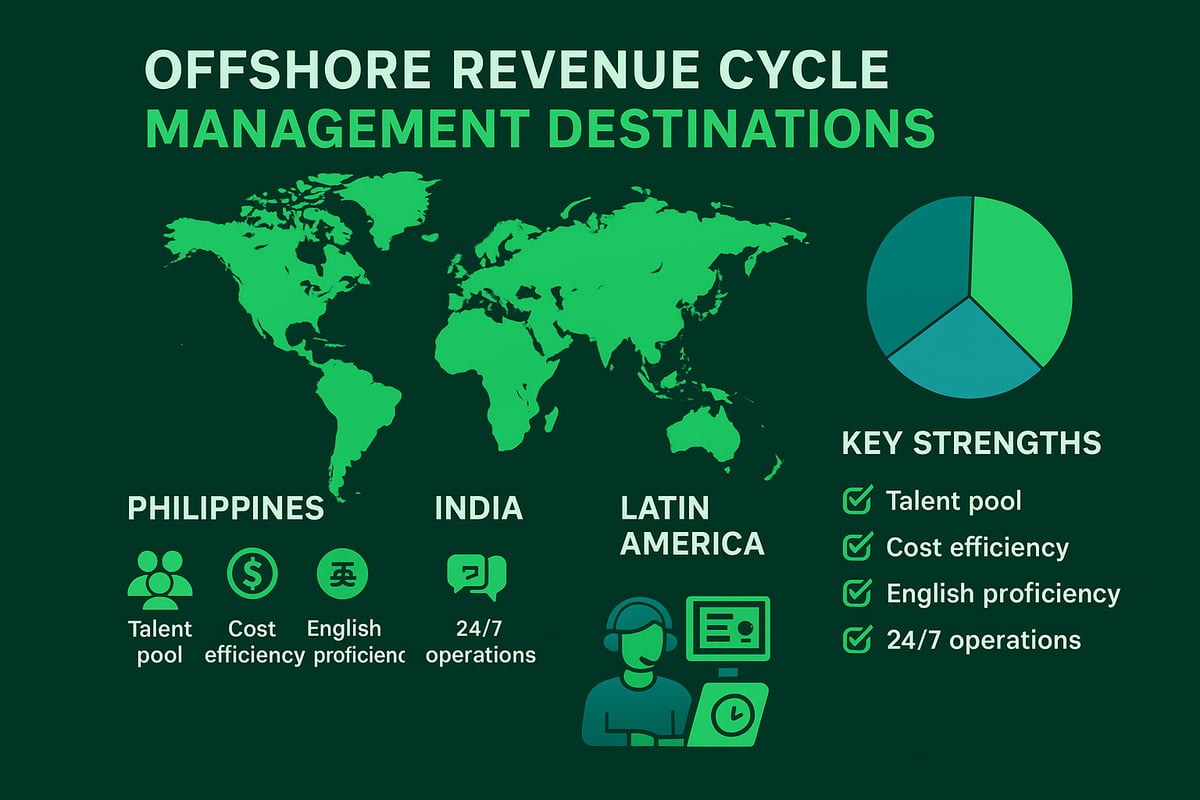
Comparison of Leading Offshore RCM Destinations
| Region | Key Strengths | Notable Advantage |
|---|---|---|
| Philippines | High English proficiency, cultural alignment | 24/7 claims processing |
| India | Large skilled workforce, specialty expertise | Cost-effective solutions |
| Latin America | Nearshore access, bilingual support | Time zone compatibility |
The Philippines is renowned for its strong English language skills and deep understanding of U.S. healthcare culture. Many U.S. clinics rely on Philippine teams for round-the-clock claims processing, ensuring faster turnaround and uninterrupted revenue flow.
India offers a vast pool of experienced RCM professionals and proven expertise in specialty billing and coding. Its cost efficiency makes it a top choice for providers looking to maximize value without sacrificing quality.
Latin America is gaining traction due to its geographic proximity to the U.S., which enables better time zone alignment and real-time collaboration. Bilingual support is a key advantage for organizations serving diverse patient populations.
Most offshore revenue cycle management partnerships for U.S. healthcare organizations are established with providers in these three regions. When selecting a destination, healthcare leaders should weigh factors such as local regulatory frameworks, talent availability, and alignment with operational requirements to ensure long-term success.
Risk Management, Compliance, and Data Security in Offshore RCM
In offshore revenue cycle management, robust risk management and strict compliance are nonnegotiable for healthcare organizations. Ensuring HIPAA and HITECH compliance when selecting an offshore partner is essential to safeguard patient data and maintain trust.
Key data protection strategies include using advanced encryption, secure data transfer protocols, and strict access controls. Offshore teams should implement regular compliance audits, conduct thorough background checks, and provide ongoing training for staff to stay current with U.S. regulatory changes and payer requirements. For a deeper look at these requirements and best practices, review HIPAA Compliance in RCM Offshoring.
Practical risk mitigation steps involve:
- Enforcing secure VPN usage and maintaining audit trails for all client interactions
- Establishing business continuity and disaster recovery plans to ensure uninterrupted operations
- Adapting to evolving regulations with proactive policy updates
A strong compliance framework is a major factor when choosing an offshore revenue cycle management partner. According to recent industry data, most providers rate compliance as a top priority in vendor selection. By prioritizing these measures, healthcare organizations minimize risk and build a foundation for secure, scalable offshore operations.
The Future of Offshore Revenue Cycle Management
As healthcare evolves, offshore revenue cycle management is rapidly embracing new technologies. AI automation, predictive analytics, and real-time reporting are becoming standard features, transforming how providers manage claims and payments.
A major trend is the shift toward value-based care, which requires more data-driven, patient-centric RCM solutions. Offshore teams are now expected to deliver specialty-specific expertise, adapting quickly to changing payer requirements and regulatory shifts.
AI-powered offshore teams are accelerating denial resolution, reducing turnaround times and improving reimbursement rates. For example, advanced denial management strategies, as outlined in denial management in medical billing, help providers recover lost revenue more efficiently.
Looking ahead, offshore revenue cycle management will be a strategic lever for growth and resilience. Market analysis, such as the U.S. Revenue Cycle Management Market Outlook, projects continued expansion as providers seek flexible, cost-effective solutions.
As you look ahead to optimizing your revenue cycle management in 2026, it’s clear that efficiency, data security, and seamless operations will drive success. If you’re wondering how offshore solutions can fit into your unique practice, why not take the next step with expert guidance? At Greenhive Billing Solutions, we offer a comprehensive audit to help you pinpoint opportunities for cost savings, stronger compliance, and improved cash flow. You’ll get a clear, tailored assessment—no obligation, just actionable insights for your organization’s goals. Ready to see where you stand? Get Your Free Audit

