
Choosing the wrong POS code can mean the difference between full reimbursement and costly denials in telehealth billing. Many healthcare organizations struggle with pos 10 in medical billing versus POS 02, risking lost revenue and compliance issues. This comprehensive guide breaks down the crucial differences, payer requirements, and best practices for using these codes. Discover how the right approach can safeguard your reimbursements and streamline your telehealth claims. Ready to protect your revenue and stay compliant? Read on for expert insights.
Understanding POS Codes in Medical Billing
Place of Service (POS) codes are critical identifiers in healthcare billing, specifying where services are delivered. The right POS code determines not just how a claim is processed, but also how much a provider is reimbursed. Misclassifying a telehealth visit can quickly lead to denials or underpayments, especially with the evolving rules around telehealth.
For example, billing a home telehealth visit with the wrong POS code may result in a claim denial, forcing the provider to appeal or absorb the loss. The Centers for Medicare & Medicaid Services (CMS), along with commercial payers, require precise POS code reporting for all encounters. To clarify these requirements, the CMS Telehealth FAQ for Calendar Year 2026 offers official guidance on when to use pos 10 in medical billing and its alternatives.
What are Place of Service (POS) Codes?
POS codes are two-digit numbers reported on claims to indicate where a patient received care. They help payers distinguish between in-person and telehealth visits, as well as facility and non-facility settings. Using the correct POS code ensures the claim is classified correctly and processed under the right payment rules.
For telehealth, POS codes separate care delivered at home from care provided at a clinic or other site. CMS and commercial payers set specific requirements for reporting POS codes, and mistakes can be costly. A common scenario is submitting a telehealth claim for a home visit with POS 02 instead of pos 10 in medical billing, resulting in a denial or reduced payment. Ensuring staff understand these distinctions is key to clean claims and full reimbursement.
Evolution of Telehealth POS Codes
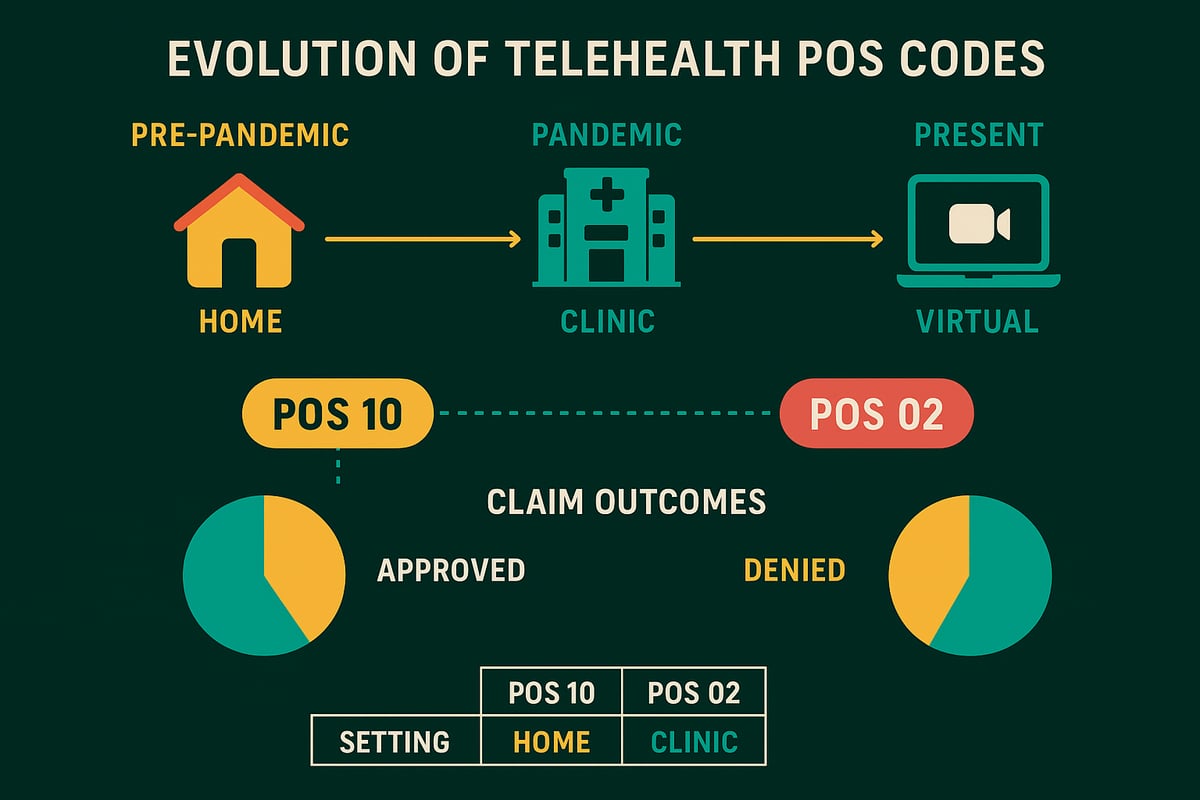
Before pos 10 in medical billing was introduced, most telehealth services used POS 02, regardless of patient location. The rapid expansion of telehealth, especially during the pandemic, highlighted the need for a dedicated code to capture services delivered in the patient’s home. In response, CMS rolled out POS 10 to better track and reimburse these encounters.
Key milestones include:
- Pre-pandemic: Limited telehealth, POS 02 used broadly
- Pandemic: Surge in home-based care, temporary flexibilities
- Introduction of POS 10: Officially recognizing “home” as a unique setting
- Post-pandemic: Payer policies evolving to support virtual visits and home care
Industry trends now favor increased home-based and virtual care, making the correct use of pos 10 in medical billing more important than ever.
Why POS 10 and POS 02 Matter for Providers
The choice between pos 10 in medical billing and POS 02 directly impacts a provider’s bottom line. POS 10 often triggers higher, non-facility reimbursement rates, while POS 02 is linked to facility-based, typically lower payments. Selecting the wrong code can lead to audits, denials, or even recoupments after payment.
Accurate POS coding also supports patient access and care flexibility, allowing practices to offer telehealth that meets payer and regulatory requirements. Consider a practice that accidentally uses POS 02 for all telehealth visits: over time, this could mean thousands of dollars in lost revenue. For compliance and revenue integrity, mastering POS code usage is a must for any healthcare organization.
POS 10 in Medical Billing: Definition, Use Cases, and Guidelines
Understanding pos 10 in medical billing is crucial for telehealth success. This section explains what POS 10 means, when to use it, how to document it, and how it affects reimbursement.
What is POS 10?
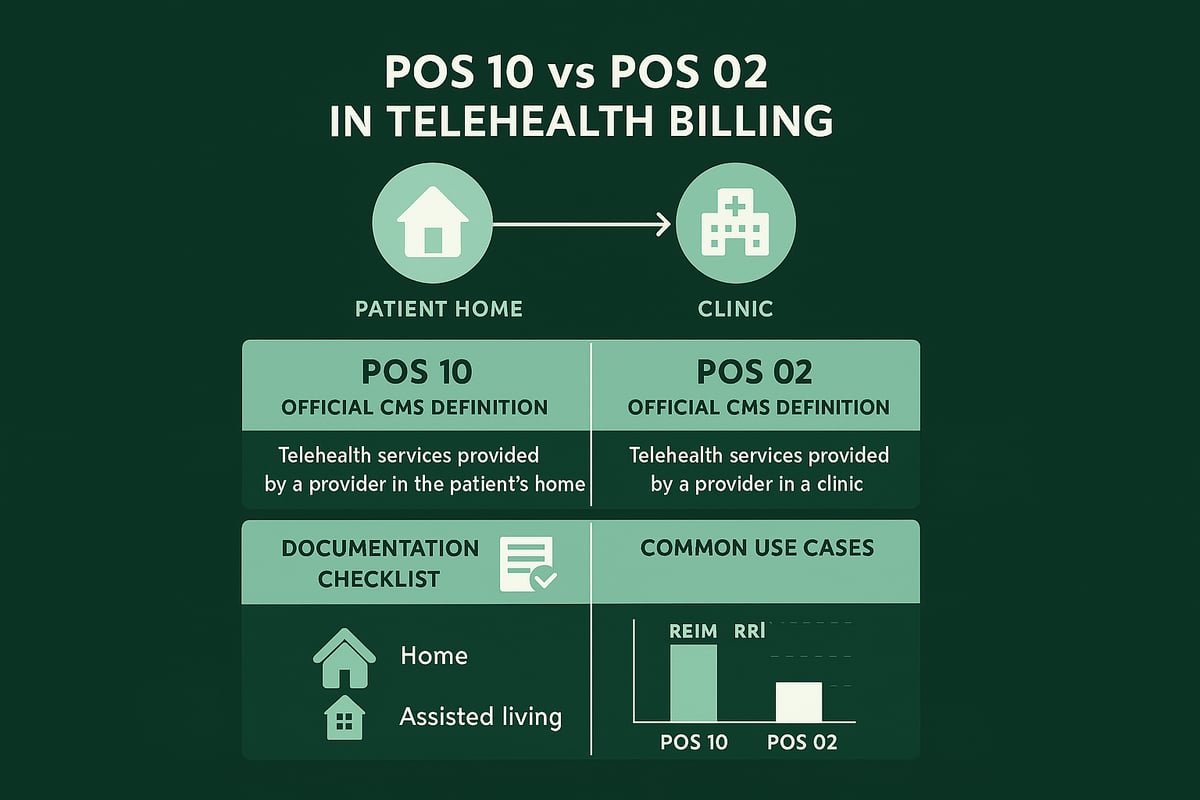
POS 10 in medical billing is officially defined by CMS as “Telehealth Provided in Patient’s Home.” This code signifies that telehealth services occurred while the patient was physically located in their home at the time of the encounter. The term “home” is broad, including permanent residences, apartments, temporary housing, and certain assisted living arrangements.
POS 10 distinguishes itself from other telehealth POS codes by focusing exclusively on home-based care. This is different from POS 02, which is used when the patient is in a healthcare facility or other non-home setting during a virtual visit.
The introduction of pos 10 in medical billing responded to the surge in telehealth services delivered directly to patients’ homes. This change aligns with CMS guidance released in CMS Transmittal R12671CP on Telehealth Billing, which provides detailed billing instructions for providers.
By using the correct POS code, practices ensure accurate claim classification, proper payer processing, and compliance with regulatory requirements.
When to Use POS 10
POS 10 in medical billing should be used when a telehealth service is provided to a patient physically located in their home. Common scenarios include:
- Routine follow-up appointments for chronic care management
- Mental health consultations delivered in a home setting
- Urgent assessments when the patient cannot travel
- Remote check-ins for primary care or specialty follow-ups
Before using pos 10 in medical billing, providers must verify patient eligibility and obtain documented consent for telehealth. Payer-specific requirements may vary—Medicare, Medicaid, and commercial insurers each have unique policies regarding home-based telehealth services. For example, Medicare generally accepts POS 10 for telehealth visits in the patient’s home, while some commercial payers may have additional location or documentation stipulations.
Specialties frequently utilizing POS 10 include primary care, behavioral health, and chronic disease management. By selecting the correct POS code, practices can optimize reimbursement and minimize denial risk.
Documentation and Compliance for POS 10
Accurate documentation is essential when billing with pos 10 in medical billing. Providers must clearly record:
- The patient’s home address or temporary location at the time of service
- Verification of the patient’s presence at home
- Patient consent for telehealth, including date and method
- Details about the telehealth platform or technology used
Best practices include updating chart templates to prompt for required fields, and training staff to verify home-based encounters. HIPAA compliance is critical, especially when delivering care outside traditional clinical settings. Documenting privacy safeguards and secure technology usage supports audit readiness.
A common compliance pitfall is missing or ambiguous location documentation, which can lead to payer denials or recoupments. In one audit, a practice failed to specify the patient’s actual location, resulting in a costly claim denial. To avoid such issues, practices should regularly review telehealth charts and update workflows in line with evolving guidelines.
Reimbursement and Claim Processing with POS 10
Using pos 10 in medical billing often triggers non-facility (higher) reimbursement rates, compared to POS 02, which typically pays at facility rates. This distinction can significantly impact provider revenue, especially for high-volume telehealth practices.
The claim submission workflow for POS 10 follows standard telehealth billing processes but requires extra attention to patient location and documentation. Clean claims depend on accurate coding, thorough documentation, and the inclusion of required modifiers when appropriate.
Common denial reasons include mismatched patient address, missing consent, or use of the wrong POS code. To reduce errors, practices should:
- Implement pre-submission claim reviews
- Use checklists for documentation
- Stay updated on payer-specific rules
Recent data shows that claims with correctly applied pos 10 in medical billing have higher acceptance rates and fewer denials than those with POS 02 used incorrectly. By optimizing claim workflows and focusing on compliance, practices can maximize reimbursement and minimize revenue leakage.
POS 02 in Medical Billing: Definition, Use Cases, and Guidelines
Accurate use of POS 02 is crucial for any healthcare organization delivering telehealth services outside the patient’s home. Understanding the requirements for POS 02, especially in relation to pos 10 in medical billing, ensures correct reimbursement and regulatory compliance.
What is POS 02?
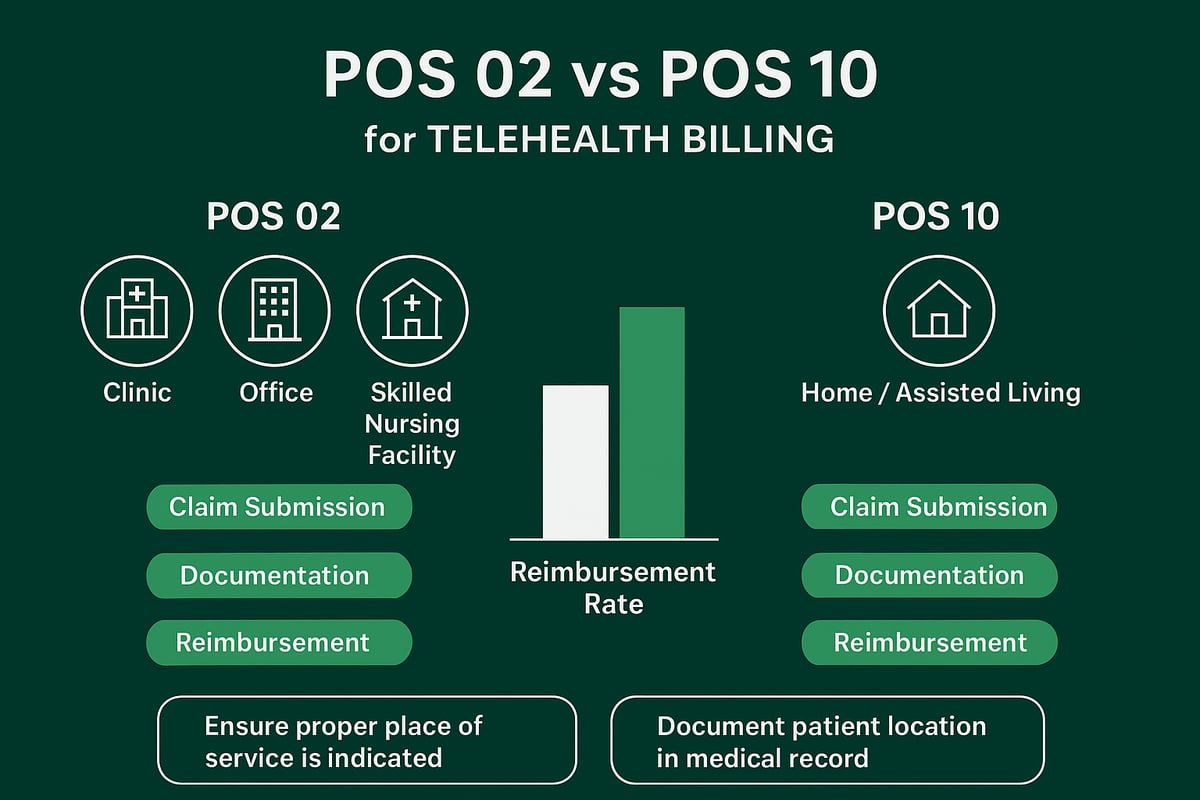
POS 02 is officially defined by CMS as “Telehealth Provided Other Than in Patient’s Home.” This code designates that the patient is receiving telehealth services while physically present at a location that is not their residence.
Examples of qualifying settings include clinics, physician offices, skilled nursing facilities, and hospitals. POS 02 is distinct from pos 10 in medical billing, which is reserved for telehealth delivered when the patient is at home or a home-like setting.
When billing telehealth under POS 02, it is essential to understand the subtle differences in payer requirements and reimbursement structures compared to pos 10 in medical billing. Choosing the right code affects both compliance and payment.
When to Use POS 02
Use POS 02 when the patient participates in a telehealth visit from a non-home location. Common scenarios include patients connecting from a clinic, outpatient facility, or a long-term care center.
Proper documentation must clearly indicate the patient’s physical location at the time of service. Many payers, including Medicare and Medicaid, have specific policies on POS 02 usage. For instance, a facility-based telehealth workflow often involves a staff member verifying the patient’s presence at the site and ensuring the technology meets regulatory standards.
Multi-location practices must pay close attention to where the patient is situated, as misclassifying a home visit as facility-based can trigger compliance issues. This is a frequent area of confusion in telehealth billing, especially when distinguishing POS 02 from pos 10 in medical billing.
Documentation and Compliance for POS 02
Compliance with POS 02 starts with robust documentation. Providers should record the exact type of site (clinic, skilled nursing facility, etc.), verify patient identity, and log the telehealth platform used.
Common compliance pitfalls include misclassifying the patient’s location or leaving the site ambiguous in the medical record. Regular staff training on correct POS selection is vital for revenue integrity. For example, a claim may be denied if the documentation does not clearly support a non-home setting.
Best practices include using checklists for telehealth encounters and conducting periodic audits to catch errors. These steps help prevent costly mistakes and ensure that POS 02 is not confused with pos 10 in medical billing, which could lead to recoupment or audit findings.
Reimbursement and Claim Processing with POS 02
Claims with POS 02 are typically reimbursed at facility-based rates, which are often lower than non-facility rates associated with pos 10 in medical billing. This distinction has a direct impact on provider revenue and billing strategies for telehealth.
The claim submission workflow for POS 02 involves accurate coding, inclusion of required modifiers, and ensuring all documentation supports the service location. Denials can occur for reasons such as location mismatch or missing site verification.
For a detailed overview of payer-specific rules and compliance considerations, review the Telehealth Services Billing Guidelines by FCSO Medicare. Practices should also monitor data on average reimbursement for both POS 02 and pos 10 in medical billing to inform their operational decisions.
Key Differences Between POS 10 and POS 02: A Side-by-Side Comparison
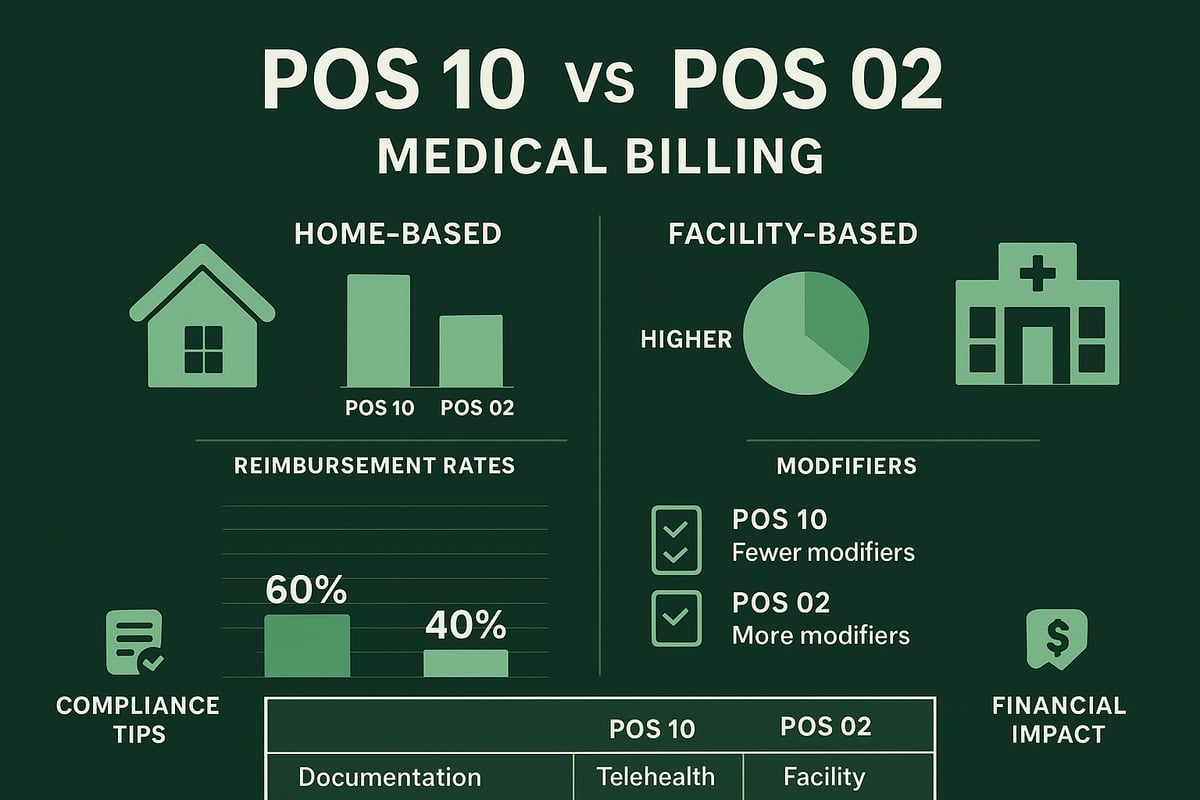
Understanding the differences between POS 10 in medical billing and POS 02 is essential for healthcare organizations aiming to maximize reimbursement and maintain compliance. This side-by-side comparison breaks down each critical factor, helping your team make informed billing decisions.
Patient Location and Service Setting
The most fundamental difference between POS 10 in medical billing and POS 02 is the patient’s location during the telehealth encounter. POS 10 is specifically for telehealth provided in the patient’s home, whether permanent, temporary, or even an assisted living facility if it is considered their residence. In contrast, POS 02 applies when the patient is at a site other than their home, such as a clinic, skilled nursing facility, or other healthcare location.
| Feature | POS 10 (Home) | POS 02 (Non-Home Facility) |
|---|---|---|
| Patient Location | Home, apartment, assisted living | Clinic, office, SNF, hospital |
| Telehealth Setting | Residential | Facility-based |
Ambiguous situations, like hotel stays or temporary housing, require clear documentation to justify use of POS 10 in medical billing. Always verify the patient’s actual location at the time of service to avoid costly mistakes.
Reimbursement Rates and Financial Impact
Reimbursement is a major consideration when selecting POS 10 in medical billing versus POS 02. POS 10 typically triggers non-facility rates, which are higher than the facility-based rates associated with POS 02. For example, a primary care telehealth visit billed with POS 10 may yield significantly more revenue than the same service with POS 02, depending on payer policy.
Each payer, including Medicare and commercial insurers, sets its own rules. A single code change can mean the difference between a full payment and a reduced rate. Practices should review payer contracts and fee schedules to ensure optimal use of pos 10 in medical billing for eligible home-based visits.
Documentation and Audit Risk
Accurate documentation is critical when using pos 10 in medical billing or POS 02. Each code requires specific details to support the site of service. For POS 10, thorough charting of the patient’s home location and consent is necessary. For POS 02, staff must record the facility type and ensure it matches claim details.
Common audit triggers include vague site descriptions, missing patient verification, or inconsistent records. Practices can face recoupments or even payer audits if the documentation does not support the selected POS code. Implementing regular internal audits and staff training helps reduce these risks.
Claim Submission and Denial Trends
Claim acceptance rates often reflect the accuracy of POS selection. POS 10 in medical billing tends to have a higher clean claim rate when documentation and payer rules are followed. Denials usually occur due to mismatched patient locations, missing modifiers, or incomplete records.
To minimize denials, follow best practices for clean claim submission tips and ensure all telehealth claims clearly document the service setting. Proactive denial management and clear workflow protocols help practices resolve issues quickly and keep revenue flowing.
Modifier Requirements and Technology Standards
Modifiers play a crucial role in distinguishing telehealth services billed with pos 10 in medical billing and POS 02. Modifier 95 is commonly required for synchronous telehealth, but some payers have unique requirements. Always verify whether modifiers like GT or 95 are needed alongside the POS code.
Additionally, technology standards must be met for both codes, including secure, HIPAA-compliant platforms. Synchronous (real-time video) services are most common, but asynchronous (store-and-forward) may be allowed for certain specialties. Keeping up with payer-specific modifier and technology requirements helps ensure compliance and proper reimbursement.
Best Practices for Telehealth Billing: Ensuring Compliance and Maximizing Reimbursement
Effective telehealth billing requires more than technical know-how. To maximize reimbursement and stay compliant, healthcare organizations must establish robust processes, train their teams, and stay ahead of industry changes. By focusing on these best practices, you can protect your revenue and reduce risk when using pos 10 in medical billing and related telehealth codes.
Staff Training and Policy Updates
Continuous staff education is fundamental for accurate use of pos 10 in medical billing. Conduct regular training sessions to ensure your billing team understands the nuances between telehealth POS codes and their financial impact. Develop easy-to-access internal reference guides and checklists that outline when to use each code.
Appoint a compliance officer or designate a team member to oversee updates and answer coding questions. This proactive approach helps prevent costly errors and ensures everyone remains aligned on the latest requirements.
Workflow Integration and EHR Optimization
Integrating telehealth best practices into your electronic health record (EHR) or practice management system is essential for accurate pos 10 in medical billing. Configure your systems to prompt users for patient location and the correct POS code at the point of service entry.
Automate reminders for required modifiers and documentation details, reducing the risk of omissions. Billing software tools can further streamline claims by flagging inconsistencies before submission. This workflow automation minimizes human error and supports compliance with payer guidelines.
Staying Current with Payer Policies
Payer rules for pos 10 in medical billing are constantly evolving, making it crucial to monitor updates from Medicare, Medicaid, and commercial insurers. Subscribe to industry bulletins, regulatory alerts, and payer newsletters to stay informed about policy changes.
For example, some payers adjust their modifier requirements or claim acceptance criteria frequently. Understanding the types of modifiers in billing can help your team avoid denials and ensure each telehealth claim meets the latest standards.
Internal Auditing and Quality Assurance
Regular internal audits are vital for maintaining accuracy and compliance with pos 10 in medical billing. Review a sample of recent telehealth claims to identify errors in code selection, documentation, or modifier usage.
Establish a feedback loop for addressing discrepancies and refining billing processes. If you encounter denials, refer to resources like denial management in billing to guide your resolution strategy. This commitment to quality assurance helps safeguard revenue and supports audit readiness.
Leveraging Professional Billing Services for Telehealth Compliance
Partnering with experienced revenue cycle management teams can elevate your approach to pos 10 in medical billing. Professional billing services stay up-to-date with code changes, payer trends, and documentation requirements, reducing the administrative burden on your staff.
These experts can quickly identify compliance gaps, streamline claim submission, and boost your clean claim rate. Many practices see measurable improvements in reimbursement and efficiency after engaging specialized support for their telehealth billing operations.
Frequently Asked Questions About POS 10 vs. POS 02 in Telehealth Billing
Navigating the nuances of pos 10 in medical billing and its distinction from POS 02 often leads to questions for healthcare organizations. Below, we address the most pressing FAQs to support compliance and maximize reimbursement.
What are the most common mistakes when choosing between POS 10 and POS 02?
One of the biggest pitfalls with pos 10 in medical billing is misclassifying the patient’s location, such as coding a home visit as POS 02. Missing documentation of the actual site, incorrect technology details, or misunderstanding payer rules also lead to denials. To avoid similar problems, review common mistakes with POS 22 for broader context on POS errors.
How do commercial payer rules differ from Medicare for POS codes?
Commercial payers and Medicare may interpret pos 10 in medical billing requirements differently. While Medicare provides clear definitions for POS 10 and POS 02, commercial payers sometimes require additional documentation or have unique reimbursement policies. Always verify payer-specific guidelines before submitting claims to ensure accurate coding and avoid payment delays.
What happens if the wrong POS code is used on a claim?
Submitting a claim with the incorrect POS code can result in denials, reduced payments, or even recoupments after an audit. If an error is discovered, the claim must be corrected and resubmitted. Timely identification and correction of POS code mistakes will help protect revenue and reduce compliance risk for your organization.
Are there specialties or scenarios where POS 10 or POS 02 is preferred?
Yes, pos 10 in medical billing is often favored for telehealth visits when patients are at home, especially in mental health, primary care, and chronic care management. POS 02 is more suitable for facility-based telehealth, such as when patients are located in clinics, skilled nursing facilities, or other non-home settings. Matching the code to the patient’s actual location is essential for accurate billing.
How can practices keep up with evolving telehealth billing guidelines?
Staying current requires subscribing to industry bulletins, payer newsletters, and regulatory updates. Joining professional associations and partnering with experienced RCM teams also helps. Regular internal training and external resources ensure your staff understands the latest requirements for telehealth billing and pos 10 in medical billing compliance.
As we’ve explored, choosing between POS 10 and POS 02 can make all the difference when it comes to compliance, reimbursement, and avoiding costly denials in your telehealth billing. If you’re unsure whether your practice is using these codes correctly, or if you want to make sure you’re maximizing revenue and staying audit ready, you don’t have to navigate it alone. Let’s take a closer look together. You can get valuable insights and peace of mind with a personalized review—simply Get Your Free Audit and let Greenhive Billing Solutions help you stay ahead in 2026 and beyond.

